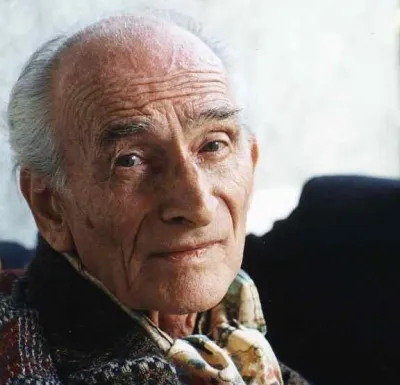
René de Naurois
Human Design Chart
Biography
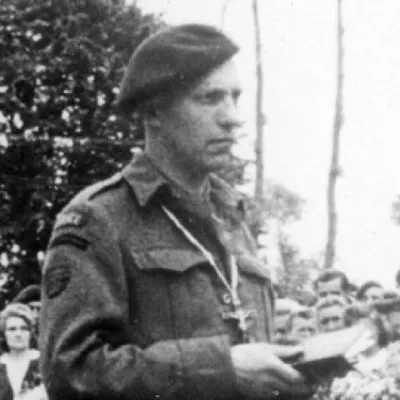
During the Second World War Naurois assisted the French Resistance, helped organise the escape of Jews from occupied France to Switzerland and Spain, and was one of the 177 Kieffer Commandos who took part in the Normandy Landings on 6 June 1944. Honours received by de Naurois for his wartime activities include the Ordre de la Libération and the title of Righteous among the Nations.
He died on 12 January 2006.
The Human Design of René de Naurois: Manifesting Generator 1/3
Manifesting Generator 1/3 — Design at a Glance
René de Naurois was revealed as an individual with a hybrid energy configuration. As a Manifesting Generator, he possessed the constant, sacral power of a Generator combined with the direct impact force of a Manifestor. This mechanism allowed him to skip steps and quickly draw results into his life.
However, the challenge lay in this speed. Often, his impulses were so rapid that important intermediate steps fell by the wayside. This occasionally forced him to backtrack and make up for missed stages, which could lead to frustration - the specific 'Not-Self' theme of his type. Additionally, he tended to pursue multiple projects simultaneously, driven by various impulses. Without confirmation from his inner authority, this creative drive quickly turned into overextension.
René de Naurois's strategy was not to initiate himself but to react to life. He acted only when his sacral center gave a clear 'yes'. With this approach, his true strength emerged: deep satisfaction in creation. Parallelism was no obstacle for him as long as he remained in the 'play mode' and sought variety. The compulsion to complete one thing before starting another stood against his natural dynamics. Instead, his creativity flourished through switching between different tasks, provided he always listened to his inner resonance space.
Emotional Authority
René de Naurois displayed an internal decision-making structure that did not rely on immediate clarity but rather on a necessary process of emotional detachment. His design was marked by Emotional Authority rooted in the defined Emotional Center. This configuration meant that René de Naurois was constantly under a wave of feelings coloring his perception of the world. What appeared inspiring at one moment could turn negative in the next; these fluctuations were not instability but the natural rhythm of his inner truth.
For René de Naurois, it was crucial not to follow spontaneous impulses immediately. A feeling in the present moment merely represented a provisional snapshot, not yet the final insight. Quick decisions made from this emotional heat could prove misleading. Instead, his mechanism required patience and conscious waiting. By allowing time for a decision to mature - often through multiple nights of reflection - intense emotions gradually subsided. Only when this emotional distance was gained did deep clarity and calmness set in. This process of delay was no obstacle for him but the essential path to correct orientation, especially regarding long-term questions that significantly influenced his life course.
The 1/3 Profile — Investigator / Martyr
René de Naurois showed himself as someone who not only collected knowledge theoretically but also tested it through direct practice on a personal level. His design inclined towards initially intensive research (Line 1) before validating insights through active experimentation and learning from mistakes (Line 3). This mechanism meant that his judgment was particularly trustworthy: if he deemed something good, it had passed both theoretical analysis and the hard test of experience.
Driven by Line 1, he studied power and survival instincts often to protect himself through competence or express frustration. This could lead him to hesitate in implementation as long as a sense remained that there was still too much unknown. Yet, Line 3 challenged him to close this gap through trial and error, particularly in the realm of relationships and intimacy. Here, he learned that experience and self-assurance were crucial for stable connections; divorces or fluctuating relationships served not as failures but necessary steps in the learning process. Thus, René de Naurois lived the dynamics of a researcher and experimenter: using his own strength and sometimes intimidating presence to explore boundaries while simultaneously finding grounded wisdom through practical experience in both personal and professional realms.
Split Definition — Defined & Open Centers
René de Naurois was characterized by immense mental density and a constant internal pressure to ask questions and understand connections. His defined Head and Ajna centers generated continuous inspiration, but this lacked direct action; he relied on passing these thoughts as impulses to others or waiting for the right moment rather than implementing them himself. This mental activity flowed into his defined Throat Center, which presented his communication, as well as his defined G Center, giving him a firm identity and direction.
As a Generator with a defined Sacral center, René de Naurois had an enormous vital energy source. His strategy was not to initiate but to respond to questions or circumstances to correctly use his sacral power. This was moderated by his defined Solar Plexus Center: He needed time to gain emotional clarity before making decisions. His defined Spleen Center provided spontaneous intuition in the present moment, while the defined Root Center delivered a constant pressure to maintain the life impulse.
In contrast, his open Heart Center showed vulnerability to a lack of willpower. He tended to feel not valuable enough and often tried to prove his worth through promises or overcompensation - a classic Non-Self pattern for this center. Instead of trusting his inner authority from Solar Plexus and Sacral, he risked falling into a cycle of self-disapproval when trying to meet expectations without consistent energy. His design challenged him to accept mental pressure without acting it out and to present his emotional and sacral truth about the desire for external validation.
Channels for intuitive leadership, focus and emotional clarity.
René de Naurois was marked by a mind that used skepticism as a tool for pattern recognition. The Logic Channel 63-4 connected Head and Ajna centers, making doubt serve not as paralysis but as a filter: Only consistent, verifiable answers were accepted. This analytical rigor worked collectively, as the pressure to find solutions should serve others once mental clarity was achieved.
Simultaneously, René de Naurois had potential for logical leadership. The Alpha Channel 7-31 connected G and Throat centers, requiring orientation based on tested patterns. His authority did not rest on imposing power but on the ability to understand trends and gain trust; he sought his influence area where he was recognized as a representative rather than exercising absolute control.
These leadership qualities were supported by extreme focus. The Concentration Channel 52-9 connected Root and Sacral centers, creating a calm pressure to keep distractions at bay. René de Naurois evaluated details precisely and held energy still until a clear reaction came from the Sacral center; without this focus, restlessness could arise.
His expression was also marked by charismatic urgency. The Charisma Channel 34-20 connected Sacral and Throat centers, directly translating generative life force into action. This required inner guidance to avoid obsession. Intuitive insights flowed through the Brainwave Channel 57-20 from Spleen to Throat center, enabling spontaneous existential truths in the present moment. This intuition was strengthened by the Power Channel 34-57, which linked sacral energy with survival instincts for quick and selective responses to threats.
Emotionally, René de Naurois moved in a pulsating wave. The Emotion Release Channel 39-55 connected Root and Solar Plexus centers, making moodiness work as creative power between joy and melancholy. His provocation served to recognize the true spirit of others and authentically express his own emotional depth rather than rationalizing moods.
Individual Circuitry — Circuit Signature
René de Naurois was shown through his design as someone with separate energetic focuses: a rational-strategic unity and an emotional-intuitive power that did not flow directly into each other. This Split Definition created two parallel experience worlds.
The Understanding Circuit formed a clear logical structure. It connected the Head to the Ajna center for strategic thinking, as well as the Throat to the Identity Center for articulating these plans. Parallel to this, Sacral and Root centers flowed together, providing concrete implementation power. This allowed René de Naurois to share rational insights free from conditioning and lead society through focus and logic towards a better future.
The Knowledge Circuit worked with pulsating, acoustic energy. Here Throat and Spleen centers connected for intuitive creativity, while Solar Plexus and Root centers generated emotional waves. This promoted the expression of a unique identity through flashes of insight and the release of emotions to initiate change.
The Integration Circuit rounded this off by connecting Throat, Sacral, and Spleen centers. This configuration used charisma and power to draw strength from reacting to life and acting in the present moment. Together these separate circuits shaped René de Naurois' ability to act both strategically clear and emotionally authentic without these areas overlapping.
Right Angle Cross of the Sleeping Phoenix 4
René de Naurois carried the design of the right cross of the sleeping phoenix. This configuration was characterized by a deep, often unspoken intuition that did not rely on logical analysis but rather on direct inner knowledge. René de Naurois possessed the ability to understand complex human dynamics and emotional currents without having to explicitly explain or rationalize them. His design inclined him towards reserve; true understanding remained frequently hidden within, like a sleeping being present yet inactive.
This mechanism described a life task of silent observation and holding knowledge internally. The energy of this cross worked subtly, supporting others through mere presence and deep empathy without taking charge or offering advice. René de Naurois lived with an inner security that did not depend on external validation. His design promoted patience and trust in his own internal compass, even if this path appeared unclear to outsiders. It was an energy of transformation through silent presence, enabling changes from the background without being at the center itself. René de Naurois used these gifts to create stability and deep emotional resonance in his environment, often unnoticed by those he supported.
Saturn Return · Uranus Opposition · Chiron Return · 2nd Saturn Return — Life Cycles
René de Naurois was someone whose life path was marked by clear phases of condensation and transformation. His design inclined him towards translating inner convictions into concrete actions, with external events often making these internal processes visible.
In 1936, at the age of 30, he was ordained as a priest. This coincided with his first Saturn return, a phase where years of groundwork and inner maturation condensed into a solid result. The ordination marked the culmination of a long journey of spiritual and personal development.
In 1945, at 39 years old, he received the title Compagnon de la Libération. This occurred during his Uranus opposition, a time when unexpected turns or sudden recognitions often happen. The award was a sign of his role in a period of upheaval and confirmed his influence beyond his original pathfinding.
In 1954, René de Naurois began his ornithological career with two articles on birds of prey. This coincided with his Chiron return, an achievement cycle between the ages of 48 and 50. During this phase, one's incarnation cross increasingly unfolds in life; meaning and purpose become experiential. The shift to ornithology was not merely a job change but the realization of a deep inner calling.
In 1965, he published several scientific works on bird species in various African regions during his second Saturn return. This phase solidified achievements from the first third of life and established them as a stable foundation for further development. His publications testified to the maturity and depth of his scientific work now standing on firm ground.
Manifesting Generator · Emotional Authority — Synthesis
He was a Manifesting Generator whose life was marked by a constant interplay between the drive for rapid implementation and the necessity of deep emotional maturation. Sacral energy provided the driving force, while the defined Head Center (with Channel 63/4) generated an unrelenting mental pressure—a continuous questioning and filtering of patterns for their consistency. This interaction led to a profound need to learn through experience and self-earned knowledge, manifesting in the role of researcher and experimenter (Profile 1/3); insights were not simply accepted but rigorously tested and validated.
A central paradox lay in the combination of quick energy and emotional authority. He could initiate things swiftly, yet each decision required a thorough engagement with his feelings to ensure it was truly aligned with his inner truth. The cycles showed how he repeatedly entered phases of intense work and insight (Saturn returns, Chiron return), followed by periods of publication and recognition—a pattern reflecting the cycle of quick action and emotional deliberation.
7 Defined Channels
Incarnation Cross - Right Angle Cross of the Sleeping Phoenix 4
Solar Return
The Solar Return shows the moment when the sun returns to its exact birth position - your personal solar year.
Life Cycles
Discover the life cycles with a detailed triple view (birth chart, cycle chart, composite).
Human Design Profile
- Strategy
- To respond - wait for something to respond to
- Authority
- Emotional Authority
- Profile
- 1/3 - Investigator / Martyr
- Definition
- Split Definition
- Incarnation Cross
- Right Angle Cross of the Sleeping Phoenix 4
- Date of Birth
- 24.11.1906 00:10
- Place of Birth
- Paris, France
Frequently Asked Questions
What was René de Naurois' Human Design type?
What Profile did René de Naurois have?
What Authority did René de Naurois have?
What incarnation cross did René de Naurois have?
When was René de Naurois born?
Discover your own Human Design
Are you also a Manifesting Generator? Find out in a personal reading how to unfold your multi-talents and direct your energy wisely.
More Personalities
Back to overviewAldair

Alizée

Angeli

Arletty

Artus

Balthus