
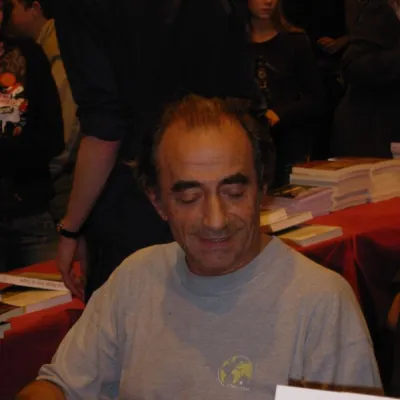
Richard Bohringer
Human Design Chart
Biography
In 2009, he had hepatitis C. Since 2014, he has been suffering from Cancer. In 2016, he came back to stage (Paris, Théâtre de l'Atelier) and published his autobiography: "15 rounds".
What does Manifesting Generator 6/2 mean for Richard Bohringer?
Manifesting Generator 6/2 — Design at a Glance
Richard Bohringers design points to a tendency towards hybrid dynamics: the speed of a manifestor combined with the constant energy source of a generator. This did not manifest as linear planning but rather as an ability to skip steps and achieve results quickly. However, the underlying mechanics require strict reaction to impulses rather than self-initiated action. Only when the sacral center clearly signals "yes" does this speed become effective; otherwise, skipping necessary phases often leads him to return later to catch up – a source of deep frustration.
Another characteristic was his inclination towards parallel action. Richard Bohringer frequently responded to multiple impulses simultaneously and started various projects side by side. If he ignored his inner agreement, the joy of creation quickly turned into exhaustion. The solution lay in what is called the "play mode". With correct application of this strategy – continuous reaction to life impulses and constant verification of sacral confirmation – this multitasking ability became a source of deep satisfaction for him. For him, it was counterproductive to finish one thing before starting another. Variety and fun were essential to keep his energy flowing and avoid frustration. His design therefore did not demand discipline in the sense of focus on a single goal but playful adaptability while simultaneously checking resonance.
Emotional Authority
Richard Bohringers design points to a tendency towards deep emotional dynamics where spontaneous judgments were often misleading. His inner authority resided in the defined Solar Plexus Center, meaning his decisions did not come from the head or through external advisors but emerged solely from an internal, intuitive clarity.
This emotional authority is subject to a natural ebb and flow: moods swing between enthusiasm and rejection, with the current emotional state being merely a snapshot, not the objective truth. An immediate reaction to this initial impulse would have been risky as it was often colored by transient heat or cold. Instead, his mechanism required patience and conscious waiting for the emotional wave to subside. Only when the initial intensity had subsided and an emotional distance had been gained did the necessary calmness set in to recognize the true nature of a situation.
This principle was particularly crucial for long-term, life-defining decisions. Richard Bohringer needed to take his time, sleep on decisions, and re-examine them multiple times to ensure that the choice made did not stem from a passing emotion but arose from a stable, clear inner position. Only by riding out this emotional wave could he find his true direction, unswayed by the distorted perspectives of the moment.
The 6/2 Profile — Role Model / Hermit
Richard Bohringers design is characterized by a clear division in his life development. In the first phase, up to around age 30, the second line of his profile dominated. This put him into a mode of "trial and error." He gathered diverse experiences, driven by a certain determination to carry forward his personal values. Often this direct presentation met with resistance because the foundation was not yet fully established. This led him to withdraw to process reactions and rejections.
After Saturn returned, the dynamics shifted fundamentally. The sixth line became active, leading to a deep withdrawal into a metaphorical "cave." During this time, Richard Bohringer withdrew to look back at his earlier experiments with great distance. This phase served for intense reflection, healing, and self-awareness. The sixth line reviewed the practicality of his previous solutions and decided what should be confirmed or discarded.
The result of this inner work was acquired wisdom. When he finally emerged from his withdrawal, a person who mastered deep introspection was revealed. His ability to understand collective knowledge and translate individual insights into socially relevant contexts attracted others. They sought him out to learn from his life wisdom and the art of deep thinking.
Quadruple Split Definition — Defined & Open Centers
Richard Bohringer's design is characterized by an immense, autonomous inner presence. Since all nine centers are defined, he generates his energy and structure completely from within, independent of the external environment. This shapes him as a closed, independent unit with constant power.
The mechanics show a persistent mental pressure through the connection between Head Center and Ajna Center. This creates ongoing questions and concepts that cannot be directly implemented because no energy source is attached to them. Instead, this mind serves as inspiration for others or requires patience until the right moment for implementation arrives. Parallel to this, a reliable identity in the G Center provides a clear sense of direction and self-love, combined with the willpower of the Heart Center. This combination allows him to keep promises and actively shape his life without losing his inner alignment.
This structure is driven by the permanent life energy of the Sacral Center. It reacts to external stimuli with a clear yes or no, ensuring that only activities are pursued for which actual energy is available. This prevents exhaustion and promotes deep satisfaction through correct reaction rather than initiation. Emotional decisions are governed by the rhythm of the Solar Plexus Center; here it's about trusting the emotional wave and waiting for clarity instead of impulsively reacting to highs or lows. Spontaneous intuition in the present moment is provided by the Spleen Center, which signals existential warnings and well-being. Finally, the Root Center ensures a stable stress management rhythm that sustains and propels the life impulse.
Since no centers are open, there are no areas vulnerable to external conditioning or reflection. Richard Bohringer acts as a complete system where mental inspiration, emotional depth, intuitive security, and vital power interweave without him relying on external validation. His communication in the Throat Center manifests these inner processes directly and reliably outward.
Channels for mystical synthesis, inspiration, values and abstraction.
Richard Bohringers design was characterized by a defining tension between individual radiance and tribal responsibility. Central to this was Channel of Inspiration 1-8, which connected G Center with Throat Center. This configuration made him a living role model: His mere presence radiated a mutative perspective that inspired others to live their unique selves – without words or explanations. It was about the brave step out of the masses and the natural attraction of attention through authentic life.
Simultaneously, Channel of the Money Line 21-45 shaped his relationship with the material world. Connecting Heart Center with Throat Center, it propelled him with a strong will to take responsibility and maintain control over his resources. He sought independence to follow his natural rhythm and saw himself as someone who had to master the material plane to provide for the tribe – often with the dilemma between service and having the last word.
Emotionally grounded was he through Channel of Synthesis 19-49, which linked Root Center with Solar Plexus Center. Here a deep sensitivity for belonging and tribal loyalty showed itself. He sought emotional validation in relationships driven by principles (Gate 49) that accepted or rejected who belonged to the inner circle. This channel functioned as an emotional glue for family and community based on the need to be needed and offer protection.
Additionally, Channel of Preservation 27-50 (Sacral-Spleen) with its selfless care and instinct for preserving values, and Channel of Abstraction 64-47 (Head-Ajna), which promoted an active, experience-based mind seeking meaning in confusion, were at work. Individual Gates like Gate 3 (Mutation in Sacral Center) and Gate 21 (Hunter Ego) underscored the dynamic power of his design while Gates like 61 (inner truth) and 62 (logical details) shaped his cognitive depth.
Tribal Circuitry — Circuit Signature
Richard Bohringers design was characterized by four separate, parallel functioning energy blocks. The Knowledge Circuit connected his Throat with Identity Center. This promoted the urge to express individuality acoustically and creatively, supported by inspiring flashes of inspiration from Channel of Inspiration (Gate 8-1). The energy was pulsing and aimed at transformation.
Simultaneously existed the Sense Finding Circuit connecting Head and Ajna Centers. Here it was about reflecting on the past and finding meaning behind events carried through abstract thought processes (Gate 64-47). This visual, wave-like energy stood in contrast to the cool logic of other areas.
A third block, the Ego Circuit, comprised two separate segments: Throat Center was connected with Heart Center (Money Line, Gate 45-21), which promoted the accumulation of resources and material well-being through communication. Parallel to this, Solar Plexus Center linked with Root Center (Synthesis, Gate 49-19), translating emotional waves directly into physical action impulses. This circuit emphasized cooperation and mutual support in the tribe but required pauses for resource regeneration.
The fourth block was the Hunter Circuit connecting Sacral and Spleen Centers (Preservation, Gate 27-50). This primal energy served to protect and preserve family and genetics through instinctive care. Overall, Richard Bohringer showed himself as someone loudly advocating his unique identity, meaningfully processing past experiences, building resources in the collective, and simultaneously nurturing deeply rooted protective motivations – all as independent but coexisting forces.
Left Angle Cross of Obscuration 2
Richard Bohringers design is marked by the left cross of the Veil 2. Without specific mechanical details such as defined Gates, Channels or Centers, no derived characterization or behavior can be formulated from the given facts. The Human Design system only provides a mention of this configuration without an elaboration on its underlying dynamics. Any interpretation of personality traits or life patterns would be speculative without these mechanical foundations and would violate the rule to describe only what is explicitly shown in the chart. Therefore, the description remains at identifying the cross alone. There are no hints towards specific strategies, authorities, or energetic profiles that could enable a deeper classification. The analysis thus limits itself to this constitutive assignment, making no further assumptions about Richard Bohringers internal process or external manifestation. Any extension would be uncontrolled invention since the raw content explicitly provides no descriptive elements.
Saturn Return · Uranus Opposition · Chiron Return · 2nd Saturn Return — Life Cycles
Richard Bohringers design was characterized by sudden, disruptive turning points that radically shifted his public perception and career. This dynamic became concrete in 1980 at age 38: The Uranus opposition marked a moment of abrupt transformation. Through his role as the Gestapo man in 'The Last Metro', he gained international fame – a typical expression of these transits, breaking established structures and forcing new visibility often without warning.
This disruptive beginning did not lead to chaos but prepared the ground for deeper validation. The Chiron Return, marking the cycle of fulfillment and flowering of one's purpose, was evident in 1988 at age 46 when Richard Bohringer received a César as Best Actor for 'On the Great Road'. This award was no coincidence but the visible fruit of long-term development: The incarnation cross unfolds increasingly during this phase if one follows their inner authority. Success did not come as healing old wounds but as validation of the lived path – the fruits of labor were now publicly recognized and meaningfully experienced. The combination of an early, shocking breakthrough and later well-deserved recognition shapes his design as someone who becomes visible through breaks to then land in deeper resonance.
Manifesting Generator · Emotional Authority — Synthesis
Richard Bohringer navigates life through a dynamic interplay of spontaneity and deep emotional processing. The combination of the manifesting Generator strategy – react and then act swiftly – with emotional authority creates an inner rhythm that inclines both towards quick reactions and waiting for emotional clarity. This ability to respond to impulses while simultaneously awaiting the emotional wave shapes his decision-making and expression in the world. The defined G Center gives him a strong internal direction and the need to live out this authenticity, while the connection to the Throat Center enables him to communicate this wisdom.
A central paradox lies in the tension between the drive for swift manifestation and the necessity of emotional maturation. This design points towards someone driven by energy and initiative but also dependent on clear feelings to make decisions. This duality requires constant navigation between the impulsive and reflective, creating a dynamic interplay of action and waiting.
5 Defined Channels
Incarnation Cross - Left Angle Cross of Obscuration 2
Solar Return
The Solar Return shows the moment when the sun returns to its exact birth position - your personal solar year.
Life Cycles
Discover the life cycles with a detailed triple view (birth chart, cycle chart, composite).
Human Design Profile
- Strategy
- To respond - wait for something to respond to
- Authority
- Emotional Authority
- Profile
- 6/2 - Role Model / Hermit
- Definition
- Quadruple Split
- Incarnation Cross
- Left Angle Cross of Obscuration 2
- Date of Birth
- 16.01.1942 18:00
- Place of Birth
- Vichy, France
Frequently Asked Questions
What is Richard Bohringer's Human Design type?
What profile does Richard Bohringer have in Human Design?
Which authority guides Richard Bohringer's decisions?
What incarnation cross is active for Richard Bohringer?
When was Richard Bohringer born?
Discover your own Human Design
Are you also a Manifesting Generator? Find out in a personal reading how to unfold your multi-talents and direct your energy wisely.
More Personalities
Back to overviewSissy Spacek

Aldair

Alizée

Anémone

Angeli

Ann-Margret
