
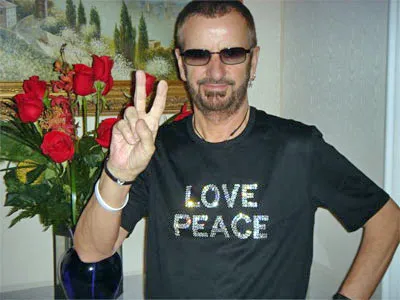
Ringo Starr
Human Design Chart
Biography
Starr grew up in a dysfunctional family in Liverpool, England. As an only child, he grew up longing for brothers. His wish would be later fulfilled by his comrades when he joined the rock and roll band, "The Beatles." His childhood memories are of drunken family parties with members passing out after excessive drinking, a natural part of his family life. As a kid, he had two hospitalizations, for a burst appendix and pleurisy. At the age of nine, Starr drank liquor at the Christmas family get-together and experienced his first black-out.
Growing up, he loved the new sound of rock and roll. Early music rock singer Johnnie Ray was a big hero to young Starr and at 15, he watched Ray throw photos down to his screaming fans from the roof of Liverpool's Adelphi Hotel. At that point, Starr knew he wanted to lead that kind of rock and roll life.
In 1962, Starr officially joined the already formed band "The Beatles" as their drummer. He became part of the British Invasion phenomena on popular culture of the 1960s. The band was a monster mega-international music hit with teenagers. In England, he was known as the band's drummer but in America, fans treated him as a star alongside George Harrison, John Lennon, and Paul McCartney.
After the band was dissolved in 1971, Starr slipped into a career crisis. Too big to join other rock bands, he sat home in London watched television and drinking. He tried to establish a solo career, but was unmotivated after his moderate hit album "Ringo" was released in 1973. In 1988, he suffered a career low as an 18-inch train conductor on a kiddy TV show, "Shining Time Station." In 1989, he rebounded, back on tour with his own band, "Ringo's All Starr Band.
Human Design Analysis: Ringo Starr as Projector 6/2
Projector 6/2 — Design at a Glance
Ringo Starr's design is characterized by his dense, focusing aura, which made him shine like a bright flashlight illuminating dark corners. His design suggested that he could quickly identify errors in others' systems and guide them to the right path. However, directly addressing these issues often led to resistance or resentment from the other person, as if shining light directly into their eyes. Instead, his optimal strategy was passive illumination: by living in harmony himself, he attracted those who would seek out his advice on their own.
This attractive effect is most effective when waiting for a respectful and honest invitation. Without this invitation, friction occurs; with it, Ringo Starr can exercise his leadership role without resistance.
Additionally, his undefined Sacral Center shaped his energy balance. Since he did not have constant intrinsic life force available to him, he experienced cycles of high productivity followed by necessary rest phases. This up-and-down rhythm was physiologically conditioned; continuous activity without recovery threatened to slow him down or lead to burnout. Societal expectations for continuous performance did not align with this rhythm.
Those who respected his design were rewarded with success. If Ringo Starr ignored the need for invitations and breaks, sooner or later his non-self theme of 'Bitterness' would arise. His path therefore involved patiently shining until he was invited and consciously conserving his energy to remain effective long-term.
Splenic Authority
Ringo Starr's design inclined him towards spontaneous, intuitive decision-making based on physical well-being and survival intelligence in the moment. He practiced strict boundaries against harmful influences. This stance stems from his inner authority in the Spleen Center. For the Spleen Center to take this role, the Emotional and Sacral Centers must be open; thus, only Projectors or Manifestors have this specific configuration.
The Spleen Center functions as a health and alarm system. It grants excellent survival intelligence that manifests as spontaneous inner knowledge about what is right. Instinct, intuition, and physical well-being served Ringo Starr as reliable indicators for the correctness of environment, situation, or society. Decisions had to be made in the moment. The first, spontaneous impulse was correct and immediately beneficial to his health. This allowed him to take very good care of himself and rigorously set boundaries.
However, this Spleen voice is a very fine impulse that only comes once in the moment. It could easily be ignored or drowned out by other influences, requiring high vigilance. Since Ringo Starr could only know what was right at the moment, plans could change suddenly. Long-term decisions were difficult; therefore, he should avoid committing himself and rather act spontaneously. A lot of free space and flexibility were essential for his design to follow the sole reliable source of health and correctness—the one-time impulse from the Spleen—immediately.
The 6/2 Profile — Role Model / Hermit
Ringo Starr's design is marked by a clear two-part development in personal growth. In the first three decades of his life, a pattern of experimentation and situational withdrawal dominated. Before turning 30, the sixth line of his profile acts like the third: it involves trial and error, gathering personal experiences through direct action. When threatened or unsuccessful, his design would retreat to learn and try new approaches.
After turning 30, this dynamic fundamentally changed. The sixth line fully activated, changing Ringo Starr's aura. Instead of continuing experiments in everyday life, his design tended towards a deep withdrawal—metaphorically into a 'cave on the mountain.' This phase served for intense reflection on accumulated life experiences as well as healing and self-discovery.
The mechanics behind this involve connecting the altruistic problem-solving power of the sixth line with the strong-willed, discerning nature of the second line. The second line brings a specific aura of willpower; it retreats when ego is threatened to find recovery and only respond to correct calls. Through this combination, Ringo Starr's design matured into that of a wise mentor. After a period of distance and introspection, he became accessible to others seeking his life wisdom and deep self-reflection skills. His ability to altruistically solve problems only became effective and accepted after this maturation phase.
Split Definition — Defined & Open Centers
Ringo Starr's design shows a tendency towards a consistent internal structure anchored in four defined centers. His throat provided a reliable yet limited means of expression; it acted as a pivot point that transmuted messages from the body into clear communication. The defined G Center gave him a firm sense of self-identity and direction, allowing him to feel loved while showing others their way without being dependent on them. Constant willpower came from his Heart Center; it gave him the energy to keep promises and prove his worth, preferring to follow his own mechanisms. Spontaneous body intelligence in the present moment was provided by his Spleen Center, which immediately perceived intuitive warning signals and health impulses without needing to rationalize them.
In contrast, seven open centers acted as receptors for environmental influences, not representing a constant internal source. His open Head Center was vulnerable to mental pressure and doubt often stemming from the environment; he tended to question whether he had to find inspiring answers that actually belonged to others. The open Ajna Center absorbed conceptual ideas and opinions, making him open to intellectual stimulation but also prone to identifying with foreign theories. His open Sacral Center lacked a constant energy flow; it took on the generative power of others, leading to overexertion if he did not listen to his inner authority and pause. Emotional waves were amplified by his open Solar Plexus; he reflected the climate but risked personalizing other people's moods as his own instability. Finally, his open Root Center absorbed adrenal stress from the environment, potentially leading to a cycle of pressure and exhaustion if this external drive was not recognized. This configuration shows Ringo Starr's design as someone with stable identity and intuition who must carefully manage which mental, energetic, and emotional impulses he takes in from his surroundings.
Channels & Gates
Ringo Starr's design is characterized by a connection between deep, instinctive intuition and a strong desire for individual distinction. This dynamic is most evident in two defined channels. The Channel of the Flash 57-20 connects the Spleen Center with the Throat Center. It gives intuitive insights based on ancient primal instincts an immediate voice in the present moment. This mechanism allows spontaneous truths to be spoken and encourages others to activate their own survival intelligence. It's about knowing 'I know that I am living now' without prolonged thought.
At the same time, the Channel of Initiation 51-25 shapes his approach. It links competitive energy from the Heart Center (Gate 51) with spiritual self (Gate 25). This channel promotes individualization through a 'shock' or initiation process. It's about expanding boundaries and releasing potential for uniqueness. Competition is seen here as a means to move forward and reach new levels of consciousness. Crucial is that this initiation only works when invited; forced initiation often leads to resistance.
Additionally, individual gates work in the background: Gate 39 brings mutation energy through analysis and provocation, while Gate 38 stands for protecting individual integrity against harmful forces. On a personality level, Gates 31 (leadership through transmission) and 15 (collective rhythm) support social integration. In his design, Gates 23 (understanding despite difference) and 56 (mental stimulation and storytelling) contribute to internal processing. Overall, this profile lives in the moment, speaks intuitive truths, and defines its uniqueness through conscious challenges.
Circuit Signature
Ringo Starr showed himself through his design as someone who combined new impulses with inner strength. His Knowledge Circuit, specifically Channel 20-57 (Flash), connected his Throat Center directly to his Spleen Center. This allowed him to immediately formulate innovative ideas and creative flashes in the present moment. The energy was pulsing and acoustic, enabling him to manifest his unique identity through spontaneous emotional expressions – here transformation through expression of new knowledge took place.
Parallel to this, his Focusing Circuit stabilized his inner self. Through Channel 25-51 (Initiation), his Identity Center and Heart Center were directly connected in him. This connection created a strong internal conviction, courage, and solid self-worth. Since Ringo Starr has a split definition, these two circuits existed as separate, not directly linked energy groups. The firm inner stance of identity and heart did not automatically flow into outward expression; instead, they worked parallel: once the outward-directed innovative communication via Spleen-Throat, and the other silent individual affirmation of self through Heart-Identity. This configuration shaped a person who was strengthened by his own individuality and supported others in being themselves, with expression primarily through creative flashes, not rhetorical persuasion.
Left Angle Cross of Individualism 1
Ringo Starr's Design establishes a tendency towards an archetypal essence defined by the will for self-determination and separation from the masses. His Inner Authority served as the foundation for this individual identity, driving independently of external expectations or pressure to conform.
This configuration is known in Human-Design as the left cross of Individualism. It describes a life task that does not aim at harmony with the environment but rather on clear differentiation of the self. The focus lies on authenticity: who one is and what matters to them becomes the central compass. This does not necessarily mean conflict, but an inner strength that allows one to walk their own path without being swept away by the general flow.
For Ringo Starr, this mechanism shaped a stance where his Inner Authority about who he is became the driving force. It was less about seeking recognition from others and more about preserving and making visible his own substance. This energy supports the ability not to dissolve in groups or systems but to stand as an independent entity. The strength lies in the consistency of this self-determination, enabling one to maintain their own line even under pressure and thereby develop an authentic presence.
Saturn Return · Uranus Opposition · Chiron Return · 2nd Saturn Return — Life Cycles
Ringo Starr's design is characterized by a clear cyclical structure of life phases, where planetary returns and oppositions act as decisive turning points. This mechanism structures his path not linearly but in recurring cycles of consolidation and transformation.
In 1968, at the age of 28, he experienced his first Saturn return. This cycle often marks the transition from experimental youth to structural responsibility. Starr switched to a Ludwig "Hollywood" set during this period – a concrete manifestation of this energetic condensation that stabilized his professional identity.
Ten years later, in 1980, the Uranus opposition came into effect. At age 40, this phase represents sudden changes and breaking old patterns. When John Lennon was murdered, Starr played drums on "All Those Years Ago." The event underscores how this cycle brings unexpected breaks that simultaneously enforce new forms of expression.
At age 49, his Chiron return began, a fulfillment cycle ("blossoming"), in which one's incarnation cross increasingly makes sense – provided strategy and authority are respected. This was not about healing old wounds but about unfolding personal purpose. In 1989, Starr went on tour with his All-Starr Band, a sign of this opening life task.
His second Saturn return followed in 1998 at the age of 58. This cycle calls for a re-evaluation of one's structures and values. The release of the commercially successful album "Vertical Man" demonstrated how Starr reaffirmed and strengthened his established position during this phase.
Projector · Splenic Authority — Synthesis
A central red thread in this design is the ability to receive subtle perceptions and transform them into clear communication (Throat Center defined, Channel 57-20). This projection quality – recognizing patterns and potential problems in others – shapes a role as an observer and mediator. The inner authority of the Spleen (Authority Center) strengthens this impulse to perceive what may be hidden for others, while the 6/2 Profile Line initially learns through experience and later functions as a wise advisor. The Knowledge Circuit underscores the potential to generate new insights and carry them outward through authentic expression – a power that manifests in recurring moments of creative unfolding (charted cycles).
The design reveals a paradox between the need for boundaries and the natural tendency towards connection. Spleen authority demands recognizing and avoiding disharmony, suggesting withdrawal or selective interaction. At the same time, the defined Throat projects information onto others, creating immediate contact – "shedding light into darkness" (Projector Type). This tension field between intuitive knowledge of one's own well-being and the ability to help others shapes a rhythm of observation, reflection, and targeted communication.
2 Defined Channels
Incarnation Cross - Left Angle Cross of Individualism 1
Solar Return
The Solar Return shows the moment when the sun returns to its exact birth position - your personal solar year.
Life Cycles
Discover the life cycles with a detailed triple view (birth chart, cycle chart, composite).
Human Design Profile
- Type
- Projector
- Strategy
- Wait for the respectful invitation
- Authority
- Splenic Authority
- Profile
- 6/2 - Role Model / Hermit
- Definition
- Split Definition
- Incarnation Cross
- Left Angle Cross of Individualism 1
- Date of Birth
- 07.07.1940 00:05
- Place of Birth
- Liverpool, UK
Frequently Asked Questions
What is Ringo Starr's Human Design type?
What is Ringo Starr's Profile in Human Design?
What authority does Ringo Starr have in his Human Design?
What incarnation cross was calculated for Ringo Starr?
When was Ringo Starr born?
Discover your own Human Design
Are you also a Projector? Find out in a personal reading how to unfold your leadership qualities and recognize the right invitations.
More Personalities
Back to overviewSissy Spacek

Alain-Fournier

Anémone

Ann-Margret

Arletty
Arno
