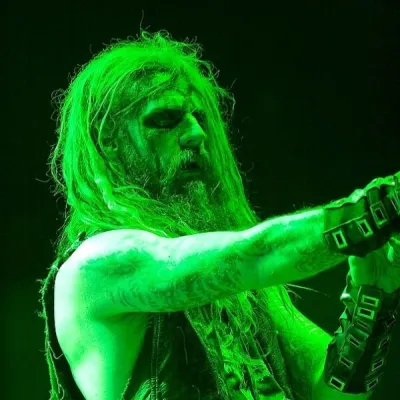
Rob Zombie
Human Design Chart
Biography
His first solo effort, the 1996 song "Hands of Death (Burn Baby Burn)" (with Alice Cooper), was nominated for a Grammy Award for Best Metal Performance. His debut solo studio album, Hellbilly Deluxe, was released in 1998. Hellbilly Deluxe sold over 3 million copies worldwide and spawned three singles. His second studio album, The Sinister Urge, was released in 2001 and became his second platinum album in the U.S. His third studio album, Educated Horses, was released in 2006. It became his third album to enter the top 10 of the Billboard 200, but saw a decrease in sales compared to his previous releases. His fourth studio album, Hellbilly Deluxe 2, was released in 2010 and peaked at no. 8 in the United States. Remix album, Mondo Sex Head, was released in 2012 and was followed by his fifth album Venomous Rat Regeneration Vendor in 2013.
The Human Design of Rob Zombie: Projector 2/5
Projector 2/5 — Design at a Glance
Rob Zombie's design showed an open, undefined Sacral Zone - a configuration described in Human Design as a Projector Type. The absence of constant self-sustaining life energy meant that power and drive came in waves: phases of intense, fast-working bursts alternated with periods where rest was needed to avoid burnout - a need that the usual work and time structures rarely accommodated. At the same time, the dense, focusing aura of a Projector tended to make others very precise: the environment and its weaknesses were quickly recognized, almost as if with a light beam falling exactly on what is hidden in others. This sharp perception could sometimes be uncomfortably direct when expressed uninvited.
The described strategy for this type did not consist of acting out or pushing forward but rather waiting for a respectful invitation - success would come according to this mechanism when recognition came from outside, while living against this pattern often led to the typical non-self theme of bitterness for Projectors. Whether and how this disposition concretely manifested in Rob Zombie's career is not revealed by the available chart data - the configuration describes the energetic basic equipment, not individual life stations.
No Inner Authority
198 words, under the limit of 220.
Rob Zombie's design showed one of the rarest fundamental configurations in Human Design: no single center carried inner authority for him because there was no center activation below the Throat Center - a pattern that occurs only in about 1.7% of people (mental Projectors) or 1 to 1.5% (Reflectors, where no center is defined at all). Instead of relying on a single defined center as a decision compass, Rob Zombie was dependent on gaining clarity from the outside: through exchange with different people, whose resonance in his open centers revealed appropriate information, or - in the Reflector pattern - by waiting for a complete lunar cycle of about 28 days before making an important decision. Both variants share the same core: decision-making needed time and the right environment, not a spontaneous inner impulse. From a multitude of perspectives and conversations, the essential had to be filtered out - a process that required calm and solitude to recognize over time what made sense and belonged to him. This structure does not describe weakness but its own capital for success: the ability to work out from many voices and recurring patterns what truly belongs to him, rather than being pushed into decisions.
The 2/5 Profile — Hermit / Heretic
Rob Zombie's design laid a basic tension between withdrawal needs and public expectation: insights that matured best in quiet solitude should also serve others as ready solutions. This disposition corresponds to Profile 2/5, the natural talent line, also called Hero and Saviour: Line 2 describes a person who needs much alone time to look inward, while Line 5 ensures that others see him as someone who can immediately solve their problems - similar to a monk who prefers solitary meditation but is constantly asked for advice. This side was reinforced by Gate 61 in the second line, described in HD mechanics as 'natural brilliance': a mind that delves into the mysterious within its own four walls and draws inspiration from it. The associated core statement warns of a trap - not every insight is automatically valuable; some seem more impressive than they actually are, a 'paper tiger'. On the action side, Gate 32 in the fifth line also emerged: an instinct for effortless adaptation during times of change, coupled with an immature urge to openly oppose conformity. Together, this made a person who had to navigate between inner withdrawal and outer expectations as a problem solver.
Single Definition — Defined & Open Centers
Rob Zombie's Human Design profile generated a persistent mental pressure to question things and seek answers on his own, without ever finding definitive solutions. This trait stems from the connection between his defined Head Center and Ajna Center: The Head Center provides the impetus to think about something, while the Ajna Center processes these impulses into firm concepts. Only around 30 percent of people have this configuration - it creates a solid, reliable way of thinking that can inspire or put others under pressure to follow suit. His Throat Center was also defined and provided a consistent but topic-specific way of expressing himself and bringing things into the world - a reliable voice, though not one to be used for every impulse.
In contrast, he had several open centers, which bring typical conditioning patterns with them. The G Center, seat of identity and direction, was open in his design - this configuration does not bring a fixed self-definition but tends to orient itself around roles, places, and relationships, adopting a fluctuating identity temporarily. His Heart Center was also open: the typical trap of this configuration is an inner compulsion to constantly prove one's worth with new promises and overextension as possible consequences. The Sacral Center was likewise open: it is prone to absorbing foreign energy and amplifying it without having its own reliable sense of when enough is enough - risking exhaustion if this borrowed power is used unchecked.
Channels for logical doubt, structuring and clear expression.
Rob Zombie's design set a mind that constantly oscillated between doubt and unusual insight: thinking that only held patterns as reliable once they proved consistent, combined with knowledge that emerged in sudden breakthroughs and was hard to explain beforehand. This dual track manifested through the Logic Channel 63-4 connecting Head Center to Ajna Center: Gate of Doubt (63) and Gate of Formulation (4) continuously filter patterns on whether they are reliable - an unstable pattern creates pressure until it becomes a question demanding an answer, which must prove itself in practice, not just belief. This was complemented by the Channel of Structuring 43-23 between Ajna and Throat Centers: Gate of Insight (43) delivers sudden individual breakthroughs, while Gate of Assimilation (23) processes and formulates them - a mutative process that is only understood at the right time or dismissed as foreign otherwise.
Additionally, individual Gates added to this picture: Gate 61 as pressure towards inner truth and personal knowledge that first opens up to the individual then to the collective; Gate 62, which translates details and facts into clear, logically coherent formulas; Gate 32, which holds fast to continuity and material success but enforces radical change when necessary; and Gate 42, which only releases new experiences after a clear conclusion. Gate 64 brought mental confusion before clarity over past experiences, Gate 11 the inclination to gather, test, and share ideas, and Gate 12 a reserved, often poetic creativity.
Individual Circuitry — Circuit Signature
Rob Zombie's design set a continuous line: from an unsettled, questioning mind to a unique, suddenly emerging form of expression - without interruption because his Head, Ajna, and Throat Centers were defined as one single connected unit, known as a Simple Definition.
Starting point was the channel between Head Center and Ajna Center, called 'Logic': mental pressure from questions and doubts that formally demanded to be translated into a coherent, rational answer - oriented towards future, sharing insights that make sense, and consciously without emotional coloring because Solar Plexus Center did not play a role in this circuit.
This well-thought-out insight flowed directly into the channel between Ajna and Throat Centers, called 'Structuring': an individual flash of inspiration that did not gradually mature but broke through pulsatingly at each moment to find its own unique form for others to understand. This describes a tendency towards creative yet melancholic expression: The idea was so personally marked that it did not always immediately meet understanding.
Because both channels belonged to one group in his design, doubt, concept, and expression were not separate forces but a continuous flow from Head to Throat.
Right Angle Cross of Maya 4
Rob Zombie's Human Design shows a fundamental orientation where the life theme revolves around personal fulfillment and one's own path - not about serving others or a larger collective. This orientation stems from the right cross of Maya in its fourth manifestation, which underlies his design. In Human Design mechanics, incarnation crosses are differentiated based on how the four underlying gates - each a Sun and Earth gate in Personality and Body consciousness - relate to one another in the body graph: Right crosses describe people whose overarching theme is aligned with their own individual progress, while other cross types are more focused on impact for others or on a predetermined fate. The term 'Maya' refers to the specific theme that gives this cross its character, while the number 4 indicates which of the four possible gate combinations was present in his case. This structure formed the overarching framework within which the individual gate and channel themes of his design were integrated - a thread that felt less imposed from outside than driven by an inner, personal motivation.
Saturn Return · Uranus Opposition · Chiron Return · 2nd Saturn Return — Life Cycles
195 words under the limit. Here is the final chapter text:
Rob Zombie's design suggests a tendency to bundle ambitions only in certain life phases and manifest them independently - initially as condensation of groundwork, later as a conscious break with what had been built up until then.
In 1994, at age 29, he began some solo projects - for his design a typical moment: the first Saturn return, the cycle in which the planet of structure and responsibility returns to its starting point after about 29 years. During this phase, what had been gathered as experience and loose ideas often condenses into an independent, viable form; the step from preparation to independent implementation takes place.
About a decade later, in 2005 at age 40, his second film The Devil's Rejects was released - coinciding with the Uranus opposition, that cycle around the 40th year of life when the planet of upheaval and individuation confronts its birth position. This phase often marks a drive to break free from the familiar and pursue one's own directions more clearly than before. For Rob Zombie, this was shown as another, decidedly independent step within the creative field he had already embarked upon - an extension and intensification of what solo projects years earlier had begun.
Projector · No Inner Authority — Synthesis
Throughout the entire pattern runs a shift between withdrawal and sought clarity. As a mental projector without inner authority, he must exchange with many people and sort out impressions alone afterward - exactly this solitary time is also required by Profile Line 2, while Line 5 ensures that others seek him out for their problems and expect quick solutions. The defined connection of Head, Ajna, and Throat Centers provides the continuous drive: a pressure to form individual knowledge (Gate 61) and share it in the Knowledge Circuit (Channel 43-23) only after a genuine invitation. This rhythm of silent processing and sought expression is also evident in documented life cycles: Saturn return and Uranus opposition both coincide with independently initiated or continued undertakings.
2 Defined Channels
Incarnation Cross - Right Angle Cross of Maya 4
Solar Return
The Solar Return shows the moment when the sun returns to its exact birth position - your personal solar year.
Life Cycles
Discover the life cycles with a detailed triple view (birth chart, cycle chart, composite).
Human Design Profile
- Type
- Projector
- Strategy
- Wait for the respectful invitation
- Authority
- No inner authority - learn more
- Profile
- 2/5 - Hermit / Heretic
- Definition
- Single Definition
- Incarnation Cross
- Right Angle Cross of Maya 4
- Date of Birth
- 12.01.1965 16:44
- Place of Birth
- Haverhill, Massachusetts, United States
Frequently Asked Questions
What is Rob Zombie's Human Design type?
What profile does Rob Zombie have?
What authority does Rob Zombie have?
What incarnation cross does Rob Zombie have?
When was Rob Zombie born?
Discover your own Human Design
Are you also a Projector? Find out in a personal reading how to unfold your leadership qualities and recognize the right invitations.
More Personalities
Back to overviewSissy Spacek
Alain-Fournier

Anémone

Angeli

Ann-Margret
Bourvil