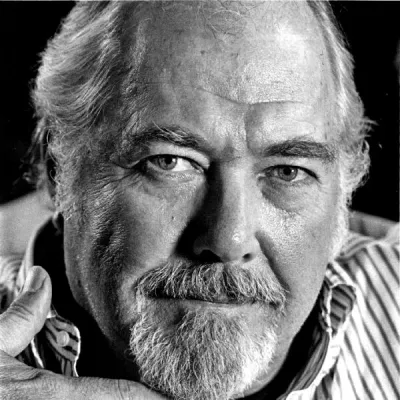
Robert Altman
Human Design Chart
Biography
After 15 years of rebellion, burned bridges and self-imposed exile, he made what he called his "fourth comeback" with his film, "The Player," 1992, a wry, post modern view of Hollywood. No longer drinking and carousing, he resumed his place as one of Hollywood's quintessential directors.
Notorious as a womanizer during his first two marriages, his third marriage was to former actress Kathryn Reed in 1962; five kids.
He was firstborn, the only child in the family for his first five years. His childhood family was not close and he later remarked, "I had no problem ever leaving anybody anywhere." With a restless intelligence, he was an indifferent student. After a brief stint unsuccessfully peddling screenplays after his Army discharge, he returned to Kansas City and took a job making industrial films. Six years later, he was back in Los Angeles directing episodes of "Alfred Hitchcock Presents." His first feature was "The Delinquents," shot in Kansas City with local actors.
He worked for several years directing episodes of various TV series before he was offered the job of directing "M.A.S.H." The job had been turned down by 14 other directors.
Human Design Analysis: Robert Altman as Manifesting Generator 2/4
Manifesting Generator 2/4 — Design at a Glance
Robert Altman showed himself to be someone who possessed immense, constant power that allowed him to quickly draw things into his life. His design combined the endurance of a Generator with the speed of a Manifestor, making him a hybrid. This configuration, however, brought a specific tension field: the tendency to skip steps or work on multiple projects simultaneously.
Without the constant calibration with his inner authority – the signal from the sacral center – this quickness often led to missing important phases. The result was not efficiency but frustration, as he had to go back later and make up for the missed steps. Similarly, multitasking, reacting to many impulses at once, became a trap when inner consent was lacking.
The solution lay in his strategy of responding rather than initiating. Only when he waited for an external offer and responded with a clear "yes" from within could his creative power become productive. In this state, the so-called Play Mode, it even served him to work on different things simultaneously. Satisfaction did not come through linear completion but through this playful, alternating engagement with many facets at once, as long as inner energy supported it.
Emotional Authority
Robert Altmans design suggests a tendency for spontaneous judgments to often be unreliable and decisions requiring time as well as emotional distance. This results from his emotional authority: With his Emotional Center defined, he was subject to constant waves of emotional highs and lows. The world appeared colored by his current mood; a moment of enthusiasm could quickly turn into a negative outlook in the next. However, this fleeting feeling was merely an initial impression, not necessarily the truth. Therefore, quick decisions made from emotion often had negative consequences.
The mechanics of his inner authority demanded patience and repeatedly "sleeping on" decisions. The longer he let a decision mature, the deeper and more comprehensive he could perceive the situation. This process served to calm intense feelings and gain emotional distance. Only then did clarity and composure set in – signs that the internal process was complete. This strategy was particularly important for long-term decisions with significant influence on life's course. Thus, Robert Altmans showed himself as someone who had to hesitate to arrive at his true inner truth rather than relying on first impulses.
The 2/4 Profile — Hermit / Opportunist
Robert Altman's design created a clear tension between the need for withdrawal and the desire to connect. He was someone who constantly oscillated between two poles: Line 2, which demanded solitude and internal processing, and Line 4, which sought community with chosen individuals. This Profile 2/4, known as the Natural Talent Networker profile, required him to communicate his availability boundaries clearly. Without this transparency, friction arose; with it, he could steer his environment.
During his withdrawal phases, Robert Altman immersed himself in internal processes to find peace and clarity. This isolation was essential because Line 2 is often characterized by mistrust or fear of gossip. Only when this emotional balance was restored did he return from his "cave." Then, driven by the intuition and trust of Line 4, he actively sought contact with his favorite people.
This cycle allowed him to reflect on and evaluate external inputs from his network in solitude. The power of Line 4 lies in respectful interaction with others and building trust. When Robert Altman clearly communicated these boundaries—when he needed company and when he needed silence—he could leverage the knowledge of his network to develop brilliant ideas. His design showed that success depended on consciously shaping this interplay between being alone and being part of a community, and making it visible to the outside world.
Quadruple Split Definition — Defined & Open Centers
Robert Altman revealed himself through a design with nearly complete internal structure: Head, Ajna, Throat, Heart, Sacral, Solar Plexus, Spleen, and Root were defined. This endowed him with constant mental inspiration, willpower, vital energy, as well as emotional and intuitive depth. His mind was under permanent pressure to ask questions and find answers, while his heart pursued clear goals and his sacral center awaited initiation to provide energy. The emotional authority of his solar plexus required patience until the waves subsided before decisions were made.
Despite this strong internal mechanism, the G Center remained open. Robert Altman did not have a fixed internal identity or direction. Instead, he tended to be initiated by environment and relationships. The risk was that his defined mind or will tried to fill this gap, which could lead to frustration as the correct path came from outside rather than within himself. He relied on finding the right place and the right people to feel comfortable and use his energy effectively. The tension between his strong internal structure and the missing fixed identity shaped his essence: he had to learn to follow his internal strategies – waiting for questions, waiting out emotions, reacting to initiation – while remaining open externally to being led by others to find his direction.
Channels for clarity, logic, drive, instinct and emotion.
Robert Altman showed a fundamental tension between logical doubt and impulsive, charismatic manifestation. His design set up that the mind filtered patterns and sought confirmation through skepticism, while sacral energy pushed for immediate action. The Logic Channel 63-4 connected the Head Center with the Ajna Center; this was the doubting mind constantly checking if patterns were consistent. Logic could be formulated correctly yet still be wrong, making skepticism essential. Only practical testing and verifiable evidence made an answer acceptable; unfounded belief found no place here.
Simultaneously, the Charisma Channel 34-20, connecting Sacral with Throat Center, was at work. This was the classic energy of the Manifesting Generator: raw physiological power (Gate 34) was redirected through the thyroid system to become a key energetic component for survival. The drive to express NOW (Gate 20) conflicted with the need to wait for internal sacral reaction. Without this guidance, the energy could turn into obsession or be carried away like a misdirected rocket; with it, impressive self-reinforcing vitality emerged.
Additionally, there was a deep, mutative emotional wave through the channel of releasing feelings 39-55. This channel connected Root and Solar Plexus Centers, generating moods between ecstatic joy and melancholic uncertainty. This provocation served to strengthen mental perception and test one's own as well as others' minds. Emotional authenticity was key; rationalizing this wave was avoided, instead Robert Altman lived in its alchemy.
Another aspect was the channel of devotion 44-26, connecting Spleen and Heart Centers. This conveyed an instinctive entrepreneurial drive to devote and sell ideas. With deep tribal memory (Gate 44) and ego strength (Gate 26), he could selectively use historical memory to sell improvements to a target group – the capitalist with creative business art manipulating the tribe to keep it alive.
Individual Circuitry — Circuit Signature
Robert Altman was marked by four separate energetic blocks that worked in parallel. The Knowledge Circuit formed two isolated segments: Head and Ajna Centers connected awareness, while Solar Plexus and Root Center generated pulsating acoustic impulses through the channel 'release emotions'. This promoted a melancholic individuality and transformation of new knowledge. The Understanding Circuit complemented with logical structure; its Logic Channel also connected Head and Ajna Centers with focused, emotion-free ratio for future-oriented strategies. Parallel to this, the Ego Circuit steered cooperation: The Devotion Channel connecting Heart and Spleen Centers allowed resource management within giving and taking as well as mutual support – yet without direct life force of Sacral Center, requiring rest periods. Finally, Integration secured survival: The Charisma Channel connected Throat and Sacral Centers, making power from reacting to life in the present effective. These four groups remained energetically separate; there was no continuous flow between them but existing side by side forces for identity, logic, tribal cooperation, and individual adaptation.
Right Angle Cross of the Sleeping Phoenix 1
Robert Altman revealed himself as someone whose identity and life path were defined by the 'Right Cross of the Sleeping Phoenix 1'. This configuration shaped an archetypal life energy and a deeper identity structure, as prescribed by this specific cross.
In Human Design, such a cross describes the fundamental energetic orientation of a person throughout their entire range. It is not about individual isolated features but rather the overall picture of inner disposition and outer manifestation. For Robert Altman, it meant that his being was permeated by this particular archetypal quality. The 'Right Cross of the Sleeping Phoenix 1' set the framework for his deeper identity structure. This was an energy that did not just have a superficial effect but formed the foundation of his personality.
This definition through the cross created a consistent basis for his experience and actions. The archetypal life energy associated with it significantly determined how he interacted with himself and the world. It was not a transient phase or situational state, but rather the constant foundation of his design. Robert Altman lived in accordance with this prescribed structure that defined him at the deepest level. The mechanics of this cross ensured that his inner disposition and outer appearance were shaped by this specific archetypal imprinting. This formed the core of who he was within the context of his Human Design chart.
Saturn Return · Uranus Opposition · Chiron Return · 2nd Saturn Return — Life Cycles
Robert Altman's life was marked by sudden breaks and profound transformation phases. This cyclical dynamics arose from the interaction of Uranus influences, which initiated unexpected changes, and Chiron cycles, which required intense inner restructuring after crises.
In 1962, at age 37, Robert Altman married Kathryn Reed. This event fell into a Uranus opposition cycle. Such phases often brought abrupt turns or new connections that broke the status quo and required rapid adaptation. The marriage thus marked not only a private milestone but also the beginning of a new life phase driven by change.
Later, in 1975 at age 50, his Chiron Return occurred. During this period, personal chaos threatened to engulf him. The Chiron Return is not a process of healing old wounds in a mythological sense, but rather a fulfillment cycle where one's incarnation cross unfolds. If the strategy and authority are observed, meaning becomes experiential; otherwise, this phase can appear as an intense crisis that dissolves old patterns to make way for deeper self-realization. For Robert Altman, this moment was a critical point of transformation, at which his life task either condensed or culminated in a severe test. These cycles did not repeat statically but continuously shaped his development through rupture and reconstruction.
Manifesting Generator · Emotional Authority — Synthesis
Robert Altman lived a life marked by an inner dynamic between initiating and reacting. As a Manifesting Generator, he possessed the ability to quickly spark things off, yet his design required him to wait for external impulses to channel his energy correctly. This combination of self-initiative and responsiveness created a constant flow of activity, enhanced by a defined Heart Center – an unceasing drive towards self-realization and building personal projects. The connection between Head and Ajna Centers provided continuous mental stimulation that drove him to recognize patterns and develop new perspectives, while the defined Root Center supplied the necessary energy for bringing these visions into the world.
A central paradox in Robert Altman's design lay in the tension between his need for autonomy and his ability to deeply connect with others. His defined Solar Plexus Center required emotional clarity through waiting out emotional waves, while his open G Center made him susceptible to the influences of others. This opposition led to a constant search for authentic identity and belonging, an interplay between the desire for solitude for reflection (Line 2) and the longing for community and exchange (Line 4). This tension manifested in his ability to act both as an independent thinker and a master of collaboration.
5 Defined Channels
Incarnation Cross - Right Angle Cross of the Sleeping Phoenix 1
Solar Return
The Solar Return shows the moment when the sun returns to its exact birth position - your personal solar year.
Life Cycles
Discover the life cycles with a detailed triple view (birth chart, cycle chart, composite).
Human Design Profile
- Strategy
- To respond - wait for something to respond to
- Authority
- Emotional Authority
- Profile
- 2/4 - Hermit / Opportunist
- Definition
- Quadruple Split
- Incarnation Cross
- Right Angle Cross of the Sleeping Phoenix 1
- Date of Birth
- 20.02.1925 00:01
- Place of Birth
- Kansas City, MO, United States
Frequently Asked Questions
What was Robert Altman's Human Design type?
What profile did Robert Altman have in Human Design?
What authority did Robert Altman have?
What incarnation cross did Robert Altman have?
When was Robert Altman born?
Discover your own Human Design
Are you also a Manifesting Generator? Find out in a personal reading how to unfold your multi-talents and direct your energy wisely.
More Personalities
Back to overviewAldair

Alizée

Angeli

Arletty

Artus
Balthus