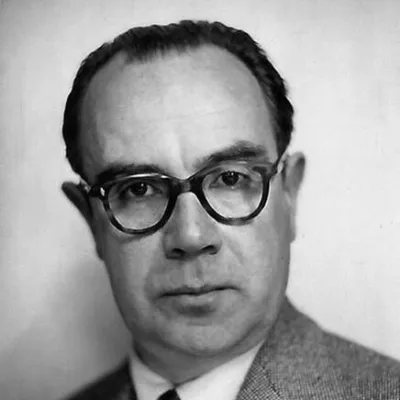
Robert Ambelain
Human Design Chart
Biography
The Human Design of Robert Ambelain: Generator 4/6
Generator 4/6 — Design at a Glance
Robert Ambelain possessed high physical endurance and a considerable energy reservoir that enabled him to undertake long-term ventures. However, his design as a Generator included a fundamental mechanical compulsion: Success and deep satisfaction did not arise from spontaneous initiative but exclusively through reaction to external impulses. The energy of his sacral center only became effective when he responded to signals from the environment – the so-called „Yes-Signal“ from the gut.
This configuration determined his operational strategy: Instead of taking the first step himself, which would go against his energetic flow, he waited until an opportunity or request arrived that resonated with him. If he reacted in this way, he could efficiently deploy his strength and was rewarded with a sense of deep fulfillment. Ignoring these inner signals or forcing himself to engage in activities for which there was no internal consent inevitably led to frustration and energy loss. The risk of burnout lurked where he used his endurance on tasks that did not intrinsically move him. His design therefore demanded disciplined restraint when initiating actions, coupled with a quick, intuitive readiness to respond once life pointed him towards a direction that aligned with his essence. Only in this rhythm of waiting and reacting could he unleash his full potential without depleting himself.
Emotional Authority
Robert Ambelain exhibited a decision-making stance that countered spontaneous impulses and instead required strategic patience. His design carried emotional authority, meaning his defined Emotional Center was the source of his inner truth – regardless of which other centers were also defined. This configuration subjected him to a constant emotional wave, an up-and-down of feelings that colored his perception of the world through the current mood. What appeared inspiring in one moment could seem negative in the next; this initial impression was merely a snapshot, not the final truth. Quick decisions made from this emotional heat risked negative consequences.
The strength of his design lay in the ability to take time. By hesitating and reconsidering decisions multiple times, he created the necessary distance for intense feelings to subside. This process of maturation allowed him to let go of the initial emotional coloring and reach a state of deeper clarity and calmness. Only when this peace set in had the emotional cycle run its course and the decision made aligned with his inner truth. This mechanism primarily shaped long-term life decisions, where patience formed the key to proper orientation rather than relying on the first, often misleading impulse.
The 4/6 Profile — Opportunist / Role Model
Robert Ambelain was marked by a Profile 4/6 that structured his lifespan. In the first thirty years, before the Saturn Return cycle, he acted experimentally and sought intense connection in relationships and friendships. This phase was driven by the dynamics of Line 4, which required correctly timed opportunities within the network. There was always the risk of burnout through overloading or stroking the ego when quality was sacrificed for quantity.
With the activation of Line 6, an inner conflict emerged: The heart's desire for belonging (Line 4) stood in opposition to the head's need for distance and meaning-making (Line 6). This tension between emotional attachment and intellectual superiority shaped his development. Initially, there was a certain gullibility and vulnerability to propaganda as he still learned to assess others' expressive power.
In later life, it was expected of him to act as a wise role model. His Line 6 now enabled him to make judgments and find the right skills for achieving a consistent ideal. Meanwhile, the large heart of Line 4 continued to open cautiously to avoid being hurt by false people. The balance between willpower and necessary rest phases was crucial to maintaining this harmonious state and preventing depression when the ideal was not reached.
Split Definition — Defined & Open Centers
Robert Ambelain was characterized by a strong inner density: His design featured defined Head, Ajna, Heart, Sacral, Solar Plexus and Root Centers. This created a constant mental pressure to question and form concepts, paired with a strong willpower and generative life force. His emotions followed their own wave that he had to wait out while an existential drive propelled him forward. The combination of inspiration, ego strength, and vitality formed his consistent energy base.
At the same time, his Throat, G, and Spleen Centers were open. This meant that communication, identity, and well-being were not fixed but situational. Instead of initiating himself or setting a firm direction, he had to wait for invitations to speak correctly. His identity crystallized only in proper relationships and places; at the wrong place, he felt lost. Additionally, he tended to absorb others' health and well-being vibrations, requiring him to distinguish between his own intuition and external conditioning.
The mechanics of his design lay in the tension field between this strong inner source and the receptivity of open centers. While his mind and will were constantly active, his communication had to remain spontaneous, triggered by external impulses. His emotional authority required patience while the open G Zone kept him flexible for new directions as long as he was at the right place. The challenge lay in not turning internal pressure into hasty actions but using it to inspire others while waiting for the right timing for expression and connection. Thus, his energy worked less through direct imposition but rather through the quality of his presence and reactions.
Channel 40-37: Community — Channels & Gates
Robert Ambelain was characterized by a group-building mechanism based on emotional clarity and mutual benefit. The Channel 37-40 shaped his personality as a strategic orientation: He sought direct personal contact for 'good deals' – fair agreements like 'I do this if you do that'. This energy oscillated between the need for recognition in groups (Gate 37) and the necessity of withdrawal to regenerate (Gate 40). He waited for the right invitation through touch or proximity to create structures where everyone had an honorable place.
This social dynamic was supported by internal processes. The Channel 52-9 connected his Root Center with his Sacral Center, giving him the ability to perfect patterns through calm non-action (Gate 52) and focused attention on details (Gate 9). It was a format energy that applied logic step-by-step to correct action patterns, provided he followed his inner reaction.
Parallel to this, the Channel 61-24 between Head and Ajna Centers worked. Here, his mind processed inspiration (Gate 61) through rationalization (Gate 24), until sudden insights – a Satori – appeared. He could not control his thinking but had to trust the mutative truth that emerged in its own time.
Additionally, he carried the Channel of Emotional Release 39-55, which generated a pulsating emotional wave between joy and melancholy. Through provocation (Gate 39), he could address others' minds and release authentic moods.
Individual Gates rounded out the picture: Gate 16 promoted experimental mastery, Gate 59 genetic strategy of pairing without personal preferences, and Gate 58 created pressure for perfecting life processes. Gate 54 connected worldly success with mystical insight while Gate 38 protected individual integrity through resistance and Gate 36 released emotional energy in crises.
Individual Circuitry — Circuit Signature
Robert Ambelain was characterized by a divided energetic structure that produced two parallel, non-directly connected power fields. One field united life force and emotions (Sacral, Root, Solar Plexus, and Heart Centers), the other intuition and strategy (Ajna and Head Centers). This separation meant that rational planning and emotional impulses worked as separate processes without forming a common flow.
The Knowledge Circuit shaped his expression through two distinct parts: innovative flashes of insight connected the Head with the Ajna Center while Channel 55-39 released emotional waves between Solar Plexus and Root Center. This promoted the transformation of individual knowledge into acoustic or pulsating expressions, driven by creativity and personal identity.
Parallel to this, the Understanding Circuit worked through Channel 9-52 (Concentration), connecting Sacral with Root Center. Here it was about focused logical structuring and sharing rational insights for the future, free from emotional influence by Solar Plexus Center which was not involved in this circuit.
Central was the Ego Circuit emphasizing cooperation and resource management. Channel 37-40 (Community) connected Heart and Solar Plexus Centers focusing on mutual support as well as traditional values in exchange of give-and-take. As there was no connection to Sacral Center, this energy required quiet pauses for regenerating resources for community. Robert Ambelain thus moved in the tension field between individual knowledge transformation and structured cooperative future-making, with solar presence in Gate 40 reinforcing alignment on stability through shared values.
Right Angle Cross of Planning 3
Robert Ambelain's actions were characterized by a clear inner logic. His design determined the way he set and implemented plans – less about the content itself but rather the methodical approach. He exhibited a systematic, often strategic or even tactical nature in his planning processes.
This structuring resulted from the influence of the right cross of Planning 3 in his chart. This configuration suggested that he made steps dependent on one another and brought clear order and structure to his actions. It was not about spontaneous impulses but rather a well-thought-out approach where the sequence of measures was crucial. Robert Ambelain organized his activities according to a fixed pattern, creating security and predictability. The mechanics of this design promoted an attitude in which planning served as a tool for controlling one's path. He structured his environment and tasks so that they followed logical sequences. This allowed him to master complex situations through clear processes rather than succumbing to chaos. His strategy was to bring order into execution, making his actions coherent and goal-oriented.
Saturn Return · Uranus Opposition · Chiron Return · 2nd Saturn Return — Life Cycles
Robert Ambelain went through a life structure marked by clearly defined rhythmic turning points. His design showed itself in the sequence of classical astrological cycles: two Saturn returns, one Uranus opposition, and a Chiron return. These phases did not mark random events but structural stages of his development.
The first Saturn return around age 29 signaled the transition from youth to adult responsibility. Here early groundwork solidified into stable structure; Robert Ambelain had to learn to set boundaries and focus his energy. This process repeated itself with the second Saturn return around age 58, initiating another phase of maturity and consolidation. In this period, it was less about a new beginning than confirmation and deepening of already established life foundations.
In between lay the Uranus opposition at around age 40. This cycle acted as a catalyst for liberation and necessary break from established patterns. For Robert Ambelain, this often meant a phase of rebellion against earlier constraints or structures that limited him. It was a moment of letting go to gain new freedom levels, even if it felt destabilizing initially.
The Chiron return between ages 49 and 51 concluded this sequence. In Human Design mechanics, this cycle does not represent healing in the therapeutic sense but rather the blossoming of one's incarnation purpose. If Robert Ambelain had followed his strategy up to that point, this phase would have shown deep soul integration and a sense of meaning. The four cycles together formed a pattern of structuring, liberation, and ultimately fulfilling his individual purpose.
Generator · Emotional Authority — Synthesis
Robert Ambelain lived a life marked by profound inner dynamics: the interplay between creative inspiration and the need for practical implementation. His Generator design with emotional authority points to someone who possessed immense energy but could only optimally utilize it when responding to external impulses and validating decisions through waiting for an emotional wave. The connection of Head Center and Ajna Center intensified this internal pressure towards insight, while his defined Heart Center gave him the willpower to pursue visions – as long as he followed his strategy. This led to a lifestyle where creative energy was channeled through careful planning and implementation to achieve sustainable results.
A central tension field in Robert Ambelain's design lies between the desire for community (Line 4 in Profile) and the need for independent thinking and spiritual reflection (Line 6). This paradox likely manifested as an ongoing balancing act between belonging to a group and striving for individual development. The open definition of G Center intensified this ambivalence, as he constantly adapted to his environment while the Root Center pushed him to walk his own path and stand up for his values.
4 Defined Channels
Incarnation Cross - Right Angle Cross of Planning 3
Solar Return
The Solar Return shows the moment when the sun returns to its exact birth position - your personal solar year.
Life Cycles
Discover the life cycles with a detailed triple view (birth chart, cycle chart, composite).
Human Design Profile
- Type
- Generator
- Strategy
- To respond - wait for something to respond to
- Authority
- Emotional Authority
- Profile
- 4/6 - Opportunist / Role Model
- Definition
- Split Definition
- Incarnation Cross
- Right Angle Cross of Planning 3
- Date of Birth
- 02.09.1907 10:20
- Place of Birth
- Paris, France
Frequently Asked Questions
What was Robert Ambelain's Human Design type?
What Profile did Robert Ambelain have in Human Design?
Which Authority guided Robert Ambelain?
What incarnation cross did Robert Ambelain have?
When was Robert Ambelain born?
Discover your own Human Design
Are you also a Generator? Find out in a personal reading how to use your sacral energy correctly and discover deep satisfaction.
More Personalities
Back to overviewAaliyah

Alexia

Angèle

Anne-Marie

Arcángel

Arno