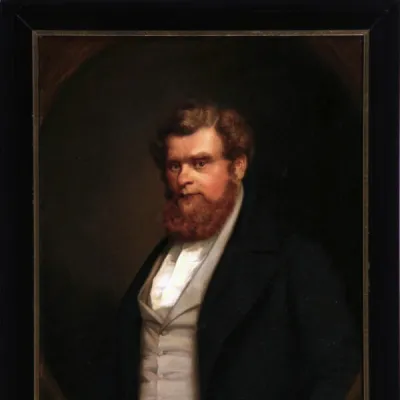
Robert Blum
Human Design Chart
Biography
In his fight for a strong, unified Germany he opposed ethnocentrism and it was his strong belief that no one people should rule over another. As such he was an opponent of the Prussian occupation of Poland and was in contact with the revolutionists there. Blum was a critic of antisemitism, supported the German Catholics and agitated for the equality of the sexes. In spite of his diplomatic immunity as a member of parliament he was illegally arrested during a stay at the hotel "Stadt London" in Vienna and murdered in a summary execution, making him a martyr of the German revolution. He died on 9 November 1848.
Robert Blum — Manifesting Generator with Profile 5/1
Manifesting Generator 5/1 — Design at a Glance
Robert Blum's design inclines towards a hybrid work style: He possesses the constant, vital energy of a Generator paired with the ability to skip steps and produce results quickly. This configuration as an Manifesting Generator means that he has much power but can only use it effectively when responding to external impulses rather than initiating himself.
The mechanics of his design present specific challenges. His natural speed often leads him to omit important intermediate steps or pursue multiple projects simultaneously. Acting without inner consent frequently results in frustration – his central non-self theme. The key to his satisfaction lies in constant validation from the Sacral Center. Only when this says "yes" is his energy meaningfully applied.
Instead of focusing on a single task, Robert Blum finds his creative power in change and what is called the "play mode". Parallelism is not an obstacle for him but a source of satisfaction as long as he responds to impulses rather than acting out of self-dynamics. Through this approach, he avoids exhaustion from hasty actions and can productively use his unique combination of endurance and speed. His path involves waiting until life speaks to him and then responding with full force but playful ease.
Sacral Authority
Robert Blum's design shows a clear tendency towards reactive decision-making. As a Generator, his inner authority was the Sacral Center, which simplified his process: he did not act from proactive planning but rather as a response to external impulses. This mechanism required an open Emotional Center to clearly perceive the immediate physical resonance.
His truth manifested in physical signals. A grunting, humming, or an internal surge of energy marked the right path. When these stimuli appeared, he felt vital and alive. His energy then seemed inexhaustible, driven by a deep enthusiasm for the activity itself, free from rigid purposefulness. This allowed him to dive into his creative work with joy.
Additionally, there was a supportive Spleen Authority at play here. This connection gave him the ability for quick, spontaneous reactions. He had direct access to his instinctive perception and physical well-being. These instincts served as reliable guideposts for his decisions, which directly arose from the sacral response. Thus, a process emerged where swift intuition and powerful confirmation went hand in hand to guide him through life.
The 5/1 Profile — Heretic / Investigator
Robert Blum's design points to a dual orientation: an inner drive for deep research and an outer magnetic attraction as a problem solver for others. As a Hero-Researcher (Profile 5/1), he utilized the depth of his knowledge base to serve others. Line 5 gave him almost magnetic qualities; people often sought solutions from him and projected high expectations onto him. This could quickly lead to energy loss if clear boundaries were not set.
The challenge lay in protecting these personal resources from excessive demands by society. The Fifth Line is attractive but creates a large field of expectation and projection. Eccentric creativity was an important resource during crises, provided it was protected by a steadfast ego. Only then could interference be handled well and the creative process maintained.
Line 1 emphasized study and preparation as the path to perfect timing. Answers should only be given when the right moment arrived; pleasure and success would occur if these were in the proper context. By learning to say no, Robert Blum preserved a beneficial balance between his private knowledge treasury for himself and public service. This allowed him to optimally use his gifts without being drained by the burden of others' questions and criticism.
Split Definition — Defined & Open Centers
Robert Blum's design indicated a tendency towards constant, mechanical presence. His defined Head Center and Ajna Center created persistent mental pressure to question and conceptualize continuously. This was not a choice but rather a steady state of thinking. His defined Throat Center allowed him to articulate these thoughts reliably, while his defined G Center provided a firm identity and direction. As a Generator, he had immense vital energy in the Sacral Center, which could only be activated through reaction – not by initiative. His defined Spleen Center ensured spontaneous body awareness and intuitive security in the moment.
This inner strength sharply contrasted with his open centers. The open Heart Center meant lacking consistent willpower; he tended to question whether he had enough value to keep promises, often leading into a cycle of overcompensation and disappointment. His open Solar Plexus acted like an emotional barometer: He absorbed the moods of his environment rather than possessing stable emotions himself, making him vulnerable to others' moods. The open Root Center took on external stress that he did not generate but amplified – pressure that often drove him into restlessness as a way to escape it.
The central challenge lay in the tension between his powerful Sacral energy and the mental urging of the Head-Ajna channel. Since no energy flowed directly from the mind for manifestation, ignoring the strategy 'Wait for the answer' led to frustration. Robert Blum showed himself to be someone whose true strength lay in releasing mental pressure and using his Sacral energy only where a clear inner consent existed – rather than fighting against open centers or interpreting external stress waves as personal necessity.
Channels for charisma, rhythm, logic and intuitive precision.
Robert Blum exhibited a fundamental tension between the urgency of immediate impact and the deep need for logical verification and perfect execution. His design combined the powerful life force of Channel Pairing 14-2 with the analytical skepticism of Channel Logic 63-4 and the intuitive depth of Channel Wavelength 48-16.
Channel Pairing 14-2 connected the material power competence of Gate 14 to the higher knowledge of Gate 2 in the G Center. This configuration gave him the ability to chart innovative directions and encourage others' development through his presence, provided he trusted his inner reaction rather than external expectations. Simultaneously, Channel Charisma 34-20 from his personality fueled a drive for immediate manifestation through the connection of sacral power (Gate 34) and expression in the present moment (Gate 20). This created an internal rhythm where energy wanted to be quickly translated into action, often faster than his design allowed by reflection.
These impulsive forces were however tempered by Channel Logic 63-4. Through the connection of doubt (Gate 63) and formulation (Gate 4), his mind constantly filtered for consistent patterns. He did not blindly seek answers but asked questions to test the viability of ideas; only what was logically verifiable found entry into his actions. Additionally, Channel Wavelength 48-16 provided quality and depth. Through the connection of intuitive intelligence (Gate 48) with technical skillfulness (Gate 16), he tended to perfect skills through repeated practice. His talent developed not as sudden inspiration but as a step-by-step refinement of patterns based on an inner insight that was hard for his mind to grasp.
Gate 1 in his personality further strengthened this mutative impulse by focusing on uniqueness and the here-and-now. Robert Blum thus lived in the tension between the drive to lead new paths as an individual and the discipline to make these paths viable through logical scrutiny and masterful perfection.
Individual Circuitry — Circuit Signature
Robert Blum's design presented two separate, parallel operating energy systems. One system propelled forward through emotional waves and individual beat transformation; the other operated emotionlessly with logic and strategy for future-oriented improvements. This tension between pulsating identity claim and rational analysis characterized his inner self.
The Knowledge Circuit connected his Identity Center and Sacral Center directly. Through Channel 'The Beat' (Gates 2, 14), a pulsing energy of personal individuality emerged. This fostered the expression form of a unique identity supported by emotional cycles from the Solar Plexus – even though this center was not directly in the circuit, it acted as a source for emotional expression through the Throat Center.
Simultaneously, the Mind Circuit existed as a separate system. It comprised two unconnected segments: Head and Ajna Centers on one side, Throat and Spleen Centers on the other. Channel 'Logic' (Gates 63, 4) connected Head and Ajna, enabling focused visual strategies for the future. Channel 'The Wavelength' (Gates 16, 48) linked Throat and Spleen, thereby logically structuring intuitive, life-relevant insights. Both parts of this circuit worked free from emotional conditioning.
Additionally, the Integration Circuit operated through Channel 'Charisma' (Gates 20, 34), connecting Throat and Sacral Centers. This supported the ability to draw power from reacting to life and express it acoustically in the present moment.
As Robert Blum had a Split Definition, these energies did not flow together. The emotional identity-forming force of the Knowledge Circuit stood beside the cold rational analysis of the Mind Circuit. Both systems existed side by side without direct energetic exchange, creating an inner duality between expressive emotion and strategic distance.
Left Angle Cross of Defiance 2
Robert Blum's Human Design configuration pointed to the left cross of Challenge 2. This structure shaped a fundamental attitude where internal tensions and external resistances were not seen as obstacles but rather as necessary impulses for development. The left cross of Challenge 2 describes a process in which an individual gains their own strength and clarity through confrontation with difficulties. It was a mechanism aimed at overcoming uncertainties through direct experience, thereby creating new capacity for action. For Robert Blum, this meant that his path was often characterized by the necessity to engage with challenging situations to define his identity and place in the world. This configuration promoted a form of learning through resistance, where each overcoming of an obstacle contributed to strengthening his inner compass. It wasn't about avoiding conflicts but transforming these experiences into personal growth and deeper self-knowledge. The design suggested that Robert Blum often gained his greatest insights precisely when he had to confront the most difficult aspects of his life. This dynamic created a continuous cycle of challenge, reflection, and development that shaped his entire life and helped him build a robust inner structure that could remain steadfast even as external circumstances changed or intensified.
Saturn Return · Uranus Opposition — Life Cycles
Robert Blum's Human Design was marked by clear phases of maturation and conscious breaking with the past to create independent structures. This dynamic was influenced by two prominent astronomical cycles: the Saturn Return and the Uranus Opposition.
The first Saturn Return occurred at age 28. This cycle signaled a phase of structuring, where years of groundwork often condensed into a solid result. For Robert Blum, this concretely manifested in 1835 when he undertook a journey to the Saxon Switzerland. This event marked a moment of inner consolidation and orientation, typical for the beginning of this maturation phase.
Later, around age 40, the Uranus Opposition took effect. This cycle represents a conscious break with established patterns and a drive towards new individual autonomy. For Robert Blum, this energy was active in 1847 when he founded the publishing bookstore Blum & Co. This founding was not an accidental step but rather a concrete expression of the urge to dissolve old bonds and establish independent professional structures. Both cycles underscored his path from internal consolidation towards external self-determination.
Manifesting Generator · Sacral Authority — Synthesis
Robert Blum was a Manifesting Generator whose life was marked by deep, sacral-driven energy and a drive for creative unfolding. The connection of defined Sacral, Head, and Throat Centers points to someone who is both impulsive and conceptually strong – an inner engine set in motion by external stimuli that could quickly manifest ideas. This ability to swiftly implement coupled with the Profile of Hero/Explorer (5/1) led to a constant pursuit of knowledge and a tendency to make it accessible to others. The Channel of Logic (63-4) reinforced the tendency to recognize patterns and offer solutions, while the Channel of Charisma (34-20) provided a natural radiance that attracted and inspired others. The defined Spleen Center ensured a strong intuitive foundation that offered orientation during moments of decision-making.
A central tension field lay in the combination of rapid implementation power and the need for deep analysis. While sacral energy pushed towards immediate action, the defined Head Center demanded thorough consideration. This dynamic could lead to an internal conflict between the desire for spontaneity and the responsibility to make well-founded decisions. The left cross of Challenge 2 underscores this tendency to engage with complex problems and forge new paths through creative solutions – a constant interplay between inner drive and external necessity.
4 Defined Channels
Incarnation Cross - Left Angle Cross of Defiance 2
Solar Return
The Solar Return shows the moment when the sun returns to its exact birth position - your personal solar year.
Life Cycles
Discover the life cycles with a detailed triple view (birth chart, cycle chart, composite).
Human Design Profile
- Strategy
- To respond - wait for something to respond to
- Authority
- Sacral Authority
- Profile
- 5/1 - Heretic / Investigator
- Definition
- Split Definition
- Incarnation Cross
- Left Angle Cross of Defiance 2
- Date of Birth
- 10.11.1807 08:30
- Place of Birth
- Cologne, Germany
Frequently Asked Questions
What was Robert Blum's Human Design type?
Which profile did Robert Blum have?
What authority did Robert Blum have?
Which incarnation cross was active for Robert Blum?
When was Robert Blum born?
Discover your own Human Design
Are you also a Manifesting Generator? Find out in a personal reading how to unfold your multi-talents and direct your energy wisely.
More Personalities
Back to overviewAldair

Alizée

Angeli

Arletty

Artus

Balthus