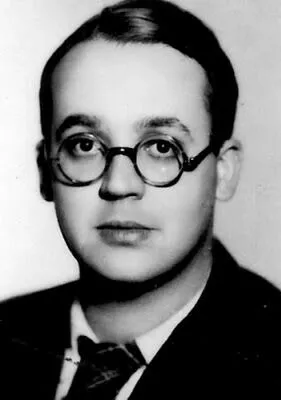
Robert Brasillach
Human Design Chart
Biography
Executed on 6 February 1945, Paris.
The Human Design of Robert Brasillach: Manifestor 2/4
Manifestor 2/4 — Design at a Glance
Robert Brasillach was revealed as a pioneer and visionary whose design predestined him to lead the world into a new future. His character bore traits of an emperor in ancient Rome: He possessed the vision of a great empire, but rather than leading the necessary wars himself, he sent others to conquer foreign lands for him. This superior viewpoint inevitably led to misunderstandings and polarization. As he often thought further ahead than his surroundings, he was loved and followed by some, while others hated or rejected him precisely because of his immense visions.
To find the right followers, it was crucial for Robert Brasillach to inform others about his plans in a timely and precise manner. This strategy of informing served to minimize resistance and foster understanding. If he lived according to this principle and followed his inner authority, his system rewarded him with a sense of internal peace. Ignoring this necessity and acting without prior communication, however, led to an enduring, deep-seated anger within him. This conflict between being rewarded by harmony and punished by wrath formed the core of his energetic experience as a Manifestor.
Emotional Authority
Robert Brasillach's inner authority was characterized by the defined emotional center. This meant that his decision-making did not rely on immediate clarity but rather on a permanent emotional wave, manifesting in constant ups and downs of his feelings. The world appeared to him always colored through his current mood; what had excited him one moment could appear negative the next. Since this feeling was merely a snapshot and not necessarily his deeper truth, spontaneous judgments in his design were often misleading and risky.
The mechanics of his emotional authority required patience and time cycles to gain true insight. Quick decisions based on emotion tended to have negative consequences. Instead, Robert Brasillach needed to reconsider decisions multiple times, until the initial emotional intensity had subsided. Through this process of waiting and distancing himself emotionally, he gained emotional distance. Only when intense feelings had subsided and calmness set in did the necessary clarity emerge. This mechanism was always the leading instance for long-term, life-defining steps, independent of other defined centers in his chart. He had to learn to trust the rhythm of his emotions rather than immediately following them to recognize his true inner truth.
The 2/4 Profile — Hermit / Opportunist
Robert Brasillach's design inclined towards a constant alternation between deep withdrawal and the desire for selective community. As someone with Profile 2/4, the Natural Talent-Networker, he oscillated between the need of Line 2 to be alone to gain internal clarity and the impulse of Line 4 to spend time with trusted individuals. This configuration required clear communication about his availability limits: He had to make it clear when he sought company and when he wanted to remain undisturbed.
During his withdrawal phases, Robert Brasillach immersed himself in his own processes to find peace. Line 2 reacted extremely to interference; persistent disturbance led to a decisive hardness that intimidated intruders, followed by neptunian regret over this sharpness. Once the need for alone time was satisfied, he returned to his network. Line 4 helped him analyze opportunities and build trust, emphasizing contrast rather than conflict. Aggressiveness hindered credibility here. In the quiet of his 'cave', Robert Brasillach then reflected on knowledge from his network, evaluated it, and developed brilliant ideas from it. This cycle of withdrawal for reflection and re-emergence in a circle of familiar people shaped how he dealt with information and relationships.
Single Definition — Defined & Open Centers
Robert Brasillachs Design laid the foundation for consistent willpower and emotional depth that shaped his expression. His defined Heart Center provided a constant energy source for will and self-worth; he acted from a clear "I" and maintained control over his resources. This inner strength flowed directly into his also defined Throat Center, which served as a pivot point for communication. His voice was reliable and clear, guided not by fleeting thoughts but by his firm will. Parallel to this, his defined Solar Plexus functioned as an emotional authority. He possessed a deep, wave-like emotionality that he had to wait out to reach clarity. This combination of Heart and Solar Plexus created an expression that was both strong-willed and emotionally rich, with the truth of his words revealing itself over time.
In contrast, his Head, Ajna, G Center, Sacral, and Root Centers were open. This made him situationally dependent on his environment. His open Head and open Ajna Center allowed him to absorb mental pressure; he tended to engage with questions that weren't his own or sought inspiration from the outside world rather than generating it internally. His identity (open G) was flexible and adapted to the people he interacted with; he found his direction through the initiation of others. Energy-wise, he was vulnerable to overload, as his open Sacral Center amplified foreign vitality, leading to exhaustion if he ignored boundaries. Similarly, his open Root Center absorbed external stress and adrenaline from the environment, causing him to fall into chaos when trying to resolve this non-self-generated pressure through action. His stability thus lay in his will and emotions, while his mind, identity, and energy were strongly influenced by the conditions of his surroundings.
Channels & Gates
Robert Brasillach showed an inner tension between mood-driven openness and will-driven control. His design combined the moody nature of Channel 22-12 with the authoritarian claim of Channel 21-45. Channel 22-12 determined his social interaction through the emotional wave: He was only communicative when he felt like it. This connection between Solar Plexus and Throat allowed him to emotionally touch or provoke others through voice and timing, yet always dependent on his current mood state. If not in the right wavelength, he withdrew or acted harshly.
At the same time, Channel 21-45 shaped his actions through a strong willful claim and the need for material control. This channel connected Heart and Throat with an authoritative voice that took responsibility and managed resources. Robert Brasillach sought independence and the status of being his own boss to maintain his natural rhythm. The conflict between the passive waiting period of his emotional authority and the active, controlling drive of his ego created a dynamic, often contradictory presence.
Additionally, Channel 48-16 promoted his talent development through perfectionism. By connecting Spleen and Throat, he combined intuitive depth with technical skill. He sought life-critical information and perfected skills through repeated practice to achieve mastery. This required recognition and material reward as confirmation of his work. The prioritization of Gates 38 and 39 emphasized a fighting spirit for the preservation of individual integrity as well as an analytical provocation driven by adrenaline. Gates 26 and 40 added that he could sell innovations but always expected rest and ego massage in return for his willful effort.
Circuit Signature
Robert Brasillach's Design inclines towards emotional authenticity paired with rational structure and a drive for material security. In simple terms, he has a continuous energetic flow between the Throat, Solar Plexus, Spleen, and Heart Centers.
The Knowledge Circuit connects his Throat Center to his Solar Plexus Center (Channel 12-22, Openness). This allows for the expression of unique identity through emotional waves, where new insights are communicated impulsively and acoustically – a pulsing energy of the present moment.
Parallelly, the Understanding Circuit operates via Channel 16-48 (The Wave Length) between his Throat and Spleen Centers. Here, emotionless logic prevails: sharing rational, structured insights for future planning, free from conditioning, focused on visual clarity and strategic improvement.
The Ego Circuit completes the connection through Channel 45-21 (The Money Line) between his Throat and Heart Centers. This involves cooperation and resource management: giving and taking in exchange to secure material well-being for the tribe, always mindful of necessary pauses for regenerative rest.
These three circuits shape Robert Brasillach's essence as a unity of individual emotional transformation (Knowledge), cold, future-oriented strategy (Understanding), and traditional, resource-based support (Ego). The tension between the impulsive, melancholic pulse of identity and focused visual logic defines his way of shaping the world and interacting with others.
Right Angle Cross of Tension 1
Robert Brasillach's Human Design profile carried the signature of the right cross of tension 1. This configuration established a fundamental disposition characterized by inner tension and a drive towards dissolution or transformation. It was not about external chaos but rather a deep internal process where old structures were put under pressure to make way for something new.
In Human Design, this cross describes a specific energetic dynamic: the tension arises from the interplay of different centers and channels aimed at change. For Robert Brasillach, it served as the driving force behind his actions and thoughts. It manifested in phases of intense inner work where he questioned existing patterns and reordered them. This tension was not a state of suffering but a mechanism for development. It compelled him to confront the status quo and fostered readiness to take radically new paths.
The energy of this cross demanded movement and progress. Robert Brasillach lived out this dynamic by placing himself in situations that challenged him and expanded his limits. It was a life task to use tension to enforce personal growth. His decisions were often guided by this inner impulse seeking freedom from old bindings. Thus, the tension energy became an engine for change that profoundly shaped his life and made him always seek and embrace the unexpected.
Saturn Return · Uranus Opposition · Chiron Return · 2nd Saturn Return — Life Cycles
Robert Brasillach structurally anchored himself in his late twenties. In 1935, at age 26, he published 'Histoire du cinéma' alongside Maurice Bardèche. This career-relevant milestone marked his first Saturn return, a phase defining long-term roles and boundaries.
The first Saturn return often requires condensing years of groundwork into a viable result. It is a moment of maturity testing where the individual assesses which structures in life should endure. For Robert Brasillach, this was evident through the concrete manifestation of his public work. The publication was not an accidental event but rather an expression of an inner necessity to solidify his position and expertise.
This cycle laid the foundation for further development. Through writing and publishing, he defined himself in relation to the world. The Saturn return acts like a filter: what does not bear fruit is dismantled; what is stable remains. Robert Brasillach used this energy to clarify his life role. His collaboration with Bardèche underscores the social dimension of this anchoring – it was about sharing knowledge and establishing a common platform.
The mechanics of the Saturn return demand discipline and focus. It forces prioritization and concentration on essentials. Robert Brasillach lived up to these demands by bundling his intellectual resources. The result was a work of lasting significance for his career path, confirming his ability to make complex topics accessible while finding his own voice. This step was crucial for his later creative output.
Manifestor · Emotional Authority — Synthesis
Robert Brasillach led a life marked by an inner drive towards design and transformation. As a Manifestor (Design), he possessed the vision to tread new paths and influence others – a role reinforced by the connection of his defined Throat Center with the Solar Plexus Center, channeling emotional energy into expressive power. The profile as a natural talent and networker pointed to an interplay between the need for inner reflection and the desire for exchange, manifesting in his creative process. The openness of Channel 22-12 allowed him to use the emotional wave to express his unique perspective while the Knowledge Circuit fueled the desire for innovation and sharing new insights.
A central paradox in his design lay in the tension between his manifesting authority and emotional depth. While he was destined as a Manifestor to act and initiate, he was subject to an emotional wave that required time and maturity for decisions. This discrepancy led to an internal conflict between the need for immediate implementation of his visions and the necessity to process his feelings – a field of tension visible in his creative work and pursuit of recognition, such as the publication of a work (Saturn return) at age 26.
3 Defined Channels
Incarnation Cross - Right Angle Cross of Tension 1
Solar Return
The Solar Return shows the moment when the sun returns to its exact birth position - your personal solar year.
Life Cycles
Discover the life cycles with a detailed triple view (birth chart, cycle chart, composite).
Human Design Profile
- Type
- Manifestor
- Strategy
- To inform others before acting
- Authority
- Emotional Authority
- Profile
- 2/4 - Hermit / Opportunist
- Definition
- Single Definition
- Incarnation Cross
- Right Angle Cross of Tension 1
- Date of Birth
- 31.03.1909 22:00
- Place of Birth
- Perpignan, France
Frequently Asked Questions
What was Robert Brasillach's Human Design type?
What Profile did Robert Brasillach have in Human Design?
Which Authority guided Robert Brasillach?
What incarnation cross was assigned to Robert Brasillach?
When was Robert Brasillach born?
Discover your own Human Design
Are you also a Manifestor? Find out in a personal reading how to use your initiation power peacefully and dissolve resistance.
More Personalities
Back to overviewAlain-Fournier
Angeli

Christian-Jaque
Juninho

Kesha

Lucebert