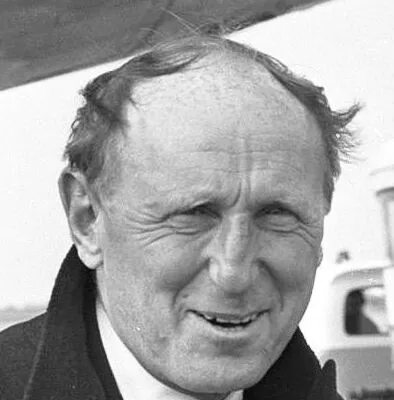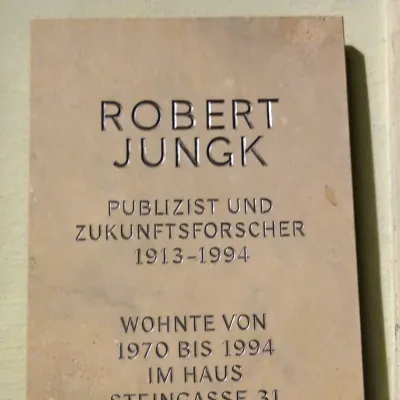
Robert Jungk
Human Design Chart
Biography
Jungk was born into a Jewish family. When Adolf Hitler came to power, Jungk was arrested, released, moved to Paris, then back to Nazi Germany to work in a subversive press service. These activities forced him to move through various cities, such as Prague, Paris, Zurich, during World War II. He continued journalism after the war.
He is also well known as the inventor of future workshop which are a method for social innovation, participation by the concerned and visionary future planning "from below". There is an international library inSalzburg called Robert Jungk Bibliothek fur Zukunftsfragen (Robert Jungk Library for Questions about the Future).
His book Brighter than a Thousand Suns: A Personal History of the Atomic Scientists was the first published account of the Manhattan Project and the German atomic bomb project, and its first Danish edition included a passage which implied that the project had been purposely dissuaded from developing a weapon by Werner Heisenberg and his associates (a claim strongly contested by Niels Bohr), and lead to a series of questions over a 1941 meeting between Bohr and Heisenberg in Copenhagen, Denmark, which was later the basis for Michael Frayn's 1998 play, Copenhagen.
In 1986, he received the Right Livelihood Award.
In 1992 he made an unsuccessful bid for the Austrian presidency on behalf of the Green Party.
Jungk died in Salzburg on 14 July 1994.
Human Design Analysis: Robert Jungk as Projector 2/4
Projector 2/4 — Design at a Glance
Robert Jungk appeared as someone who radiated with a dense, focused aura - comparable to a bright light beam that targeted weaknesses in systems or others. His design as a Projector gave him the ability to immediately recognize where processes were bumpy or in the dark. However, this sharper perception could be perceived unpleasantly if addressed directly and without filters; it often felt like glaring light into another's face, quickly causing resistance.
The appropriate strategy for this configuration was not to push himself actively but to wait for an honest invitation from his environment. By living his own harmony and clarity, he naturally became attractive; others then sought out his advice on their own initiative as they saw him as a source of orientation. Since Projectors do not have a defined Sacral Center, they lack a constant intrinsic energy source. Instead, Robert Jungk experienced phases of high productivity and rapid insight acquisition that necessarily had to be followed by necessary rest periods to prevent burnout. Living in harmony with this rhythm and the wait strategy led him to be rewarded successfully; ignoring these mechanics eventually resulted in the non-self theme of bitterness.
Ego Authority
Robert Jungk carried rare authority within his ego, a configuration only found in Projectors or Manifestors with open Emotional, Sacral, and Spleen Centers along with a defined Ego Center. This structure gave him great openness but also made him vulnerable to distractions from external influences. His inner truth did not lie in the rational mind - often advocating for others' interests in his open centers - but rather in spontaneous will. He had to learn to listen to himself while speaking: The uncensored and spontaneous from his throat aligned with his true nature, whereas deliberate thinking usually served the non-self.
When Robert Jungk did something that truly mattered to him, he showed the necessary willpower to achieve goals and keep promises. This consistent following of his own will could appear selfish outwardly but was essential for him to stand by himself. He always aimed for personal value or reward in his actions - whether material success or the will to surpass limits and be a pioneer on new paths. Leading others into new directions often followed. A central mechanism of his design was the necessity to pause after goal achievement; continuous work without interruption would not have led him to the desired result but rather to unhealthy exhaustion.
The 2/4 Profile — Hermit / Opportunist
Robert Jungk appeared as someone who constantly balanced between the deep need for withdrawal and the urge to connect. His design as a 2/4 Profile ("Natural Talent / Networker") created an inner tension: On one hand, Line 2 (Hermit) called for isolated time to introspect, gain clarity, and reflect on his own processes. On the other hand, he was strongly drawn through Line 4 (Community) to his closest confidants. For him, it was essential to clearly communicate these needs - when he sought company and when he needed solitude - to create a safe environment. During his alone time, he could process knowledge from his network and develop brilliant ideas.
Simultaneously, his design demanded the defense of individuality. The mechanics emphasized that where he was unique, no interference would be tolerated; this served the survival of his personal identity under societal pressure. Particularly pronounced was the drive for revolutionary changes and human rights (fourth line from Gate 49). He felt called to carry his principles outward and find support for these visions. This meant not only preserving personal integrity but actively demanding a 'party program' for social transformation, always seeing the danger that new truths could be perceived as threatening.
Split Definition — Defined & Open Centers
Robert Jungk was characterized by a design that combined conceptual clarity with a strong inner direction. His defined Ajna Center provided consistent, trustworthy mental function; he thought continuously and was difficult to influence from the outside. This intellectual stability flowed directly into his defined Throat Center, allowing him to express what he conceived reliably and clearly. His communication was thus not impulsive reacting but rather an expression of a well-thought-out truth.
Additionally, Robert Jungk had a defined G Center, which gave him a firm sense of self-identity and a clear sense of his life direction. He knew who he was and could support others in their orientation without being dependent on them. His defined Heart Center complemented this by providing available willpower; he could keep promises and control resources, helping him to push forward his visions with determination.
At the same time, Robert Jungk was exposed to several open centers that made him vulnerable to external conditioning. His open Head Center left him without permanent access to inspiration; he tended to be distracted by doubts or foreign questions rather than trusting his inner authority. The open Sacral Center meant that he did not have constant generative energy and risked overextending himself with borrowed energy from others, which could lead to exhaustion. His open Solar Plexus absorbed the emotions of the environment, so he amplified other people's moods and confused them for his own, making decision-making on an emotional level difficult. Furthermore, his open Spleen Center was marked by a fundamental survival fear; it tended to cling to things that offered false security rather than using intuitive wisdom. Finally, his open Root Center absorbed external stress, making him vulnerable to hyperactivity and burnout if he succumbed to this pressure instead of recognizing it as not his own.
Channels for structure, mental order and spiritual breakthrough.
Robert Jungk's design inclined towards a tendency for logical structuring of complex information, paired with a deep drive to translate individual insights into collective reality. His mind was constantly occupied with ordering details into a mental system. The Accepting Channel 17-62 connected his Ajna Center with the Throat Center; he visualized patterns through the Gate of Opinions (17) and translated them via the Gate of Details (62) into language. This created an internal process where only what could be logically integrated into his worldview was considered understood. He had the gift to grasp visual connections as testable theories, but needed to pay attention to timing to avoid resistance.
Parallel to this, the Structuring Channel 23-43 also connected Ajna with Throat Center. Here he received spontaneous breakthroughs through the Gate of Insight (43) and processed them via the Gate of Assimilation (23). His thinking often felt ahead of its time; his challenge was to explain these innovative perspectives clearly enough for collective acceptance. Without the right invitation or timing, his unique knowledge risked being rejected.
Emotionally and energetically, he displayed a competitive nature driven by the Initiation Channel 25-51 in Heart Center. The Shock Gate (51) connected with the Self Spirit Gate (25). He was here to strengthen individualization through competition and 'shock'—both within himself and others. This channel challenged him to live authentically without controlling deep changes, thereby inspiring others towards transcendence.
Additionally, prioritized Gates like Gate 49 (Revolution/Principles) and Gate 4 (Formulation/Future Security) helped clarify suspicious patterns through logical formulas while respecting tribal principles. His presence was marked by Gate 46, emphasizing full dedication to the process and nurturing the body as a temple. Thus, his design united analytical sharpness with a mutative force aimed at elevating consciousness levels.
Individual Circuitry — Circuit Signature
Robert Jungk's design inclined towards structured individual expression strength. He appeared as someone who clearly articulated inner convictions, yet always in service of logical development. This attitude resulted from his shared definition: two energetically isolated groups shaped his essence parallel to each other without direct exchange.
The first group connected Ajna with Throat Center. Here the Knowledge Circuit worked through Channel 43-23 (Structuring). This gave him the ability to translate inner concepts and ideas into orderly, understandable language. Simultaneously, the Understanding Circuit via Channel 17-62 (Accepting) contributed to formulating rational insights and strategic solutions. Both channels flowed into the same expression structure: Robert Jungk could not only think complex connections but also convey them acoustically and structurally precisely.
The second completely separate group connected Identity with Heart Center. Here the Centering Circuit worked through Channel 25-51 (Initiation). This created a deep inner firmness and strong self-worth based on bold personal convictions. Since this group lacked connection to Throat Center, these deep inner forces remained private; they were not directly expressed but served as a silent, stabilizing foundation of his personality.
Thus emerged a person who communicated externally clearly and logically (Ajna-Throat) while his internal substance was carried by a quiet, firm identity (Identity-Heart)—two parallel, non-fusing realities in one chart.
Right Angle Cross of Explanation 2
Robert Jungks Human-Design shows the signature of the right cross of the Manifestation, a configuration aimed at uncovering truths. This structure marked him as someone who not only gathered information but also connected it into a coherent whole to make it accessible to others. It was an energy specifically oriented towards clarifying and making complex connections understandable.
In Human-Design, this cross represents the ability to prepare knowledge in such a way that it can be accepted by the general public. Robert Jungk used this internal mechanism to transform hidden or difficult-to-access insights into forms that promoted discussion and understanding. His life mission was to act as an intermediary between specialized knowledge and the broad audience.
This configuration did not require aggressive enforcement but clear, precise communication. Robert Jungk demonstrated himself in the role of the explainer, ensuring that the message was not only heard but also understood. His design suggested that his greatest impact occurred where he succeeded in translating abstract concepts into tangible, understandable statements. This was no coincidence but a direct result of the optimized energetic structure of his chart for clarity and knowledge distribution. Through this approach, he contributed to making important topics not remain in ivory towers but flow into public discourse.
Saturn Return · Uranus Opposition · Chiron Return · 2nd Saturn Return — Life Cycles
Robert Jungk appeared as someone whose inner structure relied on long-term condensation and structural confirmation. His design indicated a tendency towards sustainable anchoring that unfolded its full effect through years of consistent work rather than spontaneous impulses. This configuration describes a process where internal values and competencies gradually condense over time into a stable foundation that is then also externally recognized.
This mechanism became visible in 1970, at the age of 57: Jungk was appointed Honorary Professor at TU Berlin. For his design, this was a typical moment of the second Saturn return. In this life phase, often set between the ages of 28 and 57 or shortly thereafter, long-term groundwork condenses into a stable result. The appointment to Honorary Professor marked not a sudden new beginning but the official confirmation of an already long-standing internal stance and professional depth. It was the point where private or semi-private work transitioned into a public role anchored institutionally. This structure supported him in presenting his insights not just collecting them, but doing so within a framework that radiated stability and authority. The mechanics of his chart thus promoted no quick, fleeting recognition but deep structural integration of his role into the academic fabric.
Projector · Ego Authority — Synthesis
Robert Jungk was a projector whose life seemed marked by a profound need for recognition and at the same time a desire to withdraw (Profile 2/4). He lived this duality by recognizing the potential in others – a natural ability of projectors to bring light into darkness (Gate 17) – while simultaneously feeling the necessity to internally retreat to gain clarity. This internal processing allowed him to grasp details precisely (Gate 62) and organize them into coherent concepts (defined Ajna Center), which in turn strengthened his ability to understand and communicate complex issues.
A central paradox lay in his authority within the ego: he had to listen to himself while speaking, separating his own truth from external influences. This points to an internal tension between a need for independent thinking (Knowledge Circuit) and openness to external stimuli. The Saturn return in 1970, coupled with a professional change, could have been an expression of this inner process – a phase where he strengthened his individuality and defined his unique path.
3 Defined Channels
Incarnation Cross - Right Angle Cross of Explanation 2
Solar Return
The Solar Return shows the moment when the sun returns to its exact birth position - your personal solar year.
Life Cycles
Discover the life cycles with a detailed triple view (birth chart, cycle chart, composite).
Human Design Profile
- Type
- Projector
- Strategy
- Wait for the respectful invitation
- Authority
- Ego Authority
- Profile
- 2/4 - Hermit / Opportunist
- Definition
- Split Definition
- Incarnation Cross
- Right Angle Cross of Explanation 2
- Date of Birth
- 11.05.1913 10:30
- Place of Birth
- Berlin-Mitte, Germany
Frequently Asked Questions
What was Robert Jungk's Human Design type?
What Profile did Robert Jungk have in Human Design?
Which Authority guided Robert Jungk?
What incarnation cross did Robert Jungk carry?
When was Robert Jungk born?
Discover your own Human Design
Are you also a Projector? Find out in a personal reading how to unfold your leadership qualities and recognize the right invitations.
More Personalities
Back to overviewSissy Spacek

Alain-Fournier

Anémone

Angeli

Ann-Margret

Bourvil