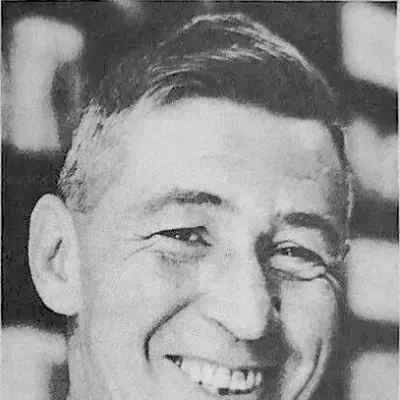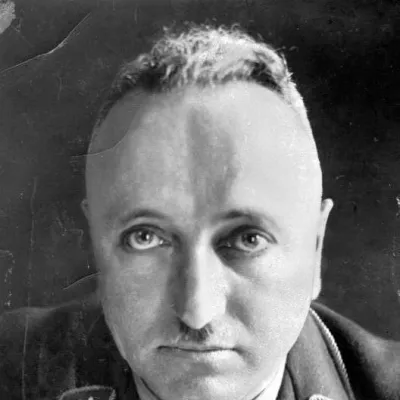
Robert Ley
Human Design Chart
Biography
He committed suicide while awaiting trial in Nurnberg prison, on 24 October 1945.
Human Design Analysis: Robert Ley as Projector 3/5
Projector 3/5 — Design at a Glance
Robert Ley revealed himself as someone with an extremely focused aura that intensely penetrated his surroundings. As a Projector, he did not have a constant internal energy source but acted like a bright flashlight, directing its light precisely onto weaknesses in other people's systems. This mechanism allowed him to immediately recognize errors and inefficiencies. However, this direct confrontation with the shortcomings of others could be perceived as unpleasant or even aggressive, akin to shining a light directly into someone else's face.
His strategy involved waiting for a respectful and honest invitation from his environment rather than acting independently. Due to his undefined Sacral Center, he experienced phases of high activity followed by necessary rest periods for regeneration because he lacked intrinsic life energy. If he did not live according to the principle of recognition and waiting for invitations, bitterness developed as his non-self theme. His design suggested that through his specific perceptual ability, he could guide others if he accepted this role rather than forcing it upon them. This shaped his approach to social interactions and how he exerted influence.
Emotional Authority
Robert Ley displayed a fundamental disposition marked by strong emotional waves. His design featured emotional authority in the defined Solar Plexus Center. This configuration meant that his inner decision-making was always determined by the rhythm of his emotions, regardless of which other centers were defined in his chart. He experienced the world colored by his current mood; enthusiasm could quickly turn into rejection without any change in external circumstances.
For Robert Ley, however, an initial emotional impulse was only a snapshot and not necessarily the deep truth of a matter. Quick, spontaneous decisions made in the heat of emotion often proved problematic for him as they were based on transient states. His strategy involved taking time to let decisions sleep and reconsider them multiple times. By gaining emotional distance, clarity set in once the initial intensity faded and calmness prevailed. This process of emotional maturation was essential for him to make long-term course corrections that significantly influenced his life path. He had to learn to be patient and wait until the emotional waters cleared before acting.
The 3/5 Profile — Martyr / Heretic
Robert Ley's design inclined towards a heroic adventurer and storyteller profile. As a person of Profile 3/5, he initially believed nothing predetermined but had to experience everything himself. This line of the experimenter drove him to gather knowledge through personal practice, including failures. He presented this experiential understanding to others to solve their problems. The Line 5 endows natural attractiveness; others looked up to him as a source of practical wisdom, strengthening his role as a hero. This projection flattered his ego but could be painful if experiments in public failed.
The mechanics of his lines deepened this dynamic. The third line brought resignation and acceptance through a learning process; life appeared as waves without lasting fulfillment. Simultaneously, the fifth line represented power often perceived as arrogance. This apparent overconfidence served as a protective mechanism to maintain the dignity and authority projected onto him by others. If this projection failed or his basis of power felt threatened, it could lead to rejection. Thus, Robert Ley revealed himself as someone who gained his authority through lived experimentation and preserved it with a protective facade of infallibility.
Split Definition — Defined & Open Centers
Robert Ley revealed himself through his Human Design as someone with a fixed, reliable self-identity and a clear sense of direction. His defined G Center gave him an inner security that allowed him to lead others without being dependent on them. This constancy in identity worked together with his also defined Throat Center: His voice was a steady expression of his inner truth and will direction. He did not just speak concepts, but articulated directly his “I” – what he wanted and would do. This created a powerful yet limited form of communication that brought honesty and clarity as long as it was based on his strategy.
His emotional system was characterized by the defined Solar Plexus Center, which acted as his inner authority. Robert Ley was designed to not make decisions in an impulsive moment but to wait for the emotional wave until clarity entered. His feelings were powerful and seductive; they strongly colored the environment. Those close to him felt these waves intensely since his Solar Plexus dominated the emotional atmosphere. Patience here was key to emotional intelligence and proper judgment.
Despite this inner strength in identity, voice, and emotion, he was vulnerable to conditioning in other areas. His open Head Center meant that he did not have a constant mental focus; he tended to engage with questions that were not his or be overwhelmed by doubts when he did not trust his authority. Similarly, his open Ajna Center reflected the concepts and opinions of his environment rather than generating stable theories on its own. This could lead him to feel intellectually insecure or try to hold others' answers as truth for himself.
His open Heart Center also made him vulnerable to having to prove his worth through willpower and promises. Without a constant energy for competitive assertion, he easily fell into spirals of self-disapproval when expectations were not met. His open Sacral Center amplified this dynamic: He absorbed the vital energy and work pressure from his environment, leading to overexertion since he had no natural limits on his availability. The combination of defined, directional identity and these open, conditionable fields created a complex profile where inner security clashed with external mental and energetic pressures.
Channels for focused intuition, presence and sharp logic.
Robert Ley revealed himself as someone who possessed an unyielding drive to question existing patterns and work towards what he perceived as perfection. This attitude was significantly influenced by the Judgment Channel 58-18, which connected his Root Center with his Spleen Center. Here, Gate 58 of Vitality drove a logical impulse to always demand “better and more,” while Gate 18 of Correction checked what was deemed faulty or unhealthy. This created an inner vigilance aimed at guiding the collective into a perfect pattern, often driven by fear of energy waste and a need for order.
Parallel to this, the Awakening Channel 10-20, connecting his G Center with his Throat Center, expressed a strong desire to declare his existence as “I am!” Through Gate 10 of Appearance and Gate 20 of Now, this was less an intellectual realization but rather an expression of self-love and trust aimed at inspiring others through mere presence and clear communication to be themselves. Robert Ley lived in a constant state of awakening, where his survival strategy involved accepting himself and carrying this clarity outward to minimize resistance.
Another defining element was the Recognition Channel 41-30 between Root and Solar Plexus Centers. Gate 41 of Limitation generated a constant pressure and restlessness to collect new experiences while Gate 30 of Feeling Sensing emotionally charged this longing. This resulted in an intense desire for new situations, often accompanied by the expectation that each experience must bring immediate satisfaction. The combination of corrective judgment, urgent awakening, and emotional restlessness shaped Robert Ley’s way of not just observing but actively and often impatiently reshaping the world, driven by a deep inner discomfort with any form of stagnation or imperfection.
Collective Circuitry — Circuit Signature
Robert Ley revealed himself through separate, parallel energetic streams. His defined centers formed two isolated groups: one connecting Throat and Identity Centers, and another triad consisting of Spleen, Root, and Solar Plexus Centers. Between these blocks there was no direct flow; they worked as independent energy fields side by side.
In the Understanding Circuit, the Judgment Channel connected the Spleen with the Root Center. This created a focused rational energy that sought logical structures for future improvement – free from emotional influence. Parallel to this, in the Meaning Circuit, the Recognition Channel between Solar Plexus and Root Center worked on cyclical emotional waves from the past, whose reflections were shared to collectively learn. These two circuits remained energetically separate: the cool ratio of the future did not directly exchange with the emotional past waves.
A third stream, Integration, connected Throat with Identity Centers through the Awakening Channel. This allowed power from reacting to life through intuitive knowledge to be channeled and expressed verbally or action-oriented in the present moment. Since this center pair stood in its own group, this individual self-empowerment was not directly linked with the rational or emotional processes of other centers. Robert Ley’s design thus consisted of three autonomous operational units: strategic rationality, emotional meaning-making, and individual expressive strength, each working for itself.
Right Angle Cross of Contagion 1
Robert Leys Design trug die spezifische Signatur des „Rechten Kreuzes der Ansteckung“. Diese Konfiguration prägte eine Grundhaltung, bei der innere Überzeugungen nicht nur privat gehalten, sondern mit einer fast physischen Intensität nach außen getragen wurden. Es handelte sich dabei um einen Mechanismus der emotionalen und ideologischen Durchdringung: Wer diese Struktur besaß, wirkte auf sein Umfeld wie ein Katalysator für bestimmte Haltungen oder Stimmungen.
Die Energie dieses Kreuzes arbeitete weniger durch rationale Argumentation als vielmehr durch eine Art strukturelle Ansteckung. Robert Ley zeigte sich in diesem Kontext als jemand, der die Fähigkeit besaß, eigene emotionale Zustände und tief verwurzelte Überzeugungen auf andere zu übertragen – oft unbewusst und mit großer Wirkung. Dies geschah nicht primär durch gezielte Propaganda im engeren Sinne, sondern durch eine Art resonanzartige Ausstrahlung, die das Umfeld miteinbezog.
Die Mechanik dieses Kreuzes legte nahe, dass Robert Ley in Gruppen oder Systemen dazu neigte, eine zentrale Rolle bei der Verbreitung und Verfestigung bestimmter kollektiver Haltungen einzunehmen. Seine Präsenz konnte dabei wirken wie ein Impulsgeber, der latente Tendenzen im Umfeld aktivierte und verstärkte. Dies bedeutete nicht zwangsläufig bewusste Manipulation, sondern beschrieb eine energetische Dynamik, bei der die Grenze zwischen individuellem Empfinden und kollektiver Stimmung fließend wurde. Robert Ley lebte in einem Design, das solche Übertragungsprozesse strukturell begünstigte und sie zu einem prägenden Merkmal seines Auftretens machte.
Saturn Return · Uranus Opposition · Chiron Return — Life Cycles
Robert Ley zeigte eine Struktur, die auf expansive, oft disruptive Kräfte reagierte. Sein Uranus-Aspekt wirkte als Katalysator für plötzliche Veränderungen und den Bruch mit etablierten Strukturen. Dies schlug sich 1930 nieder: Im Alter von 40 Jahren erhielt Ley einen Sitz im Reichstag. Dieser Karriereimpuls entsprach der Mechanik einer Opposition, die durch äußere Schocks oder revolutionäre Momente aktiviert wird und raschen Aufstieg ermöglicht, wenn man diese Energien nutzt.
Später trat ein anderer Rhythmus in Kraft: Der Chiron-Return um das 50. Lebensjahr markierte im Human Design den Punkt höchster Entfaltung des Inkarnationszwecks. Es handelte sich nicht um Heilung, sondern um die Blüte der eigenen Bestimmung. 1940 wurde Ley zum Reichskommissar für den sozialen Wohnungsbau ernannt. Diese Position spiegelt die Vollendung jener spezifischen Lebensaufgabe wider, die sein Chart vorgegeben hatte. Die Ernennung war kein Zufall, sondern das sichtbare Ergebnis eines Zyklus, in dem sich seine innere Architektur nach außen hin vollständig auslebte. Beide Ereignisse – der politische Einmarsch und die spätere administrative Machtübernahme – illustrieren, wie astrologische Zyklen konkrete Lebensstationen bestimmen können, sofern sie mit der individuellen Konfiguration übereinstimmen.
Projector · Emotional Authority — Synthesis
Robert Ley war ein Projektor, dessen Leben von einem tiefen Bedürfnis geprägt zu sein schien, Muster zu erkennen und diese anderen zugänglich zu machen. Die Fähigkeit, schnell Fehler im System (Gate 11) aufzudecken, verbunden mit der emotionalen Welle (Emotionale Autorität), deutet darauf hin, dass er die Dynamik anderer intensiv wahrnahm und in seinen Bewertungen pendelte – ein Prozess, der durch das Erwachen-Kanal verstärkt wurde, indem er Prinzipien erkannte und transformierte. Dieses Erkennen von Mustern und die daraus resultierende Notwendigkeit, Wissen weiterzugeben (Profile 3/5), bildete einen roten Faden, der sich in wiederholten beruflichen Wendungen zeigte, wo er offenbar Erfahrungen sammelte und diese anderen präsentierte.
Zentral für Robert Ley war jedoch ein Paradox zwischen dem Bedürfnis nach Anerkennung als jemand, der Lösungen anbietet, und der Art und Weise, wie er dies tat. Als Projektor benötigte er die Einladung, sein Wissen zu teilen, doch das definierte Herz-Zentrum deutete auf einen starken Ausdruck des eigenen Willens hin – ein potentieller Konflikt zwischen dem Bedürfnis nach Bestätigung und der direkten Ansprache von Problemen. Die Urteilsfähigkeit (Kanal 18/58) im Verstehen-Schaltkreis verstärkte die Tendenz, logische Erkenntnisse zu teilen, während das rechte Kreuz der Ansteckung darauf hindeutete, dass seine Wahrnehmungen und Bewertungen stark auf andere wirkten.
3 Defined Channels
Incarnation Cross - Right Angle Cross of Contagion 1
Solar Return
The Solar Return shows the moment when the sun returns to its exact birth position - your personal solar year.
Life Cycles
Discover the life cycles with a detailed triple view (birth chart, cycle chart, composite).
Human Design Profile
- Type
- Projector
- Strategy
- Wait for the respectful invitation
- Authority
- Emotional Authority
- Profile
- 3/5 - Martyr / Heretic
- Definition
- Split Definition
- Incarnation Cross
- Right Angle Cross of Contagion 1
- Date of Birth
- 15.02.1890 19:00
- Place of Birth
- Much, Germany
Frequently Asked Questions
What was Robert Ley's Human Design type?
What Profile did Robert Ley have in Human Design?
What authority did Robert Ley possess?
What incarnation cross did Robert Ley have?
When was Robert Ley born?
Discover your own Human Design
Are you also a Projector? Find out in a personal reading how to unfold your leadership qualities and recognize the right invitations.
More Personalities
Back to overviewSissy Spacek
Alain-Fournier
Anémone
Ann-Margret

Bourvil
Hergé