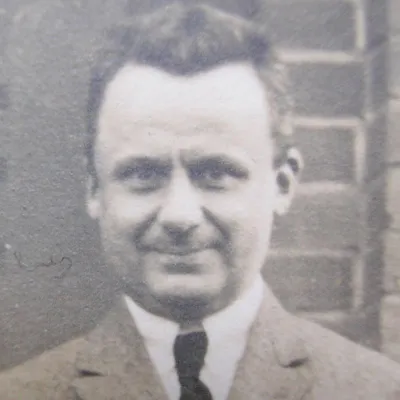
Robert Pohl
Human Design Chart
Biography
He died on 5 June 1976, aged 91, in Göttingen, West Germany.
Human Design Analysis: Robert Pohl as Projector 6/2
Projector 6/2 — Design at a Glance
Robert Pohl appeared as a Projector with a dense, focusing aura. His design inclined him to precisely penetrate other people and immediately identify their blind spots. Similar to a bright flashlight, he cast his beam of light directly onto areas in the environment that were still dark or not functioning properly. This ability to instantly pinpoint errors in the system could be counterproductive if he addressed these flaws right away. The person on the receiving end often finds this uncomfortable, much like being blinded by harsh light.
A more effective strategy for Robert Pohl was not to actively illuminate but to shine harmoniously himself. By living his own relationships or work methods, he became naturally attractive. Others would then come to him of their own accord and ask about his insights. His central life task was to wait for a respectful invitation from others before sharing his knowledge.
Since his Sacral Center was undefined, Robert Pohl did not have a constant intrinsic energy source. Instead, he experienced phases of high activity followed by necessary rest periods for regeneration. Ignoring this rhythm quickly led to exhaustion. Living according to the strategy of waiting and being invited rewarded him with success. If he missed this path and tried to impose his insights, his non-self theme would eventually manifest: bitterness over not being recognized for his leadership abilities.
Splenic Authority
Robert Pohl demonstrated decision-making based on a subtle, spontaneous inner impulse. His inner authority lay in his defined Spleen Center, which shaped his life direction through an acute survival intelligence. With his Emotional and Sacral Centers open, he belonged to the Projectors or Manifestors who can carry this specific authority. The Spleen Center served as his health and alarm system; it provided him with immediate physical signals about whether a situation, environment, or society was right for him.
This instinct was subtle and only appeared once in the present moment. It required Robert Pohl to maintain high vigilance so that this initial impulse would not be drowned out by external influences. Decisions had to be made in the here and now; the spontaneous trigger directly served his well-being and allowed him to rigorously distance himself from harmful factors. Since his knowledge of what was right was always only available in the moment, his plans often changed short-term. Long-term commitments were difficult for him; he needed instead a lot of freedom and flexibility. A temporary retreat could help him hear this subtle voice more clearly and not ignore it.
The 6/2 Profile — Role Model / Hermit
Robert Pohl emerged as someone who learned through trial and error in his youth. His Profile 6/2 initially appeared like a 3-line: He experimented with various roles and withdrew after setbacks to gather experience. This phase of experimentation shaped his early years before he delved deeper.
With the inward retreat typical for the activation of the 6-line around age thirty, his focus shifted. He sought distance from earlier experiments to reflect on them from a higher perspective. This period of deep introspection served healing and self-knowledge. From this 'cave', he developed wisdom that he later made accessible to others.
Central to his style of leadership was the theme of power distribution. Instead of exercising classical authority, he learned to delegate responsibility fairly. This aligned with his role as a 'role model' for leadership not through dominance but through the ability to distribute tasks justly.
At the same time, his design emphasized the necessity of self-defense of individuality. Where he was unique, he tolerated no interference. He recognized that insisting on one's truth is often perceived as dangerous and thus clear boundaries must be set to secure one's survival – in terms of preserving identity. This balance between sharing wisdom and protecting the individual core characterized his essence.
Split Definition — Defined & Open Centers
Robert Pohl demonstrated a robust, constant mental foundation and clear self-determination. His defined Ajna Center gave him a consistent way of conceptual thinking; he processed data and concepts always according to the same trustworthy patterns, regardless of external influences. This mental stability flowed directly into his defined Throat Center, allowing him to express what he thought reliably. His voice was thus a dependable expression of his inner conception.
Parallel to this, Robert Pohl had a firm identity and willpower. His defined G Center gave him a clear sense of direction and love for himself, while the defined Heart Center provided him with the necessary energy to keep promises and actively shape his life. He was able to take responsibility for his resources and act from a position of inner strength. This was complemented by a defined Spleen Center, which allowed him an intuitive, immediate perception of health and well-being; he could listen spontaneously to his body and make decisions that served his survival.
Despite this strong internal structure, Robert Pohl was open in other areas to external influences. His open Head Center made him susceptible to mental pressure and doubt when trying to find answers not coming from himself. He tended to identify with others' questions or get lost in the whirlwind of confusion rather than trusting his inner authority. Similarly, his open Sacral Center absorbed the energy and expectations of his environment, which could easily lead to overexertion as he did not always know when enough was enough. His open Solar Plexus took on emotional waves from others, causing him to swing between joy and sadness without always recognizing these feelings as their own. Additionally, his open Root Center was sensitive to external stress; he often amplified the pressure of his environment, which could set him into a state of restlessness if he did not learn to release or use this adrenalized impulse purposefully.
Channels for breakthrough, intuitive clarity and structured insight.
Robert Pohl showed himself to be someone who combined intuitive knowledge with structured clarity. His design tended towards spontaneous insights that he communicated precisely. The Channel Flash of Insight 57-20 connected his Spleen Center (Intuition) directly with the Throat Center (Expression). This allowed him to articulate deep self-awareness and the awareness 'I know I am alive now.' He could encourage others to awaken their survival intelligence by acting and speaking in the moment without lengthy deliberation.
Parallel to this, the Channel Structuring 43-23 linked his Ajna Center (Mind) with the Throat Center. This gave his mental insight form: he could explain innovative perspectives and new ways of thinking so that others would adopt them. His thinking often felt far ahead; he had to learn to present his unique ideas simply, so they were not rejected as foreign but promoted efficiency.
Another aspect was the Channel Initiation 51-25 in the Heart Center. This connected ego-driven competitive energy with the spirit of self and universal love. Robert Pohl possessed the potential to initiate individuation through 'shocks' or challenges—both for himself and others when invited. This fostered an evolutionary leap from collective 'we' to individual 'I'.
Additionally, prioritized gates like Gate 13 (Continuity and Memory) and Gate 7 (Leadership Perspective) contributed to his way of reflecting experiences in a temporal context and projecting patterns for the future. His ability to discriminate between life-critical corrections (Gate 18) helped him focus on what was essential. Overall, these connections shaped someone who acted intuitively, clearly structured, and through competition promoted personal development.
Individual Circuitry — Circuit Signature
Robert Pohl's design tended towards inner strength and individual identity, shown by separate energetic poles. As a person with Split Definition, his system consisted of two non-directly connected groups: on one side the Throat, Spleen, and Ajna Centers; on the other side the Heart and Identity Centers. This separation meant that creative impulses and internal convictions worked as parallel, independent forces without forming a single continuous flow.
The Knowledge Circuit in Robert Pohl was linked through Channels Structuring (43-23) and Flash of Insight (57-20), connecting Ajna, Throat, and Spleen Centers. This shaped a pulsating, acoustic energy aimed at innovation and the expression of new insights. The connection allowed creative ideas from the mind to be directly articulated into words, supported by the intuitive perception of the Spleen.
Parallel to this, the Centering Circuit worked through Channel Initiation (25-51), linking the Heart with the Identity Center. This configuration promoted solid personalities with strong internal convictions and self-esteem. However, without a connection to the Throat Center, these deep convictions often remained unspoken or hard to articulate in words. Robert Pohl thus showed himself as someone who possessed inner strength but primarily carried it in private or individual contexts, while external communication was more influenced by the creative impulse of the Knowledge Circuit.
Left Angle Cross of Masks 2
Robert Pohl had the Human-Design 'Left Mask Cross'. This configuration created a specific internal tension arising from the interplay of self-perception and external expectations. The design described a person often caught between the desire for authentic self-expression and the necessity to adopt societal roles or 'masks' to be accepted. It was not hypocrisy in a moral sense, but rather a profound psychological mechanism: Robert Pohl had to learn which facade he wore to find protection, and where his true identity remained hidden. This cross-configuration shaped his life through constant confrontation with the question of who he really was compared to how others saw him. The energy of this design challenged him to integrate this duality rather than completely hiding behind a role or exposing himself without protection. It was a path of self-discovery through analyzing his own projections and the reactions of those around him. Robert Pohl's chart thus showed a life task that lay in conscious navigation between privacy and public life, without losing his true essence or fully conforming.
Saturn Return · Uranus Opposition · Chiron Return · 2nd Saturn Return — Life Cycles
Robert Pohl's life unfolded in clear, structured phases marked by planetary cycles. At age 28 in 1912, he received his Habilitation – a classic Saturn Return moment where years of academic groundwork condensed into a stable professional foundation. This cycle established his disciplinary authority and laid the groundwork for his further work.
Ten years later, in 1922 at age 38, Robert Pohl married Tussa Madelung. This fell during the Uranus Opposition, a phase of detachment and reorientation often leading to fundamental life decisions. The marriage signaled not only personal commitment but also stabilization in his private sphere as an opposite pole to scientific activity.
In 1930 at age 46, he published 'Mechanics and Acoustics'. This corresponded with the Chiron Return, a fulfillment cycle where inner calling and life's work increasingly unfolded outward. The publication was not mere coincidence but expressed a mature professional bloom, making his specific contribution to physics clearly visible.
The second Saturn Return appeared in 1941 with the publication of the third volume 'Optics'. At age 57, Robert Pohl consolidated his scientific legacy. This cycle emphasized the durability and structural value of his work by preserving it in a comprehensive form that went beyond pure research results and served as reference.
Projector · Splenic Authority — Synthesis
Robert Pohl was a projector whose life was marked by a deep ability to recognize potential and weaknesses in his environment (Gate 57/20). His intuitive perception, fueled by his defined Spleen Center authority, allowed him direct access to truth and profound self-knowledge. His knowledge drew from an inner source that he communicated directly in the present moment – a process that encouraged others to discover their own inner wisdom (Knowledge Circuit). The recurring successes in his career (Saturn Returns and Chiron Return) were expressions of this ability to generate innovative insights and pass them on through his work.
A central paradox lay in Robert Pohl being destined to bring 'light into the darkness' for others, yet his projecting nature could also potentially meet resistance. His profile as a role model (6/2 Line) suggests he had to accumulate many experiences before stepping into the role of wise advisor – a process marked by phases of intense reflection and withdrawal. This tendency towards detachment stood in tension with his natural gift for making connections and pointing others toward their potentials.
3 Defined Channels
Incarnation Cross - Left Angle Cross of Masks 2
Solar Return
The Solar Return shows the moment when the sun returns to its exact birth position - your personal solar year.
Life Cycles
Discover the life cycles with a detailed triple view (birth chart, cycle chart, composite).
Human Design Profile
- Type
- Projector
- Strategy
- Wait for the respectful invitation
- Authority
- Splenic Authority
- Profile
- 6/2 - Role Model / Hermit
- Definition
- Split Definition
- Incarnation Cross
- Left Angle Cross of Masks 2
- Date of Birth
- 10.08.1884 01:00
- Place of Birth
- Hamburg, GER
Frequently Asked Questions
What was Robert Pohl's Human Design type?
What Profile did Robert Pohl have in his chart?
What Authority did Robert Pohl have?
What incarnation cross did Robert Pohl have?
When was Robert Pohl born?
Discover your own Human Design
Are you also a Projector? Find out in a personal reading how to unfold your leadership qualities and recognize the right invitations.
More Personalities
Back to overviewSissy Spacek

Alain-Fournier

Anémone

Ann-Margret

Bourvil
Hergé