Robert van de Walle
Human Design Chart
Biography
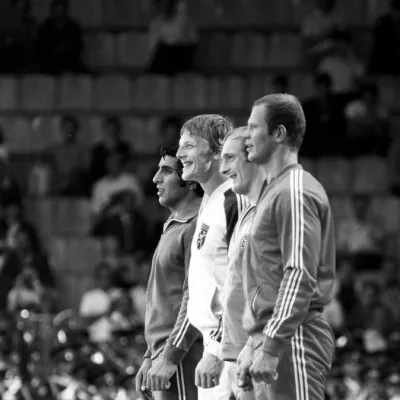
He won Gold at Moscow in 1980, Bronze at Seoul 1988. He has won medals also at the World Championships in 1979, '81, '83, '85 and '89 as well as Bronze, Silver and Gold medals at the European championships every year from 1976 to 1988 with the exception of 1982. He was Belgian sportsman of the year for 1981.
Human Design Analysis: Robert van de Walle as Generator 5/1
Generator 5/1 — Design at a Glance
Robert van de Walle revealed himself as someone whose strength stems from a deep, sacral endurance. His design points to a tendency towards great constancy, comparable to a workhorse that provides enormous energy – provided it is used for tasks that truly resonate with him. This energy source, however, is not an unlimited reserve that can simply be tapped into, but it unfolds through a specific interaction with the environment.
The mechanics of his Generator type define 'Reacting' as the central strategy. Robert van de Walle was programmed to not take the first step himself, but to wait for signals from life. When his sacral center – often felt as gut feeling or inner enthusiasm – clearly said 'yes', he could respond with full power. This is the crucial difference from other types: Here, efficiency does not lie in initiative but in the resonant response to external impulses.
Living in harmony with this principle led to a deep sense of fulfillment. However, when he went against this nature by initiating things he had no inner desire for, or when he was prevented from pursuing his heart's project even though the energy was still there, frustration loomed. The danger lay in wasting energy on inappropriate tasks, which could quickly lead to exhaustion. His path to satisfaction therefore consisted of patiently waiting for the right impulse and then consistently acting.
Emotional Authority
Robert van de Walle showed an internal decision-making structure based on patience and temporal distance. His inner authority lay in the defined Solar Plexus Center, the emotional authority. This mechanism means that his perception of the world was always colored by his current mood. In one moment, he could be enthusiastic about something, in the next, he could negatively evaluate the same situation. This emotional ups and downs are characteristic of this configuration.
A crucial aspect of his design was the rule that the Solar Plexus Center always takes precedence over other defined centers, regardless of further features in the chart. However, his current feelings were only initial impressions, not necessarily his deeper truth. Quick, spontaneous decisions based on impulsive emotions could therefore have negative consequences.
Instead, his clarity only emerged after a maturation process. The more time he took, the more comprehensively he could perceive situations. This required him to review decisions multiple times and sleep on them. Over time, the intense feelings smoothed out, he gained emotional distance, and calmness set in. This process was particularly crucial for long-term, life-defining decisions, as only then did his true inner voice come to the fore.
The 5/1 Profile — Heretic / Investigator
Robert van de Walle revealed himself through Profile 5/1 as someone who gathers deep knowledge to offer others for problem-solving. Line 1 drove him to engage intensively with topics and build a solid knowledge base. Simultaneously, Line 5 radiated a magnetic aura that attracted people seeking solutions, making Robert van de Walle often perceived as an expert willing to share his insights.
However, this dynamic also carried risks. Without clear boundaries, the constant demand for advice and help could lead to exhaustion, similar to a scientist drained after long conferences and confronted with further inquiries. The mechanics of Profile 5/1 emphasize the importance of time-limited contributions and withdrawal to maintain personal energy. Robert van de Walle learned to say no to maintain the balance between research for himself and support for others.
Collaborating with stronger forces, as suggested by Line 1 and Gate 55, was significant for his spiritual growth. By aligning his activities with principles and seeking long-term support, he could optimally utilize his gifts while maintaining his boundaries. This allowed him to make a sustainable contribution without overloading himself.
Triple Split Definition — Defined & Open Centers
Robert van de Walle was marked by a design characterized by constant mental pressure and profound emotional intelligence. His defined Head and Ajna Centers generated a continuous inspiration that shaped questions without immediately answering them. This state required patience, as there was no direct energy available to implement thoughts; attempting to act on ideas immediately led to frustration. Instead, he acted as a source that encouraged others to think.
At the same time, he possessed a reliable inner identity through his defined G Center, which gave him a secure sense of his own direction. This self-love allowed him to show others new paths without being dependent on their approval. His ability to act stemmed from his defined Sacral Center, which generated immense vital energy. Crucial here was the reaction: Only responding to invitations, rather than initiating himself, ensured the necessary strength for long-term satisfaction and prevented exhaustion.
Emotional clarity was his compass. The defined Solar Plexus Center as an inner authority required waiting for the emotional wave before making decisions. Impulsive reactions to highs or lows of mood were avoided to recognize deeper truths. This was supported by the defined Spleen Center, which provided intuitive, spontaneous judgments in the here and now, as well as the defined Root Center, which provided a constant pressure for forward movement and survival.
In contrast, his openness in the undefined centers revealed his vulnerability to conditioning. The open Throat Center tended to feel pressured to demand attention through constant speaking, rather than waiting for natural invitations. The open Heart Center was not designed for willpower or competition; the attempt to prove his worth through promises or performance led into a cycle of disappointment. The wisdom of his design lay in recognizing these mental and willful traps and instead relying on his sacral response and emotional clarity.
Channels for logic, intimacy, self-expression and ambition.
Robert van de Walle was marked by a mind that used skepticism as a tool to examine patterns before accepting them. The Channel of Logic 63-4 connected Head and Ajna, making doubt serve as a filter to formulate only consistent truths. This logical rigor stood in contrast to his deep emotional intensity. The Channel of Union 59-6 linked Sacral and Solar Plexus, creating a strong desire for intimacy and merging that required patience, as the emotional wave needed time to create clarity.
His actions were marked by a drive for self-confirmation and independence. The Channel of Exploration 34-10 connected Sacral and G Center, linking inner strength with the acceptance of his own identity. This allowed him to remain authentic without being led by external expectations. Simultaneously, the Channel of Transformation 54-32, linking Root and Spleen, drove him. Here, ambition, driven by the fear of failure, combined with the search for talent and continuity, to secure his position and prove himself through consistency.
Additionally, Gates supported these dynamics: Gate 8 promoted contribution to the group, Gate 14 handled power with grace, and Gate 55 brought emotional awareness. Gate 58 provided humor under pressure, Gate 15 for adaptation to rhythms, and Gate 28 for decisions in the here and now. Gate 61 sought inner truth, Gate 37 for friendship, Gate 44 for vigilance, and Gate 53 for freedom for new cycles. This configuration described a person who logically examined, emotionally deeply connected, remained true to himself, and ambitiously progressed.
Tribal Circuitry — Circuit Signature
Robert van de Walle was marked by his design as someone who combined inner strength with strategic clarity, separate from a drive-driven adaptability. His Triple Definition meant that three independent energetic systems worked in parallel without directly flowing into each other.
In the Centering Circuit, the Channel of Exploration connected the Sacral with the Identity Center. This created a direct line between life force and the core of the self, leading to solidified convictions and a strong individuality. Since there was no connection to the Throat Center, these inner truths often remained unsaid.
Parallel to this, the Understanding Circuit worked. Here, the Channel of Logic connected the Head with the Ajna Center. This allowed a focused, rational analysis of situations, free from emotional coloring, to draw logical conclusions for the future.
The third system formed the Ego Circuit. The Channel of Transformation connected the Spleen with the Root Center. This generated an instinctive, transformative energy aimed at survival and resource preservation, but without the constant power of the Sacral Center, which required regular rest phases.
Additionally, the Archer Circuit worked. The Channel of Union connected the Sacral with the Solar Plexus Center. This generated primal, emotional energies of protection and care, but remained energetically separate from the logical analysis and individual identity. Robert van de Walle thus navigated between these three separate power fields: inner identity, rational strategy, and instinctive protection.
Left Angle Cross of Uncertainty 1
Robert van de Walle revealed himself through a fundamental disposition that did not rely on external security or predictable outcomes. His design inclined him to move continuously in states of uncertainty without this being seen as a flaw or mistake. This configuration, known as the left cross of uncertainty 1, describes a specific energetic structure that focuses on the unknown. It is not mere confusion but a deeper orientation towards processes whose outcome cannot be predetermined.
For Robert van de Walle, this meant that his strength did not lie in controlling environments but in handling open questions and unpredictable developments. The mechanics of this design require accepting the state of uncertainty as a natural space where new possibilities can unfold. Those who try to eliminate this indeterminacy prematurely through rigid plans or coercion risk blocking the true dynamics of their character. Instead, a disposition that trusted the flow of events, even if it had no clear boundaries, characterized him. This inner readiness to face the unknown without immediately defining it formed the foundation of his personal expression and approach to challenges. It was a way of seeing the world not as a fixed puzzle but as a living process that constantly required adaptation and attention.
Saturn Return · Uranus Opposition · Chiron Return · 2nd Saturn Return — Life Cycles
Robert van de Walle showed himself in his athletic peaks as someone whose design revealed its true resilience under extreme pressure and in moments of apparent defeat. This was evident in 1981 when, at the age of 27, he lost in the World Championship final but won the bronze medal. For his Human Design, this was not a failure but his first Saturn Return: a cycle where years of often invisible groundwork condenses and lays a structural foundation for the future. The crisis of non-firstness marked here the transition from development to established presence.
A similar pattern repeated in 1992 when, at the age of 38, he placed seventh at the Olympic Games. This fell into the Uranus Opposition, a phase in Human Design considered a profound inner restructuring. Instead of conforming to external expectations, this cycle demands breaking free from outdated patterns. That Robert van de Walle did not reach the peak but secured a position outside the medal ranks in this period reflects the mechanical truth: the Uranus Opposition serves not to affirm the status quo but to necessitate a break. It prepares the ground for a new, more authentic expression by consciously letting go of what no longer serves. Both events were not deviations from his path but precise expressions of his inner architecture.
Generator · Emotional Authority — Synthesis
A central red thread in this design is the deep connection between energy, learning, and the need to share this knowledge. The sacral energy of the Generator (Design View) is channeled through the defined Head and Ajna Centers (Centers, Channels/Gates) into a continuous process of inspiration and questioning. This inner drive to recognize and formulate patterns (Logic Channel) culminates in the role of the Hero/Researcher (Profile Role), who makes their knowledge available to others. The recurring crises in the cycles, such as the experience in the World Championship final (Saturn Return) and the placement at the Olympic Games (Uranus Opposition), seem to reflect this intense engagement with his performance and the pursuit of perfection.
Simultaneously, a paradox is revealed between the inner pressure to constantly learn and question (defined Head/Ajna, Logic Channel) and the emotional authority (Authority) that requires time and maturity for decisions. The quick inspiration and doubt that arise in the Head Center stand in tension with the necessity to experience and validate feelings before acting. This creates a dynamic between the need for immediate understanding and the realization that true clarity requires time – a tension that can lead to profound knowledge as well as inner dissonance.
4 Defined Channels
Incarnation Cross - Left Angle Cross of Uncertainty 1
Solar Return
The Solar Return shows the moment when the sun returns to its exact birth position - your personal solar year.
Life Cycles
Discover the life cycles with a detailed triple view (birth chart, cycle chart, composite).
Human Design Profile
- Type
- Generator
- Strategy
- To respond - wait for something to respond to
- Authority
- Emotional Authority
- Profile
- 5/1 - Heretic / Investigator
- Definition
- Triple Split
- Incarnation Cross
- Left Angle Cross of Uncertainty 1
- Date of Birth
- 20.05.1954 16:00
- Place of Birth
- Ostende, BEL
Frequently Asked Questions
What is Robert van de Walle's Human Design type?
What profile does Robert van de Walle have?
What authority does Robert van de Walle have?
What incarnation cross does Robert van de Walle have?
When was Robert van de Walle born?
Discover your own Human Design
Are you also a Generator? Find out in a personal reading how to use your sacral energy correctly and discover deep satisfaction.
More Personalities
Back to overviewAaliyah

Aldair

Alexia
Angèle

Anne-Marie

Arcángel