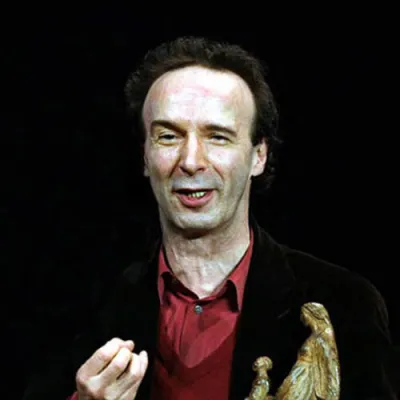
Roberto Benigni
Human Design Chart
Biography
The idea for "Life is Beautiful" came from Benigni's dad, Luigi, now 80, as he was imprisoned in Bergen-Belsen concentration camp for two years after the German-Italian alliance collapsed; he was liberated in 1945 weighing only 90 lbs. Amidst poverty and hardships, the senior Benigni taught his kids to see the bright side and the humor of situations. Luigi worked odd jobs, farmer, carpenter, bricklayer, while Roberto's mom worked at home inspecting fabric. Their home had no water or electricity and the boy shared their one bed with his parents and three older sisters.
As a kid, he loved the movies where he discovered his inspiration, Charlie Chaplin. Benigni carried an encyclopedic knowledge of cinema all his life. After high school, he considered the priesthood, attending seminary in Florence. When the school closed due to a flood, he never returned. He went instead to learn accounting in Prato, studying theater in his spare time. At 20, he went to Rome, making a name as a stand-up comic and storyteller, moving to films in 1977.
Benigni directed and starred in the comedy "Johnny Stecchino" in 1991, which became one of the highest-grossing films in Italian history. That year he married Braschi, whom he had met in the early '80s while she was studying theater in Rome. They have worked well together ever since. They hope to have kids in the future and at present, have an apartment in Rome.
Roberto Benigni as a Projector 3/5 in Human Design
Projector 3/5 — Design at a Glance
Roberto Benigni's Human Design shows a tendency towards a dense, focusing aura that immediately recognizes systemic errors. He is someone who, like a bright flashlight, sheds light on dark corners and illuminates the path for others. This mechanism means: Projectors project their energy onto the environment and quickly see what doesn't work in others. However, direct criticism would provoke rejection, comparable to a glaring beam of light into someone's face.
Instead, it was more elegant to attract through his own harmonious glow. When Roberto Benigni demonstrated harmony himself, others automatically came to him seeking advice. The best strategy was to wait for appreciative invitations rather than forcing his way in. This led to recognition, while ignoring this strategy resulted in bitterness as a non-self consequence.
Especially relevant was his undefined Sacral: It did not provide a constant intrinsic energy source. Instead, he experienced phases of high productivity followed by necessary rest periods for regeneration. The school system and many jobs often do not respect this need, increasing the risk of burnout. Living according to this design – through restraint until invitation and respecting his energy cycles – rewarded him with success. The danger of bitterness arose when he tried to force systems that did not acknowledge his need for breaks. His path lay in attracting rather than pushing; in glowing rather than illuminating others' errors directly.
Splenic Authority
Roberto Benigni showed a tendency towards spontaneous, intuitive decision-making where the initial impulse was decisive. His design established that inner authority stems from the defined Spleen Center – a center functioning as a health and alarm system. This configuration grants fine survival intelligence: A spontaneous inner knowledge signaled immediately whether a situation or environment was beneficial for health and well-being.
For Roberto Benigni, this meant decisions had to be made in the immediate moment. The initial impulse served as a reliable compass; boundary setting against harmful influences thus occurred rigorously and instinctively. Since this signal is fine and only appears once, his mechanism required high vigilance not to miss it or dilute it through subsequent rumination.
A key aspect of his design was difficulty with long-term planning. The right thing could only be recognized in the moment, so priorities could change short-term. This created a need for great flexibility and freedom; rigid commitments or inflexible structures would have contradicted his natural dynamics. Instead, he worked best when he could act spontaneously and make few commitments to follow the intuitive guidance of the Spleen Center unimpeded.
The 3/5 Profile — Martyr / Heretic
Roberto Benigni's design revealed him as someone who gained knowledge not from books but through direct, often risky experimentation. His Profile 3/5, that of an experimenter and hero, established a basic attitude: He initially believed nothing and had to experience everything himself. This Line 3 drove him to take adventures and risks to achieve personal goals – a process that over time became more rational due to Saturn influence but always based on practical experience.
These accumulated experiences made him attractive to others. Line 5 projects a heroic role and leadership competence onto him, although he often did not actively seek this ambition. Others saw in him someone who knew solutions out of necessity and could share them. Yet, this projection carried a risk: Failure happened publicly. When his experiments failed before the collective's eyes, the hero role was painfully disappointed. The tension thus lay between the inner compulsion to learn through risk-taking and the external expectation to act as a competent leader. He did not lead out of power hunger but because the collective sought his practical solutions – a role he earned through constant testing and making mistakes.
Split Definition — Defined & Open Centers
Roberto Benigni revealed himself through a stable foundation of existential urgency and clear identity. His defined Root Center provided constant pressure to overcome obstacles and correct material non-functioning. This energy flowed into his defined Throat Center, making communication and actions serve transformation rather than being arbitrary. Simultaneously, the defined G Center gave him a reliable self-identity; he did not need external validation for his sense of lovability but radiated inner security. The also defined Spleen Center ensured spontaneous, intuitive judgments in the present moment that strengthened his well-being and immune system.
This structure meant that his manifestation was always driven by a deep survival instinct rooted in self-love. He did not act out of emotional wavering or mental confusion as his Solar Plexus, Head, and Ajna Centers were open. Open centers are vulnerable to conditioning: the open Solar Plexus Center tended to absorb and amplify foreign emotions, leading to uncertainty if identified with them. The open mental centers (Head/Ajna) invited being trapped in doubts or seeking inspiration from others rather than trusting one's own intuitive knowledge. Also, the open Heart Center was not designed for consistent willpower; here the trap lay in wanting to prove one's worth through promises and competitive thinking, often ending in a cycle of self-doubt. The open Sacral Center lacked a constant energy flow but absorbed the vitality of the environment, leading to exhaustion if inner authority was ignored.
The tension lay in how existential urgency from the Root pressure manifested in communication that did not come from ego or emotion but from intuitive truth and the will to overcome obstacles. His defined centers provided an anchor to observe the storms of open areas – emotional waves, mental questions, the pressure to prove oneself – as a witness without getting lost in them.
Channels for life's meaning in struggle and logical leadership.
Roberto Benigni's design inclined him towards stubborn determination to find his individual life purpose through active engagement with the environment. This attitude was significantly shaped by Channel 28-38 of Life Struggle, which acted as the dominant energy of his personality. This channel connects the Root Center with the Spleen Center and grants the ability to recognize deeper meaning in conflicts. Gate 28 ensured he intuitively sensed which confrontations were meaningful and worth engaging in, while Gate 38 maintained the pressure to uphold individual integrity against external distractions. It was a driving force for individuation that pushed him to bravely walk his own path even if it meant resistance.
Alongside this combative basic attitude, Channel of Alpha Animal 7-31 influenced him. This channel connects the G Center with the Throat Center and promotes logical, collective leadership competence. Gate 7 provided the strategic role to guide societies while Gate 31 possessed a voice that inspired trust in others. This configuration showed an effort to exert influence and understand patterns that others could follow if invited.
Additionally, other gates shaped his profile: Gate 27 brought genetic care and warmth into all activities, connected with self-preservation. Gate 41 propelled him through evolutionary crises and changes while Gate 13 stood for continuity and the accumulation of experiences. Gate 1 supported his uniqueness and creative expressions in the here and now. Gate 48 enabled deep pattern recognition, though this sometimes led to frustration. Gate 2 reacted sensitively to new directions of evolution, Gate 57 offered intuitive clarity in the moment, Gate 53 sought freedom for new cycles, and Gate 32 aimed at material stability and continuity for the tribe. Together these elements formed a complex web of combative individuality, caring leadership, and evolutionary change.
Individual Circuitry — Circuit Signature
Roberto Benigni's design inclined him towards individual transformation paired with the drive to pass on rational structures for societal improvement. This shared definition divided two parallel energetic poles: the Knowledge Circuit and the Understanding Circuit. In Roberto Benigni's Knowledge Circuit, Channel 3-60 'Life Struggle' connected the Spleen Center with the Root Center. This created a pulsating energy characterized by mutations – deviations from the known – and the fight for unique individuality. It was about walking new paths and initiating change through this distinct identity. Parallel to this, in the Understanding Circuit, Channel 7-31 'The Alpha Animal' connected the Throat Center with the Identity Center. Here rational, unconditioned logic stood at the forefront to share insights strategically and focusedly. This connection aimed to improve things logically and guide society towards a better future free from emotional influence by the Solar Plexus Center, which is not part of this circuit. The synthesis of these two separate systems shaped Roberto Benigni's approach: on one hand, an emotional, creative impulse for individual deviation and transformation; on the other, clear visual transmission of logical strategies. These dual forces coexisted without directly flowing into each other, creating a tension between walking one's unique path and structured societal shaping.
Right Angle Cross of the Unexpected 3
Roberto Benigni's design laid a tendency towards unpredictable turns where sudden insights shattered established frameworks. He revealed himself as someone who, in seemingly chaotic or unexpected situations, created clarity through a lightning-fast shift in perspective. His life was not planned linearly but guided by spontaneous, often surprising insights that dissolved old patterns and opened new paths.
This dynamic stems from the configuration of the Unexpected Right Cross 3. In Human Design mechanics, this structure describes a specific kind of intelligence: it is not designed for long-term straight lines but rather for the ability to find the crucial move in moments of crisis or confusion. It's about resolving blockages through a sudden Aha moment that comes out of nowhere yet feels logically inevitable.
Roberto Benigni embodied this energy as someone whose strength lay in not fearing chaos, but using it as a source of inspiration. The mechanics here do not require prior analysis but rather the willingness to embrace the next impulse. When old structures crumbled, he did not experience a vacuum but immediately a new, often surprising order emerged. This ability to bring clarity to the unpredictable through spontaneous insights was the central driving force of his inner development and work.
Saturn Return · Uranus Opposition · Chiron Return · 2nd Saturn Return — Life Cycles
Roberto Benigni revealed himself in his artistic development through three clear evolutionary turning points that structured his design. In 1983, at the age of 31, he celebrated with "Tu mi turbi" his directorial debut. This first Saturn return often marks the moment when years of groundwork condenses into a solid, public result and strengthens one's calling.
The dynamics shifted in 1991 when he both directed and starred in the comedy "Johnny Stecchino." This fell during the Uranus opposition, a cycle that frequently leads to a sudden break with established patterns and enables new, unexpected success forms – here through combining roles and expanding his artistic spectrum.
The peak of this development was in 1999 when he won the Oscar for Best Actor. This occurred during the Chiron return, a fulfillment cycle in which one's deeper life purpose and inner mission increasingly unfold and become experiential in life. This period confirms the design's alignment towards a late but intense bloom, where his artistic identity fully unfolds its impact. The sequence of these cycles shows a path from consolidation through creative rupture to full realization of individual purpose.
Projector · Splenic Authority — Synthesis
Roberto Benigni is characterized by his design as someone who views the world with a bright light and subtly influences it. The combination of Projector Design, Spleen Authority, and the Profile of the Experimenter/Savior points to a person who has deep insights into systems and people but does not impose them forcefully. Rather, he seems to wait to be invited to share his knowledge and perspective – a radiance that naturally attracts others. The defined Throat and G Centers reinforce this impression: a clear voice speaking from a strong sense of identity and direction, yet only truly effective when met with sincere response.
A central paradox in Benigni's design lies in the interplay between openness and definition. While the Heart, Sacral, and Solar Plexus Centers are open – centers that stand for emotional receptivity and adaptability – the G Center is defined, suggesting a firm inner core. This creates a tension between the need to connect with the world and absorb its energies and the ability to maintain an unmistakable identity. This dynamic seems to drive him to find new paths through experiments (Line 3) while simultaneously bringing light into darkness for people in difficult situations (Line 5).
2 Defined Channels
Incarnation Cross - Right Angle Cross of the Unexpected 3
Solar Return
The Solar Return shows the moment when the sun returns to its exact birth position - your personal solar year.
Life Cycles
Discover the life cycles with a detailed triple view (birth chart, cycle chart, composite).
Human Design Profile
- Type
- Projector
- Strategy
- Wait for the respectful invitation
- Authority
- Splenic Authority
- Profile
- 3/5 - Martyr / Heretic
- Definition
- Split Definition
- Incarnation Cross
- Right Angle Cross of the Unexpected 3
- Date of Birth
- 27.10.1952 13:00
- Place of Birth
- Castiglion Fiorentino, Italy
Frequently Asked Questions
What is Roberto Benigni's Human Design type?
What profile does Roberto Benigni have?
Which authority guides Roberto Benigni?
What is Roberto Benigni's incarnation cross?
When was Roberto Benigni born?
Discover your own Human Design
Are you also a Projector? Find out in a personal reading how to unfold your leadership qualities and recognize the right invitations.
More Personalities
Back to overviewSissy Spacek

Alain-Fournier

Anémone

Ann-Margret

Arletty
Arno