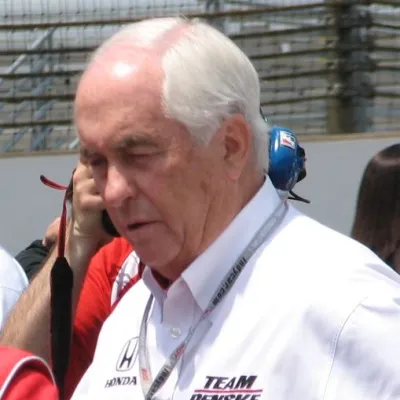
Roger Penske
Human Design Chart
Biography
Roger Penske — Manifesting Generator with Profile 2/4
Manifesting Generator 2/4 — Design at a Glance
Roger Penske revealed himself as someone who quickly drew things into his life and skipped steps in the process. As an Manifesting Generator, he had constant sacral energy that gave him a hybrid nature: the endurance of a generator paired with the initiating power of a manifestor. This configuration allowed him to tackle multiple projects simultaneously instead of focusing on just one.
The challenge lay in the speed. Often his actions were so rapid that important intermediate steps were skipped, leading later to having to backtrack and fill these gaps. This could lead to frustration, especially when inner authority was not synchronized with outer action. The strategy involved initially reacting to impulses – waiting for the “yes” from the sacral center – before acting.
As long as this reaction was authentic and his inner self continued to approve of the projects, Roger Penske could fully unleash his creative power. He found deep satisfaction not in linear task completion but in a playful mode with constant variety. Working on several ventures simultaneously was no barrier for him, but rather the source of his energy, provided he listened to his internal feedback and did not work against his own rhythm.
Emotional Authority
Roger Penske showed an inner decision-making structure that didn’t arise from logical analysis or social pressure but from a deep emotional wave. His design carried Emotional Authority, meaning his Emotional Center was defined and thus automatically became his inner authority – independent of which other centers were active in his graph. This configuration is subject to constant ups and downs; the perception of the world is always colored by current mood. What appears inspiring at one moment can seem negative the next. Such spontaneous impressions are merely snapshots, not final truths. Quick decisions made from this emotional heat often proved problematic for his system. Instead, his mechanics required patience: decisions needed time to mature, ideally over several nights. Only when intense feelings subsided and emotional distance was gained did clarity set in. This process of “sleeping on it” wasn’t a sign of hesitation but an essential strategy to recognize the deeper truth behind current emotions. Only through this delay could Roger Penske make long-term adjustments that aligned with his true essence, rather than merely responding to fleeting mood reactions.
The 2/4 Profile — Hermit / Opportunist
Roger Penske’s design laid out a tendency towards a pendulum rhythm between deep withdrawal and close social exchange. He showed himself as someone who had to balance the tension between the need for solitude (Line 2) and the desire for community (Line 4). For him, it was crucial to create a safe environment where he could clearly communicate when he sought company and when he wanted to be undisturbed. During his “me-time,” he immersed himself in internal processes to gain clarity. Once this need was satisfied, he returned to spend time with his favorite people. This structure allowed him to reflect on the knowledge of his network during alone time and develop brilliant ideas from it. His emotional mindset tended to project outward, making him appear fickle; his balance depended heavily on others’ trust. At the same time, he possessed a transpersonal intuition in the here and now (Line 4), based on respect and sensitive handling. Misuse of this power or lack of respect for individual survival would have triggered mistrust, while strengthened trust secured his success. Thus, he wove network knowledge with introspective depth.
Single Definition — Defined & Open Centers
Roger Penske's design shows a tendency towards continuous mental activity and conceptual structuring. His defined Ajna Center provided a steady, trustworthy thought process that was not easily influenced from the outside. This mind served as an external authority conditioning his mental field of environment. Together with his defined Throat Center, he could directly express his concepts and theories; his voice transmuted mental data into communication and action. This connection allowed him to influence others to think and express themselves through pressure, but there was a risk of impulsively wasting too much energy through talking or acting if strategy wasn't considered.
His ability to act stemmed from the defined Sacral Center, a source of immense vital energy. This power was only available with reactive consent; initiatives without prior questioning led to loss of this support and frustration. His defined G Center gave him a firm sense of self-identity and clear direction, while his defined Solar Plexus Center offered emotional depth. Here lay his inner authority: He had to wait for the emotional wave to clarify before making decisions to avoid impulsiveness.
In contrast, open centers showed specific vulnerabilities. The open Head Center tended to internalize mental pressure and questions from others as personal problems, leading to confusion if not using inner authority. His open Heart Center was vulnerable to trying to prove value through promises or competition – a cycle of self-disapproval upon failing. Additionally, the open Root Center absorbed external stress from the environment, which could lead to hyperactivity or burnout without awareness that this pressure wasn't his own. The open Spleen Center made him sensitive to well-being in the environment but tended to cling to unhealthy situations for false security instead of making spontaneous decisions.
Channels for authentic presence, curiosity and emotional openness.
Roger Penske inspired others through authentic self-confidence and the ability to be present in the moment. His design inclined towards implementing survival principles and self-love into concrete action, manifesting as a living expression of awakened clarity.
This trait is rooted in the Awakening Channel 10-20 connecting G Center with Throat Center. It transforms individual knowledge into right action (Gate 20) and ensures interactions through an underlying behavioral code (Gate 10). The result is a natural emanation of self-acceptance, minimizing resistance and inviting genuine invitations from the environment.
Parallel to this, the Research Channel 34-10 between Sacral and G Center worked. It provides inner strength (Gate 34) to hold personal convictions while Gate 10 initiates behavior to honor oneself. This configuration reinforced Roger Penske's independent action and demonstrated mastery of self through pure reaction to external stimuli without imposing his individuality on others.
Additionally, the Charisma Channel 34-20 shaped his influence. As a connection between Sacral Center (Gate 34) and Throat Center (Gate 20), it channeled the drive for manifestation through sacral reaction. This allowed him to quickly bring generative power into the world provided he remained connected with inner guidance and did not act impulsively from the mind.
In the Juxta-area, the Channel of Curiosity 11-56 (Ajna-Throat) and the Channel of Openness 22-12 (Solar Plexus-Throat) were evident. The first promoted storytelling to share ideas and inspire others, while the second made an emotional wave the basis for social interaction. Only when the mood was right could he use his words as catalysts to emotionally touch others and instigate change.
Prioritized Gates like Gate of Fulfillment (55) emphasized the importance of emotional awareness, while Gate of Partnership (59) pointed towards genetic strategies for bonding.
Individual Circuitry — Circuit Signature
Roger Penske's design inclined towards strong individual self-worth paired with the ability to emotionally process and express past experiences. In simple terms, he had a continuous energetic flow between Identity-, Heart-, Sacral-, Ajna-, Solar Plexus- and Throat Centers.
The Centering Circuit connected his Identity with the Sacral Center (Channel 10-34). This promoted firm convictions and inner strength even if direct expression was lacking. Parallel, the Knowledge Circuit worked through Channel 12-22 between Throat and Solar Plexus Centers. Here it was about open exchange of emotional waves, emphasizing creativity and individuality.
The Meaning Circuit connected Ajna with Throat Center (Channel 11-56). This allowed reflecting insights from the past and sharing them with the collective driven by curious intuition. Finally, the Integration Circuit integrated Throat-, Sacral and Identity Centers through Channels 20-10 (Awakening) and 20-34 (Charisma). This configuration bundled intuitive power, right behavior and presence in the now into a coherent expression.
All these circuits colored his entire design: The energy was pulsing, acoustically strong and strongly individual. Roger Penske showed himself as someone who carried his unique identity through emotional reflection and direct open expression into the world, where inner confirmation and outer communication were closely intertwined.
Right Angle Cross of the Sleeping Phoenix 1
Roger Penske is characterized by an inner dynamism that aims at rebirth and breaking free from old structures. This configuration, known as the right cross of the sleeping phoenix, describes a process where deeply rooted patterns must not just be adapted but fundamentally transformed. It's about the ability to rise from ashes and create new forms where there was only stagnation or decay before.
This energy often works unnoticed in the background until a critical point is reached when change becomes inevitable. For Roger Penske, this means a tendency to redefine systems or situations not just by optimizing them but radically redefining them once old ways have lost their validity. The focus lies on creating something enduring and alive from what was previously rigid.
The mechanics of this cross require patience and trust in the natural cycle of endings and beginnings. It's not linear development, but a spiral process where past experiences serve as a foundation for future innovations. Roger Penske's design suggests that he is particularly effective when ready to let go of old identities or structures to make room for fruitful new beginnings. This attitude shapes his way of seeing challenges not as obstacles but as necessary steps towards renewal.
Saturn Return · Uranus Opposition · Chiron Return · 2nd Saturn Return — Life Cycles
Roger Penske's design showed a tendency toward deep structural breaks, followed by the need to establish new, more stable foundations. This dynamic was evident in 1976 at age 39 when he ended his Formula-1 involvement. This step marked the peak of an Uranus opposition cycle, which often forcibly resolves established patterns to make way for necessary renewal. The crisis here was not a mistake but a mechanically induced turning point that freed old structures.
Later rhythms shaped his development further. In 1995 at age 58, he was inducted into the American Motorsports Hall of Fame. This fell during his second Saturn return, a phase where long-term consequences and condensed life experiences often lead to official recognition or institutional anchoring. While Uranus broke old patterns, Saturn validated the newly created through structural confirmation. Thus, his design describes a path from disruptive change towards lasting consolidation and appreciation of achieved results.
Manifesting Generator · Emotional Authority — Synthesis
A central red thread runs through the design: a dynamic interaction between inner clarity and outer expression. The defined Mental Center (Ajna) creates consistent conceptual thinking that serves as a foundation for concept development. This internal processing is connected to the Awakening Channel (Gate 10/20) with the Throat Center, seeking expression in the world – an ability to recognize principles and implement them into action. However, emotional authority requires time for decision maturation while the Manifesting Generator strategy suggests quick response to impulses. This interplay between deep reflection and swift action shapes a path that is both thoughtful and effective.
The design reveals a central paradox: the tension field between the need for isolation and community. The Profile Natural Talent/Networker (Line 2/4) oscillates between withdrawal into inner processes for clarity and seeking connection with selected people. This is reinforced by sacral energy, which is constantly present but waits on external impulses – an internal potential that only becomes activated through interaction. The Uranus opposition in 1976 points to a crisis while the Saturn return in 1995 marks success, emphasizing the cyclical nature of this tension: constant swinging between one's inner world and the outer world.
5 Defined Channels
Incarnation Cross - Right Angle Cross of the Sleeping Phoenix 1
Solar Return
The Solar Return shows the moment when the sun returns to its exact birth position - your personal solar year.
Life Cycles
Discover the life cycles with a detailed triple view (birth chart, cycle chart, composite).
Human Design Profile
- Strategy
- To respond - wait for something to respond to
- Authority
- Emotional Authority
- Profile
- 2/4 - Hermit / Opportunist
- Definition
- Single Definition
- Incarnation Cross
- Right Angle Cross of the Sleeping Phoenix 1
- Date of Birth
- 20.02.1937 09:43
- Place of Birth
- Cleveland, OH, United States
Frequently Asked Questions
What is Roger Penske's Human Design type?
What Profiles does Roger Penske have?
Which Authority governs Roger Penske's decisions?
What incarnation cross is assigned to Roger Penske?
When was Roger Penske born?
Discover your own Human Design
Are you also a Manifesting Generator? Find out in a personal reading how to unfold your multi-talents and direct your energy wisely.
More Personalities
Back to overviewAldair

Alizée

Angeli

Arletty
Artus
Balthus