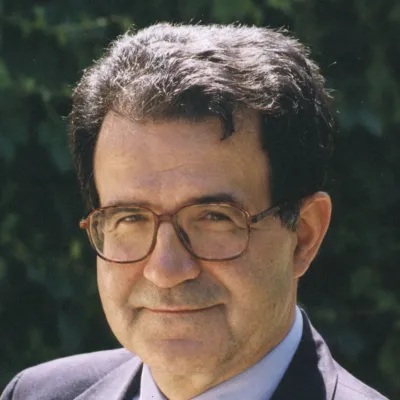
Romano Prodi
Human Design Chart
Biography
In 1999, after a nomination from the European Council, he was chosen President of the European Commission.
In 2005 Romano Prodi became president of the "Unione", Italy's centre-left parties' coalition. In October 2005, he won political leadership of the "Unione" and was positioned to be "Ulivo" 's main candidate for the April 2006 political elections.The election was close and the sitting Prime Minister, Silvio Berlusconi, hotly contested the results, but eventually ceded the post to Prodi. On May 17, 2006, at the bidding of the country's president a new government was formed, with Prodi as Prime Minister.
Prodi has degrees in economics with postgraduate studies from the London School of Economics. He is married with two kids.
What does Manifesting Generator 4/6 mean for Romano Prodi?
Manifesting Generator 4/6 — Design at a Glance
Romano Prodi's design shows a tendency towards hybrid dynamics: constant energy paired with the ability to attract things quickly. As an Manifesting Generator, he combined the perseverance of a Generator through his defined Sacral Center with the initiative of a Manifestor. This allowed him to skip steps and push forward parallel projects.
However, this type's mechanics require discipline. The tendency towards haste and multitasking carries the risk of missing important stages or being overwhelmed by simultaneous impulses. Ignoring the strategy of responding to internal signals leads quickly to frustration – the specific non-self theme of this design. To effectively use his creative power, Romano Prodi must respond to life impulses and only act when his Sacral Center gives a clear confirmation.
Only through this correct application does potential chaos transform into deep satisfaction. When strategy and inner authority align, a „play mode“ emerges. In this state, it is not only tolerable but beneficial for him to work on various tasks in parallel. The constant variety then becomes the source of his energy rather than a cause for exhaustion. His design thus appears as a powerful engine that relies on feedback from his internal compass to function sustainably and fulfilling.
Sacral Authority
Romano Prodi's design shows a tendency to make decisions not through logical planning but through immediate physical resonance. His inner authority lay in his defined Sacral Center, marking him as a Generator – the only type whose strategy and authority are identical: reacting to external stimuli. This mechanism replaced complex deliberations with a direct „gut feeling“. Prodi showed powerful signals like grunting or an affirming hmm-hmm during moments of confirmation, serving as physical responses to environmental stimuli.
This reaction was not arbitrary behavior but access to his energy source. When his Sacral Center responded to something, he felt vital and alive. A state of inexhaustible energy emerged, allowing him to perform tasks with great enthusiasm. He immersed himself in the work without needing external purpose; joy in the act itself sufficed as motivation.
Important for this dynamic was an open Emotional Center, which enabled his sacral authority. It prevented emotional waves from overshadowing clear physical responses. Prodi's life path followed the pattern of a Generator: he did not actively seek the „right“ in an abstract sense but waited for the stimulus and checked the physical reaction. This approach offered him reliability and satisfaction as he adhered to his natural rhythm rather than fighting against it. The connection between vitality and enthusiasm served as a constant indicator whether he was on track.
The 4/6 Profile — Opportunist / Role Model
Romano Prodi's design shows a tendency not to understand authority as an isolated claim but as something that only becomes effective through the resonance of the environment. His Profile 4/6, the Networker and Role Model, defined this dynamic: Line 4 in the Heart seeks belonging and community, while Line 6 in the Head aims for the rational overview and wisdom's distance. In the first three decades of life, experimental behavior dominated, similar to Line 3, where Prodi experimented much with relationships and friendships. With the activation of Line 6, then emerged the tension field between the heart's need for cooperation and the head's need for individual security. For his leadership ability, it was crucial that it was recognized by the community; without this confirmation, authority lost its foundation. The mechanics show: if the majority rejects the leadership, one must step back as influence otherwise is not possible. Prodi thus navigated between the impulse to cooperate and the necessity of seeing the big picture. It mattered to handle the heart carefully so as not to be hurt by false community choices while Line 6 tried either to accept or reject mutations to preserve individuality. His role as a model therefore always depended on whether he managed to reconcile these two poles – the social Heart and the rational Head.
Triple Split Definition — Defined & Open Centers
Romano Prodi's Human Design profile established a massive structural stability: Head, Ajna, Throat, G Center, Heart and Sacral were defined. This created a persistent mental pressure to ask questions and generate answers, connected with a clear identity and willpower. His communication was reliable, fueled by this inner authority and the vital energy of the Sacral, which is geared towards reacting rather than initiating.
At the same time, two sensitive windows were revealed: The Solar Plexus Center was open, making him vulnerable to the emotional climate of his surroundings. Prodi tended to personalize other people's moods as his own instead of just sensing them. Also, the Spleen was open, bringing latent survival fears and conditioning regarding health and spontaneity with it. Here lay the danger of acting impulsively or clinging to unhealthy structures in order to achieve a false sense of security.
The challenge lay in finding balance: The immense defined energy must not lead him to exert pressure on others or overwhelm his open centers. Instead of making spontaneous decisions from the Spleen or emotional reactions from the Solar Plexus, it was important to apply the strategy of waiting. Only then could the sacral response be heard and the mental clarity of the Ajna Center fully manifest without leading to frustration or exhaustion.
Channels for reflection, change, clarity and true worth.
Romano Prodi's Human Design profile revealed a tendency towards leadership that was not merely driven by power hunger but rather by structural necessity. His Personality Sun is in Gate 7, the Gate of Hierarchy and Future Patterns. This indicates that his energy was focused on projecting order structures and testing them through experiments to determine their viability. He did not act impulsively but rather anticipated the future by designing hierarchical models and checking if they were stable enough to be sustained.
This solar imprint was reinforced by Channel Alpha 31-7, which connects the need for authority (Gate 31) with the ability to lead (Gate 7). This channel signals a deep inner desire not just to follow but to set direction and bring structural order into chaotic situations. Romano Prodi demonstrated that he took this leadership role seriously as it was tied to his sense of protecting and stabilizing the collective.
In the background, additional mechanisms were at work. Channel Mutation 60-3 introduced an unpredictable energy of change. Through the Gate of Limitation (60) and the Gate of Order (3), a pressure emerged that enabled evolutionary leaps but was often accompanied by melancholic phases where the next mutation was not yet visible. Romano Prodi had to learn to accept these pauses rather than rejecting them with rational arguments.
Channel The Lost Son 13-33 added a reflective dimension. Through the Gate of Listener (13), he gathered information and secrets, which he then processed through the Gate of Withdrawal (33). This created a cycle of experience, retreat, and later sharing of wisdom, helping him to view complex situations from a historical perspective before acting.
Additionally, Channel Awareness 61-24 shaped his mental structure. Through the Gate of Secrets (61) and the Gate of Rationalizing (24), he received sudden insights or "Satori" moments. His thinking was not linear but mutative; knowledge emerged when it was ready, often unpredictably and inspiring to others.
Finally, Channel Initiation 51-25 with its competitive energy (Gate 51) and the spirit of self (Gate 25) fostered an attitude of individuation through shock experiences. This strengthened him in adopting his unique perspective and encouraged others to transcend their own boundaries.
Individual Circuitry — Circuit Signature
Romano Prodis Design shows a tendency towards individual knowledge creation, paired with inner strength and the processing of emotional past waves. His chart is marked by a Triple Definition, indicating high receptivity to external influences since no consistent internal authority is defined.
The Knowledge Circuit drove the creation of new knowledge forward. The Channels "Mutation" (Root and Sacral Centers) as well as "Awareness" (Head and Ajna Centers) formed two separate parts here. This promoted innovative impulses and a drive for unique identity, without these necessarily manifesting automatically in expression.
Parallel, the Centering Circuit worked through the Channel "Initiation," connecting Heart and Identity Centers. This connection provided inner strength, courage, and strong convictions. However, since there was no connection to the Throat Center, these deep convictions often remained unspoken or difficult to articulate directly.
The Meaning Circuit completed the experience: The Channel "The Lost Son" connected Throat and Identity Centers. Here, emotional waves from the past were processed to derive common learning experiences for the collective. The synthesis of these three circuits shaped Romano Prodi as someone who generates new knowledge, remains internally convinced, but shares his deepest insights only after emotional maturation and meaning-making.
Right Angle Cross of the Sphinx 3
Romano Prodis Human-Design profile suggests a tendency towards profound wisdom that is often unspoken. His inner self was marked by a quiet authority born from trust in intuitive truths rather than loud demands. This disposition stems from the right cross of Sphinx 3, a configuration that simplifies to the essential and sets a clear, almost fated direction.
This mechanism means that Romano Prodi had a tendency to simplify complex situations down to their core without losing depth. It wasn't superficial simplification but rather the ability to distinguish what is essential from what is not. Internally, there was a quiet certainty guiding him to find the right path in uncertain times without needing to persuade or convince others. His strength lay in the clarity of his own standpoint and the ability to radiate this clarity with calmness and composure.
This inner structure shaped how he moved through the world: not by constant action or seeking external validation, but by deep trust in his intuition. Romano Prodi was someone who knew what they wanted and pursued it with a quiet yet unshakable determination. The Sphinx 3 confers a kind of mystical aura that attracts others without them fully understanding where this calmness comes from. It was an energy of silent leadership based on inner truth, offering particular stability in uncertain times.
Saturn Return · Uranus Opposition · Chiron Return · 2nd Saturn Return — Life Cycles
Romano Prodis Human-Design profile indicates a tendency towards structured authority that solidified only after years of experimental life phases. His second Saturn return marked this transition: internal values merged with external structures, anchoring a long-term, sustainable identity within the social context. This mechanism describes when individual development becomes established responsibility.
In 1996 at age 57, Prodi was sworn in as Prime Minister of a center-left coalition government. This event exemplified the establishment of his political authority within the institutional framework. Saturn energy here did not just promote professional advancement but synthesized personal convictions with institutional conditions. It showed how through this cyclical phase a stable foundation for future action was created based on mature self-awareness and social integration. The connection between inner clarity and outer positioning marked this period profoundly.
Manifesting Generator · Sacral Authority — Synthesis
A central red thread runs through the design: the dynamic connection of initiation and reaction. With a Manifesting Generator and sacral authority (sacral center, Channel of Mutation), there is the ability to quickly initiate things but also an invitation to respond to external impulses. This combination of inner drive and receptive wisdom shapes a lifestyle focused on recognizing and utilizing opportunities – not through forced control (open emotional center) but by flowing with energy (defined sacral center). The profile as Networker/Role Model underscores this aspect, emphasizing the ability to form connections and learn from exchanges with others.
The central paradox lies in the tension between the desire for autonomy and the longing for belonging (Line 4/6). The defined Mental Center generates a constant drive for understanding and inspiration while Line 6 implies a detached perspective and the pursuit of wisdom. This leads to an internal conflict between wanting to be part of a community while maintaining the freedom to chart one's own course – a tension field amplified by the pulsating energy of the Knowledge Circuit, manifesting in the ability to initiate change (evident event: career start).
4 Defined Channels
Incarnation Cross - Right Angle Cross of the Sphinx 3
Solar Return
The Solar Return shows the moment when the sun returns to its exact birth position - your personal solar year.
Life Cycles
Discover the life cycles with a detailed triple view (birth chart, cycle chart, composite).
Human Design Profile
- Strategy
- To respond - wait for something to respond to
- Authority
- Sacral Authority
- Profile
- 4/6 - Opportunist / Role Model
- Definition
- Triple Split
- Incarnation Cross
- Right Angle Cross of the Sphinx 3
- Date of Birth
- 09.08.1939 17:15
- Place of Birth
- Scandiano, Italy
Frequently Asked Questions
What is Romano Prodi's Human Design type?
What Profiles does Romano Prodi have in his Human Design chart?
Which Authority guides Romano Prodi's decisions?
Which incarnation cross is active for Romano Prodi?
When was Romano Prodi born?
Discover your own Human Design
Are you also a Manifesting Generator? Find out in a personal reading how to unfold your multi-talents and direct your energy wisely.
More Personalities
Back to overviewAldair

Alizée

Angeli

Arletty

Artus

Balthus