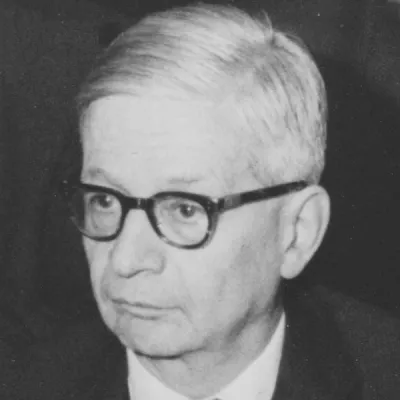
Rudolf Peierls
Human Design Chart
Biography
Peierls studied physics at the University of Berlin, at the University of Munich under Arnold Sommerfeld, the University of Leipzig under Werner Heisenberg, and ETH Zurich under Wolfgang Pauli. After receiving his DPhil from Leipzig in 1929, he became an assistant to Pauli in Zurich. In 1932, he was awarded a Rockefeller Fellowship, which he used to study in Rome under Enrico Fermi, and then at the Cavendish Laboratory at the University of Cambridge under Ralph H. Fowler.
Because of his Jewish background, he elected to not return home after Adolf Hitler's rise to power in 1933, but to remain in Britain, where he worked with Hans Bethe at the Victoria University of Manchester, then at the Mond Laboratory at Cambridge. In 1937, Mark Oliphant, the newly appointed Australian professor of physics at the University of Birmingham recruited him for a new chair there in applied mathematics.
In March 1940, Peierls co-authored the "Frisch–Peierls memorandum" with Otto Robert Frisch. This short paper was the first to set out that one could construct an atomic bomb from a small amount of fissile uranium-235. Until then it had been assumed that such a bomb would require many tons of uranium, and consequently was impractical to build and use. The paper was pivotal in igniting the interest of first the British and later the American authorities in nuclear weapons. He was also responsible for the recruitment of his compatriot Klaus Fuchs to work on Tube Alloys, as the British nuclear weapons project was called, which resulted in Peierls falling under suspicion when Fuchs was exposed as a spy for the Soviet Union in 1950.
Rudolf Peierls as a Manifesting Generator 3/5 in Human Design
Manifesting Generator 3/5 — Design at a Glance
Rudolf Peierls revealed himself as someone marked by a hybrid energy configuration: As an expressing Generator, he possessed the constant power of a Generator but also had the ability of Manifestors to skip steps and quickly draw results into his life. This acceleration brought specific risks with it. Often, his impulses were so rapid that he would miss important intermediate stations, forcing him later to backtrack and catch up on missing foundations – a process that could quickly lead to frustration, the central non-self theme of this type. Additionally, Peierls tended to pursue multiple projects simultaneously rather than focusing linearly on one thing at a time. This multitasking tendency was productive and fulfilling only when he strictly responded to inner impulses instead of initiating things himself. Only when his Sacral Center clearly signalled "yes" at every step and his inner authority agreed did the potential overload transform into deep satisfaction. Under these conditions, he entered a playful mode in which variety and parallel creation worked not as distractions but as sources of his creative power. The challenge always lay in channeling his own speed through conscious reactions to life impulses rather than blindly following them.
Emotional Authority
Rudolf Peierls lived with an emotional authority. His defined Emotional Center determined his internal decision-making strategy and always took precedence over all other defined centers in his chart, regardless of their number or type. This mechanism shaped a specific perception world: He was constantly swept by waves of feelings that showed a perpetual rise and fall. The world appeared to him always colored by his current mood; enthusiasm could shift into negative evaluation within the same moment. His immediate feeling was only a snapshot, a first impression, which did not necessarily correspond with his deepest truth. Quick, spontaneous decisions from such an emotional state often risked negative consequences. His design strategy required patience: He took time to let decisions mature. This entailed repeatedly sleeping on questions and allowing himself the luxury of hesitation. Over time, intense feelings subsided, emotional distance gained clarity and calmness. Only then was the process complete. This path was crucial for long-term decisions that could have a significant impact on his life course. Through this waiting period, he filtered out the noise of moods and arrived at a well-founded inner truth that went beyond fleeting first impressions.
The 3/5 Profile — Martyr / Heretic
Rudolf Peierls revealed himself as someone who did not gain his knowledge from abstract theory but through personal experimentation. His Profile 3/5 established a foundational stance: he initially believed nothing and had to experience everything firsthand. This line of the experimenter required trial and error, often accompanied by chaos or crises, especially in youth. Through these tough experiences, he accumulated a rich treasure trove of practical know-how.
Later, this role changed. The Hero Line (5) allowed him to learn from his own mistakes and support others with his insights. He became a reference point because his solutions were based on real experience. Others sought him out to benefit from this practical knowledge. This dynamic was attractive to him as it confirmed his competence. However, if he publicly failed in trying new approaches, this could be painful, given the high expectations of those around him. His ability to ask the right questions during crises helped him transform doubts into concrete answers. Thus, personal chaos became a source of orientation for others.
Split Definition — Defined & Open Centers
Rudolf Peierls was someone who exhibited a reliable inner identity and clear willpower. His defined G Center gave him a deep sense of direction and the need to be loved without being dependent on others. Combined with his defined Heart Center, he had the energy to fulfill promises and actively shape his life; he acted from a strong 'I' that knew what it wanted and how to use resources effectively. This combination created a stable foundation for his actions.
At the same time, his design was marked by complex emotional dynamics. His defined Solar Plexus Center served as his inner authority: He had to learn to wait out the waves of his emotions before making decisions. Emotional clarity did not arise in the moment but only after experiencing the full wave of emotion. His defined Throat Center ensured that these internal processes, whether coming from Heart or Solar Plexus, were translated into clear communication. He articulated not just thoughts but also his willpower and feelings directly into the world.
This solid core stood in contrast to his open centers. His open Head and Ajna Centers meant he did not have a constant mental inspiration but was open to ideas from the environment. He tended to identify with foreign concepts or experience mental pressure as his own if he did not trust his emotional authority. Additionally, his open Root Center absorbed external stress; he was prone to interpreting others' adrenaline-driven urgency as his own action drive. His open Spleen Center made him sensitive to health and well-being in the environment but tended to make spontaneous decisions to avoid uncertainty rather than listen to deeper instincts. This openness allowed him to adapt to various environments, yet it required constant vigilance against conditioning influences.
Channels for emotional urgency, rhythm, openness and willpower.
Rudolf Peierls lived a life deeply influenced by an inner rhythm that made him vital and closely connected with the natural flow of the world. This fundamental stance came from Channel Rhythm 5-15, which linked his Sacral Center to his G Center. Through Gate 5, he held onto firm habits, while Gate 15 integrated the diversity of society into this life flow. This mechanism ensured that his timing was internally determined and he magnetically drew others into his energy flow without appearing arrogant or emotionally volatile.
Alongside this stable foundation, Peierls sought hidden truths and new perspectives. Channel Transience 35-36 drove him to collect experiences from which to gain wisdom. Gate 35 demanded constant change, while Gate 36 used crises as learning opportunities, helping him inspire others through emotional depth and sharing of experiences. Simultaneously, he had the ability to convey these insights in a way that was received by others. Channel Openness 22-12 connected his Solar Plexus with his Throat Center; here, Gate 12 regulated his cautious articulation through the passion of Gate 22, so that he only spoke when supported by his emotional wave, giving him a transformative effect on his environment.
In the material realm, Peierls exercised leadership by taking responsibility and maintaining control. Channel The Line of Wealth 21-45 linked his Will (Gate 21) with the authoritative voice of the Gatherer (Gate 45). This allowed him to manage resources and protect the tribe while always seeking a balance between hard work and necessary rest. His mental processing was marked by doubt and detail precision: Gate 63 urged him to ensure things through questioning, while Gate 64 transformed past experiences into clear concepts. Supported by the logical pattern recognition of Gate 62 and the abstract storytelling ability of Gate 56, he made complex processes understandable. The spiritual innocence of Gate 25 and receptivity for new directions through Gate 2 rounded off his profile as someone both mystically centered and evolutionarily open.
Collective Circuitry — Circuit Signature
Rudolf Peierls was shown to possess distinct energetic poles in his design: on one hand, a stable base of identity and life force, and on the other, a complex web of communication, emotion, and will. This 'Split Definition' meant that these areas did not automatically flow into each other but existed parallel.
In the realm of identity, the Understanding Circuit worked through Channel Rhythm (Gates 15-5). It directly connected the Identity Center with the Sacral Center. This created a focus on logical, rational processes and strategic thinking driven by constant, cyclical life energy – an 'emotionless ratio' oriented towards improvement and future.
Parallel to this, a second independent block of three circuits acted, linking Throat with Solar Plexus and Heart. The Knowledge Circuit (Channel Openness, Gates 12-22) as well as the Meaning Circuit (Channel Transience, Gates 35-36) connected the Throat Center with the Solar Plexus Center. Here it was about expressing unique identity and reflecting past experiences through emotional waves. Additionally, the Ego Circuit (Channel The Line of Wealth, Gates 45-21) integrated the Heart Center into this communication flow, where will, resource building, and mutual support were verbally articulated.
This structure clearly separated the cool, strategic planning in the Sacral Identity area from the emotional, will-driven communication in the Throat-Solar Plexus-Heart complex. Rudolf Peierls had to consciously integrate these two separate energy fields as no direct energetic bridge existed between them.
Right Angle Cross of Consciousness 2
Rudolf Peierls exhibited a fundamental disposition marked by the right cross of consciousness. This configuration in the Human Design system points to a specific inner orientation where perception and handling of information played a central role. It was not merely an intellectual interest but rather a deeper, almost intuitive search for the essence of things.
The right cross of consciousness indicates a person who was driven to penetrate complex connections while always keeping sight of the big picture. Rudolf Peierls lived with this tendency, not just observing superficial phenomena but researching underlying principles. His way of seeing the world was characterized by a certain breadth that allowed him to look beyond the immediately visible.
These inner mechanisms worked as constant companions in his thinking and actions. They fostered an attitude of openness and deepening without falling into dogmatic rigidity. Rudolf Peierls used these gifts to navigate his environment and chart his own course, always driven by the desire to understand more than just the obvious.
Saturn Return · Uranus Opposition · Chiron Return · 2nd Saturn Return — Life Cycles
Rudolf Peierls showed a life path structured by clear, cyclical milestones that linked inner maturity with external recognition. His design indicated a tendency to translate personal developmental steps into concrete institutional positions.
In 1937 at age 30, Peierls received a professorship at the University of Birmingham. This coincided precisely with his first Saturn return. In Human Design mechanics, this cycle often marks the transition from an experimental phase to stable structure and responsibility; here years of groundwork solidified into a sturdy foundation for his career.
Later in 1945 at age 38, Peierls became a member of the Royal Society. This event corresponded with his Uranus opposition in his chart. This astrological configuration signifies breaking old patterns and rising to new authority or visibility. For his design, this meant not only individual success but also validation on the highest level that affirmed his previous work and provided him a platform for further influence. Both events underscore how Rudolf Peierls' inner growth processes precisely manifested in external achievements without him fighting against his natural rhythm.
Manifesting Generator · Emotional Authority — Synthesis
Rudolf Peierls lived a life marked by a deep connection to his own inner truth and the drive to bring this into the world. His design as an Manifesting Generator (with defined Sacral Center) points to someone who was energetically equipped to initiate things quickly but primarily moved through responding to impulses in flow. This sacral foundation, combined with emotional authority, required time for decision-making and processing emotional waves – an inner dynamic that showed in pivotal moments of his career path (evident event: professorship 1937). The Explorer/Hero Profile underscored this tendency to learn from personal experiences and share this knowledge.
A central paradox lay in the tension between the impulse for quick initiation characteristic of a Manifesting Generator, and the necessity of emotional maturation (through the defined Emotional Center). Peierls' design suggests that he tended to tackle things while simultaneously going through an inner wave forcing him to reconsider decisions. This combination of apparent rapid action and deep emotional processing shaped his way of generating knowledge and initiating transformations (evident event: Royal Society membership 1945), as he acted both innovatively and carefully.
4 Defined Channels
Incarnation Cross - Right Angle Cross of Consciousness 2
Solar Return
The Solar Return shows the moment when the sun returns to its exact birth position - your personal solar year.
Life Cycles
Discover the life cycles with a detailed triple view (birth chart, cycle chart, composite).
Human Design Profile
- Strategy
- To respond - wait for something to respond to
- Authority
- Emotional Authority
- Profile
- 3/5 - Martyr / Heretic
- Definition
- Split Definition
- Incarnation Cross
- Right Angle Cross of Consciousness 2
- Date of Birth
- 05.06.1907 11:15
- Place of Birth
- Berlin-Treptow, GER
Frequently Asked Questions
What is Rudolf Peierls' Human Design type?
What Profiles did Rudolf Peierls have in Human Design?
Which Authority guided Rudolf Peierls?
What incarnation cross did Rudolf Peierls carry?
When was Rudolf Peierls born?
Discover your own Human Design
Are you also a Manifesting Generator? Find out in a personal reading how to unfold your multi-talents and direct your energy wisely.
More Personalities
Back to overviewAldair
Alizée

Angeli

Arletty
Artus
Balthus