
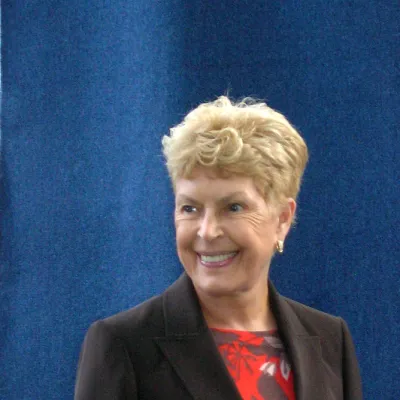
Photo: Wikimedia Commons
Ruth Rendell
Human Design Chart
Biography
The only child of two teachers, Rendell grew up in a bickering world that she shut out, withdrawing into the world of imagination that holds both enchantment and the dark recesses of the psyche. She married Don Rendell; one son; they separated in 1972, divorced in 1975 and remarried in 1977, living in a pink farmhouse in the English countryside. She wrote at times under the name Barbara Vine.
Ruth Rendell died in London at 8 a.m. on 2 May 2015, having suffered a stroke the previous January.
What does Generator 4/6 mean for Ruth Rendell?
Generator 4/6 — Design at a Glance
Ruth Rendell's design points to a tendency towards great endurance and high energy potential. As a Generator, she had a lot of sacral energy, which she used like a workhorse for her tasks, provided she felt inner consent. Her life energy was unleashed not through self-initiative but exclusively through reacting to signals from the environment. The strategy of her type was to wait for impulses and only then act when the sacral center gave a clear 'yes'. Acting in harmony with this inner resonance rewarded her with a sense of deep fulfillment. If this inner signal did not appear or she was prevented from her actual work, frustration and a lack of energy threatened. Two central stumbling blocks characterized this pattern: On the one hand, the danger of wasting energy on things that did not interest her, which could lead to burnout. On the other hand, the problem of being pushed to stop working on her heart project despite full power. Her success therefore depended on not initiating but responding from the gut to what truly moved her.
Sacral Authority
Ruth Rendell's design points to a tendency towards clear, physically anchored decision-making. As a Generator, she had the sacral authority, which also served as her strategy. This configuration simplified her process: She did not react through intellectual analysis but based on an immediate physical response. A prerequisite for this was her open emotional center, meaning she did not rely on fleeting moods but on the stable energy from the belly area.
This sacral authority manifested as a 'gut feeling' or a surge of energy in response to external stimuli. Ruth Rendell learned to pay attention to her body's own signals - loud ones like grunting or soft ones like a nodding 'mm-hmm'. When her sacral motor responded to something, she felt vital and alive. She then had seemingly inexhaustible energy and tackled her tasks with great enthusiasm. She was born to walk through life with joy and immerse herself in her activities without needing external purposefulness.
Additionally, her activated spleen center acted as a supportive authority. As it was directly connected to the sacral center, Ruth Rendell could react particularly quickly and spontaneously. She had immediate access to her instinctive perception and physical well-being. She relied on this instinctive intelligence to guide her, which further accelerated and sharpened her decisions.
The 4/6 Profile — Opportunist / Role Model
Ruth Rendell's design points to a tendency towards a deep inner conflict: the tension field between the urge to be anchored in a community and the need to withdraw to contemplate the meaning of existence. In her first thirty years, her Line 6 still acted like a Line 3. She therefore experimented a lot, especially in relationships and friendships, driven by the energy of 'burnout' (Gate 30). This line sought opportunities and influence in the network, which can be risky for Projectors, as they often get entangled in a longing for the repetition of intense feelings. Analytical thinking helped to channel this energy, but uncontrolled emotional waves threatened a breakdown.
With the activation of Line 6, a change occurred. Ruth Rendell now faced the task of resolving the contradiction between heart and head. The energy of Gate 14 (Line 6) addressed wealth, power, and humility on a grand scale. It was not about superficial success but about the spiritual realization that material achievements can be part of a divine will. Existential insights characterized this phase. She did not like to involve herself in everyday trivialities but acted primarily during mutations or events of great significance. She was expected to meet the high standards of a wise role model. Her big heart remained cautious to avoid opening up to the wrong people and getting hurt. Cooperation with others was the key to integrating these dual forces.
Single Definition — Defined & Open Centers
Ruth Rendell's design inclined towards a firm, reliable self-identity. With a defined G Center, she had a clear sense of her own direction and the ability to make others feel secure in her love for herself without being dependent on them. This inner stability shaped her approach to life.
As a Generator with a defined Sacral Center, she possessed a tremendous source of vital energy. Her design required her not to initiate but to respond to questions or invitations to use this power correctly. Only through affirming responses from the gut could she utilize her energy for satisfying tasks and avoid frustration.
At the same time, her openness was evident in several centers. The open Head Center made her vulnerable to mental pressure and the temptation to solve others' questions rather than trusting her inner authority. The open Ajna Center also indicated a flexible but not stable mind that took in ideas without solidifying them as her own truth.
The open Throat Center meant she could not communicate consistently but had to wait for invitations to speak effectively. The open Heart Center meant she was not designed to prove willpower or make promises to demonstrate her worth. Instead, she tended to ask herself how she could gain recognition, which could lead to a cycle of self-proving. The open Solar Plexus Center left her susceptible to absorbing and amplifying the emotions of her environment, making her vulnerable to foreign moods. The open Spleen Center brought fears about survival and health, causing her to cling to unhealthy situations to gain a false sense of security. Finally, the open Root Center absorbed external stress, leading to a pressure she could not control but only observe or avoid.
Channels for authentic self-expression power.
Ruth Rendell's design inclined towards deep self-acceptance and the ability to strengthen others through authentic behavior. This was primarily shown through the Channel of Investigation 34-10, which connected her Sacral Center with her G Center. Gate 34 provided the inner strength to hold onto personal convictions, while Gate 10 initiated behavior from the deepest inner self to honor herself. This configuration promoted a lifestyle in which she waited for reactions from her personal authority to express her uniqueness without guilt. Her design encouraged her to take unconventional paths and show others through this authenticity how to love themselves rather than follow collective expectations.
Additionally, gates that shaped emotional depth and strategic leadership were at work. Gate 30 steered the recognition of feelings and the confrontation with illusions, while Gate 29 emphasized persistence and saying 'yes' to life. Gate 14 ensured skillful power preservation and direction finding, and Gate 8 promoted individual contribution to group goals. On the personality side, Gate 27 with its genetic strategy of care and species preservation imbued her activities with warmth and altruistic impulse. Gate 7 also projected patterns for the future and a need for leadership, influencing her role in the social fabric. Finally, Gate 59 carried a genetic strategy of bonding and pairing, which helped overcome barriers in relationships. This combination of self-reinforcing reaction, emotional perception, and caring leadership formed a complex profile that both fostered individual independence and deep engagement with others.
Individual Circuitry — Circuit Signature
Ruth Rendell's design inclined towards a solidified individuality and inner stability. She was someone who drew her identity and self-worth from a deep, sacral source, giving her a calm, pulsating presence. This configuration formed the Centering Circuit, which in her was specifically active through the Channel of Investigation (Gate 10-34). This channel connected her Sacral Center, the source of her life energy and intuition, directly with her Identity Center, the seat of her divine essence.
Since these two centers were in the same group, energy flowed seamlessly between instinct and identity. This strengthened her inner conviction and courage without her always having to articulate it outwardly; the circuit lacked the connection to the Throat Center, so her firm convictions were often lived rather than explained. As a person with a simple definition and a separate group of G and Sacral Centers, which were not directly linked to the Identity-Sacral connection, these energetic fields existed parallel. The G-Sacral group stood for her life direction and motivation, while the Centering Circuit shaped her inner structure. This separation meant that her external orientation and her inner identity formation worked as two adjacent, not directly merging forces. The melancholic, creative note of the circuit colored her entire being, giving her a strong but introverted presence that reinforced others in their own individuality without dominating them.
Right Angle Cross of Contagion 1
Ruth Rendell's Human Design profile featured the structure of the right Cross of Imprinting. This configuration deeply influenced her profound sensitivity to the collective currents of her time. She operated not in isolation but with her inner state intricately intertwined with external circumstances. The right Cross of Imprinting describes an energy that arises through the absorption and processing of information from the environment. It is a dynamic interaction between the individual and the collective. Ruth Rendell lived in a system that required constant adaptation and reaction to the social context. Her energy was geared towards sensing and responding to the mood of society. This occurred not through conscious analysis but through an intuitive resonance with what was happening around her. The mechanics of this cross imply a high susceptibility to external influences, which also brought the ability to quickly orient oneself in complex social fields. Ruth Rendell was part of a larger whole, whose rhythm she followed. Her actions and reactions often mirrored the collective dynamics in which she was situated. This connection created a kind of symbiotic relationship between her and her environment, which shaped her entire existence.
Saturn Return · Uranus Opposition · Chiron Return · 2nd Saturn Return — Life Cycles
Ruth Rendell's Human Design profile showed a clear tendency to translate internal psychological tensions into structured, tangible forms. Her energy was directed at making the hidden visible and fixing it in a framework that promised stability. This was not just a preference but a mechanical necessity of her system to create order from the complexity of human motives.
In 1971, at the age of 41, she published “No More Dying Then”. This step marked the Uranus aspect in her chart, a moment of sudden clarity and breakthrough, carrying long-held impulses into the public domain. The energy of this aspect acted as a catalyst, propelling her creative vision from the inside out and redefining her career.
Ten years later, in 1980, she reached a peak with the Swedish Crime Prize for “Drömmar till döds”. This coincided with her Chiron Return, the cycle of fulfillment. Here it was evident that her life's purpose, if she had followed her inner authority, had now reached its full bloom. It was not a moment of healing but of confirmation of her purpose and the visible unfolding of her Inkarnationskreuz.
In 1987, at the age of 57, she received the Edgar Allan Poe Award for “A Dark-Adapted Eye”. This corresponded with her second Saturn Return, a phase of maturity and the final anchoring of her achievements. What had begun as an impulse or bloom was now a stable, recognized structure. Her design thus marked a path from explosive discovery through meaningful fulfillment to enduring institutional recognition.
Generator · Sacral Authority — Synthesis
Ruth Rendell was a Generator whose life was marked by a deep, sacral energy (Sacral Authority). This energy constantly sought activities that truly fulfilled her and in which she could immerse herself (Sacral Center), with the reaction to external stimuli being crucial for the decision. The Profile as a Networker/Role Model indicates a development where the early years of experimentation (Line 4) condensed into a stronger inner wisdom and a need for authenticity (Line 6). The Channel of Exploration (34/10) reinforced the search for behavior that aligned with her deepest self and provided the inner strength to hold onto her convictions. The repeated successes (1980, 1987) and the documented event of publication (1971) show that this energy was channeled into creative work.
A central paradox in Ruth Rendell's design lay in the tension between the need for connection (Line 4) and the desire for inner autonomy and reflection (Line 6). While her heart yearned for exchange and community, she repeatedly withdrew to ponder fundamental questions of life. This conflict between social interaction and inner reflection shaped her character and created a dynamic in which she acted both engaged and detached – a give-and-take reinforced by the connection of the Centering Circuit (Sacral and Identity Centers).
1 Defined Channel
Incarnation Cross - Right Angle Cross of Contagion 1
Solar Return
The Solar Return shows the moment when the sun returns to its exact birth position - your personal solar year.
Life Cycles
Discover the life cycles with a detailed triple view (birth chart, cycle chart, composite).
Human Design Profile
- Type
- Generator
- Strategy
- To respond - wait for something to respond to
- Authority
- Sacral Authority
- Profile
- 4/6 - Opportunist / Role Model
- Definition
- Single Definition
- Incarnation Cross
- Right Angle Cross of Contagion 1
- Date of Birth
- 17.02.1930 09:00
- Place of Birth
- South Woodford, UK
Frequently Asked Questions
What was Ruth Rendell's Human Design type?
What Profile did Ruth Rendell have in Human Design?
Which Authority guided Ruth Rendell's decisions?
What incarnation cross determined Ruth Rendell's life path?
When was Ruth Rendell born?
Discover your own Human Design
Are you also a Generator? Find out in a personal reading how to use your sacral energy correctly and discover deep satisfaction.
More Personalities
Back to overviewAaliyah

Alain-Fournier
Alexia

Angèle

Angeli
Anne-Marie
