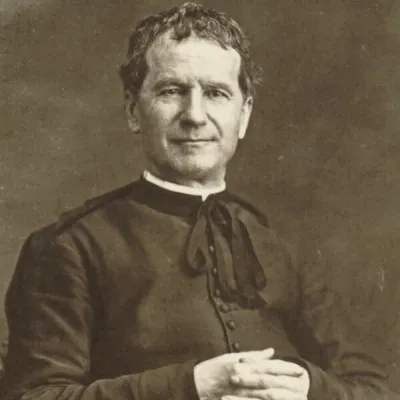
Saint John Bosco
Human Design Chart
Biography
John Bosco’s father died when he was two and he was brought up in a peasant family by his loving and very pious widowed mother. He and his older brother Joseph, supervised by their stepbrother, Anthony, tackled the endless farm work with energy. From an early age he was drawn to work among boys and young men, hearing the voice of the Master urging him on to this work. Ordained a priest on 5 June 1841 he settled in a suburb of Turin, Italy and soon had hundreds of youths attending his chapel and evening classes. He opened a boarding-school for apprentices and established workshops to teach tailoring, shoemaking and other trades to adapt the young men for the first industrial revolution in Italy.
In Turin, on the evening of 18 December 1859 he and 22 companions founded the Society of St. Francis de Sales, which before his death had spread to England, France, Spain and South America. Because of his admiration for the spirit of St. Frances de Sales he called his helpers Silesians. They offered a general education and taught skills in agriculture and trade. Girls were also helped in a similar manner when he established the Daughters of Mary, Help of Christians with the aid of St. Mary Mazzarello, a peasant woman from Genoa.
Known for his missionary work, he led expeditions to Asia, Africa and Latin America. While he was in Brazil, he predicted the exact place for the future capital.
Don Bosco died on 31 January 1888 in Turin, aged 72. On Easter Sunday, 1 April 1934, his personal friend Pope Pius XI declared Don Bosco a saint; the Pope called him "a giant of sanctity." His feast day is 31 January.
A centennial observation in 1988 included the Italian motion picture "Giovanni Bosco," which starred Ben Gazzara.
Saint John Bosco — Generator with Profile 5/1
Generator 5/1 — Design at a Glance
Saint John Bosco possessed immense physical endurance and the ability to shape his life through consistent action. His Generator design endowed him with this strength, comparable to a workhorse: strong and steady as long as he had energy for his task. However, his capacity to materialize life strictly depended on the proper use of his sacral energy.
The central principle of his design was 'Reacting instead of Initiating'. His deep satisfaction arose only when he responded to inner impulses from his gut. Ignoring these signals or trying to force initiatives inevitably led to frustration and energy loss. Two specific stumbling blocks shaped his dynamics: First, persistently doing things that did not interest him, which could lead to burnout even with high creative potential. Second, holding back from working on his heart project when he still had plenty of power left – a state where external constraints interrupted his inner urgency.
His most successful strategy was to react to life signals and then, when his sacral center gave the 'yes', to respond through action. Living in harmony with this design made him unstoppable; he was rewarded with a sense of deep fulfillment. Deviations from it, especially constant initiating against his internal rhythm, resulted in persistent frustration and a noticeable lack of energy.
Emotional Authority
Saint John Bosco showed a clear tendency never to make decisions in the heat of emotion. His design dictated that he was subject to a continuous wave of feelings coloring his perception of the world according to current mood. What appeared inspiring at one moment could turn negative the next. This emotional authority, carried by the defined Solar Plexus Center, always took precedence over all other defined centers of his design.
Since his immediate feeling often only represented a snapshot and not the deeper truth, spontaneous reactions from emotion could have negative consequences. Instead, he used waiting periods and sleep as mandatory filters to gain clarity. The process of 'sleeping on' a decision allowed him to gain distance as the emotional wave subsided. Through this patience and conscious waiting, intense feelings abated so that calmness ensued. Only then, when the emotional noise had quieted, could he gain clear, comprehensive insight. This mechanism served to avoid spontaneous impulses and ensure that important life decisions were based on a stable foundation rather than fleeting moods.
The 5/1 Profile — Heretic / Investigator
Saint John Bosco exhibited a characteristic tension between the need for deep, individual research and a nearly magnetic presence drawing others to him. His design as Profile 5/1, the Hero/Researcher, shaped this dynamic: Line 5 endowed him with the ability to offer solutions while Line 1 formed the foundation of his specific knowledge. Others often sought advice or answers from him regarding their problems, which carried a risk. Without clear boundaries, constant external demand could lead to exhaustion as he expended energy to advance others' logical processes.
The mechanics of this profile require setting limits – saying 'no' – to maintain balance between personal research and service to others. Saint John Bosco had to learn to use his gifts optimally without exhausting himself. The danger lay in undeserved reward or cynicism if he did not receive adequate support or recognition for his knowledge. His honesty was crucial for his contribution to the community; by sharing his knowledge, he sought acceptance and mutual understanding. This allowed him to act as a master passing on insights as long as he maintained balance between withdrawal for deepening his knowledge and external availability for others.
Split Definition — Defined & Open Centers
Saint John Bosco had a strong foundation of self-identity and vital energy. His defined G Center gave him a firm, reliable life direction and a clear sense of his mission, while the defined Sacral Center provided a constant source of power that was activated by invitations. This combination allowed persistence in tasks that resonated with him. Additionally, his defined Solar Plexus and Spleen Centers shaped his perception: He used emotional waves for decision-making and trusted spontaneous, intuitive safety in the moment for health and well-being. The defined Root Center provided the necessary existential pressure to move forward.
In contrast, Head, Ajna, and Throat Centers were open. Mental inspiration and conceptual thinking were not constant but situationally dependent on external stimuli. This could lead to confusion when he tried to find answers in the moment or tended to identify with others' questions. His open Throat Center meant that communication was spontaneous and through invitations, not by seeking forced attention. He tended to avoid the pressure of having to speak constantly to be noticed. His Heart Center was also open; willpower and competitiveness were not part of his nature. Instead, he took on other people's egos, which carried the risk of making promises he could not keep to prove his worth. His mechanics showed in the ability to wait for inner clarity and release from external expectations.
Channels for powerful self-assertion and logical synthesis.
Saint John Bosco was someone who created new directions by trusting that life would act through him. This attitude came from Channel 14-2, a connection between power competency and higher knowledge. This channel linked the generative energy of the Sacral Center with identity in the G Center. Saint John Bosco had material resources to drive mutation and knew the rhythm directing movement through space and time. By listening to his sacral reaction even without knowing the goal, he brought innovative impulses into the world. His presence encouraged others to find their own life purpose as they were touched by his authentic aura.
Alongside this driving force, Channel 34-10 worked as a juxtapositioned energy. It connected inner strength with behavior from deepest self-love. Saint John Bosco followed his convictions independently of external pressure and demonstrated through his authentic reactions the benefits of self-acceptance. This energy promoted independence and helped others honor their uniqueness without imposing it.
Additionally, further configurations shaped his essence: Gate 4 enabled logical formulas for future security, while Gate 8 fostered contributions to group goals. In personality design, Gate 54 with a drive for worldly success as a basis for spirituality, and Gate 22 supported mutation through calm listening. Gate 42 emphasized the need to complete processes before taking on new commitments. Within the design itself, Gate 52 promoted concentrated pattern correction in silence, while Gate 59 represented a genetic strategy of binding without emotional condition. Gate 55 brought about emotional awareness through mood swings, and Gate 46 linked dedication with physical presence. Gate 36 used crises as cyclical movement for development, and Gate 15 adapted to collective rhythms. These mechanisms together formed a person who initiated mutative changes through trusting reactions and inner convictions.
Individual Circuitry — Circuit Signature
Saint John Bosco showed pulsating, acoustic energy aimed at inspiring new identity and transformation through expression. His Knowledge Circuit, activated by Channel 2-14 (The Beat), directly linked his Identity Center with the Sacral Center in him. This connection promoted his unique path and creative flashes that acted as emotional waves.
Parallel to this, his Focusing Circuit shaped his attitude. Through Channel 10-34 (Exploration) there was also a direct link between Identity Center and Sacral Center. This gave him fortified, courageous individuality and strong inner convictions. He strengthened himself in his uniqueness and encouraged others to be who they are.
Although both circuits connected the same centers, the Focusing Circuit lacked a direct connection to the Throat Center. This made it difficult for clear expression of firm values while the Knowledge Circuit compensated this lack through emotional intensity and creative impulse.
Additionally, two further separate energies were at work. The Understanding Circuit linked Spleen and Root Centers (Channel 18-58), allowing focused, logical judgment without emotional coloring. The Ego Circuit connected Solar Plexus and Root Centers (Channel 49-19). This promoted cooperation and the joint creation of resources but required pauses for regeneration as there was no direct Sacral connection. These four circuits formed separate, non-interconnected energetic streams in Saint John Bosco.
Left Angle Cross of Revolution 2
Saint John Bosco's Human Design showed a profound imprint of the left cross of Revolution 2. This archetypal structure established an inner dynamic that aimed less at everyday adaptation and more at fundamental transformation. The left cross of Revolution 2 is a rare, complex mechanism in Human Design that creates an existential tension between old and new. It is not just a property but a structural framework that permeates the entire life.
For Saint John Bosco, this meant his essence was programmed to question deeply rooted structures and reform them anew. The energy of this cross often acts disruptively; it breaks rigid patterns to make room for higher order. It is a process of inner revolution seeking authenticity and true renewal rather than settling for superficial solutions. This configuration shaped his fundamental attitude: an ongoing struggle to distinguish the essential from what merely exists as remnants of old times.
The mechanics of this cross demand radical honesty with one's truth. It does not support compromises with false identities or outdated systems. Instead, it fosters a transformative power ready to let go of the old so that new can emerge. For Saint John Bosco, this was not a conscious act of resistance but a natural consequence of his energetic architecture. His design drove him to elevate not only his own reality but also that of his environment to a deeper level of authenticity and renewal. It was an ongoing movement in the flow of change.
Saturn Return · Uranus Opposition · Chiron Return · 2nd Saturn Return — Life Cycles
Saint John Bosco's Human Design showed a clear arc from individual calling to collective, structural responsibility. This process crystallized significantly through the two Saturn return cycles in his life. The first Saturn Return often marks the transition from experimental youth phase to serious life task and institutional anchoring. In 1841, at age 26, Saint John Bosco was ordained as a deacon and later that year became a priest. These events signaled the assumption of binding spiritual authority and the step out of personal search into a defined role within an established structure.
The second Saturn Return, which occurred roughly two decades later, deepened this structural maturation. In this phase, it is not just about taking up a position but laying the groundwork for something enduring for future generations. In 1872, at age 57, Saint John Bosco founded an order community together with Maria Mazzarello. This was the expression of a completed institutional anchoring: the individual calling was translated into an organic system that could continue to function independently of the individual person. Both cycles underscore in Saint John Bosco's design the tendency to pour inner convictions into outer, enduring orders and thus secure a long-term legacy.
Generator · Emotional Authority — Synthesis
Saint John Bosco lived a deeply rooted cycle of reaction and creation. As a Generator, he primarily reacted to the circumstances life offered him (sacral center) and unfolded an inexhaustible energy for his work with young people from it. This sacral response was modulated by emotional authority – decisions matured over time leading to deeper clarity about his direction (G Center). His profile as Hero/Researcher (5/1) strengthened this process: he actively sought solutions for others' problems while diving deeply into understanding the underlying causes. The connection of Sacral Center and G Center through Channel Beat (2/14) points to a natural ability to advance innovations and forge new paths to help others.
A central tension field in Saint John Bosco's design lies between the need for inner clarity (emotional center) and the constant demand from his environment for answers and solutions (5/1 profile). He was destined to react to life impulses but needed time to emotionally process these impulses. This tension manifested as a dynamic interplay between engagement with his work and the need for rest and self-reflection, which was further amplified by his open Heart Center – an ongoing balancing act between giving to others and personal self-care.
4 Defined Channels
Incarnation Cross - Left Angle Cross of Revolution 2
Solar Return
The Solar Return shows the moment when the sun returns to its exact birth position - your personal solar year.
Life Cycles
Discover the life cycles with a detailed triple view (birth chart, cycle chart, composite).
Human Design Profile
- Type
- Generator
- Strategy
- To respond - wait for something to respond to
- Authority
- Emotional Authority
- Profile
- 5/1 - Heretic / Investigator
- Definition
- Split Definition
- Incarnation Cross
- Left Angle Cross of Revolution 2
- Date of Birth
- 16.08.1815 17:20
- Place of Birth
- Castelnuovo Don Bosco, Italy
Frequently Asked Questions
What was the Human Design type of Saint John Bosco?
Which Profile did Saint John BOSCO have?
What Authority guided Saint John Bosco?
What incarnation cross did Saint John Bosco have?
When was Saint John Bosco born?
Discover your own Human Design
Are you also a Generator? Find out in a personal reading how to use your sacral energy correctly and discover deep satisfaction.
More Personalities
Back to overviewAaliyah

Alexia

Angèle

Anne-Marie

Arcángel

Arno