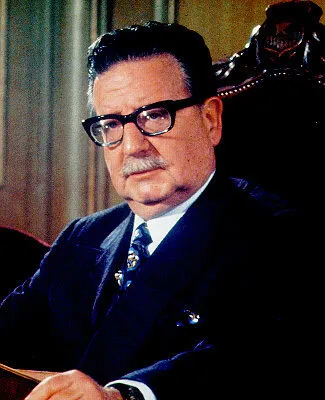
Salvador Allende
Human Design Chart
Biography
He allegedly committed suicide during a military coup on 11 September 1973.
Salvador Allende — Projector with Profile 1/3
Projector 1/3 — Design at a Glance
Salvador Allende was someone with a focusing aura that immediately recognized system errors. His design acted like a bright flashlight pointing directly to places where others were malfunctioning or in the dark. This ability to quickly identify faults in the system was characteristic of his Projector type.
The challenge lay in not shining this light directly into another's face, which often provoked rejection. Instead, he worked most effectively through leading by example: By radiating harmony himself, he attracted others who then actively sought out his insights. The central strategy was to wait for a genuine invitation. This prevented bitterness, his specific non-self theme that arose when going against the flow or not being recognized.
Since Projectors do not have a constant source of life energy, Salvador Allende needed regular rest phases to avoid burning out. Traditional systems often ignored this need. However, living according to his design and waiting for invitations rewarded him with success. His essence was to illuminate others' paths, not through direct confrontation but by attracting clarity and guiding patiently.
Splenic Authority
Salvador Allende exhibited a decision-making structure based on a subtle, momentary impulse: his Spleen Authority. His design required the highest vigilance towards this inner signal that acted as spontaneous knowledge about health and survival. With his open Emotional and Sacral Centers – a prerequisite for this authority in Projectors or Manifestors – his intuition and physical well-being served as a reliable compass to determine if a situation or environment was right.
This Spleen impulse occurred only once at the moment and could easily be drowned out by external influences. Therefore, Salvador Allende often withdrew to gain clarity and avoided rigid long-term planning in favor of flexibility. His first impulse was considered the correct path for self-care and rigorous boundary setting against harmful factors. Plans changed frequently as he knew what served him only in the present moment. This created a need for much free space; spontaneous actions were more effective for him than firm commitments. Thus, his inner authority lay in the ability to distinguish in the here and now what was beneficial and what wasn't, with this fine instinct requiring constant attention not to be lost.
The 1/3 Profile — Investigator / Martyr
Salvador Allende's design laid a tendency towards an intensive learning process based on trial and error. His Profile 1/3, the Researcher/Experimentor, defined his life task as continuous interaction between thorough theoretical examination and practical testing. Line 1 of his design emphasized the need for a pause to concentrate; it required silence and energy conservation before any action to avoid an early, wasteful release. This aspect created internal pressure to commit only after careful consideration. Simultaneously, Line 3, represented by Gate 17, called for active experimentation and detailed work. The key to understanding lay here: Only through direct engagement with connections and experiencing the consequences of his actions could Allende gain true insights. Shortcuts were counterproductive in this system as they limited the value of his judgment and neglected important details. His credibility emerged only through this synthesis – when he took a position, it had been thoroughly tested both theoretically and practically. This configuration described someone who did not merely accept knowledge but had to work at acquiring it themselves, with Line 3 ensuring that mistakes were integrated as necessary teachers rather than avoided.
Split Definition — Defined & Open Centers
Salvador Allende's Human Design profile indicated a tendency towards consequent, conceptual clarity. His defined Ajna Center provided consistent thinking and the ability to develop concepts independently of external pressure. This combined with his defined Throat Center: He spoke what his mind conceptualized, showing his communication as a trustworthy yet limited form of manifestation.
His defined G Center gave him a firm sense of self-identity and clear direction. He knew who he was and where he stood without needing to impose this on others – provided he respected his inner authority. Parallel to this, his defined Spleen and Root Centers shaped his existence: The Spleen Center delivered spontaneous, intuitive warning signals in the present moment, while the Root Center supplied the necessary pressure for survival and material functioning. This combination created a foundation of intuitive security and physical endurance.
In contrast to this inner structure stood his open centers as mirrors of the environment. His open Head Center made him vulnerable to mental confusion and the pressure to find answers to questions that were not his own concern. He tended to get caught in intellectual whirlpools when trying to resolve others' uncertainties. The open Heart Center led to a tendency to want to prove his worth through promises or competition – a cycle of self-doubt, as he lacked the consistent energy for voluntary assertion.
Furthermore, his open Sacral Center reflected the life force of his environment. He could rely on "borrowed" energy, leading to overexertion and exhaustion if he did not pause. His open Solar Plexus absorbed and amplified foreign emotions; he tended to personalize these as his own instability or avoid confrontations out of fear of rejection. The challenge lay in not identifying with these reflected states – mental doubts, emotional waves, and energetic overload – but rather perceiving them as external information while trusting his defined inner structures.
Channels for leadership, acceptance and critical judgment.
Salvador Allende's Design indicated a tendency towards collective leadership based strictly on logical pattern correction. He demonstrated himself as someone who exercised his authority not through absolute rule but by inviting society to participate. This configuration created tension between the inner drive for perfection and dependence on external validation for implementing his visions.
Channel of the Alpha Animal 7-31 connected the G Center with the Throat Center via Gate of the Role of Self (7) and Gate of Leading (31). This was the design of logical, collective leadership looking towards the future. Logical leadership relied on tested patterns that one could follow with certainty. Gate 31 acted as a collective leader whose voice had valuable influence, while Gate 7 provided the logical role to guide society—often described as the power behind the throne. Salvador Allende needed to gain trust and demonstrate his competence to the satisfaction of society. He could only show the way, not walk it himself; success occurred when he was elected by the majority to represent them.
Channel of Judgment 58-18 connected the Root Center with the Spleen Center via Gate of Vitality (58) and Gate of Correcting (18). This nurtured an insatiable urge to question, correct, and perfect patterns. Gate 58 drove a love for life ("better and more"), while Gate 18 restrained by pointing out imbalances. This channel acted like a sentry judging whether what was perceived served the well-being of the collective. Salvador Allende sought solutions applicable to society and found joy when asked: "Is something wrong here?"
Channel of Accepting 17-62 connected the Ajna Center with the Throat Center via Gate of Opinions (17) and Gate of Details (62). Logic influenced thought processes here by organizing information mentally. Gate 17 visualized patterns, while Gate 62 translated them into language and gave meaning. Salvador Allende had the ability to effectively communicate detailed visual patterns as theories or hypotheses. Successful timing and clarity occurred when he waited to be invited to speak, which reduced resistance.
Collective Circuitry — Circuit Signature
Salvador Allende's Human Design profile indicated a tendency towards analytical clarity that could only unfold through encounters with others. His structure was marked by a split definition: two energetically isolated blocks existed in parallel without direct inner flow. The first block connected the Ajna, Throat, and Identity Centers; here lay the power to formulate rational concepts and carry them outward verbally or structurally. The second block included the Spleen and Root Centers, providing an intuitive ability to recognize risk and survive in critical moments.
This separation meant that Salvador Allende could not create a connection between strategic planning (Ajna/Throat) and intuitive danger awareness (Spleen/Root) from within himself. The energy of the Understanding Circuit – aimed at sharing logical insights for societal improvement – became effective only when he interacted with people who bridged this gap. It was an "emotionless ratio," free from conditioned feelings, focused on logic and future visions. Channels of Acceptance (17-62), Alpha Animal (31-7), and Judgment (18-58) formed the foundation: He sought truth within himself, accepted others' reality, and exercised clear judgment. This mechanism required constant exchange processes to unite the separated energetic poles into a functional strategy.
Right Angle Cross of Service 2
Salvador Allende's Human Design profile featured the signature of the right cross of service. This configuration established a fundamental disposition in which his own work was inseparably linked to the well-being of others. It wasn't an optional behavior but rather a structural imprint: His innermost self sought ways to serve and found its validation only when this service was accepted and proved useful.
The right cross of service describes a specific energy alignment within Human Design. People with this manifestation often experience their life mission as a call to feel obligated towards others. The focus is less on personal fame or individual greatness, but rather on fulfilling a role that stabilizes or enhances the environment around them. Salvador Allende was marked by this mechanism; his actions were driven by the necessity to contribute beyond himself.
This structure created an inner discipline. It required him often to place his own needs behind those of service, not out of self-denial but because it appeared natural and right for his system. The energy of this cross acted like a compass guiding him where support was needed. Salvador Allende lived in the tension between the desire for personal expression and the deep conviction that his worth only came to full fruition through serving others. This shaped his entire aura and manner of engagement.
Projector · Splenic Authority — Synthesis
Salvador Allende was a Projector whose life was marked by a profound need to bring 'light into darkness' for others. His design showed an acute ability to identify errors and imbalances in systems (Gate 17/62), combined with logical thinking (defined Ajna Center) and a strong sense of direction (defined G Center). This constellation led him to analyze patterns, suggest improvements, and point out potential course changes – always aiming to positively influence the collective future. His Spleen Center as Authority pointed towards a fine intuition that helped him recognize what was right for him in the present moment and distance himself accordingly. The combination of mental sharpness and instinctive perception created a person who acted both analytically and intuitively.
Allende's design, however, contained a central paradox: He was destined to act on invitation (Projector Strategy) while his defined Throat Center simultaneously equipped him with a strong urge for communication and manifestation. This led to tension between the need to express his insights and the necessity of waiting for others' readiness. This inner conflict manifested in his pursuit of change – an unstoppable desire to make things better, coupled with the challenge of effectively exercising influence without causing resistance.
3 Defined Channels
Incarnation Cross - Right Angle Cross of Service 2
Solar Return
The Solar Return shows the moment when the sun returns to its exact birth position - your personal solar year.
Life Cycles
Discover the life cycles with a detailed triple view (birth chart, cycle chart, composite).
Human Design Profile
- Type
- Projector
- Strategy
- Wait for the respectful invitation
- Authority
- Splenic Authority
- Profile
- 1/3 - Investigator / Martyr
- Definition
- Split Definition
- Incarnation Cross
- Right Angle Cross of Service 2
- Date of Birth
- 26.06.1908 01:30
- Place of Birth
- Santiago, Chile
Frequently Asked Questions
What was Salvador Allende's Human Design type?
What Profile did Salvador Allende have in Human Design?
What Authority did Salvador Allende possess?
What incarnation cross did Salvador Allende have?
When was Salvador Allende born?
Discover your own Human Design
Are you also a Projector? Find out in a personal reading how to unfold your leadership qualities and recognize the right invitations.
More Personalities
Back to overviewSissy Spacek

Alain-Fournier

Anémone

Ann-Margret

Bourvil
Hergé