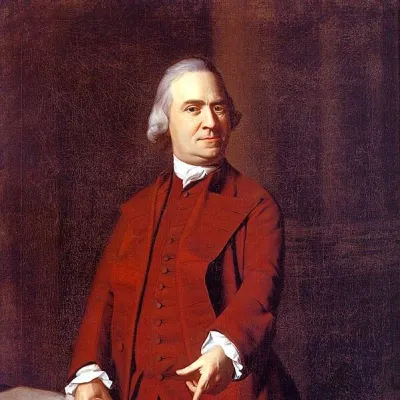
Samuel Adams
Human Design Chart
Biography
Samuel Adams was a founder of the Sons of Liberty and was a principal in the protest against the Stamp Act and in the protest known as the Boston Tea Party. He wrote prolifically in protest of British rule before and during the Revolutionary War. As a member of the Massachusetts Assembly, he advocated for a Continental Congress. After its formation he was appointed a representative.
In 1789 he was appointed lieutenant governor of the state of Massachusetts. Five years later, in 1794, he was elected Governor, a seat he held until his retirement in 1797. He died on 2 October 1803 in Boston, age 81. Boston's Republican newspaper the Independent Chronicle eulogized him as the "Father of the American Revolution".
What does Generator 1/3 mean for Samuel Adams?
Generator 1/3 — Design at a Glance
Samuel Adams had a high, enduring sacral energy. His design indicated that he was most effective when reacting to external impulses rather than initiating actions himself. As a Generator, his function was designed to wait for life signals and respond with clear inner confirmation – the "yes" from the gut. This responsiveness allowed him to make things happen in the material world, but only in harmony with this principle.
The mechanics show: When Samuel Adams listened to such signals and acted accordingly, he was rewarded with deep satisfaction. His energy level remained stable because he did not work against his natural flow. Conversely, ignoring this inner guidance or constantly initiating actions without prior signals led to frustration and energy loss. Two main risks characterized this profile: Either he spent his strength on tasks that did not internally engage him – leading to eventual exhaustion – or he was prevented from pursuing his heart's project despite the internal drive to continue.
Samuel Adams’ strength lay in enduring at things that triggered his sacral resonance. By reacting rather than compulsively acting, he utilized his full potential for materializing his goals without depleting himself. His energy was a tool that worked sustainably through proper application – waiting and responding.
Sacral Authority
Samuel Adams showed a decision-making stance that did not occur in the Head Center but deep within his body. His design determined that his inner authority is guided exclusively by the defined Sacral Center – a configuration unique to the Generator type. This fundamentally simplified his process: strategy and authority aligned. He had to wait for external stimuli to react authentically.
This mechanism manifested physically as an immediate gut feeling or a noticeable surge of energy when in resonance. Samuel Adams learned to pay attention to bodily signals like grunts, hums, or a nodding "Mhm." When these appeared, he felt vital and energized; their absence quickly drained his enthusiasm for the task at hand. His goal was not to fulfill purposes but to immerse himself with joy and satisfaction in activities that nourished his energy.
Crucial for Samuel Adams was the discipline of shutting off his mind. Intellectual deliberations often led him astray and wasted his energy. Only by trusting this sacral reaction could he make authentic decisions. When his Spleen Center was also activated, it supported his instinctive perception and enabled quick, spontaneous reactions based on physical well-being. Thus, waiting for the right impulse became a source of inexhaustible vitality rather than a source of frustration from forced actions.
The 1/3 Profile — Investigator / Martyr
Samuel Adams revealed himself as someone whose life revolved around the interplay of theoretical knowledge and practical application through trial and error. His design shows a tendency that arises from Profile 1/3: both researcher and experimenter. Line 1 demanded periods of withdrawal for regeneration and clarity, while Line 3 required social interaction and self-analysis. This dynamic created an internal tension between the need for solitude to renew himself internally and the drive to prove himself in the world.
His judgment was only trustworthy when he had examined something both theoretically and practically. When Samuel Adams deemed something as correct or good, it meant that he had tested it thoroughly; his judgment was based on self-earned insights. The fear of insufficient knowledge could block implementation, as there would be a feeling of not knowing enough yet. However, errors were necessary for his learning process, as they legitimized his competence. The process of self-analysis in the context of social interactions was characteristic of him, with uncertainties often arising in social contacts as part of the learning process. His life was marked by this constant alternation between withdrawal to gain knowledge and active experimentation in the outside world.
Split Definition — Defined & Open Centers
Samuel Adams revealed himself as someone whose mental concepts were directly translated into speech and action, supported by a clear internal direction. His design indicated a tendency towards constant energy presence: The defined Ajna Center ensured consistent conceptual thinking, which was reliably articulated through the direct connection to the defined Throat Center. This mechanism allowed him to express what he thought and set it out in the world without mental blockages.
At the same time, Samuel Adams possessed an enormous vital source in his defined Sacral Center. This motor generated daily energy, but it was only correctly activated by reacting to external impulses – not through initiation. The tension lay in that his active mind often wanted to force actions before the Sacral Center had responded. If he followed this mental urgency instead of waiting, he risked frustration and energy loss. His strength was intuitive perception in the defined Spleen Center, which helped him recognize what was healthy in the moment and protected against false statements. This was complemented by the defined G Center, which gave him a firm identity and sense of direction independent of external expectations.
In contrast, Head, Heart, Solar Plexus, and Root Centers were open. Samuel Adams had no constant internal source for inspiration, willpower, or emotional stability. These areas acted as mirrors to the environment. He tended to question whether he was valuable enough or if he needed to meet others' demands, although these feelings did not stem from his own design. The open Heart Center made him vulnerable to wanting to prove his worth through performance, which ended in a cycle of promises and disappointment. The open Solar Plexus Center absorbed the emotions of others, so he often felt emotionally out of control despite dealing with foreign moods. Similarly, the open Root Center took on external stress, leading to feelings of chaos that did not match his own nature. By accepting these open areas as mirrors rather than personal reality and trusting his sacral response, he could effectively use his defined energy.
Channel 15-5: The Rhythm — Channels & Gates
Samuel Adams was marked by a deep intuitive self-acceptance that made his behavior appear authentic and independent. This attitude stemmed from the Channel of Exploration 34-10, which combines inner strength (Gate 34) with the need to honor one's essence and love oneself (Gate 10). This created a foundation of trust in personal convictions.
This self-love was solidified through the Channel of Perfect Form 57-10. Here intuitive awareness from the Spleen (Gate 57) guided immediate action to ensure physical well-being and existential security. Samuel Adams acted spontaneously and appropriately to his environment, free from future anxieties, allowing him to move through the world unburdened.
Parallel to this, the Channel of Rhythm 5-15 radiated a universal life flow. Gate 5 held fast to fixed habits and rituals while Gate 15 leveled an impersonal playing field with its love for human diversity in extremes. This biological rhythm drew others into his energy flow impersonally and determined the course of social surroundings through a natural, logical rhythm.
Individual survival intelligence was reinforced by the Channel of Power 34-57. The generative life force from the Sacral Center (Gate 34) strengthened existential vigilance in the Spleen (Gate 57). This created an archetype that alerted to danger and secured survival through spontaneous reaction. Samuel Adams was acoustically alert and physically fit, protected by this intuitive blend of sacral power and spleen-based insight.
Additionally, Gates like Gate 11 (Ideas) and Gate 56 (Inspiration), which fostered a curious search for new perspectives, as well as Gate 28, which enabled decisions in the here and now through risk-taking readiness. These configurations together created a design based on individual vitality, intuitive adaptability, and a magnetic rhythmic flow that integrated others into his life rhythm.
Individual Circuitry — Circuit Signature
Samuel Adams exhibited a basic stance of inner strength and personal constancy. His design connected the Sacral Center with the Identity Center through the Focusing Circuit (Channel 10-34: Exploration). This configuration promoted a pulsating, present energy that supported strong personal convictions and self-worth. Since this circuit did not connect to the Throat Center, these deep internal certainties often remained unspoken; Samuel Adams strengthened others by his mere presence in their uniqueness rather than verbally instructing them.
Parallel to this, the Understanding Circuit (Channel 15-5: Rhythm) also connected the Sacral Center with the Identity Center. Here it was about focused rational structures and the desire to order logical insights for the future – emotionally detached and strategically.
A separate, parallel existing current was the Meaning-Finding Circuit (Channel 11-56: Curiosity). It linked the Ajna Center with the Throat Center and channeled cyclical emotional waves from the past into verbal communication. This allowed Samuel Adams to articulate felt experiences and historical contexts, thereby promoting collective learning.
Additionally, Integration (Channels 10-57: Perfect Form, 34-57: Power) shaped his survival. It connected Identity Center, Sacral Center, and Spleen. From this he drew strength through intuitive reactions to life and acted self-determinedly in the present moment. These shared definitions created two independent, parallel energy fields for Samuel Adams: one of inner, unspoken identity and one of emotional-communicative meaning-finding.
Right Angle Cross of Eden 3
Samuel Adams was marked by the Eden 3 Right Cross configuration, which placed a specific archetypal dynamic into his design. This structure did not dictate daily routines but rather acted as a deeper, often unconscious power line influencing his inner orientation and reactions to life circumstances.
The Eden 3 Right Cross is not a single energy or an isolated point in the Human Design system, but a complex assembly of several channels and gates. It describes a particular 'fate thread' or thematic foundational stance that runs throughout one's entire life. Those who carry this cross often move within a tension between the desire for individual autonomy and responsibility towards larger connections or communities.
For Samuel Adams, this meant that his decisions and life path were carried by this archetypal dynamic. It was not a consciously chosen program but an energetic template that favored certain patterns while making others more difficult. The constellation created a backdrop against which his personal challenges and drives played out. It lends the personality a certain depth and complexity as it integrates several different energies, sometimes in harmony, sometimes in internal debate. Samuel Adams thus lived within this framework, whose specific nuances were evident in how he dealt with freedom, structure, and his role concerning others.
Saturn Return · Uranus Opposition · Chiron Return · 2nd Saturn Return — Life Cycles
Samuel Adams’ design suggested a structure marked by recurring phases of inner consolidation and outer upheaval. His path followed a rhythm of discipline, sudden change, and profound meaning-making. The first Saturn Return often signaled the beginning of a serious engagement with responsibility and structure; here, groundwork solidified into stable foundations. This phase laid the groundwork for subsequent years.
With the Uranus Opposition came a period of disruption. Existing patterns were challenged, leading to necessary but unpredictable changes. It was not about chaos but the dissolution of outdated structures to make way for new ones. This process was essential to breaking rigid stances and gaining flexibility.
The Chiron Return marked the peak of this cyclical development. During this time, considered a fulfillment phase, one's incarnation cross unfolds increasingly in life. If Samuel Adams followed his inner strategies, here meaning and purpose became experiential – not as healing old wounds but as the blossoming of personal potential. It was a moment of integration where previous experiences from Saturn discipline and Uranus change coalesced into a coherent life stance.
The second Saturn Return crowned this process. It solidified gained insights and created a new, mature structure. Thus, Samuel Adams’ design shows a clear path: from initial order through disruptive upheavals to meaningful blossoming and finally stable maturity. Each cycle contributed to deepening his inner authority and clarifying his life mission.
Generator · Sacral Authority — Synthesis
The central red thread in this design is the dynamic interaction between internal perception and external expression. The strong sacral foundation, paired with a defined throat and G Center, points to someone deeply rooted in their body and having a clear sense of direction. This energetic base is expanded by the open centers of consciousness and emotion – constantly taking in and processing information from the environment without leading to inner fixation. Instead, it allows for flexible adaptation to new stimuli as long as sacral authority serves as a compass. The numerous channels connecting the Sacral Center underscore the importance of reaction and living within the flow of energy.
The central paradox lies in the tension between the need for internal clarity and openness to external influences. While the defined G Center sets a firm identity and direction, the open centers are constantly engaged in taking in and processing information from the environment. This can lead to feelings of confusion or being overwhelmed if sacral authority does not serve as a filter. The ability to react spontaneously to life stands thus in contrast to the necessity of protecting oneself from excessive external influences and preserving one's inner truth.
5 Defined Channels
Incarnation Cross - Right Angle Cross of Eden 3
Solar Return
The Solar Return shows the moment when the sun returns to its exact birth position - your personal solar year.
Life Cycles
Discover the life cycles with a detailed triple view (birth chart, cycle chart, composite).
Human Design Profile
- Type
- Generator
- Strategy
- To respond - wait for something to respond to
- Authority
- Sacral Authority
- Profile
- 1/3 - Investigator / Martyr
- Definition
- Split Definition
- Incarnation Cross
- Right Angle Cross of Eden 3
- Date of Birth
- 16.09.1722 12:00
- Place of Birth
- Boston, MA, United States
Frequently Asked Questions
What is Samuel Adams' Human Design type?
What Profile does Samuel Adams have according to Human Design?
What Authority does Samuel Adams possess?
Which incarnation cross is assigned to Samuel Adams?
When was Samuel Adams born?
Discover your own Human Design
Are you also a Generator? Find out in a personal reading how to use your sacral energy correctly and discover deep satisfaction.
More Personalities
Back to overviewAaliyah

Alexia

Angèle

Anne-Marie

Arcángel

Arno