Scott Adams
Human Design Chart
Biography
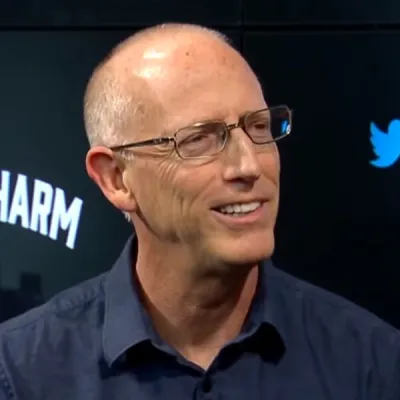
Adams grew up in the Catskill mountain region of New York State. He graduated from high school as valedictorian of his class and in 1979 earned his B.A. in economics at Hartwick College in Oneonta, New York. He earned his M.B.A. at the University of California at Berkeley in 1986. Additionally he attended Clement School of Hypnosis and in 1981 became a certified hypnotist.
From 1979 to 1986, Adams worked at Crocker National Bank in San Francisco where he held, in his words, a number of humiliating and low paying jobs. During his stint as a teller, he was robbed twice at gunpoint. He moved on, taking a position at Pacific Bell where he did various jobs of a technical and financial nature through June 1995. In 1989, he began drawing Dilbert, a composite of Adams’ co-workers over the years. Adams continued to work his day job while spending all his free time drawing the comic strip. He got many of his ideas from fans who sent him their stories citing managerial incompetence.
In 2023, Dilbert was dropped by numerous independent newspapers as well as its distributor, Andrews McMeel Syndication (which owns GoComics, from where the comic was also removed), after Adams published a video where he called Black Americans who disagreed with the slogan "It's okay to be white" a "hate group" and said White Americans should "get the hell away from" them. The video was widely described by sources such as The Economist and Reuters as containing "racist comments" and being a "racist rant". Adams stated that he disavows racism.
Scott Adams as a Manifesting Generator 1/3 in Human Design
Manifesting Generator 1/3 — Design at a Glance
Scott Adams was a Manifesting Generator. His design combined the constant energy of the Generator with the direct action of the Manifestor, allowing him to skip steps and achieve results quickly. However, this configuration created central tension: his natural speed often threatened to bypass important processes or scatter him across parallel projects.
As a hybrid type, Adams had sacral energy that relied on reaction rather than initiation. He was only successful when he waited for external impulses and checked his inner authority—the clear 'yes' of the sacrum. Ignoring this confirmation led to overflowing activity quickly resulting in frustration, his specific non-self theme. Often, he then had to backtrack to catch up on missed steps.
However, strictly adhering to his strategy transformed this dynamic. Adams found deep satisfaction in creation, especially when pursuing multiple things simultaneously. For him, the advice to finish one thing before starting another was counterproductive. Instead, his creativity flourished in a 'play mode,' driven by variety and enjoyment of the process. His productivity relied on accepting impulses, sacral validation, and then implementing them with characteristic MG speed without being constrained by linear expectations.
Emotional Authority
Scott Adams exhibited an internal decision-making structure that required time as a necessary filter. His defined Emotional Center served as authority, meaning his perception was always colored by a wave-like mood movement. The world appeared to him either in highest excitement or deep skepticism at any moment; however, this first impression was only a provisional snapshot, not the final truth. Spontaneous reactions to these intense emotional outbursts proved unreliable and carried the risk of negative consequences.
The mechanics of his emotional authority dictated a clear process: decisions could not be made in the heat of the moment but had to mature. Scott Adams needed time for the strong waves to subside. This required patience and conscious 'pondering'—repeatedly thinking over or sleeping on questions until an emotional distance grew. Only when initial intensity subsided and calm set in did true clarity emerge for him. This cycle of mood swings was not a barrier but the essential tool to gain deeper insights. Through this waiting, he filtered out temporary emotional coloring and arrived at well-founded judgments that positively influenced his life path.
The 1/3 Profile — Investigator / Martyr
Scott Adams lived Profile 1/3, the Researcher and Experimenter. His design set a tendency to collect knowledge not just theoretically but through active experimentation and acceptance of errors. This configuration created an inner tension field: Line 1 drove him to seek more information constantly and strengthen himself through education, while Line 3 fostered the urge to act—also when knowledge was incomplete.
For Scott Adams, the path of 'trial and error' was indispensable. The mechanics showed that only through practical experience and overcoming fear of ignorance did truly trustworthy judgments emerge for him. His Line 1, marked by themes like instruction and community promotion, helped him attract forces and structure knowledge. Simultaneously, Line 3 with its emotional energy and openness introduced the factor of enchantment. This was not a quick process but a long development through connections and their dissolution.
The result of this synthesis between theoretical foundation (Line 1) and practical testing (Line 3) were self-earned insights. When Scott Adams held an opinion, it was based on double validation: it had been both intellectually thought out and tested in real life. This made his conclusions absolute references as they overcame the hurdle of mere theory and proved themselves in practice.
Split Definition — Defined & Open Centers
Scott Adams revealed himself as someone with an extremely high, constant energy presence and a strong aura. His design indicated a tendency towards massive reactive life force energy paired with the ability to reliably express mental concepts. This structure created a solid core of clear identity and emotional depth.
Five of his centers were defined: Ajna (mental consciousness), Throat (communication), G Center (identity), Sacral (vital energy) and Solar Plexus (emotional consciousness). His defined Sacral Center generated an enormous daily power source, which was only activated through correct reactions to external impulses. Adams was a Generator; his strategy involved waiting and reacting rather than initiating. The immediate yes or no feeling from his gut revealed whether energy was available for a task.
At the same time, his defined Solar Plexus Center as inner authority required patience. Decisions could not be made in the moment; he had to wait out the ups and downs of the emotional wave to gain clarity. Only then would the truth of a situation emerge. Through the connection between Ajna and Throat, he was able to consistently and reliably articulate his mental concepts and theories once he reacted. His defined G Center gave him a reliable self-identity and sense of direction without being dependent on others.
In contrast, four centers were open: Head, Heart, Spleen and Root. These mirrors absorbed inspiration, willpower, health signals, and stress from the environment. Adams tended to get caught up in mental monologues about questions that weren't his own or felt pressure to find answers. His open Heart Center led him not to be driven by willpower; he did not seek proof of his worth through promises but oriented himself based on confirmation of his energy. The open Spleen Center made him vulnerable to fears and the need to seek security from others, while the open Root Center absorbed external stress. Adams had to learn to recognize this pressure as non-self in order to avoid hyperactivity or burnout. His strength lay in placing his inner authority – emotional clarity after the wave and sacral reaction – over these external influences.
Channels for rhythm, emotional openness and structured insight.
Scott Adams was driven by a deep internal rhythm. The Rhythm Channel 5-15 connected his Sacral Center with the G Center, generating a magnetic life flow through firm habits (Gate 5) and love for extreme human expressions (Gate 15). This impersonal magnetism drew others into his rhythm as long as he did not resist his natural reactions. However, his communication followed emotional waves rather than social constants. Through the Openness Channel 22-12 between Solar Plexus and Throat Center, he only showed mutative behavior socially when the mood was right. Gate 22 brought passion and drama while Gate 12 ensured a cautious filtering to unleash maximum transformative potential. Coercion here led to harshness; patience allowed him to emotionally touch others through his voice and initiate change.
His mind worked associatively and often ahead of time. The Structuring Channel 23-43 connected Ajna with the Throat Center, processing spontaneous insights (Gate 43) efficiently expressed (Gate 23). These 'light-years-ahead' perspectives required time to be understood by the collective; false timing led to rejection. The driving force behind this efficiency search came from Gate 45, the Gate of Tribal Level and Energy, channeling willpower from the Heart Center for tribal cohesion. This was complemented by Gate 26 in Ego, integrating innovations into the conservative tribe to prevent genetic retardation. Gate 47 helped him distill meaning from past experiences while Gates like 9 and 62 supported detail work and logical pattern recognition. Adams' design showed a person driven forward through rhythmic vitality, emotional timing, and structured innovation without breaking the natural logic of the flow.
Individual Circuitry — Circuit Signature
Scott Adams was marked by two separate yet parallel operating energetic systems. On one hand, the Knowledge Circuit dominated, linking his emotional creativity with individual identity. This circuit connected Ajna, Throat, and Solar Plexus Centers in him. The active channels here brought structured openness and a drive to express new insights through emotional waves. This created a pulsating, often melancholic creativity aimed at effecting change through self-expression.
Completely independently, the Understanding Circuit operated. It linked his identity with the Sacral Center, providing focused rational strategy and logical progress. Here, emotionless reason was in the foreground, driven by a clear rhythm and future focus. This energy served to improve things and share insights free from conditioning.
As Scott Adams had a Shared Definition, these two systems – emotional transformation on one side, cool logic on the other – remained energetically separate. They did not flow into each other but existed alongside each other. This configuration required external validation or resonance from the environment to integrate the tensions between impulsive creative expression and disciplined rational planning. Scott Adams lived in this constant balance: his design offered him both intuitive inspiration and strategic mind, yet only through external validation could he effectively combine and utilize these complementary forces.
Right Angle Cross of Rulership 2
Scott Adams’ design featured the configuration of the right-hand cross of governance. This marked him as someone who did not primarily exercise leadership through direct commands but rather through adept structuring and delegation. His approach focused less on merely the 'what' of a goal, more on the strategic 'how'. He was effective by utilizing systems and integrating other individuals into his sphere of influence to achieve larger goals.
In Human Design, this cross describes a specific mechanism of authority. It is not about charismatic dominance in the traditional sense but rather the ability to exercise power through organization. The energy flows through channels that connect planning with implementation and strategy with tactics. Those who carry this configuration naturally tend to delegate responsibility and set up processes so that results emerge without constant personal intervention. Scott Adams lived this dynamic by focusing on the architecture of his influence. He understood how to arrange resources and people in such a way that the entire system worked for him. This kind of governance requires a deep understanding of how different elements work together to achieve a common goal. It was less about individual strength and more about an intelligent networking of forces and structures.
Saturn Return · Uranus Opposition · Chiron Return · 2nd Saturn Return — Life Cycles
Scott Adams demonstrated a clear structuring of his life phases, influenced by planetary cycles. His design suggested that he experienced fundamental turning points at certain ages, where long-term developments condensed or new directions were taken.
In 1986, at the age of 29, Scott Adams completed his MBA in Management at the University of California, Berkeley. This fell during his first Saturn return period. Often, years of groundwork condense into solid results during this cycle; here, the academic achievement marked a firm milestone that strengthened and structured his professional foundation.
Ten years later, in 1997 at age 40, Scott Adams received the Reuben Award as Cartoonist of the Year. This timing coincided with his Uranus opposition. While Saturn brought stability, this opposition often ushered in phases of upheaval and reorientation. The award not only signaled success but also confirmed a new identity beyond his earlier management career. The cycle supported the transition to his true creative strength by questioning old structures and opening new paths. Thus, his design showed a dynamic where fundamental security was first built up before transformative forces steered him into his specific role as a cartoonist.
Manifesting Generator · Emotional Authority — Synthesis
Scott Adams’ life was marked by an inner dynamics arising from the combination of his manifesting generator strategy and emotional authority. He responded to impulses (Sacral Center), but needed time to filter these through the emotional wave before bringing them into the world (Throat Center). This process led to a unique ability to recognize patterns (Gate 62) and develop innovative ideas (Channel 43-23), which he then communicated with his expressive power. The connection of creativity and strategic thinking seems to have been a central element of his work, strengthened by the energy of the Knowledge Circuit.
A fundamental paradox in Scott Adams’ design lay in the tension between his ability to quickly initiate things (manifesting generator) and the need for emotional maturation (emotional authority). While he may have tended towards pursuing multiple projects simultaneously and implementing ideas rapidly, his inner wisdom required time to gain clarity and weigh the long-term consequences of his actions. This discrepancy between speed and emotional depth seems to have been a constant challenge that forced him to continually review and adapt.
3 Defined Channels
Incarnation Cross - Right Angle Cross of Rulership 2
Solar Return
The Solar Return shows the moment when the sun returns to its exact birth position - your personal solar year.
Life Cycles
Discover the life cycles with a detailed triple view (birth chart, cycle chart, composite).
Human Design Profile
- Strategy
- To respond - wait for something to respond to
- Authority
- Emotional Authority
- Profile
- 1/3 - Investigator / Martyr
- Definition
- Split Definition
- Incarnation Cross
- Right Angle Cross of Rulership 2
- Date of Birth
- 08.06.1957 02:30
- Place of Birth
- Windham, NY, United States
Frequently Asked Questions
What was Scott Adams' Human Design type?
What Profile did Scott Adams have in Human Design?
What Authority did Scott Adams possess?
What incarnation cross did Scott Adams have?
When was Scott Adams born?
Discover your own Human Design
Are you also a Manifesting Generator? Find out in a personal reading how to unfold your multi-talents and direct your energy wisely.
More Personalities
Back to overviewAldair

Alizée

Angeli

Arletty

Artus

Balthus