
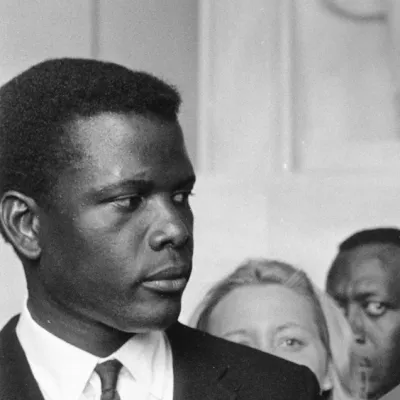
Sidney Poitier
Human Design Chart
Biography
Born in Miami, Florida, Poitier grew up on Cat Island in the Bahamas, the youngest of seven kids. His dad was a tomato farmer and his mom, Evelyn, was a shy, sensitive woman with whom he was very close. He credited her for teaching him to use "please," and "thank you," and "may I?" as the tools to get his foot in the door. When he was done with his chores he spent a lot of time by himself just roaming around, walking the beaches and relating with the elements, the birds and the trees. He had little formal education, entering school when he was 11 and finished a year and a half later. He could barely read and write.
At 15, he went to live with his brother in Miami where he first encountered racism. Finding this incomprehensible, he challenged it, heading North to New York at 16. He slept on the roof of the Brill Building and got a job washing dishes. He'd never seen a subway or an elevator and couldn't dial a telephone. When he was arrested for sleeping in Pennsylvania Station, he joined the army, lying about his age.
After being discharged, he returned to New York to wash dishes. He answered an ad at the American Negro Theatre, telling them that he was an actor and making up a study history. The ruse failed and he was thrown out. Not accepting defeat, he spent months listening to voices on the radio to overcome his accent and he learned to read from a waiter where he worked. He then persuaded the American Negro Theatre to take him on as a student, making a deal to be their janitor.
Poirier's first break came when he was understudying for Harry Belafonte in Days of Our Youth.
What does Manifesting Generator 2/4 mean for Sidney Poitier?
Manifesting Generator 2/4 — Design at a Glance
Sidney Poitier's design tended towards hybrid action: He had the constant energy source of a Manifesting Generator but also the ability to skip steps and quickly draw results into his life. As a Manifesting Generator, he primarily responded to inner impulses from the sacral center rather than taking initiatives from outside. This structure allowed him to push multiple projects forward simultaneously if there was internal agreement.
However, this type's mechanics carry specific risks: The high speed occasionally led to overlooking important intermediate steps. In such cases, he had to backtrack and make up for missing stages, which could cause frustration – a classic sign that the strategy wasn't followed. Additionally, his energy tended to spread across various impulses simultaneously. If these parallel activities were pursued without constant verification of inner authority, the joy of creation quickly turned into exhaustion.
Deeper satisfaction came when Sidney Poitier activated the "Play Mode" and sought variety. The pressure to complete one thing before starting another stood against his nature. Instead, he gained strength by responding to what brought him joy in that moment and regularly checking if his projects still resonated with his inner truth. This balance between quick implementation and conscious reaction significantly shaped his work.
Emotional Authority
Sidney Poitier's design tended towards emotional wave movements. His inner authority was the defined Emotional Center – a mechanism that always took precedence over other definitions when making decisions. He was subject to constant ups and downs of his feelings; the world appeared colored by his current mood. In one moment, he could show total enthusiasm, in the next, the same situation negatively evaluated. However, his immediate feeling was only a snapshot, not an ultimate truth claim. Quick, spontaneous decisions based on such emotion often had negative consequences.
The mechanics of his emotional authority required patience: The more time he took to let a decision mature, the deeper and broader could he perceive. This involved consciously sleeping over choices and being willing to ask himself multiple times. Over time, intense feelings subsided, emotional distance gained strength and clarity as well as calmness set in. Only then was the decision-making process complete. This process was primarily relevant for long-term decisions that had a significant impact on his life course. Sidney Poitier lived this necessity of waiting; his strength did not lie in immediate reaction but in the ability to let an emotional storm subside before acting.
The 2/4 Profile — Hermit / Opportunist
Sidney Poitier's design tended towards a pendulum rhythm between deep withdrawal and the need for close community. As a 2/4 Profile, he constantly oscillated between Line 2, which demanded solitude and self-reflection, and Line 4, which required spending time with familiar people. This tension required clear communication of his boundaries: He had to signal when he sought company and when he wanted to be left alone. During his "Me-Time," he immersed himself in internal processes to gain clarity. Once this inner balance of Line 2 was established, he returned from his "cave" to connect with his network.
This cycle allowed him to reflect on the knowledge of his environment during solitary times and develop brilliant ideas from it. His emotional mindset (Gate 55, Line 2) projected outward, making him susceptible to mood swings; his balance often depended on others' trust. Simultaneously, he possessed through Gate 34 (Line 4) a transpersonal intuition in the here and now as well as undisputed strength. Crucial was a sensitive handling without abuse of power, as disrespectfulness towards individual survival could lead to mistrust. Only when he maintained this balance – between protecting his privacy and respectfully utilizing his social connections – could he unleash his full potential and strengthen trust rather than endanger it through gossip or excess.
Single Definition — Defined & Open Centers
Sidney Poitier's Human Design profile indicated a tendency towards consistent, clear communication. His defined Throat Center served as a focal point for messages: It transformed information from other centers into reliable statements and actions. This structure shaped him as someone who spoke his truth with honesty and ease – provided he trusted his strategy.
The source of this expressiveness lay in his defined Sacral Center. As a Generator, Poitier had an enormous vital energy source that felt like a constant hum. His life task was to use this energy through reaction: Not initiating but waiting for life to ask him before responding with a yes or no from the gut. This ensured satisfaction and prevented frustration due to overexertion.
Additionally, he carried emotional depth within himself. His defined Solar Plexus acted as an inner authority. He was designed to wait out the waves of his emotions before making decisions. Emotional clarity only emerged for him with time; impulsive action at the peaks or troughs of this wave would have been counterproductive. Patience here was key to the right choice.
His defined Spleen Center also played a role: It provided spontaneous, intuitive signals in the present moment. This existential awareness protected and promoted well-being by allowing him to make trustworthy judgments about health and safety.
At the same time, Poitier was vulnerable to conditioning through his open centers. His open Head Center tended to engage with foreign questions or mental confusion rather than waiting for inspiration. The open Ajna Center made him receptive to others' concepts; he had to learn not to adopt ideas as his own truth. Particularly, his open G Center lacked a firm identity: He tended to blend with his environment or seek borrowed direction. Instead of initiating love or meaning himself, it was correct for him to wait until the right places and people initiated him. His open Heart Center also meant that he wasn't designed to give promises or prove his worth through willpower – attempting this would have only led to self-doubt.
Channels for emotional waves, focus, charisma, intuition and power.
Sidney Poitier's Human Design profile indicated a tendency towards extreme focus and calm intensity. The Channel of Concentration 52-9 connected the Root Center with the Sacral Center, supporting a passive drive (Gate 52) that focused on details (Gate 9). This energy kept him still to precisely assess relevant aspects before acting. He often lived for one activity at a time and felt restless when nothing was worth his attention.
At the same time, he possessed the power of immediate effect through the Channel of Charisma 34-20. Here, the generative drive from the Sacral Center (Gate 34) met the Throat Center (Gate 20), enabling him to manifest in the moment. However, this energy required inner guidance not to become chaotic. It worked self-reinforcingly and often made him unavailable to others as he immersed himself in his correct activity.
Intuitive insight flowed directly into his communication through the Channel of Brainwave 57-20. The Spleen (Gate 57) provided spontaneous knowledge that was articulated in the present moment (Gate 20). This gave him the ability to encourage others to awaken their own survival intelligence. His intuitive awareness helped him speak truth in the moment and reduce misunderstandings.
The connection between Spleen and Sacral Center through the Channel of Power 34-57 emphasized his individual vitality. This combination kept him alert for dangers and promoted quick reactions to protect his well-being. It served as an archetype of the individualized person who reacts from moment to moment.
Emotionally, he was marked by the Channel of Emotions Released 39-55, bringing moodiness and emotional depth. This energy provoked others' minds and opened them up for transformative qualities. Sidney Poitier used these moods authentically to experience joy or sadness without rationalizing them away. Additional Gates like 59 (Coupling), 22 (Openness), and 8 (Contribution) rounded out his profile by supporting genetic strategies of bonding as well as individual processes in social environments.
Individual Circuitry — Circuit Signature
Sidney Poitier's Human Design profile combined creative intuition with emotional depth and strategic focus. His essence showed him going new ways by translating inner impulses into outer expression. This tendency arose from his simple definition: All his defined centers – Sacral, Root, Solar Plexus, Throat, and Spleen Centers – formed a continuous energetic flow.
The Knowledge Circuit shaped him through the Channel of Eureka (20-57), connecting the Throat Center with the Spleen. This enabled innovative, creative insights that came spontaneously from gut feelings and were immediately articulated. Parallel to this, the Channel of Emotions Released (55-39) between Solar Plexus and Root Centers generated emotional waves creating a pulsing acoustic power and initiating change. These two parts of the circuit worked separately but contributed together to his expressive strength.
The Understanding Circuit brought through the Channel of Concentration (9-52) a focused, rational structure. It connected the Sacral Center with the Root Center, allowing logical insights to be pursued strategically free from distracting emotion.
Additionally, the Integration Circuit was strong. The Channel of Charisma (20-34) directly linked Throat and Sacral Centers to Spleen through Root energy, making inner power effective in the present moment. The Channel of Power (34-57) further strengthened this connection between Sacral, Root, and Spleen Centers. Sidney Poitier thus used intuitive reactions to life to affirm himself and radiate highest individuality. His energy was focused, pulsing, and served transformation through authentic expression.
Right Angle Cross of the Sleeping Phoenix 1
Sidney Poitier's Human Design profile carried the signature of the right cross of the sleeping phoenix. This configuration established a foundational disposition characterized by a deep connection to the flow of things and an inner peace. In Human Design, this cross often marks a specific energetic alignment that aims less at aggressive assertion than at harmonious integration into existing structures. Therefore, Sidney Poitier did not appear as someone who went against the current but rather as one who drew his strength from the right timing and resonance with his environment.
The 'sleeping phoenix' element points to potential that does not constantly roar out loud but instead quietly stores energy during periods of rest. For Sidney Poitier, this meant a capacity to remain unbroken in moments of silence or failure, reorganizing internally rather than breaking down. It was not passive resignation but strategic restraint. His energy worked like a silent magnet: it attracted situations without having to forcefully shape them. This mechanism allowed him to overcome resistance not through confrontation but by aligning himself with the rhythm of time until circumstances spoke for him. Thus, his design described a path of subtle transformation where true strength lay in patience and the ability to distinguish what is essential from what appears superficial.
Saturn Return · Uranus Opposition · Chiron Return · 2nd Saturn Return — Life Cycles
Sidney Poitier's Human Design profile indicated a tendency towards structural condensation followed by public recognition later on. As a Generator, his strategy was based on responding to life rather than initiating it. His first Saturn return around age 31 often marked the point where years of groundwork condensed into a viable result. This was evident in 1958 when he received the Silver Bear for 'The Defiant Ones' at age 31 – a career-defining moment of validation.
The Uranus opposition around age 37 brought sudden changes or unexpected heights through external circumstances. For Sidney Poitier, this became effective in 1964 when he won an Oscar for 'Lilies of the Field' at age 37. This success did not come from direct planning but as a reaction to given situations, which was typical of his Generator mechanics.
The Chiron return around ages 49 to 51 is a fulfillment cycle in which one's inner sense and purpose increasingly unfolds if one follows their strategy. Sidney Poitier experienced this bloom phase in 1974 at age 47 when he received the Order of Knight Commander of the British Empire (KBE). This recognition was not an act of healing but visible confirmation of his life task and status within his incarnation cross. His path demonstrated how inner resonance can be translated into external acknowledgment if one waits for life to unfold rather than forcing it.
Manifesting Generator · Emotional Authority — Synthesis
Sidney Poitier lived a life path marked by profound inner dynamics. Through the combination of manifesting Generator energy and emotional authority, he became someone who possessed both the ability to quickly respond to opportunities (Sacral Center) as well as the need for careful decision-making to validate these impulses. The defined Throat Center (communication and manifestation) indicated that he carried his inner truth outward through expression – a process deeply colored by connection to the Solar Plexus. Channel of Concentration (52/9) underscored this ability to focus energy on details and bring formative energy into the world, while Profile as a natural talent and networker revealed a balance between the need for internal reflection and social interaction.
A central paradox lay in the tension between his quick initiating energy (Manifesting Generator) and the necessity of filtering decisions through emotional waves. He seemed destined to seize opportunities and set things in motion, yet simultaneously required time and space for thorough engagement with his feelings. This dynamic was evident in verifiable moments of success (Oscar, recognition), often following a phase of reflection or an internal process, reinforced by the right cross of the sleeping phoenix 1.
5 Defined Channels
Incarnation Cross - Right Angle Cross of the Sleeping Phoenix 1
Solar Return
The Solar Return shows the moment when the sun returns to its exact birth position - your personal solar year.
Life Cycles
Discover the life cycles with a detailed triple view (birth chart, cycle chart, composite).
Human Design Profile
- Strategy
- To respond - wait for something to respond to
- Authority
- Emotional Authority
- Profile
- 2/4 - Hermit / Opportunist
- Definition
- Single Definition
- Incarnation Cross
- Right Angle Cross of the Sleeping Phoenix 1
- Date of Birth
- 20.02.1927 21:00
- Place of Birth
- Miami, FL, United States
Frequently Asked Questions
What was Sidney Poitier's Human Design type?
What Profile did Sidney Poitier have in Human Design?
What Authority did Sidney Poitier have?
What incarnation cross did Sidney Poitier have?
When was Sidney Poitier born?
Discover your own Human Design
Are you also a Manifesting Generator? Find out in a personal reading how to unfold your multi-talents and direct your energy wisely.
More Personalities
Back to overviewSissy Spacek

Aldair

Alizée

Anémone

Angeli

Ann-Margret
