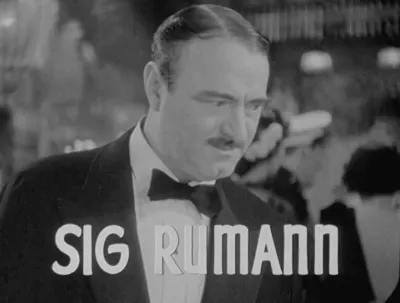
Sig Ruman
Human Design Chart
Biography
He studied electrical engineering before serving with the Imperial German Army during World War I. After his emigration to the United States in 1924, his acting career blossomed. Befriending playwright George S. Kaufman and theater critic Alexander Woollcott, he enjoyed success in many Broadway productions.
Ruman made his film debut in Lucky Boy (1929). He became a favorite of the Marx Brothers, appearing in A Night at the Opera, A Day at the Races, and A Night in Casablanca. His German accent and large stature kept him busy during World War II, playing sinister Nazi characters in a series of wartime thrillers.
During this period, he also appeared in several films by director Ernst Lubitsch, a fellow German émigré, including Ninotchka (1939) and To Be or Not to Be (1942). He played the role of Professor Herman Von Reiter in Shining Victory (1941), an adaptation of an A. J. Cronin play. Ruman continued his trend of playing over-the-top German characters later in his career for Lubitsch's protege Billy Wilder, appearing in Wilder's films The Emperor Waltz (1948), Stalag 17 (1953), and The Fortune Cookie (1966).
Despite declining health during the 1950s and 1960s, Ruman continued to find work, making many guest appearances on television. He died of a heart attack on 14 February 1967, outside his home in Julian, California. He was 82 and was survived by his wife.
Sig Ruman — Manifesting Generator with Profile 4/6
Manifesting Generator 4/6 — Design at a Glance
Sig Ruman was revealed as someone who combined the endurance of a Generator with the explosive speed of a Manifestor through a hybrid energy configuration. His design featured a defined Sacral Center, giving him constant power but requiring that he respond to external impulses rather than initiate himself. This strategy formed the foundation of his actions: waiting until an inquiry or opportunity arose and then checking if his inner center responded with a clear 'yes'.
Especially notable was his ability to skip steps and thus quickly draw results into his life. However, this speed brought two specific challenges. On one hand, he tended to omit important stages, sometimes forcing him to backtrack and catch up on missing foundations – a process that could lead to frustration if not accepted. On the other hand, his energy pulled him towards pursuing multiple projects simultaneously. Instead of focusing on one thing, he reacted to many different impulses at once.
This parallel creation was no mistake but part of his nature. As long as he adhered to the strategy of reaction and regularly checked whether his authority still approved of the projects, he found deep satisfaction in this variety. His optimal functioning occurred in 'play mode', where creative power was fueled by fun and variability rather than rigid linear planning.
Emotional Authority
Sig Ruman displayed a fundamental attitude of emotional foresight: He avoided hasty conclusions and sought clarity before acting. This resulted from his Emotional Authority carried by the defined Emotions Center. In Human Design mechanics, this authority always takes precedence over all other defined centers in the design, regardless of further configurations.
Sig Ruman was subject to a natural emotional wave, a permanent up-and-down of his feelings. His perception was always colored by his current mood; a topic could appear inspiring at one moment and negative in the next. However, this immediate reaction only represented a snapshot, not necessarily the deeper truth. Quick, spontaneous decisions from such an emotional state would often have been detrimental to him.
Instead, his design required patience and time. By letting decisions mature and reviewing them multiple times – often by sleeping on it – Sig Ruman gained the necessary emotional distance. Over time, intense feelings subsided, leading to calmness and comprehensive clarity. Only then, after this process was complete, did he make well-founded decisions, especially for long-term steps with significant influence on his life course. This ability to delay served not to hesitate but to ensure that his actions were based on a stable inner truth.
The 4/6 Profile — Opportunist / Role Model
Sig Ruman showed himself as someone who throughout his life oscillated between the deep need for connection and the urge towards distant reflection. In his first thirty years, he intensely experimented with relationships and friendships, where Line 6 of his profile still appeared like a Line 3 – marked by trial and error along with the search for new experiences. This aligned with his networking need: His survival was closely tied to social bonds that he maintained with almost instinctive intuition.
With Saturn's return, his attitude fundamentally shifted. Line 6 became active and revealed the inner conflict between heart and head. On one hand, Sig Ruman wanted to belong to a community (Line 4), on the other hand, he sought the elevated perspective to reflect on the meaning of life (Line 6). This contradiction shaped his later years. He emerged as an exemplary role model through cooperation, yet his heart remained cautious. The great networking need demanded openness, but experience taught him not to open up to 'false' people to avoid injuries. Venus enhanced his handling of relationships towards harmony, while the descending Pluto exerted pressure to repeat successful processes. Thus, he lived the balance: a wise mentor who always weighed when to connect and when to withdraw to begin the next chapter at the right time.
Split Definition — Defined & Open Centers
Sig Ruman revealed himself through a design that combined mental clarity with deep emotional processing time. His defined Ajna Center gave him a constant ability to structure concepts and theories; he thought consistently and was hardly influenced by external factors in his conceptualization. This mental stability flowed directly into his defined Throat Center, allowing him to express his thoughts reliably. His communication thus wasn't impulsive speech but the expression of well-thought-out content.
At the same time, Sig Ruman had a firm inner identity and direction through his defined G Center. He knew who he was and where he was going without needing external confirmation for this security. This self-determination was reinforced by his defined Willpower in the Heart Center: He could keep promises and control resources, which gave him natural authority. As a Generator with a defined Sacral Center, he had an enormous vital energy source that, however, could only be correctly activated through reactions to external impulses; initiated actions without prior questioning would quickly deplete this energy.
Despite these strong internal structures, Sig Ruman was exposed to the emotional wave of his defined Solar Plexus Center. Truth revealed itself to him not in the moment but after going through emotional cycles; he needed time to gain emotional clarity and avoid impulsive action. His defined Spleen Center also provided spontaneous intuitive perception of "now," helping him recognize health-promoting situations immediately.
In contrast, his vulnerabilities were revealed in the undefined centers. The open Head Center made him susceptible to mental pressure and doubt when trying to find answers to questions not coming from him; he tended to get entangled in others' confusion. Similarly, his open Root Center absorbed external stress and adrenaline from the environment. Rather than using this pressure as personal drive, he risked being overwhelmed by foreign chaos or falling into a cycle of hyperactivity and burnout if he didn't learn to clearly recognize and let go of non-self-generated stress.
Channels for determination, intimacy, intuition, willpower and structure.
Sig Ruman revealed himself through an intense, often misunderstood aura of intimacy. The Channel 59-6 connected his sacral energy with the emotional solar plexus; this configuration created a strong desire for merging and deep bonds. His emotional wave determined the timing of his release, requiring patience to avoid confusion and enable true fertility in relationships or projects.
At the same time, he possessed the ability to speak intuitive truths in the present moment. The Channel 57-20 channeled insights directly from the spleen center to the throat center. This gave him a penetrating self-awareness and the urge to verbalize his existential truth as soon as it reached him – a gift that encouraged others to awaken their own inner survival intelligence.
In the material world, his will was strongly pronounced. The Channel 21-45 connected heart with throat center and drove him to take responsibility for resources. He sought control over his working conditions to maintain his rhythm, seeing this as the basis for the survival and prosperity of his community.
His thinking was innovative and structured. The Channel 43-23 linked Ajna with the throat center, enabling him to translate complex insights into clear, efficient concepts. This allowed him to communicate new perspectives that could change collective thought, provided he waited for the right moment of receptivity.
Furthermore, he was characterized by a persistent joy of discovery. The Channel 29-46 connected sacral with G Center and fostered a deep commitment to experiences. He learned through fully immersing himself in processes without premature expectations, allowing him to go through an entire development until the end and derive valuable insights for himself and others from it.
Individual Circuitry — Circuit Signature
Sig Ruman revealed through his design as someone who carried two parallel, not directly connected energetic focal points. On one side, his knowledge circuit linked the Ajna, Throat, and Spleen Centers. This promoted the ability to bring intuitive flashes of insight (Channel 20-57) and structured insights (Channel 43-23) into the world acoustically and creatively. His identity was strongly tied to the transformation of new knowledge.
Parallel to this, three additional circuits worked that did not communicate with the first circuit. The meaning-finding circuit connected the Identity and Sacral Centers through Channel 46-29. Here it was about sharing emotional experiences from the past and finding meaning through cyclical reflection.
The Ego circuit, consisting of Throat and Heart Centers (Channel 45-21), steered resource acquisition and material support within a tribal dynamic. Since there was no connection to the Sacral Center, this energy required phases of rest for regeneration.
Lastly, the Protector circuit linked the Sacral with the Solar Plexus Center (Channel 59-6). This gave him a primal, instinctive power for protection and preservation of his genetic line, driven by emotional waves and inner security.
As a person with Split Definition, these systems existed alongside each other: The creative, knowledge-based expression (Ajna/Throat/Spleen) stood isolated next to the emotionally oriented, resource-driven, and protective forces (Identity/Sacral/Heart/Solar Plexus). Sig Ruman had to integrate these separate energy blocks in life without them automatically merging.
Right Angle Cross of Penetration 3
Sig Rumans design carried the signature of the right cross of penetration three. This configuration shaped a fundamental disposition characterized by direct, unmediated perception and a need for clear, unvarnished insight. In Human Design, this pattern describes a specific way of taking in information: not through prolonged reflection or detachment but through immediate penetration to the core of an issue. It was an energetic structure that tended to pierce complex connections often making intuitive leaps rather than proceeding logically step by step.
For Sig Ruman, this meant his understanding relied more on seeing through things than analyzing them. The mechanics of this cross promoted a kind of intuition less connected with feelings and more with almost physical perception of truth. It was about pushing aside obstacles or veils to get directly to the essence. This trait could manifest in his communication or thinking as very direct, sometimes even blunt, because detours of politeness or diplomatic circumlocution were often seen as unnecessary. The energy of this design was geared towards breaking through barriers and establishing clarity by not being distracted by external circumstances but consistently working towards the goal of insight. Sig Ruman lived with this inner dynamic that pushed him to see things as they truly were, without filters or distortion from subjective desires.
Saturn Return · Uranus Opposition · Chiron Return · 2nd Saturn Return — Life Cycles
Sig Rumans design showed a tendency toward structural anchoring paired with the ability to quickly establish himself in new environments. This configuration acted as an internal compass for long-term stability and the establishment of authority through consistent performance.
In 1924, at age 40, he came to the United States and began his acting career on Broadway. This step marked his first Uranus Return cycle: a phase of breaking free from old structures to embark on new, often unexpected paths. The opposition to his own Saturn axis demanded balancing between the urge for change and the necessity to prove oneself through discipline.
Ten years later in 1934 at age 50, he regularly acted in Hollywood. This fell during his Chiron Return: a fulfillment cycle where life's work condenses and meaning becomes tangible. Here, the bloom of his previous efforts was evident; his career stabilized not through healing wounds but through the realization of his incarnation purpose in artistic expression.
In 1942 at age 58, he played the role of Group Leader Ehrhardt in 'Life or Death'. This corresponded to his second Saturn Return: a time of maturity and responsibility where earlier achievements became a solid foundation. His design supported him in exercising authority through patience and consistency, which was reflected in this precise role choice.
Manifesting Generator · Emotional Authority — Synthesis
Sig Ruman lived a life marked by an inner dynamic between quick action and deep emotional processing. As a Manifesting Generator, he possessed the ability to seize opportunities rapidly and set things in motion (sacral center), yet his emotional authority required time to gain clarity and let decisions ripen. This combination of sacral reaction and emotional delay formed a constant red thread through his work – an interplay between impulsivity and the need for inner confirmation.
A central paradox in his design lay in the conflict between the desire for connection and the longing for individuality (Profile 4/6). He sought cooperation and recognition from others, yet felt driven to walk his own path and ponder deeper questions of life. This was evident in a career marked by adaptability to the collective (recorded event in 1942) and the pursuit of personal unfolding (Uranus opposition in 1924) – an ongoing balancing act between social role and authentic expression.
5 Defined Channels
Incarnation Cross - Right Angle Cross of Penetration 3
Solar Return
The Solar Return shows the moment when the sun returns to its exact birth position - your personal solar year.
Life Cycles
Discover the life cycles with a detailed triple view (birth chart, cycle chart, composite).
Human Design Profile
- Strategy
- To respond - wait for something to respond to
- Authority
- Emotional Authority
- Profile
- 4/6 - Opportunist / Role Model
- Definition
- Split Definition
- Incarnation Cross
- Right Angle Cross of Penetration 3
- Date of Birth
- 11.10.1884 03:15
- Place of Birth
- Hamburg, GER
Frequently Asked Questions
What was Sig Ruman's Human Design type?
What Profile did Sig Ruman have in Human Design?
What Authority did Sig Ruman have?
What incarnation cross did Sig Ruman have?
When was Sig Ruman born?
Discover your own Human Design
Are you also a Manifesting Generator? Find out in a personal reading how to unfold your multi-talents and direct your energy wisely.
More Personalities
Back to overviewSissy Spacek
Aldair

Alizée

Anémone

Angeli

Ann-Margret