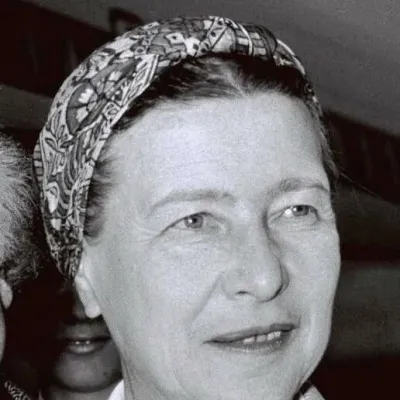
Simone de Beauvoir
Human Design Chart
Biography
Simone de Beauvoir as a Manifestor 3/6 in Human Design
Manifestor 3/6 — Design at a Glance
Simone de Beauvoir emerged as a pioneer and visionary, whose design aimed to lead the world into a new future. Similar to an emperor in ancient Rome, she had great plans but did not wage the necessary wars herself; instead, she directed her energy towards convincing others of her goals. This role came with a specific pain point: She was often misunderstood and polarized her environment. As her thinking frequently surpassed that of her contemporaries, she encountered a divided reaction – some loved and followed her due to her immense visions, while others hated or rejected her for the same reason.
To minimize this resistance and find the right followership, it was crucial for her design to inform her surroundings about her intentions in a timely and precise manner. This strategy of informing served not humility but efficiency: Only through this could she mobilize the necessary support without constantly getting entangled in conflicts. When Simone de Beauvoir followed this strategy and heeded her inner authority, she was rewarded with a sense of inner peace. Conversely, if she lived against her design, she felt instead a persistent, deep anger. Her path thus involved avoiding polarization through clear communication and using the state of inner peace as a measure for her actions.
Emotional Authority
Simone de Beauvoir was subject to an emotional wave with constant ups and downs in feelings. Her inner authority carried the defined Solar Plexus Center, meaning she always saw the world colored by her current mood. In one moment, she could be totally enthusiastic about something, only to view it completely negatively a short while later. However, her feeling at any given moment was merely a snapshot and not a reliable criterion of truth. Quick, spontaneous decisions based on emotion often had negative consequences, as the first impression did not yet represent her deeper truth.
The mechanics of her emotional authority required patience and time for judgments to mature. She needed to take her time and reconsider or sleep on decisions multiple times. Over time, intense feelings subsided, allowing her to gain an emotional distance and establish clarity and calmness. This process was essential to reach true insight through the emotional turbulence, especially in long-term life decisions with significant influence on her life course. Only by waiting out this cycle of fluctuation and not acting immediately could she utilize her deeper, more comprehensive perception. Emotional authority always took precedence over other defined centers in her chart, regardless of further configurations.
The 3/6 Profile — Martyr / Role Model
Simone de Beauvoirs design was characterized by a clear developmental line: from an experimental playful child to a wise role model. This dynamic was significantly shaped by the Profile 3/6, which until the Saturn return at around age 29.5 years dominated with a tendency towards experimentation. In this early phase, she acted like someone with Profile 3/3 – playful, charming, and open to new experiences, driven by the attraction of Line 3.
Only after this turning point did the wise leadership of Line 6 assert itself. Simone de Beauvoir increasingly withdrew to reflect on her accumulated experiences and gain a comprehensive overview of her life. The original joy of experimentation now had deeper structure; she carried both the curious inner child and the clarifying intuition of the elder within herself. This process often brought uncertainty, as the internal drive for playfulness and reflection sometimes conflicted.
Line 6 promoted clarity and integration but also helped accept limits to intuition. In survival situations, she focused on the best possible outcome rather than seeking perfect solutions. Starting from her fiftieth year, Simone de Beauvoir developed a strong role model function for others based on this synthesis of charm and wisdom. Her design thus showed a clear path from individual exploration to societal relevance through lived experience.
Single Definition — Defined & Open Centers
Simone de Beauvoir was characterized by a design that relied on a consistent inner structure and clear expressiveness. Her defined G Center gave her an unshakeable identity and internal direction; she knew her place and mission without making them dependent on external support. This self-love allowed her to attract others without clinging to them. Complementing this was her defined Heart Center, which provided her with permanent willpower for resource control. She determined her life herself, kept promises, and sought recognition for her contribution rather than submitting to others.
Her communication was authentic and direct, guided by her defined Throat Center. Her voice did not come from fleeting thoughts or emotions but from her deep identity (G) and willpower (Heart). She spoke what she wanted and had with a reliable clarity that required no interpretation. Yet, her decision-making freedom was emotionally filtered through her defined Solar Plexus Center. As an inner authority, this emotional depth allowed Simone de Beauvoir to wait patiently until the waves of her feelings subsided before acting or judging. She used this time to go through the full spectrum of her emotions and made decisions only in moments of emotional clarity, not on impulse.
This stable core system contrasted with her open centers, which served as mirrors for the environment. Her open Head and Ajna Centers made her vulnerable to mental confusion and pressure to provide answers that were not hers. She tended to identify with borrowed concepts or intellectual doubts from others rather than trusting her own inner guidance. Similarly, her open Sacral Center absorbed environmental energy, leading to exhaustion if she did not pause and distance herself from excessive drive. Her open Root and Spleen Centers also made her sensitive to external stress and survival fears that she could misinterpret as personal threats instead of recognizing them as environmental phenomena.
Channels for emotional depth, reflection and spiritual pioneering.
Simone de Beauvoir's design structured emotional mood into social articulation, collected experiences through withdrawal into wisdom, and used competitive shock for individuation. These three defined channels required patience on the emotional wave before social interaction or initiation occurred.
The Openness Channel 22-12 connected the Solar Plexus Center with the Throat Center. It expressed moodiness and passion but was regulated by the restraint of Gate 12. This limited openness to interactions with people who had the greatest mutative potential. Simone de Beauvoir waited until she felt ready for social interaction; her voice then acted as a catalyst for consciousness change in listeners.
The Lost Son Channel 13-33 connected the G Center with the Throat Center. Gate 13 listened and collected memories while Gate 33 withdrew to reflect on these experiences. This process of reflection allowed Simone de Beauvoir to uncover deeper truths before sharing them. She functioned as a guardian of life stories that, through patient contemplation, were transformed into collective wisdom.
The Initiation Channel 51-25 connected the Heart Center and used the competing ego energy from Gate 51 together with the spirit of self from Gate 25. This combination served to recognize individuation potential and provide the necessary shock for initiation. Simone de Beauvoir awakened competitiveness in others to stimulate their growth without forcing her own initiation.
Additionally, Gates 57 of intuitive clarity, 54 of worldly success and mysticism connection, and 53 of freedom for new cycles acted as integration gates. They promoted survival consciousness, the search for enlightenment through experience, and the courage to leave old patterns behind to embark on new paths.
Individual Circuitry — Circuit Signature
Simone de Beauvoir's design inclined towards pulsating, emotional expression. The Knowledge Circuit connected her Throat Center with the Solar Plexus through the Openness Channel (Gates 12-22). This allowed her to directly translate inner emotional waves into words and carry new perspectives outward acoustically. Her identity was thus dynamic, marked by creative impulses and a drive to walk her own path.
Parallel to this, the Centering Circuit worked with the Initiation Channel (Gates 25-51). This connected the Heart Center directly with the Identity Center. This connection created deep inner strength and bold convictions but often lacked direct verbal expression due to missing guidance from the Throat Center. The energy remained centered and individualistic, bolstering self-esteem but not automatically finding a verbal expression channel.
The Purpose Circuit rounded out this picture. Through the Lost Son Channel (Gates 33-13), it connected her Throat Center with the Identity Center. This directed attention to past experiences and emotions. Simone de Beauvoir reflected these feelings in waves, sought their meaning, and ultimately shared these insights verbally. While the Centering Circuit offered inner strength, the Knowledge and Purpose Circuits served as bridges to translate emotional depth and historical reflection into a common language.
Right Angle Cross of Penetration 4
Simone de Beauvoirs Human Design indicates a tendency towards a deep, often unconscious motivation characterized by the archetypal pattern of the 'Right Cross of Penetration'. This configuration acted as a constant background energy in her life, which could not be changed merely through will but fundamentally shaped her essence. It was more about her inner 'being' than external 'doing'.
The mechanics of this specific cross implied a strong drive to penetrate existing structures or truths. This often occurred with a certain hardness or inflexibility in dealing directly with reality. Simone de Beauvoir thus appeared as someone whose deepest life patterns were determined by this urge for penetration. She did not seek superficial answers but was guided by an inner logic that required looking beyond the facade and revealing what is essential. This imprinting was rigid in nature, forming the unchangeable core of her way of existing, independent of external circumstances or conscious decisions.
Saturn Return · Uranus Opposition · Chiron Return · 2nd Saturn Return — Life Cycles
Simone de Beauvoirs Human Design marked two crucial turning points in her life. In 1948, at age 40, she traveled to Berlin for the premiere of Sartres drama. This coincided with her Uranus opposition, a cycle often bringing unexpected changes and breaking old structures. For Simone de Beauvoir, this was a moment of relationship dynamics where external events challenged and reordered her personal orientation.
Six years later, in 1954, she received the Prix Goncourt for 'The Mandarins of Paris'. She was then 46 years old – a time corresponding to her Chiron Return. In Human Design mechanics, this cycle is not a phase of wound healing but a period of fulfillment and bloom. Those who have lived according to their strategy and authority experience now the unfolding of their incarnation cross and find meaning in it. For Simone de Beauvoir, this manifested as literary success that brought her inner work outwardly and confirmed her life purpose. Both events underscore how structural markers in her chart shaped specific life stages: first the disruptive power of change, then confirmation through recognition.
Manifestor · Emotional Authority — Synthesis
Simone de Beauvoirs life was profoundly marked by an inner drive towards initiation and transformation. As a Manifestor with emotional authority, she acted as a pioneer whose visions often polarized (Design View). Her ability to tread new paths was amplified by the openness of her channel (22/12), allowing her to channel emotional nuances into creative expression. Her profile as an experimenter/role model points towards a life where experimenting with new paths and subsequent reflection in old age were central – a pattern evident in documented events (Cross of Penetration 4).
A central paradox lay in the combination of her manifesting energy with the emotional wave. While she was destined to set things in motion and initiate as a Manifestor, her emotional authority required time for decision maturation (Authority). This tension between the impulse to act and the necessity to experience emotions created a dynamic interplay. The knowledge circuit supported this process by helping her gain new insights and express them authentically (Circuit), while the right cross of penetration underscored her ability to initiate deep changes.
3 Defined Channels
Incarnation Cross - Right Angle Cross of Penetration 4
Solar Return
The Solar Return shows the moment when the sun returns to its exact birth position - your personal solar year.
Life Cycles
Discover the life cycles with a detailed triple view (birth chart, cycle chart, composite).
Human Design Profile
- Type
- Manifestor
- Strategy
- To inform others before acting
- Authority
- Emotional Authority
- Profile
- 3/6 - Martyr / Role Model
- Definition
- Single Definition
- Incarnation Cross
- Right Angle Cross of Penetration 4
- Date of Birth
- 09.01.1908 04:00
- Place of Birth
- Paris, United States
Frequently Asked Questions
What was Simone de Beauvoir's Human Design type?
What Profile did Simone de Beauvoir have in Human Design?
Which Authority guided Simone de Beauvoir's decisions?
What incarnation cross was assigned to Simone de Beauvoir?
When was Simone de Beauvoir born?
Discover your own Human Design
Are you also a Manifestor? Find out in a personal reading how to use your initiation power peacefully and dissolve resistance.
More Personalities
Back to overviewAlain-Fournier

Angeli

Christian-Jaque

Juninho

Kesha

Lucebert