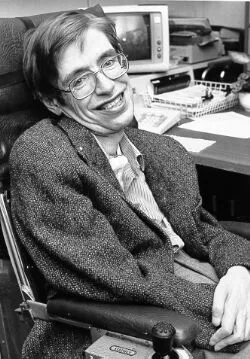
Stephen Hawking
Human Design Chart
Biography
Hawking was born in Oxford into a family of physicians. In 1959, at the age of 17, he began his university education at University College, Oxford, where he received a first-class BA degree in physics. In 1962, he began his graduate work at Trinity Hall, Cambridge, where, in 1966, he obtained his PhD in applied mathematics and theoretical physics, specialising in general relativity and cosmology. In 1963, at age 21, Hawking was diagnosed with an early-onset slow-progressing form of motor neurone disease that gradually, over decades, paralysed him. After the loss of his speech, he communicated through a speech-generating device, initially through use of a handheld switch, and eventually by using a single cheek muscle.
Hawking's scientific works included a collaboration with Roger Penrose on gravitational singularity theorems in the framework of general relativity, and the theoretical prediction that black holes emit radiation, often called Hawking radiation. Initially, Hawking radiation was controversial.
Stephen Hawking as a Generator 3/5 in Human Design
Generator 3/5 — Design at a Glance
Stephen Hawking possessed immense sacral endurance that made him an archetypal workhorse. His design suggested that his strength was not derived from self-initiated action but solely through reacting to external impulses. This Generator-type mechanism means: energy is only released when life sets a trigger and the inner center responds with a clear 'yes'.
Hawking's path was marked by the necessity of following this internal signal. When he responded to stimuli from his environment and performed work out of this deep resonance, a state of profound satisfaction and fulfillment arose within him. His design offered immense capacity for performance as long as it aligned with the strategy of reacting.
The danger lay in deviating from this principle. If he had attempted to initiate against his inner feeling or done things that did not inspire internal desire, his energy would have quickly been depleted. The design warns against ignoring the sacral 'yes' or suppressing the urge to work on what truly fascinates, leading to frustration and burnout. Hawking's strength lay in channeling this high energy through consistent reaction to life rather than squandering it by compulsively pushing forward. Thus, his enormous potential transformed into sustainable endurance while any deviation from reacting to internal confirmation would have dried up the source of his power.
Sacral Authority
Stephen Hawking's design inclined towards reactive decision-making. As a Generator, he possessed sacral authority as an inner instance. This was also his strategy: not initiating but waiting for external stimuli and responding. This simplified his process significantly since strategy and authority were identical. A prerequisite for this was an open emotional center that did not allow immediate judgments.
Sacral authority manifested physically in Stephen Hawking. It spoke through a 'gut feeling' – audible as grunts, hums or loud mhm/hm-hm sounds. Such signals marked the right path. When his sacral motor responded to a trigger, an instant energy surge followed. He then felt vital and alive. This resonance gave him seemingly inexhaustible power. He accomplished tasks with great enthusiasm. His activities were free from purposefulness; he immersed himself in them because they fulfilled him.
This mechanism allowed Stephen Hawking to walk through life with joy and satisfaction. He was born to use energy where it was internally confirmed. The connection to the sacral source secured access to his true nature. By waiting for the right impulses, he avoided frustration. His vitality sprang not from will but from reacting to what truly moved him. Thus, he found his way through the world guided by this inner compass that only spoke when something was right.
The 3/5 Profile — Martyr / Heretic
Stephen Hawking's design inclined towards gaining knowledge not through theoretical assumption but through intensive personal experimentation. As a person of Profile 3/5, the experimenter and hero, he primarily learned from his own practice and the resulting setbacks. This Line 3 demanded direct experience; belief in established paths was secondary to the necessity of testing things himself.
This process of experimenting was shaped by the dynamics of Gate 54, where ambition often strengthened through secret interactions and concealment. Official channels presented obstacles while hidden means smoothed the way. The allure of Stephen Hawking arose precisely from this treasure trove of lived experience. Others felt drawn to him to learn from his accumulated insights.
In times of crisis, Line 5 acted as a hero line. Here it was about further developing intuition and viability. Stephen Hawking established new forms that served the collective to protect against threats. These individual mutations became generalizable. The attractiveness of his person rested on deriving solutions from personal failure and experimentation and presenting them as an example for others. His design showed itself in the tension between the private, often hidden learning process and the public role as a rescuer with practical answers.
Split Definition — Defined & Open Centers
Stephen Hawking's Human Design indicated a tendency towards constant mental pressure paired with a specific thought structure. His defined Head and Ajna Centers generated a perpetual impulse to question and form concepts but did not provide the energy for direct implementation. This state required patience, as the build-up of pressure often led to frustration; instead, his inspiration manifested through prompting others.
As a Generator, he had a defined Sacral Center, which endowed him with an immense source of vital energy that was released only in reaction. Initiatives without prior inquiry resulted in resistance and exhaustion; his strength showed in persistence on tasks to which he responded with an inner "yes." Additionally, his defined Spleen Center offered an intuitive moment-to-moment awareness for health and well-being that acted in the present and could not be rationalized. His defined Root Center also provided a set stress pressure that propelled him forward and helped him navigate existential challenges.
In contrast, his open centers reflected environmental impulses. His open Throat Center meant he did not have controlled communication energy; communication occurred spontaneously or was absent depending on the situation, without him being able to force it. The open G Center indicated that identity and direction were not set but learned through places and relationships – false environments led to disorientation. Furthermore, his open Heart Center lacked consistent willpower; making promises or proving oneself often resulted in overextension as the energy for this was not sustainably available. Finally, his open Solar Plexus absorbed emotions from the environment, making him vulnerable to foreign moods and requiring that he not personalize these feelings as his own.
Channels for change, intuitive power and mental abstraction.
Stephen Hawking revealed himself as someone whose drive came from the connection between worldly ambition and mystical insight. Gate 54 in his personality linked the desire for success with a quest for spiritual depth; material recognition was often a prerequisite for developing higher consciousness for him. This process did not follow a linear path but rather unfolded through a learning journey marked by experience and shocks.
This dynamic was intensified by Channel of Mutation 60-3, which connected the Root Center to the Sacral Center, bringing about evolutionary change in unpredictable ways. The energy of this channel was impulsive and often accompanied by melancholy, as it required acceptance of limitation (Gate 60) and the ability to move beyond the confusion of a new beginning (Gate 3). Stephen Hawking lived through cycles of chaos and order, with inner tension arising when the pulse of change stalled.
At the same time, Channel of Power 34-57 was at work in his design. It linked the intuitive insight of the Spleen (Gate 57) to the generative life force of the Sacral Center (Gate 34). This gave him a selective perception and an instinctive survival intelligence that made him alert to dangers and enabled spontaneous reactions. This intuitive awareness underpinned his actions independently of mental deliberation.
Additionally, the Juxta-Channel Channel of Abstraction 64-47 contributed to mental complexity by connecting the Head Center with the Ajna Center, creating a constant pressure to filter experiences through a kaleidoscope of mental images. This occasionally led to confusion as he tried to weave a coherent narrative from his impressions. The synthesis of these energies shaped him as someone who propelled innovation through intuitive impulses and mental abstraction, driven by a deep need to translate the mysterious into comprehensible narratives.
Individual Circuitry — Circuit Signature
Stephen Hawking showed a driving force to deviate from established norms to create new knowledge. This energy came from the Knowledge Circuit, specifically through Channel 3-60 (Mutation). It connected his Sacral Center with the Root Center and worked pulsatingly as well as acoustically. It was not about cool logic but rather expressing one's unique identity through emotional waves and thus initiating change.
Parallel to this, there was a separate energetic structure in the Meaning Circuit. Here, Channel 47-64 (Abstraction) connected the Head Center with the Ajna Center. This connection referred to reflecting on the past and finding meaning in past events, driven by cyclical emotions. Since Stephen Hawking had a Shared Definition, these two areas – the mutating creativity in the lower chart and the abstract reflection above – were not directly linked to each other. They existed as separate, parallel forces.
A third aspect was the Integration Circuit with Channel 34-57 (Power). This connected the Sacral Center with the Spleen Center and drew power from reacting to life, guiding it intuitively in the present moment. This served to secure individual survival and self-reinforcement. Together, these three separate circuits shaped his design: pulsating innovation, visual meaning-making, and intuitive adaptability, each working within their own energetic pathways.
Right Angle Cross of Penetration 4
Stephen Hawking's Design bore the imprint of the right cross of the Manifestation 4. This configuration laid a foundational structure aimed at profound insights and uncovering hidden connections. The right cross symbolizes archetypally an impulse to penetrate surfaces and recognize underlying truths. The number 4 often indicates a methodical or structural approach to this penetration.
In Stephen Hawking's case, this cross formed a framework for his inner orientation, even though the specific mechanical details in the raw content here are not further specified. It was an archetypal backdrop supporting his potential for gaining knowledge without prescribing a detailed behavioral pattern. The energy of this cross worked as a constant undercurrent fostering the ability to penetrate complex realities and translate them into comprehensible structures. It was less an active strategy of action but rather a passive yet effective imprinting of his perceptual world. Stephen Hawking lived within this framework, which significantly influenced his way of engaging with the universe. The penetration did not occur through external aggression but through inner clarity and the ability to distinguish the essential from the non-essential. This shaped his entire existence as someone who could look beyond the visible world.
Saturn Return · Uranus Opposition · Chiron Return · 2nd Saturn Return — Life Cycles
Stephen Hawking's life path followed a clear structural sequence of planetary cycles marking his intellectual development. The first Saturn return around the age of 28 served as a phase of professional consolidation. This was concretely evident in 1970: at the age of 28, he published "The singularities of gravitational collapse and cosmology" with Roger Penrose. This work condensed years of preliminary research into a solid scientific result, typical of Saturn's influence on structure and recognition.
Ten years later, the Uranus opposition acted as a catalyst for breaking through into new theoretical dimensions. In 1982, at age 40, Stephen Hawking, together with James Hartle, presented an approach to quantum gravity and its cosmology. This cycle promoted the breaking of old patterns in favor of innovative perspectives.
The Chiron return around the age of 50 marked a point of personal fulfillment and finding meaning, not primarily as a healing process but as the unfolding of one's purpose. During this phase, specifically in 1990 at age 48, his divorce from Jane Wilde occurred. This change in the private sphere corresponded with the inner maturity that this cycle demands.
Finally, his position was consolidated again during the second Saturn return. In 2001, at the age of 59, Stephen Hawking published "The Universe in a Nutshell". This work stood for established success and the dissemination of his knowledge to a broader audience, underscoring the final structuring of his professional career.
Generator · Sacral Authority — Synthesis
Stephen Hawking was a Generator whose life was marked by a profound interplay between sacral energy and the drive for knowledge. The ability to generate energy through engaged work (sacral center) seemed inseparable from the necessity of constantly asking questions and understanding things (defined Head Center). This pattern manifested in his career: breakthrough moments in knowledge and publications were repeatedly achieved – often after phases of intense work and experimental enthusiasm (Profile 3/5) –, fueled by a melancholic energy (Channel 3-60). He lived a process of constant mutation by questioning the status quo and embarking on new paths.
A central paradox in his design lay in the combination of the pulsating, present format of the Knowledge Circuit with experiences amplified by the right cross of Manifestation 4. On one hand, he seemed driven by an unstoppable urge for innovation and transformation that enabled him to gain new insights. On the other hand, cycles – particularly Saturn Returns, which coincided with professional successes but also marked a divorce – pointed to an inner conflict: the need for personal freedom versus the challenges of breaking conventions.
3 Defined Channels
Incarnation Cross - Right Angle Cross of Penetration 4
Solar Return
The Solar Return shows the moment when the sun returns to its exact birth position - your personal solar year.
Life Cycles
Discover the life cycles with a detailed triple view (birth chart, cycle chart, composite).
Human Design Profile
- Type
- Generator
- Strategy
- To respond - wait for something to respond to
- Authority
- Sacral Authority
- Profile
- 3/5 - Martyr / Heretic
- Definition
- Split Definition
- Incarnation Cross
- Right Angle Cross of Penetration 4
- Date of Birth
- 08.01.1942 10:08
- Place of Birth
- Oxford, England, United Kingdom
Frequently Asked Questions
What is Stephen Hawking's Human Design type?
Which Profile did Stephen Hawking have in Human Design?
What was Stephen Hawking's Authority?
Which incarnation cross was assigned to Stephen Hawking?
When was Stephen Hawking born?
Discover your own Human Design
Are you also a Generator? Find out in a personal reading how to use your sacral energy correctly and discover deep satisfaction.
More Personalities
Back to overviewAaliyah

Alexia

Angèle

Anne-Marie

Arcángel

Arno