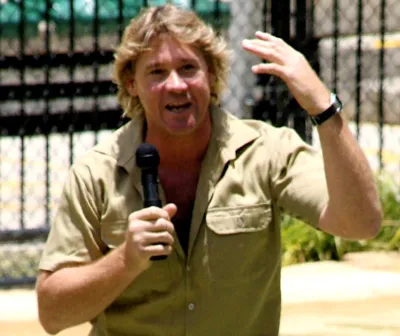
Steve Irwin
Human Design Chart
Biography
The son of a reptile enthusiast and a nurse who cared for injured animals, he received his first snake on his 6th birthday and was hooked just as his father was. His parents moved to Queensland in 1970 where his father established a small reptile park three years later at the town of Beerwah. Young Irwin reportedly wrestled his first crocodile under his father's supervision when he was 9 years old. In 1991, when his parents retired, Irwin took over the family business, the Australia Zoo.
With business savvy and love for reptiles, the Australia Zoo expanded. In 1990 while filming a TV commercial in the zoo, John Stainton, producer, featured Irwin showing off his animals. A documentary was born, and Irwin would later achieve worldwide fame from the television series The Crocodile Hunter (1996–2007), an internationally broadcast wildlife documentary series which he co-hosted with his wife Terri.
Its terrific reception led to more TV series, Croc Files (1999-2001), Croc Diaries (2002-2006) and The New Breed Vets (2005). Irwin's showmanship and his love for his work were evident in his TV programs and documentaries. Nicknaming himself the "wildlife warrior," Irwin said his business was really conservation: "Our motto is conservation through exciting education."
In June 1992, he married Terri Raines and the couple had two children, a daughter Bindi Sue Irwin (born 24 July 1998), and a son, Robert Clarence "Bob" Irwin (born 1 December 2003). His mother died in a car crash on 11 February 2000.
On 2 January 2004 Irwin came under public fire when he held his then one-month-old son Robert in his arm while hand-feeding a chicken carcass to a 3.8-metre (12 ft 6 in) saltwater crocodile.
Irwin's demise was sudden and, in a way, ironic.
The Human Design of Steve Irwin: Manifesting Generator 3/5
Manifesting Generator 3/5 — Design at a Glance
Steve Irwin was known for his quick actions and often skipped what seemed to be important intermediate steps. As an Manifesting Generator, he had a constant sacral energy source that gave him immense creative power. This energy allowed him to draw things into his life at speeds that pure generators couldn't match.
However, this speed was a double-edged sword. It often led him to pursue multiple projects simultaneously and respond to various impulses at once. If he neglected his inner strategy – waiting until his sacral center clearly agreed before acting – the complexity could quickly turn into frustration. The risk lay in skipping fundamental steps due to rushed actions, forcing him later to backtrack and fill gaps.
Despite these risks, his nature was geared towards operating in a 'play mode'. Once he responded to real impulses and his inner centers continued to support his projects, Steve Irwin found deep satisfaction in his work. It wasn't an issue for him to handle tasks concurrently; on the contrary, this variety fueled his energy. His design thus demanded not linear processing but dynamic reactions to life, ensuring that his internal compass system was 'on board'. Only then could his hybrid power of Manifestor speed and Generator energy operate without friction.
Emotional Authority
Steve Irwin's design inclined towards intense emotional waves that profoundly shaped his perception of the world. His inner authority was Emotional Authority, carried by a defined Emotional Center. In Human Design mechanics, this center is prioritized for decision-making regardless of other defined areas in the chart. This meant Steve Irwin was subject to constant fluctuations between enthusiasm and negative coloring; his current mood always tinted his viewpoint. A momentary feeling was merely a temporary snapshot, not necessarily the final truth. Quick, spontaneous decisions made from this emotional heat could have negative repercussions. The mechanics required patience: Steve Irwin had to allow time for decisions to mature, often through multiple nights of reflection. Only when intense feelings subsided and an emotional distance was gained did clarity and calm set in. This process of maturation and waiting was essential for long-term life decisions with significant influence on his life path. By waiting, he gained the necessary depth and breadth in his understanding before acting.
The 3/5 Profile — Martyr / Heretic
Steve Irwin's design inclined towards a heroic adventurous spirit coupled with the urge to humorously share practical experiences. As a 3/5 Profile (Explorer/Hero), he lived by the necessity of trying things out himself before believing them. The Explorer line drove him to gather knowledge through his own actions and even mistakes – a process where failure was not personal defeat but a necessary learning step. This authentically gained experiential wisdom made him attractive to others; people saw him as an authority they trusted.
The Hero Line projected a presence that attracted and often repelled others. Steve Irwin used this power to solve other people's problems or provide them with security. Yet, precisely this role carried the risk of public failure: when he experimented in front of everyone and it didn't work out, the pain was intense. His authenticity arose from the moment – if he did not act from genuine emotion, he lost his impact. The combination of unassuming curiosity (Line 3) and projected power in crisis moments (Line 5) marked him as someone who generated knowledge through personal risk to make it accessible to others.
Single Definition — Defined & Open Centers
Steve Irwin's design inclined towards powerful, self-determined action. His defined Heart Center endowed him with willpower and the desire to control his own resources; he enjoyed working as his own boss and keeping promises, which strengthened his self-esteem. This energy flowed into his defined Throat Center, serving as a focal point for communication: He did not just speak from the mind but acted directly from his will – 'I want to do this' became visible action.
As a Generator with a defined Sacral Center, he possessed an immense vital energy source. His strategy was to wait and react to stimuli; when he listened to the inner 'yes'-tone, full power for satisfaction was available to him. Ignoring this response in favor of mental plans led to resistance and frustration. His defined Solar Plexus functioned as emotional authority: He had to await the waves of his feelings to gain clarity rather than impulsively deciding in highs or lows. The defined Root Center provided physical pressure, propelling him forward and fostering existential awareness.
At the same time, he was vulnerable to conditioning through his open centers. His open Head and Ajna Centers left him exposed to mental doubts or foreign inspirations; he tended to engage with questions not of his own making rather than trusting his inner authority. His open G Center meant no fixed identity; he adapted to the environment in search of the right place for love and direction, rather than initiating it himself. The open Spleen Center made him sensitive to well-being or fear in his surroundings; he could pick up intuitive signals from others but risked spontaneous decisions out of uncertainty that could harm him long-term.
Channels for intimacy, synthesis, charisma and community.
Steve Irwin's design inclined towards intense physical presence and a deep connection with his environment. He was someone who acted through direct experience and emotional clarity. The Channel of Union 59-6 rooted him in a powerful Quantum Sacral and emotional energy, known as Intimacy. This connection between sexuality and the emotional wave of pleasure and pain fostered personal and profound relationships. His drive was to merge; through patience and waiting for his emotional waves, he could discover truths about connections.
At the same time, the Channel of Synthesis 19-49 connected him with tribal consciousness. He keenly felt his position within the whole and sought belonging based on loyalty and resource protection. This channel determined who belonged to the group by linking principles with fundamental needs for safety. His gift lay in finding a balance between feasibility and fairness, crucial for community survival.
His activity was marked by the Channel of Charisma 34-20. Here generative power met the ability for immediate manifestation. Steve Irwin could maintain prolonged active periods if he listened to his inner sacral response. This energy enabled him to act in the moment and inspire others through his vitality, provided he acted from inner guidance rather than intellect.
The Channel of Community 37-40 underscored his need for fair agreements and mutual support. He waited for the right invitation into an organization or relationship to find his place. His energy focused on building bridges between individuals so that everyone could make a respected contribution. Along with the ability for detail work (Gate 9) and emotional awareness (Gate 55), this configuration shaped a person who worked through persistence and emotional depth.
Tribal Circuitry — Circuit Signature
Steve Irwin's design linked Heart, Solar Plexus, and Root Centers into a closed unit. This created an intense inner dynamic: Emotions from the Solar Plexus flowed directly into the willpower of the Heart and generated immediate reactions in the Root Center. The Ego Circuit carrying this connection emphasized cooperation and resource exchange ('Giving and Taking'). Without involvement of the Sacral Center, constant life energy was missing; instead, Steve Irwin needed rest periods to generate new power for his environment.
Parallel to this, the Archer Circuit operated through Channel 6-59 (Union). It connected the Sacral with the Solar Plexus. This gave his emotional wave a primal quality of protection and preservation rooted in life force. A third aspect came from the Integration Circuit: Channel 20-34 (Charisma) linked Throat to Sacral, enabling him to draw power from reacting to life and express this energy now through his voice.
Though all these centers were defined, they did not form a single continuous line. The connection of Heart to Root stood separate beside the flow from Sacral over Solar Plexus to protective instinct as well as the expression channel from Sacral to Throat. Thus, Steve Irwin lived with several parallel strong energetic streams: cooperative will, protective emotional stance, and powerful reactive expressiveness. These separate systems shaped his way of approaching the world – intensely but in different, not directly interconnecting areas.
Right Angle Cross of the Sleeping Phoenix 1
Steve Irwin's design carried the signature of the right cross of the sleeping phoenix. This configuration established a specific, often underestimated internal structure that was not defined by external noise but rather by deep, silent resonance. It was a pattern that worked in the subtlest ways and set its focus less on loud action than on precise, almost invisible impulses.
In Human Design, this cross describes a special alignment of energy centers aimed at collecting information or energies without immediately pushing them outward. It is a design for an observer who works from behind the scenes, whose influence often only becomes visible in retrospect. Steve Irwin showed himself through this mechanism as someone who did not unleash his power across a broad front but rather in focused, targeted moments. The energy of this cross requires a high sensitivity to the invisible; it acts like a silent compass that guides decisions without the carrier having to consciously steer them.
This structure shaped his way of interacting with his environment: less through dominant presence and more through a nearly magnetic attraction based on resonance. It was a path aimed at separating the essential from the inessential and only acting when inner alignment was perfect. Steve Irwin lived this dynamic by focusing on his specific niche and working there with an intensity that arose from this silent, phoenix-like structure. His influence was thus less a broad beam than a precise laser beam hitting exactly where it was needed, driven by an internal logic known fully to few.
Saturn Return · Uranus Opposition — Life Cycles
Steve Irwin's design set a tendency towards structured responsibility followed later by inner dissonance. As a Generator, his energy was oriented toward responding to life calls, yet planetary influences marked specific turning points in this response strategy. In 1991, at the age of 29, Irwin took over the Reptile & Fauna Park in Queensland, which was later renamed Australia Zoo. This coincided with his first Saturn return, a cycle where years of groundwork often condenses into a solid result and fundamental life structures are anchored. For his design, this marked the transition from spontaneous action to institutional responsibility. Later, however, another dynamic became apparent: In 2003, at age 41, Irwin said he saw his fame as the dark side of his success. This corresponds with the Uranus opposition, a phase where often a conflict between established identity and the need for freedom or authenticity sharpens. Instead of just acting outwardly, here the discrepancy between public image and inner truth became palpable. His design illustrates thus the path from anchoring through Saturn to critical reflection through Uranus, while the strategy of the Generator – responding to life – remained central in both phases but took on different qualities: once as building up, later as questioning.
Manifesting Generator · Emotional Authority — Synthesis
He was a Manifesting Generator with emotional authority and the Profile of the Experimenter/Hero. This combination shaped a character marked by tireless activity and a deep reaction to life (sacral center, MG type). He threw himself into experiences (line 3) to gather knowledge and then make it accessible to others (line 5). The connection between Throat Center and Sacral Center indicated that his actions often began impulsively but were filtered through emotional maturation – a process giving him time to reflect on the consequences. The Ego Circuit further emphasized a natural inclination towards cooperation and resource distribution within his tribe.
A central paradox lay in the tension between his ability to quickly initiate things (Manifestor aspect) and the necessity of emotional clarity (emotional authority). He could act swiftly, yet the emotional wave required patience and sleeping on decisions. This led to an internal rhythm where he swung between spontaneous ventures and phases of reflection – a pattern also evident in documented events such as taking over a park (quick step) and later grappling with the dark side of fame (emotional processing).
4 Defined Channels
Incarnation Cross - Right Angle Cross of the Sleeping Phoenix 1
Solar Return
The Solar Return shows the moment when the sun returns to its exact birth position - your personal solar year.
Life Cycles
Discover the life cycles with a detailed triple view (birth chart, cycle chart, composite).
Human Design Profile
- Strategy
- To respond - wait for something to respond to
- Authority
- Emotional Authority
- Profile
- 3/5 - Martyr / Heretic
- Definition
- Single Definition
- Incarnation Cross
- Right Angle Cross of the Sleeping Phoenix 1
- Date of Birth
- 22.02.1962 01:00
- Place of Birth
- Melbourne, Australia
Frequently Asked Questions
What was Steve Irwin's Human Design type?
What profile did Steve Irwin have in Human Design?
What authority did Steve Irwin have?
What incarnation cross did Steve Irwin have?
When was Steve Irwin born?
Discover your own Human Design
Are you also a Manifesting Generator? Find out in a personal reading how to unfold your multi-talents and direct your energy wisely.
More Personalities
Back to overviewAldair

Alizée

Angeli

Arletty

Artus
Balthus