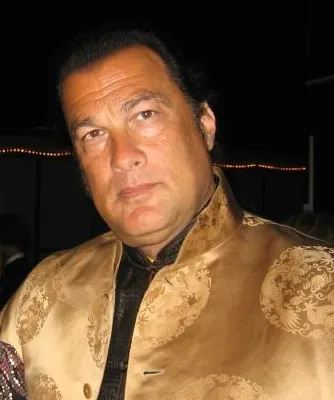
Steven Seagal
Human Design Chart
Biography
He founded the Aikido Ten martial arts academy. His film debut was in "Above the Law," 1988. He is a 6th degree black belt (Sensei, or Master) of the Japanese Martial Art of Aikido, and has extensive knowledge of other more obscure Asian martial arts as well, some of which he demonstrated on film (his excellent and lethal knife-wielding skills in "Under Siege 1," for example). Seagal began his Martial Arts career in the 1960s after seeing a demonstration that intrigued him. He also became interested in Buddhism during this time, and took to its tenets ardently. It was in Japan that he met his now-ex wife, model and sometime actress Kelli Lebrock.
He burst on the American movie scene in the late 1980s with his debut film, "Above the Law", said to be a semi-autobiographical account of his life in the years immediately following the Vietnam War. Other hit films followed, perhaps the best of which was "Marked for Death." During the latter half of the '90s, Seagal's star power declined, along with some personal problems such as the end of his marriage to Lebrock.
Seagal made three marriages; five kids.
What does Projector 1/3 mean for Steven Seagal?
Projector 1/3 — Design at a Glance
Steven Seagal's design tended to project a tendency: He possessed the ability to scrutinize systems and people with high precision. His aura functioned like a focused light beam that immediately identified weaknesses or errors in others. This direct perception could, however, quickly be perceived as unpleasant when communicated without consideration – comparable to a flashlight shining directly into someone's face and exposing their problems.
The optimal strategy for his design was not to take the initiative independently but to wait for an honest invitation from the environment. Instead of exercising criticism, he worked most effectively through his own harmony; if he himself set a shining example, others automatically sought his advice. Since Projectors do not have constant energy levels, phases of intense activity were always followed by necessary rest periods to avoid exhaustion. If Steven Seagal lived according to this strategy of patience and waiting for recognition, he was rewarded with success. Ignoring this dynamic and instead forcing himself into the spotlight led sooner or later to a bitter experience of non-self-realization as his specific leadership function was not respected.
Emotional Authority
Steven Seagal's design tended towards emotional wave movements. His inner authority resides in the defined Solar Plexus Center – Emotional Authority. In Human-Design, this configuration is considered prioritized: Once the Solar Plexus Center is activated, it takes over decision-making regardless of other defined centers in the chart.
This mechanism generates a permanent up and down of feelings. The world is always colored by the current mood; enthusiasm can quickly turn into negative evaluation. However, the momentary impulse is only a snapshot, not an ultimate truth. Quick, spontaneous decisions made from this emotional heat often have negative consequences as they are based on incomplete inner clarity.
Steven Seagal's strategy was to give time. Through patience and repeatedly 'sleeping on' a decision, intense feelings could subside. Only with growing emotional distance did true calm set in. This process was particularly crucial for long-term life decisions as it created the necessary depth for comprehensive insights. Without this waiting period, the perspective remained superficial and vulnerable to mood swings.
The 1/3 Profile — Investigator / Martyr
Steven Seagal's design tended towards intensive practical testing: He showed himself as someone who not only collected knowledge theoretically but validated it through direct experimentation and enduring failures. As a researcher and experimenter (Profile 1/3), his path was characterized by the constant alternation between the urge to learn more and the need to apply these insights in real life. Often, the energy of the first line took control, leading him to feel insecure when moving from planning to implementation – out of fear of not knowing enough yet. But precisely here lay his strength: The third line challenged him to advance through trial and error. Each experience served to avoid mistakes and find safer paths. When Steven Seagal made a decision or evaluated a method as good, he had previously tested it both theoretically and practically on heart and soul. His judgment was thus based on self-earned, verified truth. Additionally, he learned through mutual dependence that he needed other people to rationally explain his inner truth and find supportive relationships rather than hindering ones.
Triple Split Definition — Defined & Open Centers
Steven Seagal's design suggests a tendency towards continuous mental processing and clear but limited expression. His defined Ajna Center provided consistent concepts and theories; he always thought through things, which protected him from accepting others' opinions as his own truth. This mental structure flowed directly into his defined Throat Center, allowing him to articulate his thoughts consistently. Therefore, his communication was not a spontaneous reaction to circumstances but the translation of an already formed body of ideas.
At the same time, he had a firm inner identity through his defined G Center. This gave him a reliable sense of direction and self-love independent of external validation. He intuitively knew where he belonged without having to prove it – an advantage over people with open Heart Centers who often get caught in cycles of promises and disappointments to demonstrate their worth. Steven Seagal tended not to be driven by the need for recognition but acted from his central identity.
His emotional process, however, was complex: His defined Solar Plexus Center meant that truth became visible only over time for him. He had to wait out the emotional wave to gain clarity rather than reacting impulsively to highs or lows. This contrasted with his open Head Center, which made him vulnerable to mental irritation from external inspiration. Instead of needing immediate answers, he could learn to observe his own thoughts and not get pulled into a whirlpool of others' doubts.
Physically, his defined Spleen Center acted as an instinct for protection in the present moment while his open Sacral Center made him susceptible to overexertion from foreign energy. He had to learn to set boundaries and rest before exhaustion set in since he did not have a constant generative force but absorbed and amplified it from the environment. His defined Root Center provided the necessary pressure for movement, which he could only use healthily if he accepted it as a driving force for his existential well-being rather than stress.
Channels for intuitive elegance, logical clarity and emotional depth.
Steven Seagal's design suggests a tendency towards intuitive, spontaneous action guided by deep inner security. This attitude came from Channel Perfect Form 57-10, connecting the Spleen and G Centers. He had the ability to perceive acoustic qualities of his environment – not just words but tones – to respond appropriately immediately. This created natural elegance in behavior based on self-love that secured his physical survival without seeking external recognition.
Parallel to this, Steven Seagal showed a strong inclination towards logical organization of details. Channel Accepting 17-62 connected his Thinking Center with the Throat Center. He visualized patterns (Gate 17) and translated them precisely into language (Gate 62). This gave him the gift to structure complex information so that it became understandable. However, this required patience: He had to wait until invited to speak to generate clarity rather than resistance.
Emotionally, his essence was marked by a pulsating wave. Channel Emotions Release 39-55 connected Root and Solar Plexus Centers. He could provoke (Gate 39) the minds of others but this depended strongly on his current mood. This capriciousness was not a weakness but a mutative force swinging between joy and melancholy. Authenticity in this emotional depth allowed him to transmit spiritual passion while suppressing these waves led to frustration.
Additionally, influences such as Recognizing Feelings (Gate 30) or Seeking Inner Truth (Gate 61) were at play. His design challenged him not to resist his intuitive nature and emotional rhythms but use them as a source for creative expression and logical precision.
Individual Circuitry — Circuit Signature
Steven Seagal's design suggests an inclination towards emotional intensity paired with clear strategic thinking and deep inner intuition. These three distinct energy fields worked in parallel: The Solar Plexus and Root Centers were connected by the Knowledge Circuit via Channel 'Emotions Release'. This generated pulsating emotional waves carrying impulses from subconscious to outside.
Regardless of this, the Understanding Circuit linked Ajna and Throat Centers through Channel 'Accepting'. Here logical structure was paramount: Strategies were visually clearly recognized and directly translated into words free of emotional distortion. It was about sharing rational insights for future improvement.
The third field formed an integration between Identity and Spleen Centers via Channel 'Perfect Form'. This connection used intuitive knowledge from the Spleen to channel personal power in here and now, supported by spontaneous reactions and inner confirmation. It fostered a highly individual orientation of survival instinct.
As a Triple Defined, Steven Seagal possessed these three separate energy flows that did not overlap each other. Each area – emotional expression strength, logical communication, intuitive self-determination – operated as an independent unit. This shaped a profile driven by deep feelings and cool analysis and instinctive presence without necessarily merging these aspects.
Right Angle Cross of Maya 1
Steven Seagal's Human Design reveals a tendency towards a profound, almost mystical connection with the cosmos. He is someone who acts not just in the material world but whose existence is marked by a strong sense of spiritual dimension. This attitude stems from the configuration of the right cross of Maya 1. In Human Design mechanics, this cross represents a specific kind of cosmic alignment that connects the Center of Intuition with the Center of Identity in a way that allows for direct intuitive insight into one's place in the universe. For Steven Seagal, this meant that his actions and being were often guided by an inner spiritual compass. He was not just an actor in the world but someone who understood himself as part of a larger divine plan. This configuration fostered a lifestyle that enriched everyday life with higher meaning, almost sacred significance. His decisions and reactions were frequently influenced by this deeply rooted spiritual conviction, giving him a unique aura that transcended the purely physical. It was less a conscious choice than a natural result of his energetic structure, which led him to recognize and live the divine in daily life.
Saturn Return · Uranus Opposition · Chiron Return · 2nd Saturn Return — Life Cycles
Steven Seagal's Human Design points towards sudden, penetrating turning points often accompanied by a sense of inevitability. This dynamic is evident during moments when internal tensions become visible after a long period of preparation, forcing a new reality.
At age 40, in 1992, "Alarm Stage: Red" was released, one of his commercial successes. For his design, this marked the Uranus Return, a cycle traditionally associated with sudden changes, liberation from old structures, and breakthroughs to greater visibility. The opposition in the chart suggests that this success did not arise gradually but rather as a reaction to external pressure or crisis, which unlocked inner potentials.
The mechanics of the Uranus Return often describe an awakening from routine or stagnation. What was previously latent now comes to the forefront demanding adaptation. In Steven Seagal's case, this energy manifested through a concrete professional milestone that significantly changed his public presence. It was not a gradual development but an event that broke existing conditions and initiated a new phase. This moment illustrates how astrological cycles in Human Design can act as catalysts for visible life changes when internal structures are ready to open up and step forward.
Projector · Emotional Authority — Synthesis
A central thread runs through the design: the ability to recognize and highlight patterns (defined Ajna Center, Channel 57/10). This occurs not as neutral observation but with a projecting energy that directly impacts what needs improvement—a 'light into darkness' approach. The Researcher/Experimentor Profile (Profile 1/3) reinforces this impulse through the drive to acquire knowledge and validate it through experimentation before making informed judgments. Emotional authority underscores the necessity of allowing feelings to mature before they can serve as a guide—this process deepens the recognition and evaluation of patterns.
The central paradox lies in the combination of the Projector type's ability to identify system errors with emotional authority that requires time for deeper processing. The impulse to give immediate feedback (Projector) stands in tension with the need to make decisions only after an emotional wave has passed (emotional authority). This creates a dynamic field between directly pointing out improvement potential and patiently maturing a well-founded judgment. A documented event shows that this process can also lead to external success when timing and expression are aligned.
3 Defined Channels
Incarnation Cross - Right Angle Cross of Maya 1
Solar Return
The Solar Return shows the moment when the sun returns to its exact birth position - your personal solar year.
Life Cycles
Discover the life cycles with a detailed triple view (birth chart, cycle chart, composite).
Human Design Profile
- Type
- Projector
- Strategy
- Wait for the respectful invitation
- Authority
- Emotional Authority
- Profile
- 1/3 - Investigator / Martyr
- Definition
- Triple Split
- Incarnation Cross
- Right Angle Cross of Maya 1
- Date of Birth
- 10.04.1952 13:54
- Place of Birth
- Lansing, MI, United States
Frequently Asked Questions
What is Steven Seagal's Human Design type?
What Profile does Steven Seagal have in Human Design?
Which Authority guides Steven Seagal's decisions?
Which incarnation cross is assigned to Steven Seagal?
When was Steven Seagal born?
Discover your own Human Design
Are you also a Projector? Find out in a personal reading how to unfold your leadership qualities and recognize the right invitations.
More Personalities
Back to overviewSissy Spacek

Alain-Fournier

Anémone

Ann-Margret

Arletty
Arno