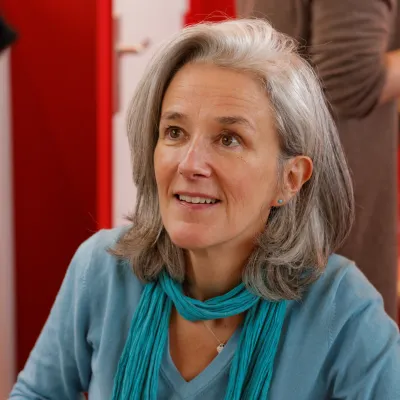
Tatiana de Rosnay
Human Design Chart
Biography
In 2006 de Rosnay published her most popular novel, Sarah's Key, which has sold over three million copies in French and almost two million in English. In 2009 the book was adapted into the French film Sarah's Key by Serge Joncour, with Kristin Scott Thomas as Julia.
The Human Design of Tatiana de Rosnay: Projector 2/4
Projector 2/4 — Design at a Glance
Tatiana de Rosnay is characterized by a design that allows her to perceive her environment with sharp focus and clarity. Her system is designed to immediately recognize errors in others or in systems, and to pinpoint areas where processes are in the dark. This ability acts like a bright flashlight, shining light on problematic areas.
As a Projector, she does not have a constant, intrinsic source of life energy. Instead, she experiences phases of high activity followed by necessary rest periods to prevent burnout. This often conflicts with societal structures that expect continuous performance. The challenge lies in not formulating this diagnostic sharpness as direct criticism, which often triggers defensiveness in others.
Her most effective strategy is to attract others through her own harmonious actions. When she successfully follows her own path, people seek her out for advice. Waiting for an honest, appreciative invitation is the key to her effectiveness. Living by this pattern rewards her with success. Ignoring this dynamic and trying to push her energy against the resistance of her environment leads to feelings of bitterness, the typical non-self theme of this type.
Emotional Authority
Tatiana de Rosnay shows an inner decision-making structure based on Emotional Authority. Her design specifies that the Solar Plexus Center is defined, giving it the leadership function regardless of all other defined centers in her graph. This priority means that her emotional wave always takes precedence over other internal impulses.
She experiences a constant fluctuation of feelings that strongly colors her perception of the world. In one moment, she can be enthusiastic about something, and in the next, she can negatively evaluate the same situation. However, this immediate emotional reaction is only a snapshot and not necessarily her deeper truth. Quick, spontaneous decisions made directly from this first emotion often risk negative consequences, as they are based on transient moods.
Her path to clarity requires patience and time. By letting decisions mature and reviewing them multiple times, the intense feelings lose their intensity. With this distance, calmness sets in and the true direction becomes visible. This process of waiting is especially crucial for long-term, life-defining decisions, as it ensures that the choice is made on a stable, clear basis and not on a transient emotional flood.
The 2/4 Profile — Hermit / Opportunist
Tatiana de Rosnay shows a characteristic tension between a deep need for withdrawal and the urge to connect. Her design suggests that she constantly oscillates between two poles: the need to be alone to gain inner clarity and the desire to spend time with chosen people. This dynamic requires clear communication of her boundaries to protect both the necessary 'me-time' and social interaction.
In her isolation, she delves into internal processes to find peace. This behavior corresponds to Line 2, connected to Gate 18. It involves the realization of the irreversibility of certain situations and the resulting spiritual renewal through acceptance. If she resists this reality, it leads to futile rage; if she accepts it, she finds peace.
Once this inner balance is established, Tatiana de Rosnay seeks exchange. Line 4, represented by Gate 52, brings self-discipline and focus to her social interactions. Although she is active in communities, she must maintain her concentration. Her doubts and uncertainties are not obstacles but become useful through exchange with the collective. Thus, she can reflect on the knowledge of her network during subsequent alone time and develop brilliant ideas. The cycle of withdrawal for processing and surrender for networking shapes her work style and well-being significantly.
Single Definition — Defined & Open Centers
Tatiana de Rosnay was characterized by deep emotional intelligence and a strong instinct for the essential. Her defined Solar Plexus Center gave her the ability to not immediately judge situations but to wait for the emotional wave to pass until clarity emerged. This patience allowed her to make decisions based on a deep, time-ripened truth rather than on impulsive reactions. Simultaneously, her defined Spleen Center supported these processes through spontaneous, intuitive warning signals in the here and now, helping her to stay healthy and protected.
At the same time, her design was marked by several open centers, making her vulnerable to external influences. Her open Head Center meant that she did not have a constant source of mental inspiration; she tended to engage with questions that were not hers or to be swayed by others' doubts, rather than trusting her inner authority. Similarly, her open Ajna Center meant that she took on concepts and opinions from her environment without identifying them as her own truth, giving her a flexible but also vulnerable mind.
Her open G Center indicated that she did not have a fixed, unchangeable identity or life direction. Instead, she made decisions about places and relationships by sensing whether she felt well and authentic at a specific place. She relied on others to initiate her direction and avoided actively seeking a fixed self-image. Additionally, her open Heart Center made her vulnerable to the pressure to prove herself or to make promises she could not keep, leading her to define her value not through competition but through trust in her own strategy. Her open Sacral Center also meant that her energy was unstable; she had to learn not to be overwhelmed by the generative energy of others but to respect her own limits and rest sufficiently.
Channels for logical scrutiny and emotional intuition.
Tatiana de Rosnay's design inclined towards analytical precision and emotional intensity. She was someone who questioned patterns while also seeking deep experiences.
This attitude was shaped by the Judgment Channel 58-18. It connects the Root Center with the Spleen Center and drives an insatiable urge to prove logic and correct patterns. Gate 58, the Gate of Liveliness, demands 'better and more', while Gate 18, the Gate of Correction, checks what is healthy or in balance. This channel acts like a sentry, assessing whether the perceived reality brightens life for the collective. Tatiana de Rosnay possessed the ability to check patterns and strive for perfection, with her criticism being most effective when explicitly requested.
Parallel to this, the Recognition Channel 41-30 was also at play. It connects the Root Center with the Solar Plexus Center. Gate 41, the Gate of Limitation, generates restlessness and the urge for new scenarios. In conjunction with Gate 30, the Gate of Feeling Recognition, emotions fuel this urge further. This resulted in a strong need to seek new experiences and feel deeply. The emotional wave of this channel required patience to gain clarity before making decisions.
Additionally, other gates shaped her profile: Gate 17 stood for succession and logical teaching, linked with human rights and emancipation. Gate 52 represented self-imposed pauses for concentration and pattern correction, closely tied to silence. Gate 50 as a protective reflex nurtured awareness of traditions and values. Gate 38 showed resistance to preserve individual integrity and set boundaries. Gate 60 conveyed the acceptance of limitations as a path to transcendence, often accompanied by melancholy. Gate 44 stood for vigilance and transformation through interaction. This configuration described a person who structured their reality through critical analysis and emotional depth.
Collective Circuitry — Circuit Signature
Tatiana de Rosnay's design inclined towards a clear, judgmental perception characterized by a close connection between intuition and nerve energy. The Spleen Center, the seat of intuition and the sense of the essential, was directly linked to the Root Center, the source of pure nerve energy and survival will. This Judgment Channel allowed her to immediately translate intuitive insights into tangible energy without delay through logical filtering or emotional waves. It was a direct, 'emotionless' ratio based on the moment of insight.
Additionally, a second, separate energetic structure was evident. The Solar Plexus, the center of emotions and cyclical wave movement, was also connected to the Root Center. This created its own stream of emotional intensity, coming in waves and receding. Since these two connections - Spleen-Root and Solar Plexus-Root - belong to different circuits (Understanding and Meaning respectively), they existed as parallel, side-by-side forces. The intuitive clarity of one system did not directly exchange with the emotional depth of the other, but formed two distinct yet energetically powered areas by the shared Root Center. Tatiana de Rosnay thus possessed a precise, intuitive judgment ability as well as a separate, cyclically unfolding emotional landscape, each following their own laws.
Right Angle Cross of Service 3
Tatiana de Rosnay revealed herself through a deeply rooted orientation towards serving others. Her design laid a tendency to put herself in the background to meet the needs of her environment. This attitude is an expression of the right cross of service, a configuration that does not aim for egocentric recognition but for silent support.
In Human Design, this cross describes a specific energy that involves taking responsibility for the well-being of others without standing in the spotlight. It is about a kind of leadership that works through reliability and care, rather than through loud commanding. Tatiana de Rosnay thus acted as someone who created stability and security for her fellow humans by carrying their burdens.
This mechanism does not mean that her own needs were ignored, but rather that fulfillment resulted from the act of giving itself. The energy of this cross flows where help is needed. Tatiana de Rosnay used this power to build bridges and resolve conflicts through empathetic action. Her influence was subtle but lasting, as it was based on trust and loyalty. She understood how to instill calm in chaotic situations by focusing on the essential: the people in front of her. This shaped her way of interacting with the world as a continuous gesture of dedication and protection.
Saturn Return · Uranus Opposition · Chiron Return · 2nd Saturn Return — Life Cycles
Tatiana de Rosnay's design tended to translate inner clarity and structure into concrete, tangible results. This orientation was clearly evident in her first Saturn return in 1992, at the age of 31. During this life stage, which often marks the condensation of years of inner work, she published her first novel. This step was no coincidence, but a typical expression of the mechanics where personal maturity manifests in a first major public achievement.
Later, during her Chiron return in 2010, at the age of 49, another important cycle took place. The Chiron return is a fulfillment cycle in which one's life purpose, if one has followed their strategy, increasingly unfolds and becomes experiential. In this year, her novel “Sarah's Key” was adapted into a film. This underscores the nature of this cycle as a phase of bloom, in which one's work reaches a new dimension and its meaning becomes visible in a broader context.
Her second Saturn return in 2015, at the age of 54, confirmed this development. Her biography “Manderley for ever” was nominated for the Prix Goncourt de la Biographie and won the Prix de la Biographie de la Ville d'Hossegor. This success illustrates how in the second Saturn return, the work previously done condenses into established authority. Tatiana de Rosnay thus showed herself as someone whose creative output is closely linked to the structural cycles of her design, with each return bringing a new level of confirmation and effectiveness.
Projector · Emotional Authority — Synthesis
A central red thread in her design is the ability to recognize hidden patterns and correct them (Channel Judgment, defined Solar Plexus Center). This is evident in a deep sensitivity for what is out of balance, coupled with a drive to create clarity and improve. The projection of her energy onto the environment, combined with emotional authority, indicates that she intuitively grasps the dynamics of other people and can bring
2 Defined Channels
Incarnation Cross - Right Angle Cross of Service 3
Solar Return
The Solar Return shows the moment when the sun returns to its exact birth position - your personal solar year.
Life Cycles
Discover the life cycles with a detailed triple view (birth chart, cycle chart, composite).
Human Design Profile
- Type
- Projector
- Strategy
- Wait for the respectful invitation
- Authority
- Emotional Authority
- Profile
- 2/4 - Hermit / Opportunist
- Definition
- Single Definition
- Incarnation Cross
- Right Angle Cross of Service 3
- Date of Birth
- 28.09.1961 11:45
- Place of Birth
- Neuilly sur Seine, France
Frequently Asked Questions
What is Tatiana de Rosnay's Human Design type?
What are Tatiana de Rosnay's Profiles?
What authority does Tatiana de Rosnay have?
When was Tatiana de Rosnay born?
Discover your own Human Design
Are you also a Projector? Find out in a personal reading how to unfold your leadership qualities and recognize the right invitations.
More Personalities
Back to overviewSissy Spacek

Alain-Fournier

Anémone

Angeli

Ann-Margret

Bourvil