
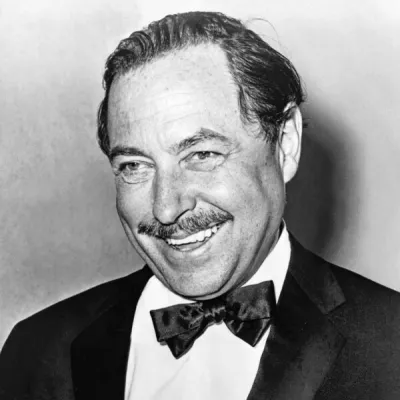
Tennessee Williams
Human Design Chart
Biography
At age 33, after years of obscurity, Williams suddenly became famous with the success of The Glass Menagerie (1944) in New York City. It was the first of a string of successes, including A Streetcar Named Desire (1947), Cat on a Hot Tin Roof (1955), Sweet Bird of Youth (1959), and The Night of the Iguana (1961). With his later work, Williams attempted a new style that did not appeal as widely to audiences. His drama A Streetcar Named Desire is often numbered on short lists of the finest American plays of the 20th century alongside Eugene O'Neill's Long Day's Journey into Night and Arthur Miller's Death of a Salesman.
Much of Williams's most acclaimed work has been adapted for the cinema. He also wrote short stories, poetry, essays, and a volume of memoirs. In 1979, four years before his death, Williams was inducted into the American Theater Hall of Fame.
The Human Design of Tennessee Williams: Generator 1/3
Generator 1/3 — Design at a Glance
Tennessee Williams' design suggests a foundational approach that leans less on self-initiation and more on responding to impulses. As a Generator, he possessed an enduring, sacral energy – akin to power that immersed itself in tasks as long as they genuinely sparked interest. This energy wasn't unleashed by initiative but rather through reacting to external stimuli: not starting things himself but responding to life's signals when there was a clear internal yes. From this mechanism emerged two typical vulnerabilities. One involved doing things for extended periods without genuine interest – a pattern that could dissipate the energy and lead to exhaustion. The other showed up where he was prevented from working on a project despite having the energy to continue flowing. If Williams stayed within this reactive logic, little could stop him, and engagement itself brought a sense of deep fulfillment. Conversely, persistent self-initiation instead of waiting and responding often led to frustration or a noticeable lack of energy – two states closely tied to whether he waited or acted.
Sacral Authority
Tennessee Williams' design suggested decision-making that ran through the body rather than the head: sacral authority. This form of inner authority was exclusive to Generator types - the only type where strategy could also be internal authority, simplifying the decision-making process somewhat. A prerequisite for this was an open emotional center. It didn't manifest as a thought but as a gut reaction to external stimuli – a surge of power or bodily voice expressed in sounds like grunting, humming, groaning, or hmm. When this sacral engine engaged with something, vitality and seemingly inexhaustible energy set in, enabling tasks to be accomplished enthusiastically - a state designed for immersion in the activity itself without external purpose binding.
With an activated Spleen Center connected to the Sacral Center, supportive authority was added: exceptionally quick, spontaneous reactivity with immediate access to physical well-being and instinctive perception, providing reliable orientation. For Tennessee Williams' design, this meant clarity arose not through weighing options but through reaction - by listening to what his body actually responded with at the moment of engagement.
The 1/3 Profile — Investigator / Martyr
Tennessee Williams' design established a fundamental tension between wanting to know and needing to try things out. His Profile 1/3 – known in Human Design parlance as Researcher and Experimenter – combined the desire to thoroughly penetrate an issue with the drive to test it practically afterward. This combination brought typical friction: As long as the research side held sway, he might hesitate to move from planning into implementation out of a feeling of not knowing enough – while the experiential part wanted to act and learn from mistakes. Insights he had worked out and practically tested carried special weight for him.
Two individual activations further shaped this foundational approach. One line featuring openness in the center allowed him to consider multiple perspectives simultaneously, rather than fixating on a single opinion – breadth that helped grasp reality more comprehensively without narrowing thought to an aesthetically pleasing but narrow range of possibilities. A second activation described an energy-charged, self-stimulating quality not dependent on external support – with the downside of rejecting help from others until his own experience showed how much he truly needed them.
Split Definition — Defined & Open Centers
Tennessee Williams' design created a tension between an ever-active mind without its own drive and a body energy that is only available upon request. His Head Center and Ajna Center were defined – the area that creates constant mental pressure to question, interpret, and understand. Since neither the Head nor Ajna centers are connected to any of the energy centers, this pressure lacks the power to directly translate thoughts into action; when resisted, frustration, anger, bitterness, or disappointment arise. His Sacral Center was also defined – a daily, constant hum of life force that manifests as restlessness and the need to burn off energy through activity; however, this energy is only reliably available in response to something from outside, not through self-initiation – if mental decision replaces this response, exhaustion and frustration follow. The Spleen Center was also defined and provided spontaneous, immediate perceptions of health and harmony.
Opposing these stable areas was an open G Center – the center for identity and direction that, in an open definition, does not provide a firm, reliable answer to who one is or where one belongs. The typical vulnerability of this open center lies in constantly questioning one's direction and belonging rather than recognizing that environment and relationships bring these answers from outside. His Solar Plexus Center was also open: foreign moods are taken in and amplified without originating from one’s own feelings – a mechanism that can make confrontations particularly burdensome. Together, this created a design where an ever-active but driveless mind met with body energy that could only flow reactively while no stable identity provided the framework.
Channel 3-60: Mutation — Channels & Gates
Tennessee Williams' design established a pronounced tension between sudden insight and a melancholic drive for renewal. Four channels shaped this pattern.
The Channel of Mutation 60-3 connected the Root Center to the Sacral Center: Gate 60, the Gate of Limitation, met with Gate 3, the Gate of Order. This created a pulsating on/off energy closely linked to melancholy – evolutionary change only occurred when limitation was accepted and the confusion of a new beginning was navigated.
Alongside this stood the Channel of Concentration 52-9, also between Root and Sacral Centers: Gate 52, the Gate of Non-action, held still so that Gate 9, the Gate of Focusing, could direct attention to details and facts. A calm, tense pressure to remain still characterized this process.
The Channel of Judgment 58-18 connected the Root Center with the Spleen Center: Gate 58, the Gate of Liveliness, drove an insatiable desire for 'better and more', while Gate 18, the Gate of Correcting, pointed out imbalances. This led to a drive to continuously question and perfect patterns.
The Channel of Awareness 61-24 connected the Head Center with the Ajna Center: Gate 61, the Gate of Secrets, provided inspiration as an internal 'white noise', which Gate 24, the Gate of Rationalizing, transformed into a sudden moment of knowing – a Satori.
This was complemented by Gate 17, the need to logically organize the future, accompanied by doubt as a healthy part of this process; Gate 19, the desire for resources and community; Gate 27, a caring role; Gate 38, resistance to preserve one's integrity; as well as Gate 44 and Gate 53, awareness of others and the drive to begin new cycles as a pioneer.
Individual Circuitry — Circuit Signature
Tennessee Williams' design showed a tendency to seek new insights on his own initiative and form something unique that stood out from what had been before. This tendency came from the Channel of Mutation (Gates 3-60), part of the Knowledge Circuit: it brought the power to set deviations from what was already there rather than merely continuing the existing. In addition, the Channel of Awareness (Gates 61-24) contributed a second, independent quality – an inner drive to mentally penetrate unclear impressions until they became comprehensible insights. Both channels belonged to the same circuit but, according to available data, only connected his Head and Ajna Centers directly with each other – the Sacral Center, which this circuit generally also touches, was not included here through its own channel.
In addition stood an independent force, not directly related: the Understanding Circuit: Concentration (Gates 9-52) as well as Judgment (Gates 18-58) connected his Sacral-, Root-, and Spleen Centers and focused on logical improvement and the transmission of rational insights without conditioning.
As Tennessee Williams had a Split Definition, these two forces – the mind-focused search for knowledge and the body-instinctive judgment power – ran as separate, parallel existing drives alongside each other, not as one continuous flow.
Right Angle Cross of Service 1
Tennessee Williamss Design was assigned to one of the right-angled crosses, specifically the Service Cross in its first manifestation—a fundamental orientation that shaped his life more strongly from a personal destiny than from an externally imposed task. In Human Design mechanics, Incarnation Crosses differ according to how closely a life is bound to an external fate: Right-angled crosses like this describe a path primarily formed through personal experience and decisions rather than from a predefined role for a collective. The number 1 in the name indicates that this cross was one of several possible variants among thematically related crosses, depending on the involved lines. For Tennessee Williams, this configuration mainly described a basic attitude: service to others lived as a self-chosen part of his own path.
Saturn Return · Uranus Opposition · Chiron Return · 2nd Saturn Return — Life Cycles
Tennessee Williamss Design showed a phase of breaking out in midlife, which became particularly visible in 1951 when he published The Glass Menagerie—a typical moment for his Uranus opposition cycle around the age of 40. This cycle, active roughly between ages 38 and 42, describes in Human Design mechanics the break with unconscious imprinting from childhood and youth: what had previously been carried by foreign expectations receded, making way for a more independent and unfiltered orientation. For Williams, this turning point coincided with one of his central works.
Ten years later, in 1961 at age 50, he published Summer and Smoke—marking the time of his Chiron Return cycle between ages 49 and 51. In Human Design interpretation, this is not a healing process for old wounds but rather an achievement cycle: The incarnation cross laid out in his chart unfolded increasingly in lived life if the person had previously acted according to their strategy and authority, making one's own purpose tangible. For Williams, this cycle also coincided with another publication—a pattern that made both cycles appear as successive stations of an increasingly independent and mature creative orientation.
Generator · Sacral Authority — Synthesis
Through his design ran a pattern of never-ending testing. As a Generator with sacral authority, Tennessee Williams was designed to react rather than plan and endure stagnation phases until breakthroughs occurred. The same attitude showed in the Profile: as a Researcher and Experimenter (1/3), he lived alternating between learning and experimenting, suspicious of hasty conclusions until an insight had been tested. Channel Judgment (Gate 58-18) intensified this as an insatiable urge to question and correct patterns—knowing that true perfection was never attainable. The defined Head-Ajna Center kept him in constant mental pressure to ask questions and seek answers, without ever resolving doubts definitively. Thus emerged a red thread without an endpoint: react, experiment, correct, then ask again.
At the same time, there existed a tension between two forces that lay side by side as separate definition groups. On one hand, a continuously active individual mind from Head and Ajna Centers generating constant questions and seeking inspiration but lacking the energy to translate thoughts into action. On the other hand, an earthy power center from Sacral, Root, and Spleen Centers moving only in reaction to impulses and waiting patiently for the right moment. Both systems remained coherent yet did not directly interact: a restless, questioning mind beside a patient, instinctive response-power—the central paradox of his design.
4 Defined Channels
Incarnation Cross - Right Angle Cross of Service 1
Solar Return
The Solar Return shows the moment when the sun returns to its exact birth position - your personal solar year.
Life Cycles
Discover the life cycles with a detailed triple view (birth chart, cycle chart, composite).
Human Design Profile
- Type
- Generator
- Strategy
- To respond - wait for something to respond to
- Authority
- Sacral Authority
- Profile
- 1/3 - Investigator / Martyr
- Definition
- Split Definition
- Incarnation Cross
- Right Angle Cross of Service 1
- Date of Birth
- 26.03.1911 02:30
- Place of Birth
- Columbus, Mississippi, United States
Frequently Asked Questions
What was Tennessee Williams' Human Design type?
What Profile did Tennessee Williams have in Human Design?
What Authority did Tennessee Williams have according to Human Design?
What incarnation cross did Tennessee Williams carry?
When was Tennessee Williams born?
Discover your own Human Design
Are you also a Generator? Find out in a personal reading how to use your sacral energy correctly and discover deep satisfaction.
More Personalities
Back to overviewAaliyah

Alain-Fournier

Alexia

Angèle

Angeli

Anne-Marie
