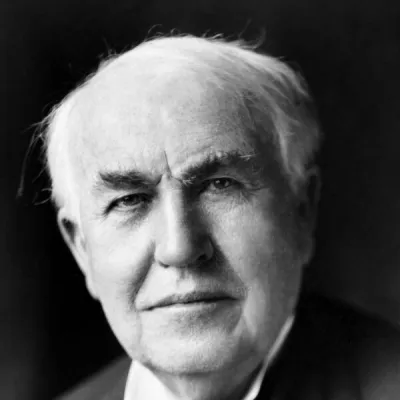
Thomas A. Edison
Human Design Chart
Biography
Edison was raised in the American Midwest. Early in his career he worked as a telegraph operator, which inspired some of his earliest inventions. In 1876, he established his first laboratory facility in Menlo Park, New Jersey, where many of his early inventions were developed. He went into business and became wealthy. Edison used his fortune to further his passion for invention. This was realized in experimental mining operations, the first film studio, and 1,093 US patents.
What does Projector 4/6 mean for Thomas A. Edison?
Projector 4/6 — Design at a Glance
Thomas A. Edison appeared as a dense, focused aura, comparable to a bright flashlight that immediately revealed system errors. His design marked him as someone who intuitively recognized where processes were in the dark or not functioning properly. However, this ability to find faults in the system was only effective when it wasn't used directly and confrontationally. Direct criticism would have triggered resistance from his environment, similar to shining a bright light into someone's face. Instead, his strength lay in attracting others through his own harmonious glow. When he embodied efficient solutions himself, people sought him out for advice. His strategy was to wait for an appreciative invitation rather than imposing his knowledge.
This approach was essential due to his undefined Sacral Center. Thomas A. Edison did not have a constant source of intrinsic life energy. His rhythm consisted of phases of high activity and fast workability, followed by necessary rest periods to avoid burnout. The traditional system with its expectation of continuous performance did not fit this cycle. Living according to his design – holding back until invited and respecting his energy waves – rewarded him with success. Deviations from this led sooner or later to feelings of bitterness, his non-self theme. His success was thus not the result of constant effort but rather the outcome of a clever management of his limited energy through targeted focus and patience for the right invitation.
Splenic Authority
Thomas A. Edison exhibited a decision-making stance based on a fine, spontaneous impulse. His design carried the inner authority of the Spleen, meaning that the defined Spleen Center functioned as a health and alarm system. This configuration required open emotional and sacral centers, which only Projectors or Manifestors can possess.
The Spleen conveyed him an immediate survival intelligence: a spontaneous internal knowledge about whether a situation, environment, or society was right for him. This first impulse served directly his protection and health, enabling him to rigorously isolate against harmful influences and effectively provide for himself. Since this voice was very subtle and only appeared once at each moment, it required the highest vigilance not to be overshadowed or ignored by other influences. A withdrawal could be helpful in decision-making to follow these fine signals.
Since Thomas A. Edison could only know what was right for him in the moment, his plans were subject to short-term changes. Long-term commitments proved difficult; instead, his design promoted flexibility and freedom. He acted best spontaneously rather than binding himself long-term, as this aligned with the nature of his Spleen authority, which found clarity in the here and now.
The 4/6 Profile — Opportunist / Role Model
Thomas A. Edison showed an experimental attitude in his first half of life, driven by the need to find support for his ideas through relationships and networks. His design tended towards carrying revolutionary principles outward and establishing a 'party program' based on human rights and political change. This aligned with the dynamics of the fourth line through Gate 49, which promoted reaching outwards and implementing changes, Jupiter amplifying this program.
With the activation of the sixth line, a fundamental inner conflict arose: The desire for community belonging clashed with the intellectual need for wise distance and meaning-making. Gate 43 added the dynamics of breakthrough and mutation; the intellect immediately recognized what led to a new order but risked losing ground contact in doing so. Edison engaged only with those who supported this transformation. In later years, he was expected to act as an example through cooperation. His heart remained cautious not to open up to false people and get hurt while his head pondered the greater meaning.
Split Definition — Defined & Open Centers
Thomas A. Edison was characterized by a stable triangle of defined Ajna Center, G-Center, and Spleen Center. His design offered a consistent mental function: He processed data and concepts in the same way regardless of external influences. This clear thinking structure directly flowed into his communication (defined throat), allowing him to consistently express his mental ideas. The defined G-Center gave him a firm identity and a clear sense of direction; he knew who he was and where he was going without relying on others. The defined Spleen Center provided spontaneous intuition in the present moment, a reliable instinct for health and survival.
Opposing this stability were five open centers: Head, Heart, Sacral, Solar Plexus, and Root. These opennesses did not indicate deficits but situational sensitivity. Edison took inspiration (Head), willpower pressure (Heart), energy (Sacral), emotions (Solar Plexus), and stress (Root) from the environment and amplified them without being part of them. The challenge lay in using his defined mental authority without identifying with the absorbed external pressures.
So he tended to interpret mental pressure as his own doubt or get lost in endless questions, though these often did not originate from him. In the open Heart Center, he could take up the need for willpower and recognition from the environment, which might lead him to make promises he couldn't keep just to prove his worth. The open Sacral Center made him vulnerable to exhaustion as he amplified foreign energy without generating it himself; he had to learn when enough was enough. Emotions from the open Solar Plexus were taken up like a barometer, leading him to feel emotionally unstable even though the feelings belonged to others. Finally, the open Root Center absorbed external stress that could drive him into hyperactivity to escape this pressure. His wisdom lay in using these fields as information rather than living them as his own reality.
Channels for intuitive elegance, structuring and clear expression.
Thomas A. Edison was someone whose actions were marked by a deep intuitive spontaneity that relied less on logical planning and more on an immediate sense of the here-and-now. This fundamental attitude stemmed from the Personality through Channel 57-10, which connected the intuitive insight of the Spleen Center with self-referential behavior in the G-Center. It was not egoism but a survival art: Through acoustic and physical sensitivity to the environment, his behavior perfectly adapted to the current moment. Thomas A. Edison followed these impulses, allowing him to let go of unfounded future anxieties and appear existentially unburdened. His creativity did not spring from intellectual reflection but from an altruistic process of expressing his own essence, often leaving his surroundings healthier and more beautiful without pursuing this as a primary goal.
At the same time, Thomas A. Edison's design included Channel 23-43 (Structuring), which stood for innovative, metaphorical insights. This channel connected assimilation in the Throat Center with spontaneous breakthrough insight in the Ajna Center. Here lay a specific challenge: His innovative knowledge and new perspectives were often so ahead of their time that they were misunderstood or rejected without proper timing. Channel 23-43 required patience as his unique thinking could only establish itself through repeated explanation and recognition within the collective. Thomas A. Edison had to learn to let go of control and trust his mind that his insights would be understood at the right time. Only when this inner authority and timing aligned could his mutative potential become effective rather than feeling like an outsider. This combination of intuitive spontaneity and the need for innovative ideas to mature shaped how he interacted with the world.
Individual Circuitry — Circuit Signature
Thomas A. Edison was someone who walked his own path and created new identity through deviation from the existing. His design laid a pulsating energy aimed at bringing change into the world. This attitude resulted from his Shared Definition: Two separate, parallel existing power fields shaped his experience without being directly connected to each other.
One field formed the Knowledge Circuit. Here Channel 43-23 (Structuring) linked Ajna Center with Throat Center. It allowed him to structure thoughts in the mind and then express them acoustically or through concrete actions in the present moment. This was about formulating innovations that sprang from his individuality.
The second field came from the Integration area. Channel 10-57 (Perfect Form) connected Identity Center with Spleen Center. This connection ensured that power derived from reacting to life through proper behavior and intuitive knowledge was channeled correctly. It served for survival through synthesis: Intuition met the necessity of asserting oneself in the present.
Both systems worked independently. One focused on expressing new ideas and transformation by structuring thought into words or actions. The other secured the foundation through intuitive adaptation to life circumstances and correct action. Thomas A. Edison thus lived from two separate sources: one that created a new identity through mutation, and another that stabilized survival through integrated intuition and behavior. Neither of these groups flowed into each other; they existed as distinct, parallel realities in his design.
Right Angle Cross of Explanation 1
Thomas A. Edison's design showed a tendency towards clear and direct communication. He was someone who reduced complex issues to their essence and shared them with others. This attitude stemmed from the right cross of Explanation 1 in his Human-Design chart.
This configuration describes a specific way of expression: the ability to structure information so that it becomes understandable and useful for others. It's not about rhetorical brilliance or emotional persuasion, but rather precise clarity. Thomas A. Edison used this mechanism to shape his ideas and discoveries into forms that could be adopted and further developed by others. His words served to explain, not decorate.
The energy of this cross acted as a tool for knowledge transmission. It helped him make the hidden visible and present connections in such a way that they were logically comprehensible. For those around him, this meant he often took on the role of an explainer – someone who asked questions or provided answers that truly helped others progress. This characteristic significantly shaped his interactions and distinguished him from people whose expression was more intuitive or emotionally driven. For Thomas A. Edison, factual correctness was paramount, supported by a natural gift for explaining things simply.
Saturn Return · Uranus Opposition · Chiron Return · 2nd Saturn Return — Life Cycles
Thomas A. Edison's design showed a tendency towards structural consolidation and simultaneous expansion, which condensed into recurring astrological cycles. The first Saturn return marked 1875 at the age of 28 as a turning point: the sale of rights to the quadruplex technology opened up new possibilities and solidified his position. This phase demonstrated how years of groundwork matured into a viable result.
The Uranus opposition in 1886 at the age of 39 marked an expansive dynamic. Edison's company grew to around 3000 employees and approximately ten million dollars in capital. Here, the mechanism of expansion was evident as existing structures were strengthened by new resources and reach.
The Chiron return around his 50th year was a fulfillment cycle where his incarnation purpose increasingly unfolded. In 1897 he received the patent for the kinetograph. This wasn't a moment of healing but rather a blooming phase in which the meaning and purpose of his work became palpable.
The second Saturn return brought further structural anchoring in 1903 at the age of 56. The development of a special phonograph for children together with Ludwig Stollwerck underscored his ability to stabilize established technologies in new contexts and continue their development. These cycles demonstrated how his design used phases of consolidation to achieve long-term impact.
Projector · Splenic Authority — Synthesis
He was a projector who, through his ability to recognize flaws in the system (Gate 11) and the resulting intuitive insight (Channel 57-10), possessed a unique quality. He projected this gift onto his environment to bring 'light into darkness' for others – a process that was amplified by his defined mental center, which continuously developed concepts and inspired others to think. By connecting intuitive awareness with a focus on personal well-being, he created a foundation for creative integration and survival.
A central paradox in his design lay in the interplay between the desire for community (Line 4) and the longing for independent thought and reflection (Line 6). This led to a lifelong conflict between heart and head that manifested in various phases of his life – from early experiments to the expectation of acting as a wise role model. Recurring successes (documented by events in Saturn and Uranus cycles) indicated that he continually transformed this inner contradiction into creative energy.
2 Defined Channels
Incarnation Cross - Right Angle Cross of Explanation 1
Solar Return
The Solar Return shows the moment when the sun returns to its exact birth position - your personal solar year.
Life Cycles
Discover the life cycles with a detailed triple view (birth chart, cycle chart, composite).
Human Design Profile
- Type
- Projector
- Strategy
- Wait for the respectful invitation
- Authority
- Splenic Authority
- Profile
- 4/6 - Opportunist / Role Model
- Definition
- Split Definition
- Incarnation Cross
- Right Angle Cross of Explanation 1
- Date of Birth
- 11.02.1847 01:30
- Place of Birth
- Milan, Ohio, United States
Frequently Asked Questions
What was Thomas A. Edison's Human Design type?
What Profile did Thomas A. Edison have in Human Design?
What Authority guided Thomas A. Edison?
What incarnation cross did Thomas A. Edison have?
When was Thomas A. Edison born?
Discover your own Human Design
Are you also a Projector? Find out in a personal reading how to unfold your leadership qualities and recognize the right invitations.
More Personalities
Back to overviewSissy Spacek

Alain-Fournier

Anémone

Ann-Margret

Bourvil
Hergé