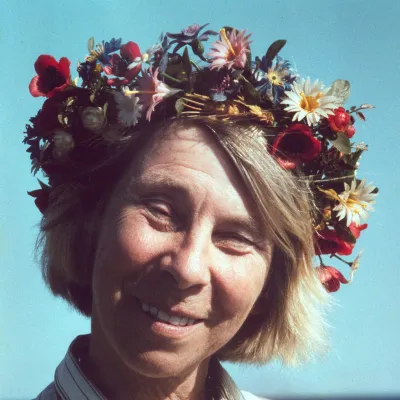
Tove Jansson
Human Design Chart
Biography
Brought up by artistic parents, Jansson studied art from 1930 to 1938 in Stockholm, Helsinki and then Paris. Her first solo art exhibition was in 1943. At the same time, she was writing short stories and articles for publication, as well as creating the graphics for book covers and other purposes. She continued to work as an artist for the rest of her life, alongside her writing.
Jansson is best known as the author of the Moomin books for children. The first such book, The Moomins and the Great Flood, appeared in 1945, though it was the next two books, Comet in Moominland and Finn Family Moomintroll, published in 1946 and 1948 respectively, that brought her fame.
Starting with the semi-autobiographical Bildhuggarens dotter (Sculptor's Daughter) in 1968, she wrote six novels and five books of short stories for adults.
Tove Jansson died on 27 June 2001, aged 86, in Helsinki.
Tove Jansson as a Projector 3/6 in Human Design
Projector 3/6 — Design at a Glance
Tove Jansson revealed herself as someone who had a focused view on the systems around her. As a Projector, she did not have a constant internal source of life energy from the undefined Sacral Center. Instead, her design featured a dense, focusing aura, comparable to a bright flashlight that pointed directly at areas where others were still in darkness. She was called upon to bring 'light into the dark' for others and illuminate their path by immediately recognizing where errors or imbalances existed within a system.
This ability to precisely identify weaknesses could be misunderstood when addressed directly. The most effective strategy for her design involved waiting for an inviting, sincere invitation from the environment. Rather than demanding uninvited observations, she attracted people through the example of her own harmony. Others would then come to her on their own initiative seeking advice.
Since her energy level fluctuated – with phases of high productivity followed by necessary rest periods to avoid burnout – her rhythm did not align with the constant pressure of school systems or standardized work models. Living according to this principle of invitation and respect for her energy cycles, she was rewarded with success. Ignoring this structure led to the non-self theme of bitterness. Thus, her design tended towards a leading but reserved role that only became effective through external recognition.
Emotional Authority
Tove Jansson displayed an internal decision-making structure that did not rely on immediate clarity but rather characterized itself by wave-like emotional movements. Her design carried Emotional Authority, meaning that her defined Emotional Center always held the lead in important life decisions – regardless of which other centers were also defined. This priority was a central mechanism of her system: even with further defined areas, the Emotional Center always had the final say.
Her perception of the world was continuously colored by her current mood. What appeared as exciting at one moment could be perceived negatively in the next. These fluctuations were not instability in a negative sense but rather a natural process. A first emotional impression was rarely the ultimate truth for her. Spontaneous decisions made directly from strong emotional impulses often proved problematic.
Instead, Tove Jansson needed time to gain clarity. She let decisions mature, slept on them multiple times, and actively sought distance from the initial emotional wave. Only when intense feelings subsided did calmness set in. This process of patience and delay was essential for long-term, life-defining steps. Through enduring this emotional dynamic, she arrived at decisions that were profound and comprehensive rather than superficially impulsive.
The 3/6 Profile — Martyr / Role Model
Tove Jansson revealed herself as someone who throughout her life oscillated between playful experimentation and a deep need for reflective wisdom. Her Human Design Profile 3/6 established this dynamic: In the first decades of her life, she acted like a pure Three Line – curious, playful, and ready to try out various roles through trial and error. This aligned with the learning task of her Line 7.3, which encouraged questioning institutional orders and finding personal leadership structures, often with growing pessimism towards established systems.
Only after Saturn returned, roughly around age thirty, did the sixth line activate in her design. From this point on, she increasingly withdrew to process accumulated experiences and gain an overview of the big picture. The wise guidance of Six now gave her playful Three a deeper perspective. She carried both her inner child and the voice of the old sage within herself, which often led to feelings of being torn: externally, she appeared controlled, internally, she longed for space to think and play.
This configuration described a life task that only fully unfolded in later years. By learning from perspectives of both lines, she developed a special charm and authentic wisdom. This increasingly marked her as an example for others in her final years, particularly those seeking orientation in integrating uncertainty and pursuing individual paths.
Split Definition — Defined & Open Centers
Tove Jansson possessed a consistent inner identity and willpower, which was evident through her defined G Center as well as the Heart Center. She had a clear sense of direction in life and desired to maintain control over her resources. This energy flowed directly into her defined Throat Center, allowing her to express her truth with ease and honesty – not as impulsive speech but from the reliable source of her self-awareness and intention.
At the same time, Tove Jansson was marked by a deep emotional wave. Her defined Solar Plexus served as an inner authority; she needed time to navigate through waves of emotions before gaining clarity. This process endowed her decisions and creations with great depth and sensitivity, as she did not react in the moment but waited for emotional calm. The constant pressure of her defined Root Center drove this development forward by connecting existential awareness with emotional intelligence.
In contrast, her design revealed a high receptivity to external influences in other areas. Her open Head and Ajna Centers meant that she lacked a fixed mental structure and was open to inspiration without having to bind herself to individual ideas or theories. She tended to absorb the mental pressure of others but retained the ability to serve as a mirror for various perspectives, rather than being trapped in endless doubt.
Especially defining was her open Sacral Center. Without her own consistent energy source, she was vulnerable to being energized by the vitality of her environment. This led her to learn how to set boundaries and take her exhaustion seriously, instead of working on borrowed energy. Her open Spleen Center amplified this sensitivity: She was intuitively aware of the well-being or illness in her surroundings but had to be careful not to act impulsively out of fear for survival. Instead, she learned to acknowledge her fears and rely on her emotional authority as well as her inner direction to navigate life safely.
Channels for community, logical leadership and mystical pressure.
Tove Jansson combined logical leadership with collective influence. The Alpha Animal (Channel 31-7) connected the G Center and Throat Center: Gate 31 acted as a collective leader whose voice inspired trust; Gate 7 provided the rational role behind the throne – manager, general. She did not lead through coercion but by understanding patterns, identifying trends, and inviting the majority to show the way.
Emotionally, she understood belonging as a living contract. The Synthesis (Channel 49-19) spanned Root Center with Solar Plexus: Gate 19 pushed for community handshakes and closeness; Gate 49 rejected what violated tribal ideals. Loyalty was her glue, regulated by emotional waves of acceptance or rejection – not a logical calculation but the foundation for family, protection, and territory.
In relationships, she sought fair agreements. The Community (Channel 40-37) connected Solar Plexus with Heart: Gate 40 worked hard for loved ones but demanded breaks; Gate 37 sought recognition in the whole. She waited for personal invitations, not impersonal offers, to build bridges and secure honor spots within groups.
Her creativity rooted in reflection and mutation. Gate 13 collected experiences for collective memory; Gate 2 received new directions through mutations; Gate 1 created uniquely here-and-now without limitations. Crises (Gate 36) she used as cyclical movement towards development; mental processes she transformed into images and narratives (Gate 56). Full commitment to the process (Gate 46) led to discovery; friction (Gate 6) propelled growth forward. Experiments she perfected through endurance (Gate 16); material attraction strengthened the tribe (Gate 45). She clarified details patiently to logically order facts (Gate 62), and adapted to society's natural rhythm (Gate 15).
Tribal Circuitry — Circuit Signature
Tove Jansson revealed herself through her design as someone who created clear, rational structures and shared them with others. This resulted from the Understanding Circuit: The channel 'The Alpha Animal' connected her Throat Center directly with the Identity Center. This connection allowed her to formulate logical insights free of emotional conditioning and communicate visually or verbally precisely – an energy focused on improvement and future.
Parallel to this, in Tove Jansson operated the Ego Circuit, which was not connected to the Understanding Circuit as she had a Shared Definition. These two systems existed as separate forces alongside each other. In the Ego Circuit, Heart, Solar Plexus, and Root Centers formed a shared flow. Here it was about cooperation and resource exchange within a group. The channel 'Community' promoted fair give-and-take, while the channel 'Synthesis' helped integrate different perspectives. Since this circuit did not connect to the Sacral Center, such forms of communal creation required necessary pauses to maintain energy for social support. Tove Jansson therefore lived with a clear separation between her individual, rational expression and her ability for emotional group cooperation.
Right Angle Cross of the Sphinx 3
Tove Jansson revealed herself through a deep, often silent connection with the invisible and mythic dimensions of life. Her design indicated a tendency to bridge the boundaries between material everyday reality and spiritual or archetypal worlds. This aligned with the mechanics of the right cross of the Sphinx 3: It linked the center of identity with that of self-expression in a way that did not seek external validation but rather fostered an inner, almost shamanic authority. This configuration allowed her to translate complex emotional and existential truths into images or stories accessible to others without sacrificing her own integrity. She lived not for the public eye but out of an internal necessity to make the hidden visible. This energy was not a loud proclamation but a gentle unveiling of deep layers often connected with sorrow, yet also great beauty. Her expression arose from this specific connection that allowed her to serve as a channel for universal human experiences without slipping into superficiality or mere entertainment.
Saturn Return · Uranus Opposition · Chiron Return · 2nd Saturn Return — Life Cycles
Tove Jansson revealed herself as someone whose creative expressions condensed in clear cyclical phases. Her design set up a structure where internal maturation processes synchronized with external milestones. In 1945, at the age of 31, her first Moomin book appeared. This marked her first Saturn Return, an astronomical cycle often showing the consolidation of long-term inner work into tangible public works. The publication was no coincidence but the result of years of development now finding its form.
Ten years later in 1955, she began a lifelong relationship with Tuulikki Pietilä. This fell on her Uranus Opposition, a conflict area in the chart demanding profound personal upheavals and breaking free from old patterns. Here was shown the need to find new relational structures that fit her identity.
In 1960, Jansson published 'Who Comforts Toffle?', an illustrated book without Moomin characters. This occurred during her Chiron Return. Unlike a healing process in therapeutic terms, this cycle is one of fulfillment and bloom where the self unfolds. The departure from her most famous figures signaled a deepening of her artistic identity beyond established success.
In 1971, she received the Karl-Emil-Tollander Prize. This was her second Saturn Return, often bringing confirmation and recognition to structures founded in the first return. The award underscored the viability of her life's work that had stabilized over decades.
Projector · Emotional Authority — Synthesis
Tove Jansson lived a process of continuous refinement in her ability to observe the world and translate these observations into understandable forms (Throat Center, Gates 7 & 31). Her design as a projector pointed towards a talent for recognizing imbalances coupled with the challenge of communicating this without resistance. This impulse toward clarity and revealing hidden dynamics ran through her life, beginning with the first recorded event in 1945, and found expression in her ability to recognize patterns and represent them creatively—a process particularly visible in the Mind Circuit. The repeated cycles emphasized the need to integrate experiences and draw wisdom from experimentation (Line 3) before becoming effective as a role model (Line 6).
A central paradox in Jansson's chart lay in the tension between her emotional nature and her capacity for logical analysis. Emotional authority required time for decision maturation, while the Alpha Animal Gate implied quick, goal-oriented guidance. This suggests she often moved between the need for inner emotional clarity and the urge to share insights with the world. The Uranus Opposition (1955) and Chiron Return (1960) might indicate internal struggles with these forces, while her second Saturn Return (1971) could reflect an integration of these polarities in her work.
3 Defined Channels
Incarnation Cross - Right Angle Cross of the Sphinx 3
Solar Return
The Solar Return shows the moment when the sun returns to its exact birth position - your personal solar year.
Life Cycles
Discover the life cycles with a detailed triple view (birth chart, cycle chart, composite).
Human Design Profile
- Type
- Projector
- Strategy
- Wait for the respectful invitation
- Authority
- Emotional Authority
- Profile
- 3/6 - Martyr / Role Model
- Definition
- Split Definition
- Incarnation Cross
- Right Angle Cross of the Sphinx 3
- Date of Birth
- 09.08.1914 11:55
- Place of Birth
- Helsinki, Finland
Frequently Asked Questions
What was Tove Jansson's Human Design type?
What Profiles did Tove Jansson have in Human Design?
Which Authority guided Tove Jansson?
What incarnation cross was assigned to Tove Jansson?
When was Tove Jansson born?
Discover your own Human Design
Are you also a Projector? Find out in a personal reading how to unfold your leadership qualities and recognize the right invitations.
More Personalities
Back to overviewSissy Spacek
Alain-Fournier

Anémone
Angeli

Ann-Margret
Bourvil