
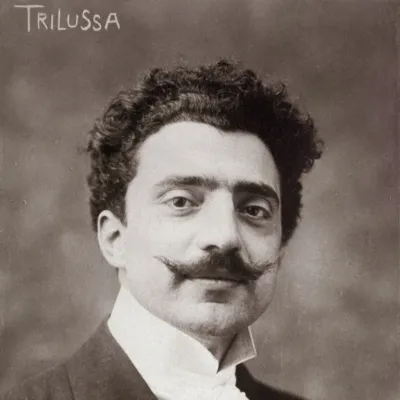
Trilussa
Human Design Chart
Biography
Trilussa lived a very poor childhood, as his father had died when he was only three years old. After irregular studies, he made a very early poetical debut in 1887 on the Rugantino magazine directed by Alfredo Zanazzo. Later he wrote also for Don Chisciotte, Capitan Fracassa, Il Messaggero and Il Travaso delle idee. His first collection, Le stelle de Roma ("Rome's Stars"), is from 1889.
Trilussa's fame grew in the 1920s and 1930s, though he was not a part of any literary circle, preferring to be in the streets and taverns, which were the source of his inspiration. His poetry features the petite bourgeoisie of Rome: the housewife, the store clerk, the servant, but also contain strong satirical denunciations against governments and the vices of rich people. Some of the sonnets are Aesop-like moralistic fables. Trilussa's own sketches and drawings were featured alongside his poetry.
A very popular person in his city and Italy, Trilussa was named Life Senator on 1 December 1950 by the Italian President Luigi Einaudi. He died twenty days later.
Human Design Analysis: Trilussa as Generator 1/3
Generator 1/3 — Design at a Glance
Trilussa possessed immense and enduring strength that was activated not by his own initiative but solely through responding to external impulses. As a Generator, he had abundant sacral energy – comparable to a strong workhorse – which could only unfold when it was engaged from the outside. His central life strategy involved waiting and then reacting with action rather than taking the lead himself.
This mechanism required him to react from his gut instinct. When Trilussa listened to his inner signal – that clear “Yes! Let’s get started!” of the sacral center – it led to deep satisfaction and fulfillment. Ignoring this signal or trying to initiate against the flow resulted in frustration, energy loss, and the risk of burnout. Two pitfalls marked his design: wasting power on things without internal resonance, and holding back from heart projects despite having the necessary strength.
Living in harmony with this pattern made him unstoppable. Successfully utilizing his energy through reactive action rather than active initiation rewarded him with a sense of deep fulfillment. However, stepping out of this path and beginning to initiate led to persistent frustration and energy deficiency. His strength lay not in starting but in powerfully responding to life.
Sacral Authority
Trilussa did not base his decisions on intellectual analysis but on direct physical resonance. His inner authority resided in the defined sacral center, meaning he responded to external stimuli through specific gut signals. These signals appeared as grunts, hums or a clear “Mhm” for agreement and an dismissive “Hmm” for disagreement. Trilussa learned to use these sounds as reliable guidelines to distinguish between true resonance and false starts.
This mechanism was exclusive to the Generator type whose strategy of reacting simultaneously formed his authority, thereby simplifying the decision-making process. A prerequisite for this clarity was an open emotional center that did not pass short-term emotional impulses as truth. When Trilussa’s sacral motor responded to a stimulus, he immediately felt vitality and inexhaustible energy. He tackled his tasks with great enthusiasm and immersed himself in the activity without needing an external goal or purpose-driven approach. This inner structure enabled him to move through life with joy and satisfaction, guided by immediate instinctive perception rather than deliberate planning.
The 1/3 Profile — Investigator / Martyr
Trilussa was someone who not only gathered knowledge but validated it through rigorous practice. His design inclined him towards intensive research and risk assessment before acting. This meticulous preparation was never an end in itself; it served the real goal: experimentation.
As a Researcher and Experimenter (Profile 1/3), Trilussa underwent a dual process. Line 1 drove him to check details and secure theoretical foundations, often with the fear of not knowing enough. Yet, line 3 demanded action, testing in real life. This tension between planning and implementation shaped his development. Mistakes were not failures but necessary teachers.
The result of this cycle was a unique kind of judgment power. When Trilussa deemed something good, he had thoroughly examined it both intellectually and practically. This authenticity made his judgments trustworthy. He did not seek quantity or broad approval but quality and genuine impact. His insights were self-earned, honed through the friction between theoretical preparation and the harsh reality of trial and error. Thus emerged a deep understanding based on personal experience, not just theory or others’ opinions.
Split Definition — Defined & Open Centers
Trilussa revealed himself as someone with a stable inner structure who acted from clear identity and intuitive security. His design featured five defined centers: Ajna, Throat, G-Center, Sacral, and Spleen Center. This configuration created a constant energy flow from the sacral source through the G-Center (Identity) and Ajna (Conceptualization) to the Throat (Communication). The defined Spleen Center gave him a spontaneous, intuitive sense of security in the present moment. As a Generator, his strategy was to wait for an impulse before reacting with full sacral energy. This allowed for reliable endurance and satisfaction through correct reactions rather than initiatives.
At the same time, Trilussa had four open centers: Head, Heart, Solar Plexus, and Root. These acted as mirrors of the environment but required distance. The open Head Center made him vulnerable to external mental pressure and confusion; he tended to question whether he needed to find inspiring answers that were not his own. The open Heart Center led to the temptation to prove personal worth through performance or promises, despite lacking consistent energy for it. The open Solar Plexus Center absorbed foreign emotions, leading him to wonder if he should avoid confrontations to prevent rejection. Finally, the open Root Center took on external stress, putting him at risk of personalizing adrenalized pressure and trying to rid himself of it through excessive activity rather than merely perceiving it informatively. The challenge was not to take these open fields as his own reality but simply to sense them while the defined structure provided a stable foundation.
Channel 27-50: Preservation — Channels & Gates
Trilussa revealed himself through spontaneous, intuitive refinement of his existence form as a survival strategy. His behavior was not guided by logical planning or emotional reflection but rather by acoustic and intuitive perception of the 'now'. This generated an aesthetic and functional uniqueness that unconsciously attracted and inspired others.
This attitude stemmed from Channel Perfect Form 57-10, connecting the Spleen Center with the G-Center and projecting behavior guided by intuitive consciousness. Trilussa listened more to the tone of his environment than words themselves, which connected him with innate wisdom existing beyond thoughts. Through this spontaneous adaptation to the environment, he released unfounded future anxieties and moved through the world unburdened. His uniqueness acted as an example: By living authentically, he created something healthy and beautiful that invited others to recognize the value of their own lives.
Additionally, Channel Curiosity 11-56 shaped his essence. It connected Ajna Center with Throat Center and drove Trilussa to constantly seek new ideas and perspectives. His creativity was evident in transforming philosophical contemplations into stories that taught or entertained others. These narratives served less as self-guidance than to engage the audience through imagination and emotion.
Channel Preservation 27-50 connected his Sacral Center with Spleen Center, giving him the ability to take responsibility for others and preserve traditional values. Trilussa automatically attracted trust and provided for his environment while always being mindful of his own energy capacity to act effectively.
Individual Gates like Gate 28 (Risks in Here and Now), Gate 31 (Leadership through Transmission) as well as Personality Gates such as Gate 12 (Reserve/Poetry) and Gate 17 (Logical Teaching) complemented this picture by emphasizing his intuitive decision-making ability and structured transmission of knowledge.
Tribal Circuitry — Circuit Signature
Trilussa revealed himself to be marked by a split definition, meaning that his inner energies did not manifest as constant isolated presences but were activated through resonance with the environment. This created tension between two parallel energy fields. One field connected Ajna and Throat Center via the Sense-Making Circuit. Here it was not about cold logic but processing emotional waves from the past. Trilussa reflected on past events to find meaning in them, sharing these felt insights with the collective so that all could learn together. This energy flowed in wave-like patterns with clear beginnings and endings.
The second independent field connected Sacral and Spleen Center via the Guardian Circuit. This ancient circuit served the protection of genetics and family. Through preservation forces, it was about safeguarding, nurturing, and nourishing one's lineage. It was timeless instinctual energy focused on survival of the 'Mother and Father' principles.
Additionally, a third aspect came into play: Integration connected Identity and Spleen Center. Here it was about gaining strength from reacting to life through intuitive knowledge and correct stance in the present moment. This configuration underscored the necessity of strengthening oneself and vigilantly protecting individual boundaries. Trilussa thus lived in an interplay between emotionally learning from history for others and instinctively protective actions for genetic survival, with both areas only fully unfolding through external interaction.
Right Angle Cross of the Unexpected 3
Trilussa carried the signature of the Unexpected Right Cross. This design element shaped his way of dealing with life: It was not about passive waiting, but a specific dynamic that led him into situations where the unforeseen became the driving force. For this profile, the unexpected was no obstacle but rather the actual motor.
In Human Design mechanics, this cross describes a configuration in which external events often occur suddenly and unexpectedly. A person with this expression learns not to resist these turns but to accept them as necessary impulses. It is about giving up control and trusting that the unexpected happens precisely when it is needed for the next step. Trilussa lived in a structure that prepared him to dance with chance rather than fight against it.
This configuration does not mean his life was chaotic in terms of being unplanned. Rather, there was a tendency for important developments often to arise from situations he himself had not brought about. His design challenged him to remain open to these moments and accept them as part of a larger pattern. The energy of this cross acted like a catalyst: it accelerated processes by removing the ground beneath his feet and thus opening up new paths. Trilussa therefore moved in a rhythm that seemed externally controlled but internally resonated deeply with his nature.
Saturn Return · Uranus Opposition · Chiron Return · 2nd Saturn Return — Life Cycles
Trilussa lived through life as a sequence of structural turning points that architecturally shaped his development. His design did not foresee linear uniformity, but rather a rhythm of challenge and integration. The first Saturn Return marked the beginning of maturation: Here, years of groundwork condensed into stable structures laying the foundation for his further creation. It was about discipline and taking responsibility in one's own life.
Later came the Uranus Opposition as a phase of emancipation. This cycle broke old identity patterns and forced a redefinition of self. Trilussa had to let go of what no longer served him, creating space for a more authentic existence. It was a necessary break that bought freedom but initially brought uncertainty.
The Chiron Return appeared as an actualization cycle. During this period, the incarnation cross unfolds increasingly in life; meaning and purpose become experiential if strategy and authority are observed. It was not about healing old wounds but rather the blossoming of one's own purpose. Finally, the second Saturn Return led to final structuring. What had been built up before was now stabilized and passed on. These four cycles formed the cornerstones of his development: from initial formation through a necessary break to meaningful blossoming and the ultimate consolidation of his life work.
Generator · Sacral Authority — Synthesis
Trilussa lived a life deeply marked by reacting to current energy. As a Generator with sacral authority, he found fulfillment in action when it sprang from an inner yes – a power amplified by the defined Sacral and G Centers. The connection through the channel of completed form (57/10) points to intuitive behavior oriented towards the needs of the moment, while the open Root and Solar Plexus Center made him receptive to the energies of his environment without taking them on. His profile as a Researcher/Experimentor (1/3) underscored this tendency: constant learning through experience combined with the need to test and refine results to generate self-acquired knowledge.
A central paradox in Trilussa's design lay in the tension between his ability for deep self-discovery (defined G Center) and openness to external influences (open Heart and Root Centers). While the defined G Center provided a clear inner direction, he simultaneously absorbed the emotions and stress of others. This dynamic led to an ongoing struggle with his own worth and the necessity to remain true to himself while responding to the needs of his environment – a balancing act between self-assertion and adaptability.
3 Defined Channels
Incarnation Cross - Right Angle Cross of the Unexpected 3
Solar Return
The Solar Return shows the moment when the sun returns to its exact birth position - your personal solar year.
Life Cycles
Discover the life cycles with a detailed triple view (birth chart, cycle chart, composite).
Human Design Profile
- Type
- Generator
- Strategy
- To respond - wait for something to respond to
- Authority
- Sacral Authority
- Profile
- 1/3 - Investigator / Martyr
- Definition
- Split Definition
- Incarnation Cross
- Right Angle Cross of the Unexpected 3
- Date of Birth
- 26.10.1871 05:00
- Place of Birth
- Rome, Italy
Frequently Asked Questions
What was Trilussa's Human Design type?
What Profile did Trilussa have in Human Design?
Which Authority guided Trilussa?
What incarnation cross did Trilussa have?
When was Trilussa born?
Discover your own Human Design
Are you also a Generator? Find out in a personal reading how to use your sacral energy correctly and discover deep satisfaction.
More Personalities
Back to overviewAaliyah

Alain-Fournier

Alexia

Angèle

Angeli

Anne-Marie
