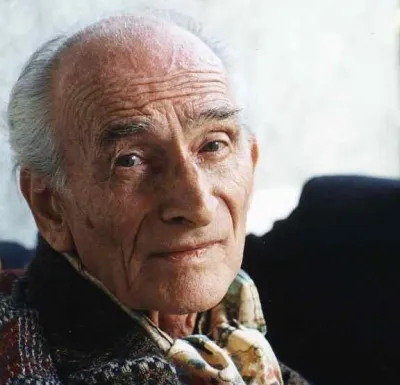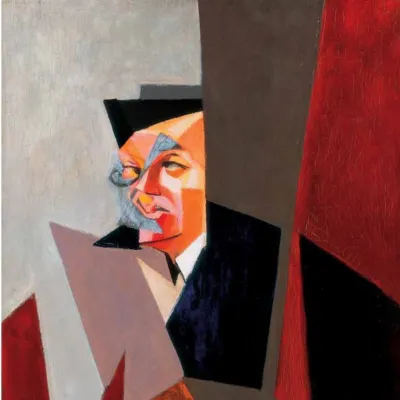
Tristan Tzara
Human Design Chart
Biography
Tzara died on 24 December 1963 in Paris, France.
Tristan Tzara as a Manifesting Generator 2/4 in Human Design
Manifesting Generator 2/4 — Design at a Glance
Tristan Tzara revealed himself as someone with a hybrid energy configuration: a Manifesting Generator. This design combined the constant, sacral life force of a Generator with the ability to skip steps and produce results quickly – a trait previously unique to Manifestors. However, his fundamental strategy was not initiating but responding to external impulses. Only when he responded to these signals and his sacral center gave a clear "yes" could he effectively utilize his immense creative power.
The danger in this design lay in the speed. Tzara tended to skip important stages or work on multiple projects simultaneously, driven by many different impulses. Without the internal approval of his authority, this multitasking tendency quickly led to frustration – the specific suffering path of his type. However, when he learned to listen to his inner feedback and fall into a playful mode, this parallel working style became an advantage rather than a hindrance. Deep satisfaction did not come from linear task completion but through the variety and joy in creation itself. His design therefore required constant checking: Was the impulse authentic? Did the project still feel good? Only then could his unique speed be beneficial rather than overwhelming him.
Emotional Authority
Tristan Tzara exhibited a decision-making structure that did not rely on immediate clarity but rather on navigating emotional fluctuations. His design indicated that his defined Solar Plexus Center carried his inner authority. This meant: Whenever this center was activated, it served as the decision-making instance, independent of other defined areas in his chart.
He experienced characteristic emotional waves that were reflected in a constant up and down of his feelings. Tristan Tzara saw the world colored by his current mood. At one moment he could be totally enthusiastic about something, only to completely negate it the next. However, his feeling at any given moment was merely a snapshot, an initial impression that did not necessarily represent his truth yet. Quick, spontaneous decisions based on emotion could therefore have negative consequences.
The mechanics of his design required patience and time delay. The more time Tristan Tzara took to let a decision mature, the deeper and more comprehensive he could understand something. This meant letting decisions "overnight" multiple times. Over time, intense feelings subsided, he gained emotional distance, and clarity as well as calmness set in. Only then had he completed the process. This mechanism served to differentiate between momentary mood and deeper truth, which was particularly important for long-term decisions.
The 2/4 Profile — Hermit / Opportunist
Tristan Tzara showed a fundamental tension between the desire for solitude and the wish for community. His design suggested that he constantly oscillated between two poles: the urge to be alone to find peace, and the desire to spend time with his favorite people. This dynamic of Profile 2/4, natural talent and networker, required creating a safe, loving environment. Only there could Tristan Tzara clearly communicate when he needed company and when he wanted to withdraw undisturbed.
During his "me-time," he immersed himself in internal processes, clarified things, and let the immaturity of Line 2 manifest, often felt as inner instability. Once this phase of reflection was complete, he emerged from his "cave." Then he used the awareness of Line 4 to increase his potential within social boundaries and prepare for mutations. The network served him to evaluate accumulated knowledge; solitude allowed brilliant ideas to develop. Without this clear distinction, there was a risk of getting stuck in confusion or depression. By enduring these cycles – withdrawal for growth and connection for exchange – he could channel his boundless energy and physically and mentally generate himself. Communicating these boundaries was crucial so that his environment accepted his need for isolation and welcomed his return to the community.
Split Definition — Defined & Open Centers
Tristan Tzaras Design shows a tendency towards constant mental structure and reliable expression. His defined Ajna Center ensures continuous conceptual processing, while the defined Throat Center translates these thoughts into clear communication. This connection allows him to directly express what he thinks. His vital energy source comes from his defined Sacral Center, which relies on reaction rather than initiation; only through responding to external stimuli can he fully unleash his power and avoid frustration.
Emotional clarity required patience: The defined Solar Plexus Center as inner authority demanded waiting for the emotional wave before making decisions. Simultaneously, the defined Root Center exerted a constant stress pressure that drove him forward and nourished existential awareness.
In contrast, his open centers shaped specific vulnerabilities. His open Head Center did not mean constant mental pressure or inspiration; he tended to get confused by doubts that were not his own and sought answers to others' questions. The open G Center led to adaptation to the environment rather than a fixed identity; he intuitively sensed whether a place or relationship was correct by reacting to 'borrowed' directions. His open Heart Center lacked constant willpower; he avoided making promises to prevent getting stuck in spirals of self-proving and failure. Finally, his open Spleen Center made him sensitive to environmental fears rather than spontaneous intuition; he clung to unhealthy situations just to gain a false sense of security and well-being. This mechanism determined his interaction with the world: constant mental and vital resources paired with high sensitivity to external emotional and existential signals.
Channels for change, curiosity and emotional expressiveness.
Tristan Tzara displays a fundamental attitude shaped by a pulsating rhythm of chaos and order. His design carries the energy of mutation, marked by inner tension and melancholy between creative impulses. This paradoxical nature requires accepting limitation and patience with the internal pulse to enable evolutionary change.
The Mutation Channel 60-3 connects his Root Center with his Sacral Center through Gate of Limitation (60) and Gate of Order (3). This format generates a powerful on/off energy that drives innovation, yet only becomes effective when he endures the confusion of a new beginning. The melancholy is not a deficit but mechanical moodiness during standstill phases where new possibilities develop in the background.
Additionally, the Channel of Curiosity 11-56 between Ajna and Throat Centers operates through Gate of Ideas (11) and Gate of Inspiration (56). He constantly seeks new perspectives, not to find something specific but to tell stories that stimulate others. This ability to present information as life parables serves to engage his environment and inspire reflection.
The Channel of Transience 36-35 connects Solar Plexus and Throat Centers via Gate of Crisis (36) and Gate of Change (35). He seeks new experiences often by creating crises to set things in motion. His emotional wave drives him to explore the depth of feeling, learning that emotions are transient and wisdom comes from lived experience.
Individual Gates like Gate 50 (Protective Reflex, Traditions), Gate 42 (Completion of Processes) or Gate 17 (Logical Teaching for the Future) round out his profile by bringing protective instincts, the ability to conclude processes as well as a drive towards structural succession into his work.
Collective Circuitry — Circuit Signature
Tristan Tzara displays dynamic tension between the pulsating urge for individual innovation and cyclical reflection on past emotions. His design contains two separate but parallel functioning energy fields: the Knowledge Circuit and the Meaning-Finding Circuit.
The Knowledge Circuit connects his Sacral with his Root Center through the Mutation Channel (Gates 3-60). This generates an acoustic, pulsating impulse to deviate from the existing. It is about creating new identity through creative rupture and transformation, driven by a primal rhythmic life energy.
Parallel to this, the Meaning-Finding Circuit connects Ajna, Throat and Solar Plexus Centers. Here two channels flow: Curiosity (11-56) and Transience (35-36). This configuration promotes visual, wave-like processing of experiences from the past. Emotions are reflected to find meaning and share insights with the collective.
While the first energy aims at acoustic mutation and individual change, the second serves emotional integration and shared learning processes. Both systems do not directly connect but exist as independent forces: on one side the driving impulse for new creation, on the other the cyclical reflection on felt and experienced to draw collective benefit from it.
Right Angle Cross of Laws 1
Tristan Tzara's design carried the 'Right Cross of Laws'. This configuration marked a specific archetypal imprint within his Human Design. Since the underlying mechanics in the provided data are not further specified, the exact energetic impact or associated behavior remains undetermined. The design featured this structural marker without a detailed description of the resulting life task or inner dynamics. It was a fixed component of his chart, whose concrete meaning in everyday life was not explained by the given facts. Tristan Tzara lived with this configuration, yet its specific effect on his decisions or experiences cannot be derived from the provided information. The focus was solely on the existence of this cross as part of his individual structure. No further interpretations or assumptions about possible consequences were made due to lack of relevant data. The analysis strictly limited itself to mentioning this design component. Tristan Tzara's chart contained this entry as an isolated fact without accompanying explanation of the processes or challenges involved.
Saturn Return · Uranus Opposition · Chiron Return · 2nd Saturn Return — Life Cycles
Tristan Tzara's design indicated a tendency towards consolidation: transitioning from experimental, often chaotic youth to established adult identity. This process marked the acceptance of long-term responsibility and stabilization of self-image. The mechanics of his first Saturn return cycle describe precisely this condensation; years of groundwork and inner development often culminate in a solid result that provides stability. In this phase, Tristan Tzara was no longer just an impulse generator without a fixed anchor but sought structure and consistency in personal life. His encounter with the Swedish artist Greta Knutson in 1924, at age 28, in France, was a concrete expression of this inner movement. This connection led to marriage the following year. For his design, this represented the typical moment of first Saturn return: seeking stability and partnership became a means of identity consolidation. It wasn't about fleeting bonds but establishing a framework within which his creative energy could now be channeled. The marriage was thus not merely a biographical date but the visible result of profound inner maturation triggered by the Saturn cycle. Tristan Tzara took responsibility for his private foundation, which profoundly shaped and stabilized his public role.
Manifesting Generator · Emotional Authority — Synthesis
Tristan Tzara lived a life marked by a constant interplay between internal processing and the desire for connection. His defined sacral knot (Manifesting Generator) provided him with a steady energy source that was always subject to an evolving emotional wave of maturity. This combination allowed him to develop and implement ideas quickly – an expression of his manifesting aspect – yet he needed time to emotionally digest decisions and fully grasp their implications. The inner necessity to withdraw (Line 2) and the resulting clarity created contrast with the need for exchange and community (Line 4), positioning him in a dynamic tension field between isolation and social interaction.
A central paradox lay in how Tzara generated and expressed knowledge. His defined Ajna knot points to constant mental activity, which through the channel of Mutation (3-60) received an unpredictable, transformative impulse. He created concepts and theories, yet this potential for evolutionary change also harbored melancholy and acceptance of limitation. This creative process, fueled by the Knowledge Circuit, was thus a continuous oscillation between seeking new insights and dealing with associated emotional challenges – a pulsating energy that both inspired and burdened.
3 Defined Channels
Incarnation Cross - Right Angle Cross of Laws 1
Solar Return
The Solar Return shows the moment when the sun returns to its exact birth position - your personal solar year.
Life Cycles
Discover the life cycles with a detailed triple view (birth chart, cycle chart, composite).
Human Design Profile
- Strategy
- To respond - wait for something to respond to
- Authority
- Emotional Authority
- Profile
- 2/4 - Hermit / Opportunist
- Definition
- Split Definition
- Incarnation Cross
- Right Angle Cross of Laws 1
- Date of Birth
- 16.04.1896 23:30
- Place of Birth
- Moinesti, ROM
Frequently Asked Questions
What is Tristan Tzara's Human Design type?
Which Profile did Tristan Tzara have?
What Authority guided Tristan Tzara?
What was Tristan Tzara's incarnation cross?
When was Tristan Tzara born?
Discover your own Human Design
Are you also a Manifesting Generator? Find out in a personal reading how to unfold your multi-talents and direct your energy wisely.
More Personalities
Back to overviewAldair

Alizée

Angeli

Arletty

Artus

Balthus