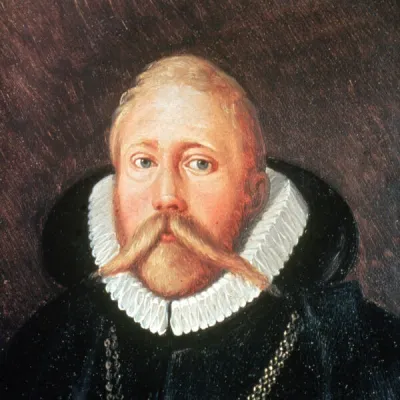
Tycho Brahe
Human Design Chart
Biography
During a youthful duel with a fellow student in December 1566, he lost part of his nose, leaving only the tip intact. Brahe later wore a prosthesis, a silver-copper shell painted to match his skin. He cast astrological charts professionally and left some measure of astrological writings.
Brahe was the first born of twins; the second twin was still-born. His younger sister, Sophias, became a noted astrologer and he praised her in one of his manuscripts that if she had been born male, she probably would have achieved notoriety.
To acknowledge his contributions to the world of science, in 1576 Frederick II, the King of Denmark, granted Brahe a pension and an island between Sweden and Denmark on which Brahe built a lavish home and observatory.
He died in Prague of an infection caused by a burst bladder. He had neglected to relieve himself before a banquet given on 13 October 1601 by the Baron of Rosenberg, and good manners prevented him from leaving the table. Eleven days later, on 24 October 1601, he died. His artificial nose was missing when the body was exhumed in 1901, probably stolen by vandals, but a bright green stain caused by copper salts could be seen on the front of the skull. His body lies in the Teyn Church, Prague.
Tycho Brahe as a Manifesting Generator 6/2 in Human Design
Manifesting Generator 6/2 — Design at a Glance
Tycho Brahe revealed himself as someone who quickly brought things to life and worked on multiple projects simultaneously. His Manifesting Generator design combined the constant energy of the Generator with the ability to skip steps, allowing him to move forward rapidly but also risking overlooking important stages or becoming frustrated through multitasking without inner consent.
The strategy was not to initiate himself but to react to impulses. Only when his sacral center clearly agreed – signaling an internal “yes” – should he act. With correct application of this response to life impulses, Tycho Brahe could draw deep satisfaction from his work. In this state, working on various projects simultaneously was no obstacle but rather promoted his creative power. He fell into a “play mode,” which offered him fun and variety. Without this inner confirmation, however, frustration loomed, especially if he acted too quickly or started projects for which there was no genuine enthusiasm. His success thus depended on channeling his natural speed through conscious reactions to internal signals and regularly checking whether the work in progress still had his approval.
Emotional Authority
Tycho Brahe showed a decision-making stance that countered spontaneous impulses and instead set time distance. His design established that the defined Emotional Center carried his inner authority – a mechanism that always took precedence over all other definitions in his chart. This meant for him constant submission to emotional wave movements: his perception was always colored by the current mood, fluctuating between enthusiasm and rejection. Since this feeling at the moment only represented a snapshot, not his deeper truth, quick decisions based on emotion were risky and often negative for him.
Instead, his system required patience and conscious delay of decisions. Tycho Brahe had to take time for insights to mature; repeatedly sleeping on an issue was essential in this process. Through this procedure, the intense feelings initially subsided, giving him emotional distance. Only when clarity and calm entered could the decision-making process be considered complete. This strategy served to distinguish transient emotional fluctuations from deeper insight, especially regarding long-term steps with significant influence on his life path.
The 6/2 Profile — Role Model / Hermit
Tycho Brahe's design indicated a tendency towards a two-phase life path, characterized by Profile 6/2. In his youth, the energy of Line 3 dominated: he learned through experiments, trial and error. Mistakes led him to withdraw to start anew – a driving principle before his thirtieth year.
After about thirty years, Line 6 was activated. This phase was marked by profound withdrawal, comparable to a “cave on the mountain.” There he intensely reflected on earlier experiences. This process served healing and fostered deep self-knowledge. The distance allowed him to integrate past mistakes and gain wisdom.
Later, Tycho Brahe emerged from this retreat as someone recognized for his wisdom by others. His ability for deep introspection became a model. Others sought his advice to partake in these life lessons. Thus, the development from an experimenting young person to an authoritative role model occurred through the shift of line energy. The result was late-confirmed authority based on years of inner work.
Split Definition — Defined & Open Centers
Tycho Brahe's design created a tendency towards constant mental pressure. The definition between the Head Center and Ajna Center generated a permanent impulse to question and form concepts. This state was not a choice but rather an automatic background noise of inspiration and doubt. Since these centers were not connected to energy sources, attempting to directly convert this pressure into action often led to frustration or hasty misjudgments. Instead, this mental process served to inspire others to think when they were ready to receive the impulses.
His actions were based on a powerful, reactive life force in his defined Sacral Center. This source generated massive daily vitality but could only be unfolded through reaction. Initiating steps without prior inquiry cut off the connection to energy and led to resistance or exhaustion. The correct application of this power required patience: waiting until life spoke to him and then listening to the immediate 'yes' or 'no' tone from his Sacral Center. This response determined whether the necessary energy was available for a task.
Decisions were guided by the inner authority of his defined Solar Plexus Center. Here, there is no truth in the present moment. Emotional clarity emerged only after completing the entire wave movement. Impulsive reactions to emotional highs or lows created chaos; waiting until calm revealed the deeper truth of a situation.
Communication was reliable and steady through his defined Throat Center, while intuition (defined Spleen Center) and survival pressure (defined Root Center) were mechanically set. In contrast, identity (open G Center) and willpower (open Heart Center) remained situational. The open G Center reflected the environment rather than setting a fixed direction; the open Heart Center lacked constant will energy and tended to fall into traps of promises to prove worth, often ending in self-doubt.
Channels for change, intuition, mysticism, emotional truth and vision.
Tycho Brahe demonstrated someone who transformed deeper truths through tireless repetition into masterful skill. This attitude stemmed from Channel 48-16. Gate 48 sought intuitive depth while Gate 16 tested new experiments and perfected skills. By combining this inner intelligence with technical mastery, he developed a unique talent based on constant practice.
Parallel to this, the channel of Mutation 60-3 promoted evolutionary change through melancholy. Gate 60 accepted limitations as pivot points for new possibilities while Gate 3 created order from the confusion of a fresh start. This pulsating rhythm between chaos and structure generated internal tension often manifesting as melancholic mood – a precursor to profound changes. Tycho Brahe learned not to resist this capriciousness but to patiently wait until new impulses emerged from his essence.
Additionally, Channel 19-49 shaped his need for belonging and clear principles. Gate 19 urged connection with the tribe while Gate 49 rejected anything that violated highest ideals. This created an emotional basis for loyalty and protection of shared resources. The channel of Transience 35-36 also drove him to accumulate new experiences. Gate 35 sought constant change, while Gate 36 used crises as learning opportunities to gain emotional wisdom.
The channel of Abstraction 47-64 provided mental clarity from confusion. Gate 64 initially generated vague uncertainties which the understanding Gate 47 translated into comprehensible stories or perspectives. This ability helped him decipher complex connections and communicate them to others.
Individual gates like Gate 9 promoted detailed work in the Sacral Center, while Gate 26 enabled innovations within conservative structures. Gate 45 represented material stability and tribal hierarchy. Tycho Brahe's design thus combined intuitive depth with technical precision, emotional resilience, and a drive for evolutionary change.
Collective Circuitry — Circuit Signature
Tycho Brahe's design created a tendency towards separate, parallel operating energy fields. His defined centers formed two unconnected groups: one including Sacral, Root, Solar Plexus, Throat, and Spleen Centers, the other comprising Ajna and Head Centers. This did not create an ongoing experience but isolated power fields.
The Knowledge Circuit connected only his Sacral with his Root Center (Channel 3-60). This pulsating energy in the present stood for mutations and the expression of a unique identity. The Understanding Circuit linked Throat and Spleen Centers (Channel 16-48) as focused, visual ratio towards the future, separate from emotions.
In the Meaning Circuit, there were two isolated segments: Head and Ajna Center (Channel 64-47), and Throat and Solar Plexus Center (Channel 35-36). This cyclical energy processed past experiences emotionally to share them. The Ego Circuit finally connected Solar Plexus and Root Centers (Channel 49-19) in timeless cooperation for resource building without direct Sacral connection.
This architecture shaped Tycho Brahe's life through alternating impulses: pulsating innovation, focused logical structuring, cyclical emotional reflection, and tactile collaboration – always as coexisting, non-directly flowing forces.
Left Angle Cross of Confrontation 2
Tycho Brahes design includes the structure of the left cross of confrontation two. This configuration is listed here without specific mechanical description or energetic impact. There are no details that would allow a concrete characterization or behavioral tendency to be derived from this particular cross constellation. The chapter does not provide a basis for a deeper classification of Tycho Brahes personality in this specific area of his design due to the lack of substantive content. The mechanics remain undefined, so it is impossible to make any statements about how this energy manifested in Tycho Brahes life or what role it played in his decisions. It is merely noted that this structure exists in the chart without further elaboration on its impact or significance. This does not mean that the area was irrelevant but rather that the available facts do not provide a basis for interpretation. Therefore, the description remains limited to the mere mention of the configuration without making additional assumptions about Tycho Brahes experiential world or his actions.
Saturn Return · Uranus Opposition · Chiron Return — Life Cycles
Tycho Brahes life followed a clear cyclical structure that condensed into three distinct planetary phases. These cycles shaped his development and gave specific directions to different periods of his life.
The first Saturn return in 1573 marked the transition to solid responsibility. At the age of 27, he married Kirsten Barbara Jørgensdatter, from which eight children emerged. This cycle stabilized his private foundation and anchored him in long-term commitments.
The Uranus opposition in 1586 brought a phase of expansion and public presentation. At the age of 40, he published his Astrological and Meteorological Diary. This cycle promoted the dissemination of his observations and changed his role in the scientific context through the publication of new, often unexpected data.
The Chiron return in 1596 ushered in a phase of fulfillment. At the age of 50, he published the first part of his correspondence on astronomy. This cycle allowed him to integrate his lifelong work and make his purpose tangible. The publication marked the maturation of his insights and the confirmation of his path based on previously lived strategies. Each of these cycles contributed to shaping his identity and contribution.
Manifesting Generator · Emotional Authority — Synthesis
He was a Generator who, through the connection between Sacral and Throat Center, possessed an unusual dynamic. This constellation shaped his life with a constant drive to use energy and simultaneously set something in motion – a combination of reactive power and the desire for influence. However, the defined emotional authority required time for decision-making to allow initial feelings to mature and gain clarity; a process that countered the rapid impulses of the Generator. The left cross of confrontation further intensified this internal tension as he was constantly confronted with external expectations and challenges.
A central paradox in his design lay in the interplay between Mutation (Channel 3-60) and the Knowledge Circuit. On one hand, the ability to drive evolutionary change, explore new paths, and question conventions propelled him forward – a pulsating format accompanied by melancholy. On the other hand, the Knowledge Circuit required a deep engagement with self-expression and emotionally grounded communication. This tension between the desire for radical transformation and the need to constructively shape it defined his path, particularly during phases of career and relationships, which were marked by specific cycles.
5 Defined Channels
Incarnation Cross - Left Angle Cross of Confrontation 2
Solar Return
The Solar Return shows the moment when the sun returns to its exact birth position - your personal solar year.
Life Cycles
Discover the life cycles with a detailed triple view (birth chart, cycle chart, composite).
Human Design Profile
- Strategy
- To respond - wait for something to respond to
- Authority
- Emotional Authority
- Profile
- 6/2 - Role Model / Hermit
- Definition
- Split Definition
- Incarnation Cross
- Left Angle Cross of Confrontation 2
- Date of Birth
- 14.12.1546 10:47
- Place of Birth
- Knutstorp, Denmark
Frequently Asked Questions
What was Tycho Brahe's Human Design type?
What Profile did Tycho Brahe have in Human Design?
Which Authority guided Tycho Brahe?
What incarnation cross did Tycho Brahe have?
When was Tycho Brahe born?
Discover your own Human Design
Are you also a Manifesting Generator? Find out in a personal reading how to unfold your multi-talents and direct your energy wisely.
More Personalities
Back to overviewAldair

Alizée

Angeli

Arletty
Artus
Balthus