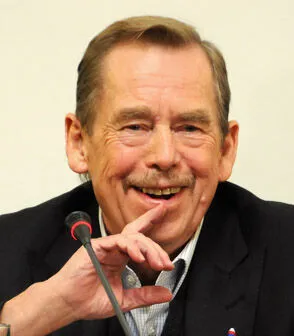
Vaclav Havel
Human Design Chart
Biography
Vaclav Havel as a Manifesting Generator 3/5 in Human Design
Manifesting Generator 3/5 — Design at a Glance
Vaclav Havel's design features a hybrid nature: the constant energy of a Generator paired with the lightning-fast implementation power of a Manifestor. He tended to skip steps and work on multiple projects simultaneously. This configuration described someone with persistent sacral energy, who should react like a Generator but also had the ability to bring things into his life extremely quickly.
However, this speed carried risks: Sometimes he was too quick and skipped important stages, leading to backtracking and frustration. Additionally, he often responded to many different stimuli at once. If strategy – reacting rather than initiating – or his inner authority did not align, his creative joy would quickly turn to dissatisfaction.
When Vaclav Havel found the right rhythm by responding to life impulses and regularly checking his sacral center to see if it still said "yes", he drew deep satisfaction from his work. In this state, working on multiple projects simultaneously was not a problem but a strength. He entered a "play mode" where variety enhanced his creative power rather than fragmenting it. His design thus did not require linear task completion but instead called for flexible, impulse-driven creation guided by inner confirmation.
Emotional Authority
Vaclav Havel's decision-making followed a wave-like pattern that was strongly influenced by his current mood. His internal authority lay in the defined Emotional Center, meaning he always perceived the world through the filter of his feelings. This emotional wave led to constant ups and downs: A topic could excite him at one moment while appearing negative the next. Since these immediate reactions were only snapshots and did not necessarily reflect his deeper truth, quick, spontaneous decisions based on emotion often proved detrimental.
The mechanics of his emotional authority therefore required conscious time delay. By letting important questions sleep and revisiting them multiple times, he gained distance from the initial intense feelings. Over time, these impulses subsided, making way for clarity and calmness. This process of patience was crucial for long-term realignments in his life. Only when the emotional flood had receded could he gain a comprehensive understanding that went beyond the first impression. This strategy protected him from misjudgments arising from transient mood swings and allowed him to make decisions that aligned with his true inner truth.
The 3/5 Profile — Martyr / Heretic
Vaclav Havel's Human Design profile set a tendency towards isolated, practical experimentation that only after prolonged learning from mistakes led to a heroic public role. As a 3/5 (Explorer/Hero), he initially believed nothing was predetermined and had to figure everything out for himself. This Line 3 stance required isolation from collective life to develop depth. Mistakes were not just possible but necessary to sharpen discernment. Only through these private setbacks did he accumulate the wealth of experience that later made him attractive to others.
The tension in his design lay between this necessary withdrawal phase and the pressure of Line 5, to step into a role as hero or savior. In times of crisis, he used his acquired knowledge not to overcome obstacles directly but to cleverly change rules or develop circumvention strategies. This ability to provoke and mutate was rarely accessible but proved powerful in dire situations. However, when he experimented publicly and failed, this heroic role became painful. His path involved building authority through private isolation so that later it could be used as a reference for others – a process that viewed failures as indispensable steps towards development.
Split Definition — Defined & Open Centers
Vaclav Havel's design showed an extremely dense internal structure: Seven of his nine centers were defined, giving him a vast, constant energy source. His defined Head and Ajna areas created a permanent mental pressure to question, justify, and inspire. Since this mind was not directly connected to his engines, he could not automatically implement these ideas; instead, this insatiable mental process served as an inspiration for others. His defined G Center gave him a firm, magnetic identity and direction, while the defined Heart Center provided strong willpower and the desire to control resources.
As a Manifestor Generator, his defined Sacral Motor was his primary energy source. However, this vital force was only correctly available through reactions to external requests; initiatives without this confirmation led to frustration. His defined Solar Plexus made him an emotional authority: Decisions required time to clarify in the wave of feelings, as impulsiveness created chaos. The defined Spleen Center complemented this by providing spontaneous, momentary intuition for health and survival in the here and now.
His single open Root Center made him vulnerable to absorbing external stress. He took on societal or environmental pressure but did not generate it himself. The danger lay in misinterpreting this foreign adrenaline surge as his own drive, which could lead to hyperactivity and burnout. Instead, he had to learn to observe and use this external pressure without identifying with it or being driven by it. This configuration described a person shaped by deep internal structures but who needed to master the art of distinguishing between their powerful energy and the absorbed stress from the environment.
Channels for will, instinct, rhythm, ideas, emotion and abstraction.
Vaclav Havel's design tended towards a deep biological rhythm that made him act as a vital anchor in groups. He appeared as someone whose inner timing magnetically attracted others when he was authentic; however, misalignment generated chaos around him. This fundamental stance stemmed from the Rhythm Channel 5-15. This channel connected the Sacral Center with the G Center through Gate 5 (firm habits) and Gate 15 (love for human diversity). It created a universal life flow that neither was steered by intellect nor emotional waves but exerted an impersonal attraction. Havel's energy drew others into this flow and determined the course of the collective as long as he followed his natural reactions.
Situationally activated Juxta-Channels triggered narrative or mental impulses that did not consistently belong to his inner truth but were triggered by the environment. The Channel of Curiosity 11-56 connected the Ajna Center with the Throat Center (Gate 11: ideas, Gate 56: inspiration). It gave him the gift of weaving stories from fragmented information, which relied less on facts and more on illustrating life parables. This storytelling power served to stimulate others and make new perspectives tangible without his actively seeking final truths.
The Channel of Openness 22-12 connected the Solar Plexus Center with the Throat Center (Gate 22: passion, Gate 12: caution). It allowed Havel's voice to trigger emotional change only when his inner mood and timing were aligned. Here, a restraint limited his openness to moments of greatest mutative potential.
The Channel of Abstraction 47-64 connected the Head Center with the Ajna Center (Gate 64: confusion, Gate 47: comprehension). It created a permanent mental pressure to sift experiences through a kaleidoscope of images until a new perspective or story emerged. This process was often marked by confusion but led to clear insights if patience was exercised.
Personality Channels represented strategic roles in the social field. The Channel of the Money Line 21-45 connected the Heart Center with the Throat Center (Gate 21: hunter, Gate 45: gatherer). It reflected an attitude taking control over resources and material level to protect the tribe. The Channel of Devotion 26-44 connected the Spleen Center with the Heart Center (Gate 44: vigilance, Gate 26: ego). It gave him an instinctive sense for what others needed and the ability to convincingly convey or 'sell' this often before the target group recognized it.
Collective Circuitry — Circuit Signature
Vaclav Havel's design tended towards pulsating acoustic creativity that expressed emotional waves from the Solar Plexus through the Throat Center. The Knowledge Circuit directly connected these two centers; it carried the sun and represented the innate path of transformation through new knowledge. This energy promoted the authentic expression of his unique identity, often accompanied by melancholy.
Since Vaclav Havel had a shared definition, additional forces existed parallel but not directly connected to the Knowledge Circuit. The Understanding Circuit linked his Identity and Sacral Centers. Here logical, strategic energies operated looking into the future free from emotions, aiming at structural improvements. This was a separate focused power of reason.
Simultaneously, the Sense-Finding Circuit and the Ego Circuit shaped his experience. The Sense-Finding Circuit connected Head-, Ajna- and Throat Center. It directed focus on the past to find hidden meaning there and cyclically share these emotional insights with the collective. The Ego Circuit linked Throat-, Heart- and Spleen Centers. It emphasized cooperation in creating resources for the tribe, fostering traditional values and mutual support. These separate groups worked alongside each other: emotional transformation, cool strategy, reflective sense-finding, and tribal cooperation formed his complex inner structure without direct energy flow between the groups.
Right Angle Cross of Tension 3
Vaclav Havel's Human Design profile established a foundational approach to seeing internal tensions and conflicts not as obstacles but as necessary catalysts for personal development and transformation. He demonstrated through the imprint of his right cross, tension (Cross 3), an archetypal configuration that defines the challenge of transforming pressure and opposition into growth. This mechanism described a life task: rather than avoiding conflict, he used it as a driving force for profound change. The tension served not to destroy but to mature; it compelled him to confront his inner self and thus fostered the development of a more resilient identity. His chart indicated that Havel often grew most during periods of high demand, as these moments provided the necessary impulses for his transformation. The energy of this cross acted like a crucible, transforming the raw materials of daily life through the pressure of experience into something new and valuable. It was less about achieving a calm equilibrium than it was about dynamically utilizing friction to perfect oneself. This structure shaped how he dealt with challenges: by embracing them and integrating them into his own development rather than fighting against or ignoring them.
Saturn Return · Uranus Opposition · Chiron Return · 2nd Saturn Return — Life Cycles
Vaclav Havel's life followed the structural turning points of his planetary cycles, marking stages of maturity and public role. His first Saturn Return around 1967 (age 31) presented a test of authority: he caused a stir at the IV Writers' Congress in Prague with criticism of censorship and power structures. This crisis forced him to grapple with inner responsibility.
The Uranus Opposition around 1977 (age 41) brought a break from the status quo for individual freedom. As one of the initiators of Charter 77, a human rights movement, he separated himself from established structures to create new possibilities in relationships and action.
His Chiron Return around 1983 (age 47) was a fulfillment cycle where his incarnation purpose unfolded through public visibility. The suspension of his prison sentences after international protests during illness and hospital release showed this bloom: the meaning of his life became tangible, not as healing old wounds but as the realization of his purpose in the public sphere.
His second Saturn Return around 1993 (age 57) crowned the test of maturity with professional affirmation. His election as President of the Czech Republic condensed years of groundwork into a viable result that solidified his authority and responsibility in society. These cycles structured his life as an ongoing confrontation with maturity, freedom, and public purpose.
Manifesting Generator · Emotional Authority — Synthesis
He lived a life deeply marked by inner dynamics. The combination of sacral energy (sacral center) and the ability to act quickly (Manifesting Generator) created an unstoppable urge to set things in motion. However, this impulsive action was modulated by emotional authority that required careful consideration before decisions could be made. The defined mental pressure (Head Center and Ajna Center) further strengthened this process by promoting constant questioning and reflection – an inner engine for knowledge and understanding. Thus emerged a person driven both to act and to recognize the need to consider the consequences of their actions.
A central paradox in his design lay in the interplay between a love for experimentation (Line 3) and the desire to save others (Line 5). He was an adventurer who blazed new trails and learned from personal experiences, yet simultaneously carried a deep responsibility for the well-being of others. This tension manifested in crises (documented events), which forced him to explore his own limits while standing up for his beliefs. The Rhythm Channel points to a natural flow that was continually challenged by these internal contradictions.
6 Defined Channels
Incarnation Cross - Right Angle Cross of Tension 3
Solar Return
The Solar Return shows the moment when the sun returns to its exact birth position - your personal solar year.
Life Cycles
Discover the life cycles with a detailed triple view (birth chart, cycle chart, composite).
Human Design Profile
- Strategy
- To respond - wait for something to respond to
- Authority
- Emotional Authority
- Profile
- 3/5 - Martyr / Heretic
- Definition
- Split Definition
- Incarnation Cross
- Right Angle Cross of Tension 3
- Date of Birth
- 05.10.1936 15:00
- Place of Birth
- Prague, Česko
Frequently Asked Questions
What was Vaclav Havel's Human Design type?
What profile did Vaclav Havel have?
What authority did Vaclav Havel have?
What incarnation cross did Václav Havel have?
When was Václav Havel born?
Discover your own Human Design
Are you also a Manifesting Generator? Find out in a personal reading how to unfold your multi-talents and direct your energy wisely.
More Personalities
Back to overviewAldair
Alizée

Angeli
Arletty
Artus
Balthus