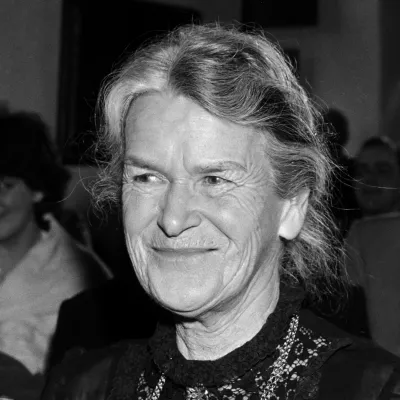
Vasalis
Human Design Chart
Biography
The pen name Vasalis of the celebrated poet Margaretha Droogleever Fortuyn-Leenmans was the latinized version of her maiden name Leenmans. It was first written as M. Vasalis. Her father Hendrik Arie ("Hal") Leenmans (8 Augustus 1876, Slochteren - 29 September 1954, Den Haag) was an erudite Ph.Dr. history teacher and used the pseudonym "de vazal" in his youth poetry. Her mother Louise Ernestine Creutzberg (2 October 1876, Woudenberg - 1969) became an insurance agent in 1906, when her two children went to school. Vasalis, nickname Kiek, was the youngest and her sister was named Ank (1906-1977).
She had a happy youth at the sea side The Haque and kept good relations with her parents and sister. Her parents were Dutch Reformed liberal (vrijzinnig) socialists with a broad cultural interest that invited likely minded politicians and writers at home. She studied medicine at Leiden University (1927-1932), later anthropology and specialised in the then not yet split disciplines of neurology and psychiatry. In 1934 she started as a junior physician in the psychiatric hospital Santpoort. She also started writing her first poetry which she send to her colleague and writer Simon Vestdijk, the editor of the periodical Groot Nederland. Here she debuted with five poems (Aug 1936). Vestdijk and critics like Menno ter Braak were very impressed by her work.
At the same time she got rheumatological complaints that forced her to stop her study. From the end of 1936 till August 1937 she went to Melton Wold Guest Farm, a guest house and sheep farm in South Africa to recover. In 1938 she worked as a physician in the Wilhelmina Gasthuis (WG) at Amsterdam. Here she met neurologist Jan Droogleever Fortuyn (R'dam, 12 April 1906 - Arnhem, 10 Jan 1999), whom she married 3 March 1939. They got four children: In April 1940 her daughter Lous, April 1942 her son Dick and in the hunger winter of 1944 her son Hal.
Vasalis as a Projector 6/2 in Human Design
Projector 6/2 — Design at a Glance
Vasalis had a dense, focusing aura that shone like a bright flashlight. His design allowed him to immediately recognize system errors in others and bring light into the darkness. However, this direct perception could be perceived as unpleasant, similar to a beam of light directly in the face. Instead of openly addressing mistakes, it was more elegant for Vasalis to set an example with his own harmonious presence. When he demonstrated a functioning relationship or structure himself, people were automatically drawn to him and asked about his insights.
The strategy involved waiting for a respectful, honest invitation. This waiting protected Vasalis from the negative reactions of his environment to his direct projection. As a projector, he had an open Sacral Center, which meant that he did not have a constant source of intrinsic life energy. Instead, he experienced cycles: phases of high efficiency and speed alternated with necessary rest periods to prevent burnout. The traditional system of work and school often did not take this need for breaks into account.
If Vasalis lived according to his design, he was rewarded with success. If he deviated from it, the non-self theme of bitterness would arise. His path was therefore not constant pushing but targeted shining and waiting for the right invitation to exercise his leadership role without wasting energy or provoking resistance.
Splenic Authority
Vasalis made decisions in the immediate moment guided by a fine inner impulse that acted as a health and alarm instinct. His design showed a tendency towards spontaneous orientation: The first impulse was reliable and served directly his well-being as well as demarcation against harmful influences. This attitude resulted from his Spleen Authority, which used the defined Spleen Center as a decision-making instance. A prerequisite for this were open Emotional and Sacral Centers, making Vasalis either a projector or manifestor.
The Spleen Authority grants an acute survival intelligence that shows itself as spontaneous knowledge whether environment or situation is fitting. Since this impulse only occurred once and was very subtle, there was the danger of it being drowned out by other influences. Therefore, Vasalis needed high vigilance to follow these fleeting signals; a short retreat could be helpful in decision-making.
Since what was right only showed itself at each moment, plans changed repeatedly in the short term. Long-term commitments were difficult and often counterproductive for Vasalis. His design instead required much freedom and flexibility to do justice to spontaneous changes. Through this unbound nature, he could rigorously protect himself and always address his system's current needs without being restricted by rigid structures.
The 6/2 Profile — Role Model / Hermit
Vasaliss design indicated a tendency towards a two-phase life path. In the early years, the 6-line of his profile (Role Model/Natural Talent) acted like a 3-line. This meant that his early life was characterized by experiments. Trial and error were the driving principles; after mistakes, he withdrew to learn. This process lasted until the return of Saturn, around age 30.
Afterward, the actual 6-line activated itself. Vasalis now sought distance from earlier experiences. He metaphorically retreated into a 'cave' to introspect deeply on his past. This phase was time for healing and self-discovery. The 2-line of his profile supported this through delegation ability and trust in experts; he did not need to prove everything himself but could delegate responsibility.
Once this period of reflection was complete, Vasalis emerged as a wise person. Others recognized his life wisdom and came to him to learn from his deep introspection. The 6-line brought the potential for transformation through personal example with it. His decisions were based on emotional clarity and whether principles were positively influenced. Thus, he transformed from an experimenting seeker into a role model whose wisdom arose from many youthful mistakes.
Single Definition — Defined & Open Centers
Vasalis revealed himself through a fundamental tension between constant inner pressure and situational vulnerability. His design imposed a persistent physical survival pressure emanating from the defined Root Center. This generated a steady energy to tackle material challenges and correct errors. Simultaneously, the also defined Spleen Center served as existential authority, providing an immediate, non-rationalizable instinct for health and well-being in the present moment. Vasalis had to trust this intuitive signal since there was no time for logical analysis; only so did he remain protected and vital.
These defined poles stood in stark contrast to his six open centers: Head, Ajna, Throat, G, Heart, Sacral, and Solar Plexus. This openness made him vulnerable to external influences. In the mental realm (open Head and Ajna Centers), he tended to identify with others' doubts or questions rather than perceiving them as transient information. He did not seek constant answers but was at risk of falling into mental confusion when trying to understand everything.
In communication (open Throat Center), he lacked a consistent expression pathway; often, he drew attention through the effort to gain notice instead of waiting for the right invitation. His open G Center meant no fixed identity or life direction. Instead, he reflected the qualities of his environment and sought the right place where he felt comfortable to find his own truth.
The open Heart Center led him to frequently want to prove his worth through promises or competition, ending in a cycle of disappointment as he lacked the steady energy for such contests. His open Sacral Center did not have constant energy levels; he was prone to identifying with others' generative power and exhausting himself instead of trusting his own availability. Finally, his open Solar Plexus absorbed the emotions of his surroundings. He tended to feel foreign moods as his own instability and avoided confrontation out of fear of rejection rather than merely observing the emotional climate objectively.
Channels for life purpose and ambitious transformation.
Vasalis showed a stubborn determination to walk his own path, driven by an intense, physical urge for individual integrity and social validation. His design was marked by two dominant channels that both connected the Root Center with the Spleen Center, creating a physically intensive, instinct-driven dynamic.
The Life Struggle channel 38-28 gave him the ability to find meaning in resistance. Gate 38 exerted pressure to resist external forces while Gate 28 intuitively recognized which struggles were worth the effort. This created an adrenaline-fueled search for individual truth, with Vasalis willing to risk security to fight for what he deemed important.
At the same time, the Transformation channel 54-32 acted as an ambitious drive towards social upward mobility. Driven by the ambition of Gate 54 and the instinctive talent recognition of Gate 32, Vasalis sought validation through proving his abilities. This channel motivated him to work harder than others to solidify his position in the "tribe" and ensure social security.
The tension lay between the individual fight for personal truth (38-28) and the social striving for status (54-32). Vasalis had to learn to strategically employ these struggles rather than engaging them out of stubbornness or fear of exclusion. Regular movement was essential to release the excess adrenaline pressure from both channels and maintain inner clarity. Additional gates like 49 (Sacrifice) and 14 (Power) underscored the need to handle resources wisely and follow principles, while Gate 8 focused on individual contribution.
Individual Circuitry — Circuit Signature
Vasalis revealed itself through two parallel, separate energetic streams. Both connected the Spleen Center with the Root Center but served different functions. In the Knowledge Circuit, the Life Struggle Channel (28-38) was active. This channel promoted the urge to follow one's unique path and create something new. The energy was pulsing and acoustic, driven by individual identity and the will for transformation through emotional waves. Here, it was about developing a personal voice and bringing new perspectives into the world.
Opposing this individual dynamic stood the Ego Circuit, which belonged to the tribe-oriented area. Through the Transformation Channel (32-54), Vasalis was oriented towards cooperation and the joint creation of resources. This circuit followed an ageless, council-like rhythm and emphasized traditional values as well as mutual support. Since there was no connection to the Sacral Center, constant life force was missing. This made regular rest pauses necessary to regenerate energy for the collective. Thus, Vasalis moved between the pulsing impulse towards individual novelty and the conservative necessity of collective recovery and resource building.
Left Angle Cross of Revolution 1
Vasalis carried the Left Cross of Revolution in Human Design. This configuration set an energetic foundation aimed at breaking the status quo and dismantling outdated systems. It was not about arbitrary destruction, but a necessary process to make room for something new. The energy often worked through conflicts or crises, as these moments were required to unleash transformative power.
The paradoxical nature of this design showed that seemingly destructive actions served constructively in evolutionary development. It was about the deliberate dismantling of structures no longer functioning or growing. Vasalis' design thus shaped an attitude that dissolved old patterns when they became burdensome. This mechanism did not describe chaotic destruction, but a focused breakdown serving as a precondition for renewal. The revolutionary energy often required resistance or tension to fully unfold its effects. By breaking boundaries and conventions, this structure enabled changes that otherwise would have been blocked. It was a force of transformation aimed at dissolving stagnant states so new forms could develop.
Saturn Return · Uranus Opposition · Chiron Return · 2nd Saturn Return — Life Cycles
Vasalis' design was marked by clear structural turning points where inner maturation translated into concrete creative achievements. These cycles shaped his path as a writer and intellectual.
The first Saturn Return signaled the transition from preparation to established position. In 1940, at age 31, his book 'Onweer' became a free gift of booksellers during the Boekenweekgeschenk event. This moment condensed years of groundwork into a solid public success and cemented his status in the literary world.
The Uranus Opposition brought a phase of necessary renewal and creative breakthrough. In 1947, at age 38, Vasalis published the poetry book 'De vogel Phoenix'. This cycle promoted breaking free from old patterns towards new artistic form, visible in this publication as a clear change.
The Chiron Return acted as a fulfillment cycle where his life purpose increasingly unfolded. In 1958, at age 49, his work 'Kunstenaar en verzet' was published. Here the bloom of his creation came to light: The connection between art and resistance was not only thematized but experienced as a central life task. This publication stood for the maturity of his voice and the realization of what his design had aimed at since the beginning – a meaningful integration of personal stance and public action.
Projector · Splenic Authority — Synthesis
A central red thread in Vasalis' design is the connection between deep instinct and the need to contribute through transformation. The defined Spleen Center granted her a fine sense for what is right and healthy, while the Life Struggle Channel (38-28) nourished the urge to confront challenges and find meaning therein. This combination of intuitive perception and courage to fight existing conditions showed in readiness to take new paths and initiate changes through creative expression – a process amplified by the Knowledge Circuit.
The central paradox lies in the interplay between openness and constancy. While Vasalis' open Solar Plexus Center made her vulnerable to others' emotions and required constant adaptation, the defined Root Center in conjunction with the Spleen Center offered an anchor point of inner stability. This tension field between receptivity and self-assertion shaped her ability both to deeply empathize and be guided by personal principles – a dynamic balance that she continually rebalanced throughout her life.
2 Defined Channels
Incarnation Cross - Left Angle Cross of Revolution 1
Solar Return
The Solar Return shows the moment when the sun returns to its exact birth position - your personal solar year.
Life Cycles
Discover the life cycles with a detailed triple view (birth chart, cycle chart, composite).
Human Design Profile
- Type
- Projector
- Strategy
- Wait for the respectful invitation
- Authority
- Splenic Authority
- Profile
- 6/2 - Role Model / Hermit
- Definition
- Single Definition
- Incarnation Cross
- Left Angle Cross of Revolution 1
- Date of Birth
- 13.02.1909 05:30
- Place of Birth
- Den Haag, NETH
Frequently Asked Questions
What was Vasalis's Human Design type?
Which profile did Vasalis have?
What authority did Vasalis have?
What incarnation cross was Vasalis assigned to?
Discover your own Human Design
Are you also a Projector? Find out in a personal reading how to unfold your leadership qualities and recognize the right invitations.
More Personalities
Back to overviewSissy Spacek
Alain-Fournier
Anémone
Angeli

Ann-Margret

Bourvil