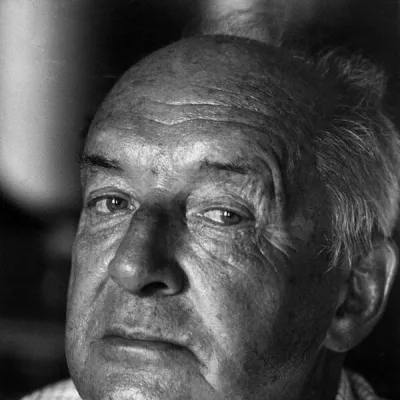
Vladimir Nabokov
Human Design Chart
Biography
From 1948 to 1959, Nabokov was a professor of Russian literature at Cornell University. His 1955 novel Lolita ranked fourth on Modern Library's list of the 100 best 20th-century novels in 1998 and is considered one of the greatest works of 20th-century literature. Nabokov's Pale Fire, published in 1962, ranked 53rd on the same list. His memoir, Speak, Memory, published in 1951, is considered among the greatest nonfiction works of the 20th century, placing eighth on Random House's ranking of 20th-century works. Nabokov was a seven-time finalist for the National Book Award for Fiction. He also was an expert lepidopterist and composer of chess problems.
What does Manifesting Generator 6/2 mean for Vladimir Nabokov?
Manifesting Generator 6/2 — Design at a Glance
Vladimir Nabokov's Design created a hybrid nature: the lightning-fast speed of a Manifestor paired with the constant energy source of a Generator. This configuration allowed him to skip steps and quickly pull things into his life. However, this acceleration also carried the risk of missing important stages or starting multiple projects simultaneously. If inner consent was lacking, this creative force would quickly turn into frustration – the specific non-self theme of this type.
The underlying mechanics required Vladimir Nabokov not to initiate himself but to respond to external impulses. Only when his sacral center said a clear "yes" and his inner authority agreed, did action become successful. If he consistently applied this strategy, he could work on various tasks simultaneously without becoming overwhelmed. Crucial was a state of play: for him, satisfaction and deep fulfillment arose only in the "play mode," where the work was fun and offered variety. The compulsion to finish one thing before starting another would have contradicted his nature. Instead, his creativity flourished once he felt secure in inner consent and experienced parallel processing as an enriching game rather than a stressful multitasking burden.
Emotional Authority
Vladimir Nabokov exhibited a decision dynamics that required time and emotional distance. His inner authority lay in the defined Solar Plexus Center, meaning his perception was always colored by current moods. This configuration was subject to a constant emotional wave with strong ups and downs. At one moment he could be enthusiastic about something, only to negatively evaluate the same situation moments later. His immediate feeling was just a snapshot, not a guaranteed truth.
Quick, spontaneous reactions to these first impressions were risky for him as they often did not align with his deeper truth. Instead, his mechanism required patience and conscious hesitation in important choices. He had to let decisions "sleep on" to allow intense feelings to subside. Only when these waves subsided did he gain the necessary emotional distance. In this state of calmness, true clarity emerged. This process of filtering was essential for long-term orientation points in his life. Emotional authority always took precedence over other defined centers, regardless of their number or type. Vladimir Nabokov thus learned to take his time and ask himself multiple times before acting. This protected him from poor decisions made in the heat of the moment and allowed him to recognize deeper connections that lay beneath the surface of current moods.
The 6/2 Profile — Role Model / Hermit
Vladimir Nabokov's Design set up a development in two clearly separated phases: first the experimental natural talent, later the reflective role model. In the first three decades of his life, the energy of Line 3 dominated. This showed as constant experimenting and learning through trial and error. Mistakes were not seen as failure but as necessary steps in the process of self-discovery; after each mistake followed a withdrawal to integrate the experience.
After turning thirty years old, the dominant energy shifted to Line 6. Vladimir Nabokov metaphorically retreated into a "cave on the mountain" – a phase of distancing and intensive reflection over his earlier experiments. This period served for healing and deepening self-understanding. The contradiction that was previously visible in action was now replaced by a conservative, cautious nature prioritizing its own security.
From this isolation emerged late wisdom. Vladimir Nabokov eventually stepped out of his retreat as someone who had learned when fighting is futile and one should surrender to the process of life. Other people were drawn to this depth he had worked on; they came to him to partake in his life wisdoms and learn the ability for deep introspection. The transformation from reckless experimenting to a broad, organizing perspective was thus complete.
Split Definition — Defined & Open Centers
Vladimir Nabokov's design established a massive, constant presence of willpower, mental conception, and emotional depth. He was an autonomous creator with a strong ego structure and intuitive certainty, driven by immense vital energy. His system was almost entirely defined: The Ajna Center provided consistent, specific thinking; the Heart Center delivered unwavering willpower and the desire for control over resources as well as self-responsibility. These decisions were not only thought but also felt and wanted – supported by the Solar Plexus as an emotional authority that demanded patience to find clarity – and implemented with sacral energy. The Sacral Center generated enormous daily vitality, which was, however, dependent on external stimuli; initiatives without such stimuli quickly led to exhaustion. Intuitively, his Spleen Center ensured his well-being in the present moment, while the Root Center provided necessary pressure for progress and survival.
The only weakness was the open Head Center. It could not generate its own “big” visions or inspiring questions. Instead, Vladimir Nabokov tended to wonder if he needed something inspirational to focus or desperately sought answers to doubts that were not his. This mental pressure arose solely from external stimuli; without these, confusion set in. While his defined mind (Ajna) constructed concepts, the open Head Center remained vulnerable to getting entangled in other people's problems or chasing false inspiration. His strength lay not in spontaneous inspiration out of nowhere but in the ability to process and precisely implement external impulses with his powerful inner machine of willpower and intuition – always under the condition that he waited for a sacral response before acting.
Channels for focus, curiosity, devotion, meaning-making and emotional change.
Vladimir Nabokov's design inclined towards precise, detail-oriented perfectionism. The Channel of Concentration 52-9 connected the Root Center to the Sacral Center through the Gate of Non-action (52) and the Gate of Focusing (9). This energy created a calm pressure to stay still and avoid distractions in order to logically correct patterns. He continuously evaluated details of his dedication while his body held its position as if in a yoga pose until the Sacral Center responded.
Parallel to this, he was shown as a storyteller who linked ideas for inspiration. The Channel of Curiosity 11-56 connected the Ajna Center with the Throat Center through the Gate of Ideas (11) and the Gate of Inspiration (56). His creativity became magical when he transformed philosophical contemplations into life parables. He was less interested in mere facts than in how stories taught or entertained others by stimulating imagination and emotions.
An instinctive salesman and persuader also emerged through his design. The Channel of Devotion 44-26 connected the Spleen Center with the Heart Center through the Gate of Awareness (44) and the Gate of Egoists (26). This gave him a sense of what people needed before they knew it themselves. He used willpower and intuitive assessment to promote products or ideologies that were seen as improvements, often accomplishing more in compressed time frames than others did over entire days.
Finally, stubborn struggle and individualization marked him. The Channel of Life Struggle 38-28 connected the Root Center with the Spleen Center through the Gate of Fighter (38) and the Gate of Players (28). He possessed the determination to follow his own path and resist external forces to maintain his integrity. This channel helped him find meaning in the struggles of his unique life journey and drive others towards individualization through this stubbornness.
Collective Circuitry — Circuit Signature
Vladimir Nabokov's design presented two clearly separated energy fields: a rational, future-oriented field and an emotional, past-related one. This separation meant that intellect and emotion did not directly transition into each other in him but rather acted as parallel forces.
The Understanding Circuit connected his Sacral with the Root Center. This created focused, visual energy of logic and strategy aimed at improving things and leading to a better future. This 'emotionless ratio' allowed him to structure rational insights free from conditioning.
In stark contrast, the Meaning-Finding Circuit on the right side of the chart linked Ajna, Throat, and Solar Plexus Centers together. Here, a cyclical, wave-like energy dealt with emotions and experiences from the past. The task was to reflect on past events, find meaning behind them, and share these felt insights with others to learn collectively.
Additionally, two more circuits acted as context. The Knowledge Circuit connected Spleen and Root Centers through the Channel of Life Struggle. This involved affirming one's individuality and learning new knowledge often tied to creative impulses or melancholic tones. The Ego Circuit linked Heart and Spleen Centers via Devotion. Here it was about cooperation and building resources within a community, where the absence of the Sacral Center required regular rest periods for energy regeneration.
Vladimir Nabokov thus lived with this specific architecture: on one hand, clear strategic logic for the future, on the other, deep emotional processing of the past, flanked by themes of individual identity and communal resource creation.
Left Angle Cross of Wishes 1
Vladimir Nabokov's design carried the archetypal structure of the left Desire Cross 1. This configuration shaped his inner foundation and determined a specific, deeply rooted life direction. In Human Design, this cross describes a fundamental imprint that does not manifest as superficial interest but rather as a central drive. It revolves around an intense, often unfulfilled longing for something transcendent or absolute, which seems unreachable through ordinary means. Vladimir Nabokov lived with this inner tension between the desire for higher truth and the experience of its inaccessibility in everyday life. The left Desire Cross 1 marks a nature driven by a strong urge to find meaning or realize an ideal vision, often accompanied by a feeling of lack or estrangement. This structure established that his essence did not seek superficial satisfaction but rather a profound, almost painful intensity in striving for his highest goals. It was an imprint that shaped his perception of the world through the filter of this unspoken yet ever-present desire. The mechanics of this cross are not seen solely in external actions but in the quality of inner experience and the constant pulsing of this specific energy characterizing his existence.
Saturn Return · Uranus Opposition · Chiron Return · 2nd Saturn Return — Life Cycles
Vladimir Nabokov's life followed a clear architectural structure, marked by four distinct astrological cycles defining phases of maturation and identity integration. His first Saturn Return around age 26 marked a phase of condensing personal foundations; in 1925 he married Véra Jewsejewna Slonim, emphasizing this structural anchoring on the relationship level.
The Uranus Opposition, a cycle of radical change and liberation from old patterns, occurred around his 41st year. This corresponded to 1940 when Nabokov's family moved to the USA – an external rupture reflecting his inner drive for transformation.
The Chiron Return, understood as a fulfillment cycle and bloom of one's purpose, fell at about age 46. During this period in 1945, Nabokov became a US citizen, legally and existentially solidifying his new existence form and anchoring the meaning of his path in his new homeland.
The second Saturn Return around age 56 brought to fruition long-term work. In 1955, the novel *Lolita* was published as a bestseller, marking a moment when years of groundwork condensed into a sustainable public success and stabilized his position. This sequence illustrates how cyclical turning points formed structural milestones in Vladimir Nabokov's life.
Manifesting Generator · Emotional Authority — Synthesis
He possessed an extraordinary ability to grasp details through concentration (Channel 52-9) and pour them into new formats – a process fueled by a constant mental flow (defined Ajna Center). This format energy was evident in his transformation of existing structures and venturing on his own paths, always seeking innovation and expression of his individuality (Knowledge Circuit). The sacral energy provided the power for this intense engagement with the material, while the emotional center required a deep, though time-consuming, decision-making process.
A central paradox lay in the combination of rapid initiation and deep reflection. As an Manifesting Generator, he could spark things quickly, yet emotional authority compelled him to repeatedly review and let these impulses mature. This led to an inner tension between the desire for immediate realization and the necessity to take time for a full emotional engagement – a pattern evident at turning points in his life (Saturn Return, Uranus Opposition) and ultimately also accompanying his success.
5 Defined Channels
Incarnation Cross - Left Angle Cross of Wishes 1
Solar Return
The Solar Return shows the moment when the sun returns to its exact birth position - your personal solar year.
Life Cycles
Discover the life cycles with a detailed triple view (birth chart, cycle chart, composite).
Human Design Profile
- Strategy
- To respond - wait for something to respond to
- Authority
- Emotional Authority
- Profile
- 6/2 - Role Model / Hermit
- Definition
- Split Definition
- Incarnation Cross
- Left Angle Cross of Wishes 1
- Date of Birth
- 22.04.1899 04:26
- Place of Birth
- Saint Petersburg, Russia
Frequently Asked Questions
What was Vladimir Nabokov's Human Design type?
What Profile did Vladimir Nabokov have in Human Design?
Which Authority guided Vladimir Nabokov?
What incarnation cross did Vladimir Nabokov have?
When was Vladimir Nabokov born?
Discover your own Human Design
Are you also a Manifesting Generator? Find out in a personal reading how to unfold your multi-talents and direct your energy wisely.
More Personalities
Back to overviewAlain-Fournier

Aldair

Alizée

Angeli
Arletty
Artus