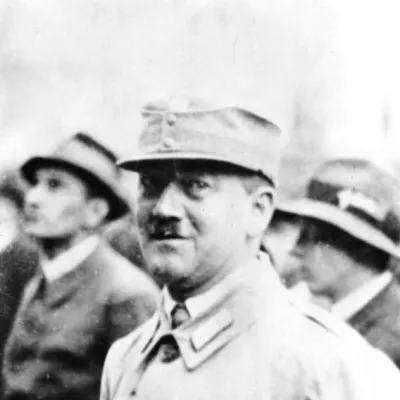
Waldemar Pabst
Human Design Chart
Biography
Waldemar Pabst — Generator with Profile 5/1
Generator 5/1 — Design at a Glance
Waldemar Pabst’s design revealed a tendency towards great endurance and inner drive. As a Generator, he had plenty of sacral energy, making him appear like a workhorse: extremely strong and resilient as long as the task aligned with his intrinsic motivation. However, his life force did not ignite merely through sheer will or external initiatives but exclusively in response to impulses from the environment. Waldemar Pabst’s central strategy was to wait for a signal and then act once his sacral center responded with a clear “Yes” – that is, to react from the gut.
This mechanism protected him from two specific dangers: First, it shielded him from investing energy in things he did not care about, which would have quickly led to exhaustion. Second, it prevented him from being distracted from his true heart project when he was still full of power. If Waldemar Pabst lived in harmony with this reactive strategy, his system rewarded him with a deep sense of fulfillment and satisfaction. However, if he tried to initiate against his natural rhythm or ignored the signals of his body, sooner or later he would encounter persistent frustration and a noticeable lack of energy. His success thus depended less on constant action than on the quality of his responses to life.
Sacral Authority
Waldemar Pabst showed himself as someone who did not make life decisions through intellectual deliberation but waited for direct physical resonance. As a Generator, his strategy was identical with his inner authority: sacral authority. This mechanism fundamentally simplified his decision-making process, as he needed neither external advisors nor logical analyses to find the right path. Instead, his design reacted to external stimuli with an immediate physical response – often felt as a palpable surge of energy in the abdominal area or as an inner voice manifesting in verbal expressions like an affirming “Hmm” or a dismissive grunt.
This reaction was not random but a reliable compass. When his sacral motor engaged with something, he felt vital and alive; then, he had access to inexhaustible energy that enabled him to immerse himself enthusiastically in activities without needing to fulfill an external purpose. The condition for this clear guidance was an open emotional center ensuring that no short-term moods overrode the sacral truth. Thus, Waldemar Pabst was guided by his instinctive well-being and acted only where he felt a genuine, physical confirmation.
The 5/1 Profile — Heretic / Investigator
Waldemar Pabst revealed through his 5/1 profile as someone who used deep knowledge to offer solutions to others. This design gives him a magnetic presence: people sought his advice because they recognized his expertise. However, Waldemar Pabst lived with the risk of overextension if he did not set clear boundaries. The Profile 5/1 combines Line 1 – the Investigator who follows stable foundations and step-by-step changes – with Line 7 – the Rebel, who questions norms in times of crisis. Waldemar Pabst had to learn to balance his own research with problem-solving for others. Without a clear “No,” he risked collapsing under the expectations of others like an overextended expert. His task was to correct traditional structures without destroying fundamental patterns. In crisis situations, his design acted as a guardian for necessary behavioral changes. Waldemar Pabst used his ability to question established traditions not to attack individuals but to secure survival and progress in unstable times. The challenge always lay in connecting this rebellious energy with the conservative necessity of stable foundations. Only through clear boundaries could he optimally utilize his gifts without burning himself out. His path was marked by the tension field between the need for deeper understanding and the pressure to provide immediate answers for society.
Single Definition — Defined & Open Centers
Waldemar Pabst revealed himself as someone with a firm, reliable self-identity and a clear sense of direction. His defined G Center gave him the ability to love others without becoming dependent on them, along with the natural potential to show new paths or perspectives to other people. This inner security formed the foundation of his existence; he knew his place in the evolution of the species and could offer comfort by explaining the nature of change. However, there was a risk that he might try to direct others without waiting for an invitation to do so.
Parallel to this, Waldemar Pabst had a defined Sacral Center, making him the guardian of an enormous power source. His sacral motor generated a specific amount of energy daily, manifesting as a constant hum or vital restlessness. For him, it was essential to use this energy through reactive expression – that is, only acting when asked and his sacral center responded with an enthusiastic “yes”. Initiating actions without prior invitation disrupted the connection to this source and led to frustration or exhaustion. His strategy involved waiting to correctly apply his energy and find satisfaction.
In contrast, his Head Center was open. Waldemar Pabst had no consistent way of processing mental information and tended to get entangled in others' doubts or questions. He might seek external inspiration to relieve mental pressure rather than trusting his inner authority. His Ajna Center was also open, giving him a flexible mind that was vulnerable to interpreting foreign opinions or concepts as his own truth. He could go through myriad possibilities and collect them but risked losing himself in intellectual pursuits not serving his own truth.
His Throat Center was likewise open, meaning he couldn’t communicate consistently. Waldemar Pabst naturally attracted attention when waiting; if he actively tried to gain a hearing, he often spoke unexpectedly or unpredictably and risked being misunderstood. His wisdom lay in waiting for an invitation to speak at the right time.
The Heart Center was open, so Waldemar Pabst wasn’t designed to be willful or make promises. He tended to want to prove his worth through performance, which could lead into a cycle of disappointment as he lacked the consistent energy for it. His open Solar Plexus absorbed emotions from the environment; he had to learn not to personalize them to avoid being overwhelmed by foreign moods. His Spleen Center was also open, making him vulnerable to survival fears and unhealthy dependencies if he clung to people with defined spleens to find security. Spontaneous decisions were risky for him. Finally, his open Root Center absorbed stress from the environment; he had to learn not to misinterpret this pressure as personal drive but rather release it consciously or use it purposefully without falling into hyperactivity.
Channels for fixed rituals and extreme life span.
Waldemar Pabst revealed himself as someone carried by the natural flow of life while possessing an inner sense of timing. This basic attitude resulted from Channel Rhythm 5-15, connecting his Sacral Center with his G Center. Gate 5 held onto firm habits and rituals, while Gate 15 integrated diversity into the life stream through its love for human extremes. This mechanism created a universal rhythm that neither succumbed to intellectual arrogance nor emotional fluctuations. Instead, an impersonal magnetic attraction drew others into this continuous energy flow and propelled a group forward. As long as Waldemar Pabst aligned with this natural rhythm, his actions felt effortless and subtly influenced his environment by bringing it into its own timing.
Additionally, his design featured an attitude of correction and logical teaching. Gate 18 in the cross emphasized work on corruption and distinguishing between life-critical and insignificant corrections within a collective process, without taking these tasks personally. Parallel to this, Gate 17 stood for succession and logical organization for the future, rooted in maintaining fundamental human rights and the principle of serving leadership. In his G Center, Gate 10 also played a role, a complex gate that fed the integration process through genetically predetermined behaviors as well as personal convictions, profoundly shaping life. Personality-wise, Gates 42 with its focus on experience, completion, and sacral power, along with Design Gates 3 (Mutation) and 2 (Receptivity to new directions), contributed to overcoming confusion and creating new orders from mutations.
Collective Circuitry — Circuit Signature
Waldemar Pabst revealed himself as someone who acted through rhythmic structure and logical clarity. His design was characterized by a simple definition: energy flowed directly between the Sacral Center – the source of his endurance and life force – and the Identity Center, representing the essence of self. This connection formed the Rhythm Channel (Gate 15 to Gate 5). Thus, he linked his fundamental vitality with a clear, recurring identity.
This channel belongs to the Understanding Circuit. This circuit uses logic, strategy, and focus to improve things or guide society towards a better future. A central theme is sharing rational insights free from conditioning. Since the Solar Plexus Center isn’t involved here, it’s “emotionless ratio.” The left side of the chart represents future-oriented energies.
In Waldemar Pabst's case, however, this energy was specific: it only connected his Sacral and Identity Centers. There were no further direct connections within this circuit as he had only this one channel active. His endurance power (Sacral) flowed directly into his personal essence (Identity). This created an inner stability based on recurring patterns and a clear strategic perspective. He used this connection to develop logical structures and solidify his self-understanding through rhythmic actions. The energy was focused and purposeful, without being distracted by other parts of the Understanding Circuit.
Left Angle Cross of Prevention 2
Waldemar Pabsts design establishes a foundational stance of caution and foresighted action. His chart features the "left cross of prevention 2," which describes a specific energetic alignment: the ability to recognize potential problems early on and prevent them through preparatory measures. This configuration marks him as someone who did not wait reactively for crises but proactively created structures to ensure stability. It was an inner logic aimed at ordering chaos through clear, preventive steps. Waldemar Pabst lived his life valuing security and reliability, not out of fear, but from a deep understanding that preparation makes the decisive difference. This energetic signature meant he often took on the role of protector or planner, minimizing risks before they could unfold. His approach was methodical and thoughtful; he sought weaknesses in systems or situations to strengthen them before they broke down. This gave others a sense of reliability because his actions were based on solid grounds of prediction and safeguarding. The energy of this cross drove him to create order out of disorder by taking the right measures at the right time to prevent negative developments.
Saturn Return · Uranus Opposition · Chiron Return · 2nd Saturn Return — Life Cycles
Waldemar Pabsts Design indicated a tendency towards strategic positioning within structural power networks. His path was characterized by cycles that combined external recognition and inner alignment. In 1907, at the age of 27, he began attending the War Academy in Berlin – a typical moment of his first Saturn return, when years of groundwork often culminate in a solid result. This marked the beginning of a career based on institutional anchoring.
The Uranus opposition around 1920 signaled a break with established structures in favor of new claims to authority. Pabst was promoted to Major after the Kapp-Lüttwitz putsch and worked closely with Lüttwitz during the coup. Here, the dynamic of breaking old ties to take on a new role during a chaotic transitional phase became evident.
The Chiron return around 1930 is a fulfillment cycle in which one's incarnation cross increasingly unfolds in life. Pabst was expelled from Austria. Although this event interrupted his external career, it coincided precisely with the period when meaning and purpose become experiential – not as healing but as clarification of one’s path through separation from non-conducive environments.
The second Saturn return around 1938 brought further structural consolidation. Pabst worked at the War Economy and Armaments Office with General Georg Thomas. This confirmed his ongoing ability to act effectively within complex hierarchies and take responsibility, after earlier cycles had laid the groundwork for this.
Generator · Sacral Authority — Synthesis
Waldemar Pabst lived a deep, sacral-driven life path (Generator Type), characterized by an inexhaustible work ethic – as long as he focused on tasks that truly attracted him. The connection of his defined G Center with the Sacral Center through the Rhythm Channel (Gate 5/15) indicates a person who acted in a natural flow, possessing a firm inner direction while simultaneously welcoming the diversity around them. His role as a Hero and Explorer (Profile 5/1) reinforced this inclination towards deep knowledge acquisition and sharing solutions, manifesting in professional turns that always aimed at understanding and structuring complex relationships.
A central tension lay in Pabst’s sacral authority driving him to follow an inner vitality while his profile placed him constantly in a position where he was asked for answers – a circumstance carrying the risk of depleting his energy. This oscillation between the need to give himself over and meet others' expectations shaped his path, especially in light of recurring events pointing towards professional challenges and changes (Saturn Returns, Uranus Opposition).
1 Defined Channel
Incarnation Cross - Left Angle Cross of Prevention 2
Solar Return
The Solar Return shows the moment when the sun returns to its exact birth position - your personal solar year.
Life Cycles
Discover the life cycles with a detailed triple view (birth chart, cycle chart, composite).
Human Design Profile
- Type
- Generator
- Strategy
- To respond - wait for something to respond to
- Authority
- Sacral Authority
- Profile
- 5/1 - Heretic / Investigator
- Definition
- Single Definition
- Incarnation Cross
- Left Angle Cross of Prevention 2
- Date of Birth
- 24.12.1880 00:15
- Place of Birth
- Berlin, GER
Frequently Asked Questions
What was Waldemar Pabst's Human Design type?
What Profile did Waldemar Pabst have in Human Design?
What Authority did Waldemar Pabst possess?
What incarnation cross was decisive for Waldemar Pabst?
When was Waldemar Pabst born?
Discover your own Human Design
Are you also a Generator? Find out in a personal reading how to use your sacral energy correctly and discover deep satisfaction.
More Personalities
Back to overviewAaliyah

Alexia

Angèle

Anne-Marie

Arcángel

Arno