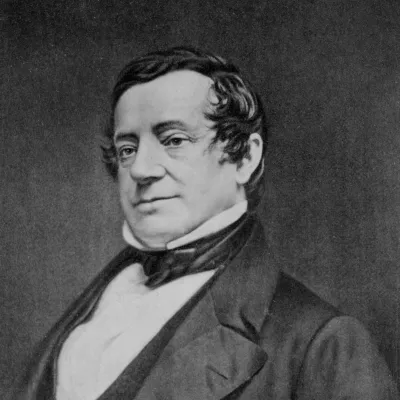
Washington Irving
Human Design Chart
Biography
Stories of his, which appeared serially from 1819 to 1820, included the classics "Legend of Sleepy Hollow" and "Rip Van Winkle." After some time in Germany and France, Irving became the diplomatic attaché in Spain from 1826 and continued to gather material for his writings. Serving at the American Legation in London 1829-1831, he returned to America where a lengthy trip through the west resulted in further noted writing. In 1835, he published "A Tour on the Prairies." His final government job was in diplomatic service in Spain, 1842-1846, returning to the U.S. until his death.
Irving died on 28 November 1859, Sunnyside, New York. He was elected to the Hall of Fame For Great Americans in 1900, the first American writer to achieve international fame.
What does Projector 5/2 mean for Washington Irving?
Projector 5/2 — Design at a Glance
Washington Irving was a Projector. His design inclined him towards focused perception: He immediately saw where other systems had flaws or overlooked aspects. This ability acted like a bright flashlight directed at problematic areas. However, lacking a constant intrinsic energy source – his Sacral was undefined – his strength fluctuated in wave-like movements. Phases of high activity and fast work alternated with necessary rest phases to prevent burnout. Traditional work life often ignored this need for regeneration.
His strategy involved not actively seeking out others or directing his observations abruptly at them. Directly addressing the errors in others was often perceived as unpleasant, similar to shining a light directly into someone's face. Instead, Washington Irving worked most effectively by maintaining a harmonious presence. This pleasant demeanor attracted people who then sought his advice of their own accord. The key to his success lay in waiting for an honest and appreciative invitation from the environment. Only when this invitation came could he optimally use his energy without falling into bitterness that arises when working against one's flow or not being recognized. His design rewarded patience and restraint with genuine appreciation.
Emotional Authority
Washington Irving displayed an inner decision-making structure characterized by emotional wave movements. His inner authority was emotionally marked, carried by the defined Emotional Center. This center fundamentally determined his perception: He saw the world always colored by his current mood state. In one moment he could be enthusiastic about something, in the next it fell negatively on him. These fluctuations were not instability in a pathological sense but rather a mechanical process of emotional condensation.
His feelings formed only a snapshot, a first impression that was not yet his final truth. Quick, spontaneous decisions made directly from such an emotion often proved disadvantageous for him. The mechanics of his authority required patience and time. By letting decisions rest over several days and sleeping on them multiple times, he gained emotional distance. Initial intense feelings subsided; clarity and calm set in. Only then was the process complete and the decision ripe.
This priority rule applied regardless of other defined centers in his design: Whenever the Emotional Center was activated, it functioned as his primary inner authority. Washington Irving therefore had to consciously take time and be patient to gain deeper insights. This process of emotional maturation particularly shaped long-term decisions that significantly influenced his life course. Through waiting, he found calmness and made decisions that aligned with his true nature rather than following transient whims.
The 5/2 Profile — Heretic / Hermit
Washington Irving revealed himself as a person with a deep inner contradiction: He strove to help others and earn admiration, yet simultaneously craved restraint and time alone. This Profile of 'Hero / Natural Talent' combined the urge for public recognition with the need to retreat into his own 'cave'. As long as the world did not recognize him as an authority, he worked intensively on his development and used solitude to sharpen his skills.
Line 5 in the first part of his design promoted objectivity and impartiality, especially in crisis situations. It required him to act guiding and leading without being emotionally influenced. This stance helped him formulate clear insights that others appreciated later. In the second part, Line 2 with its characteristic discretion strengthened his restraint and refused to extract benefits from previous interactions. Instead, he drew strength from wisdom and moderation.
This mix could lead to frustration if he passively waited to be discovered rather than actively stepping forward. His ambition was tempered by the discretion of Line 2, which sometimes weakened loyalty or intensified disloyalty. Only when he learned to clearly set boundaries while also emerging from his cave did he effectively use his presence. The world then loved him for these clear perspectives that emerged from the depth of his reflection.
Single Definition — Defined & Open Centers
Washington Irving showed himself as someone who never made decisions in a blind moment but needed time to gain emotional clarity. His defined Solar Plexus Center functioned as an inner authority: truth revealed itself to him only over time, by waiting out the ups and downs of his emotional wave. He avoided impulsive jumps into new ventures or relationships in favor of patient exploration; he recognized what was correct only when the emotional charge subsided and calm set in. This depth allowed him to view situations from many perspectives before acting.
Parallel to this, he had a defined Spleen Intuition that worked in the present moment. It delivered spontaneous, non-verbalized warning signals or confirmations for well-being and survival. Irving learned to trust these sudden body instincts without having to rationalize them. Combined with his defined Root Center, he possessed a constant inner drive that propelled him forward – whether toward material stabilization or dealing with emotional stress situations. This steady impetus anchored him in reality as long as it wasn't steered by non-self overreactions.
His open Head Center did not generate consistent inspiration. Irving tended to engage with foreign questions or doubts that actually belonged to others. Instead of mentally pressing for answers, he learned to be a detached observer of his thoughts. Similarly, his open Ajna Center led him to take in concepts and opinions without identifying them as his own truth. His mind remained flexible, open to new insights from the environment rather than being trapped in rigid theories.
His open G Center meant that Irving did not have a fixed identity or life direction. He adapted to people and places he encountered, gathering various directions until he felt where he truly belonged. At the wrong place, he felt lost; at the right one, he flourished, supported by the energy of his surroundings. His open Heart Center protected him from having to prove his worth through promises or competition. He sensed others' ego vibrations without getting caught in cycles of self-doubt and overcompensation. Finally, his open Sacral Center reflected the energy of his environment. Irving was prone to exhaustion when overloaded by other people's generative power. He learned to set boundaries and rest before fatigue set in rather than running on borrowed energy.
Channels for logical proof and emotional intuition.
Washington Irving showed himself through his design as someone whose inner drive was strongly influenced by the need to question and correct patterns. This attitude resulted from Channel of Judgment 58-18, which connected Root Center with Spleen Center. Through Gate 58, which fostered a love for life and stability, an insatiable urge for improvement arose. Gate 18 served as a corrective that checked whether something was healthy or in balance. Irving thus constantly assessed whether perceptions served the collective good, making him a sharp observer of societal structures.
Parallel to this, Channel of Recognition 30-41 worked, which connected Root Center with Solar Plexus. Gate 41 generated a drive for new experiences and restlessness, while Gate 30 emotionally charged this desire. This led Irving to an intense need to deeply feel life and experience new situations, learning to wait out his emotional wave to gain clarity.
Additional influences came from Gate 54, which linked worldly success with mystical insight, as well as Gate 21, emphasizing control over material things and the desire for respect in the community. Gate 53 enabled him as a pioneer to forge new paths, while Gate 48 promoted deep pattern recognition, though this sometimes led to frustration. In his personality, Gates 36, which saw crises as cyclical development, and Gate 6, which used emotional friction for growth, were at work. Gate 22 brought calmness in listening, while Gate 60 fostered acceptance of limitations toward transcendence. Gate 19 sought secure resources and partnerships, Gate 52 demanded focused pauses for pattern correction, and Gate 38 set boundaries to protect individual integrity.
Collective Circuitry — Circuit Signature
Washington Irving showed himself through a design that combined logical clarity with emotional depth. His Understanding Circuit activated the Channel of Judgment between Spleen and Root Centers. This gave him the ability to recognize strategic structures and focus them into the future – a rational, emotionless ratio aimed at improving things by cleverly sharing insights. Parallel to this, his Purpose Circuit worked through the Channel of Recognition connecting Solar Plexus with Root Center. Here past experiences and emotional waves converged. This energy was cyclical: feelings had a beginning, middle, and end before dissolving. Washington Irving used this connection to learn from the past and share the felt insights gained with others. Although both circuits touched the Root Center, they formed two separate streams: one focused on future logical improvement, the other on reflecting on past emotions. This configuration created a balance between cold intellect and warm memory, where Root energy served both areas with necessary urgency without directly overlapping.
Left Angle Cross of Endeavour 1
Washington Irving was marked by the left cross of endeavor. This configuration established a fundamental attitude characterized by tireless effort to achieve inner clarity and external confirmation. His design carried an impulse to prove himself through consistent action and continuous development. It was not about passive waiting for inspiration but rather an active process of creation and refinement.
The mechanics of this cross describe a life task that is connected with hard work. Washington Irving sought ways to bring his ideas into tangible forms, often accompanied by the feeling that more needed to be done. This tendency towards constant effort served to relieve internal tensions and achieve a sense of completion. He learned that the path itself – the effort, trying and failing – was an integral part of his development.
His design challenged him not to see temporary successes as ultimate goals but to accept the process of becoming. The energy of this cross drove him to continuously improve and sharpen his skills. Washington Irving thus showed himself to be someone who strengthened his identity through continuous effort. The focus was on the quality of work and the authenticity of expression, which could only be achieved through this persistent endeavor.
Saturn Return · Uranus Opposition · Chiron Return · 2nd Saturn Return — Life Cycles
Washington Irving's life was marked by clear cyclical turning points. His first Saturn return in 1809 at age 26 marked a deep turning point: Matilda Hoffman, to whom he had lost his heart, died unexpectedly at seventeen years old. This loss solidified his internal stance sustainably. Later, during the Uranus opposition in 1824 (age 41), a new creative phase began. The publication of “Tales of a Traveller” signaled a break with the known and the courage to take unconventional narrative paths. This phase of expansion led him finally to his Chiron return in 1832 (age 49). Here, the fulfillment of his life purpose was evident: His return to New York was celebrated as a triumph. This moment did not represent healing old wounds but rather the peak of his personal bloom, where his inner destiny became publicly visible. The second Saturn return in 1840 (age 57) crowned this path with the publication of Oliver Goldsmith's biography. It was a consolidating achievement that structured and solidified his previous work. Irving thus did not move through these events randomly but followed an internal logic leading from loss to experimental freedom, then to recognition, and finally to mental order. Each cycle brought a specific quality into play that shaped his overall body of work.
Projector · Emotional Authority — Synthesis
Washington Irving lived much of his life in an inner tension between the desire to understand others and serve them (Projector with Hero/Natural Talent Profile) and the necessity to withdraw and await his own internal processes. His emotional authority required time for decisions, while his defined Solar Plexus Center placed him in a constant flow of feelings – an up and down that shaped his perception. This dynamic was evident in how he recognized patterns (Judgment Channel) and shared these insights, always with an awareness of the emotional impact on his surroundings. The left cross of endeavor indicates that his energy primarily flowed towards inner work and refinement of his skills.
A central paradox lay in being a Projector destined to bring light into darkness and reveal errors while his profile simultaneously inclined him towards withdrawal. The cycles confirm this: Moments of public reception (Chiron return) alternated with times of intense personal work and loss (Saturn return 1), emphasizing the necessity of isolation and reflection to steel his gifts and act in harmony with his emotional wave. The connection between Judgment and the Meaning Circuit suggests that he always sought clarity and also wanted to convey it.
2 Defined Channels
Incarnation Cross - Left Angle Cross of Endeavour 1
Solar Return
The Solar Return shows the moment when the sun returns to its exact birth position - your personal solar year.
Life Cycles
Discover the life cycles with a detailed triple view (birth chart, cycle chart, composite).
Human Design Profile
- Type
- Projector
- Strategy
- Wait for the respectful invitation
- Authority
- Emotional Authority
- Profile
- 5/2 - Heretic / Hermit
- Definition
- Single Definition
- Incarnation Cross
- Left Angle Cross of Endeavour 1
- Date of Birth
- 03.04.1783 20:30
- Place of Birth
- New York, NY, United States
Frequently Asked Questions
What was Washington Irving's Human Design type?
What Profile did Washington Irving have in Human Design?
Which Authority determined Washington Irving's decisions?
What incarnation cross characterized Washington Irving?
When was Washington Irving born?
Discover your own Human Design
Are you also a Projector? Find out in a personal reading how to unfold your leadership qualities and recognize the right invitations.
More Personalities
Back to overviewSissy Spacek

Alain-Fournier

Anémone

Ann-Margret

Bourvil
Christian-Jaque