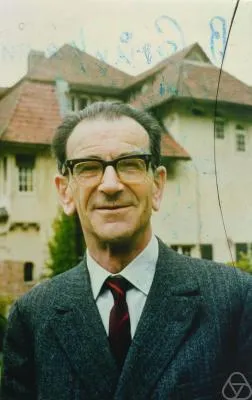
Werner Fenchel
Human Design Chart
Biography
A German-born Jew and early refugee from Nazi suppression of intellectuals, Fenchel lived most of his life in Denmark. Fenchel's monographs and lecture notes are considered influential.
His younger brother was the Israeli architect Heinz Fenchel. In December 1933, Werner Fenchel married fellow German refugee mathematician Käte Sperling. He died on 24 January 1988 at age 82 in Copenhagen, Denmark.
Human Design Analysis: Werner Fenchel as Generator 5/1
Generator 5/1 — Design at a Glance
Werner Fenchel's design points to a tendency towards great endurance and high energy potential, which is only effectively utilized when he reacts to external impulses. As a Generator, he had a lot of sacral energy, which could make him as enduring as a strong workhorse – provided he had energy for the task at hand. His design featured two central pitfalls: he was prone to burnout if he persistently did things that did not interest him, or felt restrained when prevented from pursuing his heart's project, even though he was still full of power.
The successful use of his energy depended on not initiating things himself but waiting for signals from life. When his sacral center gave a clear 'yes', he responded with action. This reacting from the gut was the motto of his design. Living in harmony with it by listening to these inner signals rewarded him with a deep sense of fulfillment. Attempting to work against his design and constantly initiating things himself led to persistent frustration and a lack of energy. His strength, therefore, did not lie in pushing forward but in the powerful response to what engaged him.
Emotional Authority
Werner Fenchel's design points to a tendency towards emotional depth and wave-like experience. He was someone whose inner authority lay in the defined Solar Plexus Center. This configuration determined that his decision-making was always influenced by an emotional wave, resulting in a constant up and down of his feelings.
This emotional authority was subject to a specific mechanism: the world appeared to him colored by his current mood. In one moment, he could be totally enthusiastic about something, in the next, he saw the same thing completely negatively. This feeling in the moment was, however, only a snapshot, a first impression, which did not necessarily represent his truth. Quick, spontaneous decisions based on such an emotion often had negative consequences.
Instead, his design required patience. The more time he took to let a decision mature, the deeper and more comprehensive he could understand the situation. This meant reconsidering decisions multiple times and 'sleeping on them'. Over time, intense feelings subsided, he gained emotional distance, and clarity and calmness set in. Only then had he gone through the process. This mechanism was particularly relevant for long-term decisions that could have a significant impact on his life course. Emotional authority always took precedence over other defined centers, regardless of further configurations in his chart.
The 5/1 Profile — Heretic / Investigator
Werner Fenchel's design points to a dual role: on one side, he was a deep researcher who collected knowledge for himself, and on the other, a hero who offered this knowledge to others for problem-solving. As a 5/1, he had a nearly magnetic presence that made people actively seek his insights. This often worked to his disadvantage if he did not set clear boundaries.
The mechanics of his profile explained this dynamic: Line 1, combined with empathy and listening, formed the foundation. It allowed him to engage with people indiscriminately and to take in secrets or stories from various sources. This openness was not without motives and could be felt as a burden if he did not learn to steer his empathy purposefully.
Line 5 demanded the courage to acknowledge past mistakes and make a confession as justification. In crisis times, this line was particularly strong, especially with strangers seeking solutions. Werner Fenchel often appeared as an expert, answering questions for hours, only to be drained later because his inbox was full of further inquiries. The challenge lay in maintaining the balance between private research (Line 1) and public problem-solving (Line 5). Only by learning to also say no could he optimally utilize his gifts without exhausting himself. His design marked him as someone who deeply understood knowledge but had to learn how to dispense it judiciously.
Triple Split Definition — Defined & Open Centers
Werner Fenchel was someone who stood under a constant, internal mental pressure to ask questions and understand connections. This tendency resulted from his definition between Head and Ajna Centers. He had a firm way of thinking and was constantly exposed to inspiration, but this inspiration did not contain direct energy for implementation. Instead of acting hastily, his task was to accept this pressure and stimulate others with his thoughts rather than manifesting the answers himself.
This mental process was linked to a strong, defined willpower in the Heart Center. Werner Fenchel liked to control his resources and his life himself. He was competitive and valued keeping promises, which strengthened his self-esteem. His energy source also lay in the defined Sacral Center. As a Generator, he possessed a tremendous vital force that he could release through reacting to external stimuli. His strategy was not to initiate but to wait until his Sacral Center responded with a clear yes or no, to avoid frustration and exhaustion.
At the same time, he was deeply emotionally involved. His defined Solar Plexus Center made him an emotional authority. He had to wait for his emotional wave to calm down to gain clarity. Impulsive decisions based on the highs or lows of his feelings often led to chaos. His defined Root Center provided the necessary stress to move forward in the world and master existential challenges.
In contrast, his Throat, G, and Spleen Centers were open. In communication, he tended to feel under pressure to gain attention or to remain silent when he did not feel secure. Without a firm identity in the G Center, he adapted to his environment and sought the right direction through external initiation. His open Spleen Center made him vulnerable to fears about health and survival, causing him to sometimes cling to uncertain situations to gain a sense of security.
Channels for change, clarity and community.
Werner Fenchel's design tended towards deep, often unexpected change, paired with a mental sharpness that relied on spontaneous insight. This configuration was shown through three central channels.
The Channel of Mutation 60-3 connected the Root and Sacral Centers. It brought a pulsating, adrenalized energy that allowed evolutionary change through the acceptance of limitation (Gate 60) and the need for order after the chaos of a new beginning (Gate 3). This power was melancholic and moody; it required patience until the inner mutation showed itself, rather than forcing it.
The Channel of Awareness 61-24 connected Head and Ajna Centers. It created the individual thinker who did not rely on logical patterns or abstract reflection, but rather on inspiration (Gate 61) and rational processing (Gate 24) to gain knowledge. Here, knowledge suddenly appeared, like a Satori, when the mental pressure subsided. Werner Fenchel could not control his thinking but had to trust the happy coincidence of the inner truth that appeared in its own time.
The Channel of Community 37-40 connected Solar Plexus and Heart Centers. It emphasized the need to build bridges between individuals to create a functioning community. Gate 37 sought recognition and a place in the whole, while Gate 40 combined the readiness for care with the need for breaks and rewards. This channel required carefully negotiated agreements based on mutual benefit and emotional clarity, rather than spontaneous decisions.
Additionally, gates like the one of Meaning (13), which gathered experiences and established continuity, and the one of Leadership (7), which projected patterns for the future, were at work. Gate 44 promoted awareness and transformation through interaction, while Gate 27 represented genetic care for the clan. Gate 43 enabled the breakthrough of individual insights that had to be clearly communicated. Gate 55 brought extreme emotional mood swings, Gate 58 the pressure to perfect patterns, and Gate 49 the emotional wave of sacrifice for principles. Gate 42 emphasized the completion of processes, and Gate 52 required a concentrated pause for pattern correction. These elements shaped Werner Fenchel's unique way of experiencing change, knowledge, and community.
Individual Circuitry — Circuit Signature
Werner Fenchel's design was characterized by three separate, parallel acting energetic poles, as his Triple Definition did not establish a continuous connection between these areas. He did not move in a single, continuous flow but had to navigate these different energy fields separately.
In the Knowledge Circuit, he connected the Head with the Ajna Center on one side. This promoted intuitive, creative flashes of insight and the ability to recognize new connections. Separately, in the same circuit, the connection between Sacral and Root Centers acted. This conveyed a pulsating, acoustic energy of mutation – the power to initiate change through deviation from the known. Both aspects, however, remained energetically isolated from each other.
Another independent pole was the Ego Circuit, which in Werner Fenchel connected the Heart with the Solar Plexus Center. Here, it was not about individual identity but about tribal dynamics: the mutual giving and taking and emotional support within a community. Since this area was not connected to the Sacral energy, this social interaction required necessary pauses for resource regeneration. Thus, Werner Fenchel lived with three distinct energy fields – creative intuition, transformative impulses, and social cooperation – that existed side by side without directly flowing into each other.
Left Angle Cross of Incarnation 1
Werner Fenchel's design indicated a tendency towards profound inner transformation, which was not shown through external hustle and bustle, but rather through quiet, consistent development. He lived the left cross of incarnation 1, a configuration aimed at gradual maturation and inner growth. This structure describes a path that does not rely on quick success or immediate recognition, but on the patient cultivation of one's essence.
For Werner Fenchel, this meant that his life was marked by a fundamental search for authenticity and inner truth. The mechanics of this cross support a stance of restraint and learning from depth. It is not about influencing the outside world, but about developing oneself into a stable, mature individual. His energy was directed inward to penetrate and understand patterns before carrying them outward.
This orientation required patience and trust in his own process. Werner Fenchel was someone who brought about changes from within, without being dependent on external confirmation. His path was one of subtle but lasting transformation, where every experience was used as an opportunity to deepen self-understanding. Through this inner work, he developed a resilience that helped him face life's challenges with clarity and composure, without being disturbed by external circumstances.
Saturn Return · Uranus Opposition · Chiron Return · 2nd Saturn Return — Life Cycles
Werner Fenchel's design showed a tendency towards profound structural breaks, which acted as catalysts for his development. The first Saturn return marked 1933, at the age of 28, when he fled to Denmark. This cycle often condensed years of groundwork into tangible results, here however in the form of an existential crisis that forced a radical reorientation. Ten years later, in 1943 at the age of 38, the Uranus opposition hit him. This phase often brings unexpected changes and the feeling of being thrown off course. For Fenchel, this manifested as a second flight, this time to Sweden, emphasizing instability and the need to adapt.
The turning point came with the Chiron return, a fulfillment cycle in which one's incarnation cross unfolds. In 1952, at the age of 47, Fenchel became a professor of mechanics at the Technical University of Copenhagen. This was not just a career step, but the concrete realization of his purpose. After years of flight and uncertainty, he found here the confirmation of his inner authority. The Chiron return confirmed that the suffering of the previous phases was necessary to pave the way to this professional and personal flourishing. His life task, to uncover hidden connections in mechanics, was now publicly visible and recognized.
Generator · Emotional Authority — Synthesis
Werner Fenchel lived deeply in the experience of emotional waves (Emotional Authority), which shaped his decisions and gave him time to mature. This inner dynamic was linked to a pronounced ability to generate and share knowledge (5/1 Profile, defined Head Center). He was a hero who accumulated knowledge through investigative depth to make it available to others – a process that continually led him into new challenges. The sacral energy (Generator type) fueled this thirst for knowledge and the endurance needed to process complex questions and search for solutions.
A central paradox in his design lay in the tension between the ability for profound inspiration and the accompanying mental pressure (defined Head Center) as well as the emotional wave that made a clear, immediate response difficult. He was capable of developing innovative ideas (Knowledge Circuit, Channel of Mutation), yet the emotional authority required a careful weighing that was associated with inner unrest. This dynamic was evident during crisis phases (Saturn Return, Uranus Opposition), but also during moments of professional advancement (Chiron Return).
3 Defined Channels
Incarnation Cross - Left Angle Cross of Incarnation 1
Solar Return
The Solar Return shows the moment when the sun returns to its exact birth position - your personal solar year.
Life Cycles
Discover the life cycles with a detailed triple view (birth chart, cycle chart, composite).
Human Design Profile
- Type
- Generator
- Strategy
- To respond - wait for something to respond to
- Authority
- Emotional Authority
- Profile
- 5/1 - Heretic / Investigator
- Definition
- Triple Split
- Incarnation Cross
- Left Angle Cross of Incarnation 1
- Date of Birth
- 03.05.1905 02:00
- Place of Birth
- Berlin, Germany
Frequently Asked Questions
What was Werner Fenchel's Human Design type?
What Profile did Werner Fenchel have in Human Design?
What Authority guided Werner Fenchel?
What incarnation cross did Werner Fenchel have?
When was Werner Fenchel born?
Discover your own Human Design
Are you also a Generator? Find out in a personal reading how to use your sacral energy correctly and discover deep satisfaction.
More Personalities
Back to overviewAaliyah

Alexia

Angèle

Anne-Marie

Arcángel

Arno