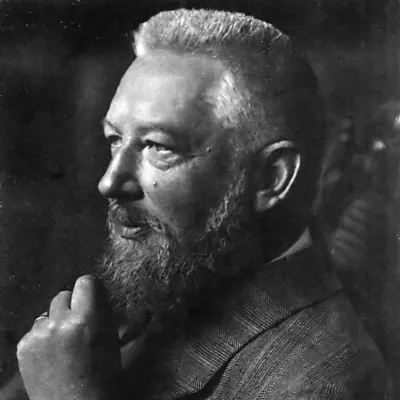
Wilhelm Ostwald
Human Design Chart
Biography
He discovered the law of dilution named after him. He had an extremely active life; his published work contains forty thousand pages. He had excellent organizational talents.
He was awarded the Nobel Prize for Chemistry in 1909.
He died on 4 April 1932, Leipzig, Germany.
Wilhelm Ostwald — Generator with Profile 5/1
Generator 5/1 — Design at a Glance
Wilhelm Ostwald's design placed a tremendous, enduring sacral energy that, however, was only released in response to external impulses and not through his own initiatives. His effectiveness strictly depended on whether he responded to signals that his inner self confirmed with a clear "yes." As a Generator, Ostwald possessed the potential of a workhorse: extremely strong and resilient as long as he had energy for his tasks. This power became effective when he reacted – "from the gut" – rather than taking the first step himself.
The central dynamic in his life was the tension between deep fulfillment through resonant reactions and the risk of burnout or frustration from forced initiation. His design challenged him to invest his energy only where there was an inner confirmation. Working on tasks that he had no interest in led to the wastage of this power, resulting in exhaustion. Conversely, the greatest stumbling block was when he was prevented from working on his heart project even though he wanted to continue with full power. If Ostwald lived in harmony with his strategy – waiting for the signal and then acting – his design rewarded him with a deep sense of satisfaction. Ignoring this principle and trying to initiate action led to persistent frustration and energy depletion. His life task was thus to act as a powerful reactor, doing only what his sacral energy immediately affirmed.
Emotional Authority
Wilhelm Ostwald's inner decision-making authority was the defined Solar Plexus Center, making him an Emotional Authority. This configuration was subject to constant ups and downs of emotions; his perception was always colored by the current mood. What appeared inspiring in one moment could seem negative in the next. For his design, this meant that immediate feelings were only a snapshot – a first impression that did not necessarily reflect his deepest truth.
Quick, spontaneous decisions from such an emotional state risked negative consequences. The mechanics required patience and time to let decisions mature instead. Wilhelm Ostwald had to restrain himself, ask questions, and rethink decisions multiple times before finalizing them. Only when intense feelings subsided and emotional distance was gained did clarity set in. This process of waiting and reflecting was particularly crucial for long-term turning points with significant influence on his life course. Through this conscious hesitation, he filtered out the noise of transient mood swings and accessed a calm, grounded truth that went beyond the initial emotional impulse.
The 5/1 Profile — Heretic / Investigator
Wilhelm Ostwald's design created a tension between the magnetic urge to solve problems for others (Line 5) and the deep need for isolated research and learning (Line 1). As a Hero-Researcher, he demonstrated someone who used his profound knowledge to help others. Others often sought him out, which, however, carried the risk of burnout if clear boundaries were not set. Line 5 brought with it the stubbornness of the ego under pressure from expectations; liberation required rejecting negative forces and recognizing the necessary rest period. At the same time, Line 1 at Gate 35 marked a developmental line of humility through rejection. This process emphasized that rejections had to be accepted as part of progress and stored as reflections. Wilhelm Ostwald had to learn to say no in order to maintain the balance between self-study and service to others. Without these boundaries, he risked becoming an exhausted expert who answered questions for hours only to end up depleted. The challenge was to mature through life experience while managing the expectations of the outside world. His design challenged him to balance the stubbornness of the ego with the humility of Line 1 in order to use his gifts optimally without self-destruction.
Triple Split Definition — Defined & Open Centers
Wilhelm Ostwald had a fully defined energy column, which endowed him with immense physical and emotional strength. As a Generator with emotional authority, he had to make decisions from the sacral reaction – the intuitive yes or no feeling – and wait for the emotional wave. His defined Heart Center gave him clear willpower and the urge to determine his own life as well as recognition for his work.
The definition of Head and Ajna Centers created a constant mental pressure towards inspiration and concept formation. He was a source of thought for others, but could not directly implement these thoughts himself since there was no connection to the Throat; instead, he had to wait until others picked them up. This configuration created an internal conflict between the urge to act and the necessity to react.
His open centers shaped him situationally: The open G Center meant no fixed identity, so he searched for the right context. The open Spleen Center made him vulnerable to survival fears and spontaneous decisions that he had to avoid. The open Throat Center attracted attention without him having to speak actively. Wilhelm Ostwald tended to wonder if he was noticed or who he really was, which is typical of these open fields. Emotional authority was the key to timing these forces correctly and avoiding frustration through impatient action.
Channels for community, logical doubt and mature growth.
Wilhelm Ostwald demonstrated a fundamental attitude that linked logical rigor with the deep desire for connected community. His design suggested that he not only analyzed structures but created them as fair agreements for the collective. This occurred through the Channel of Logic 63-4, which represented a skeptical mind: it constantly filtered patterns in the Head Center (Gate 63) and sought consistent evidence before formulating them in the Ajna Center (Gate 4). For him, skepticism was essential; an answer only mattered if it was practically verifiable and consistent.
However, this analytical clarity served a higher purpose: building belonging. The Channel of Community 37-40 connected his Solar Plexus Center (Gate 37) with his Heart Center (Gate 40). Here, his drive to build bridges and fair agreements – "I do this for you if you do that for me" – was evident. He did not seek spontaneous solutions but waited for the emotional maturity of an agreement to ensure everyone in the community had a respected place.
This process required time and full immersion in experiences, shaped by the Channel of Maturation 53-42. It connected his Root Center (Gate 53) with his Sacral Center (Gate 42), meaning Wilhelm Ostwald needed to fully experience new cycles to gain wisdom from them. Only through this complete conclusion could he reflect on and share the insights gained. His personality was further shaped by Gate 35, which sought change through interaction, as well as by Gate 29, which demanded persistence in the Sacral Center. Thus, he did not use his logical doubt for isolation but to develop functioning, just systems that served the community and were validated through lived experience.
Collective Circuitry — Circuit Signature
Wilhelm Ostwald revealed himself as someone who combined cool logic with emotional reflection and cooperative resource creation. As a Triple-Defined individual, he was open to external influences and integrated these three separate energy fields situatively. His Understanding Circuit connected the Head Center and Ajna Center through Channel of Logic. This allowed for sharing rational, emotionless insights to improve the future, free from conditioning. Parallel to this, his Life Direction Circuit linked the Sacral Center and Root Center via the Maturity Channel. Here, emotional waves from the past were processed to learn collectively with the group; this process was cyclical and wave-like. The third area was his Ego Circuit, which connected the Heart Center and Solar Plexus Center through the Community Channel. This promoted cooperation and mutual giving and taking within the clan for resource building. Since there was no connection to the Sacral Center, pauses for regeneration of this energy were necessary. These three circuits – logic, emotional processing, and clan support – existed as parallel, not directly connected forces in his design. They required constant adaptation to context since there was no internal, continuous definition present. Ostwald’s mechanics were characterized by this balance between strategic thinking, past experience, and current cooperation, with each level maintaining its own dynamics.
Left Angle Cross of Migration 2
Wilhelm Ostwald's design established a fundamental tendency towards gradual development. His internal rhythm was less focused on merely reaching an endpoint than on constant forward movement. This structure, the left cross of pulling ahead 2, described a process where the journey itself was at the center.
For Wilhelm Ostwald, this meant an energy of 'next step'. He found peace and balance not in static silence but in the flow of advancing. The mechanics of this cross promoted a stance oriented towards continuous progress. It was about overcoming stations as part of a larger whole. Wilhelm Ostwald was marked by this configuration: His focus lay on keeping the process going and understanding each stage as a necessary component of overall development.
This dynamism created an inner logic that combined patience with the pace of growth. As long as movement occurred, there was a sense of purpose. The design supported him in not being discouraged by temporary standstills but rather using them as phases for preparing for the next impulse. Thus, the energy of pulling ahead shaped his experience of time and progress: It was an ongoing journey where arrival was always postponed to give space to the process.
Saturn Return · Uranus Opposition · Chiron Return · 2nd Saturn Return — Life Cycles
Wilhelm Ostwald's design featured a clear cyclical structure that combined institutional anchoring, intellectual clarity, and personal stabilization. This framework was marked by recurring planetary cycles that structured his life phases. In 1881, at age 28, Ostwald received a professorship at the Polytechnic of Riga. This corresponded to his first Saturn return, a time when years of groundwork often condensed into a stable professional position and long-term responsibility was taken on.
Intellectual sharpening became evident in 1893 when Ostwald, aged 40, came to believe that a perpetual motion machine of the second kind is impossible. This event coincided with his Uranus opposition, a cycle often leading to profound inner shifts and redefining personal truths, breaking old structures to make way for new insights.
Personal stabilization occurred in 1901 when Ostwald, aged 48, purchased land with a summer house in Großbothen. This marked his Chiron return, a fulfillment cycle where the incarnation cross unfolds and meaning becomes tangible; here it expressed itself through creating a private retreat space. The cyclical structure peaked in 1910 at his second Saturn return: Ostwald became an honorary member of the Royal Society of Edinburgh, symbolizing final institutional recognition of his life's work and completion of previous phases.
Generator · Emotional Authority — Synthesis
Wilhelm Ostwald lived a process of continuous knowledge deepening and dissemination. His Generator type, paired with the Profile of Hero/Researcher (5/1), pointed to a profound inner motivation to generate energy through work – as long as this work aligned with his heart. The defined connection between Head and Ajna Center (Channel of Logic) further strengthened this drive by creating a constant mental pressure to recognize patterns, formulate questions, and find answers. This process of questioning and structuring was not only a personal necessity but also perceived as an offer to others seeking his expertise. Repeated evidence of professional success and recognition (Saturn return, Uranus opposition) underscores this continuous cycle of learning, formulating, and sharing.
Simultaneously, a fundamental paradox revealed itself in his design: emotional authority stood in tension with the logical circuitry. While the defined Head Center promoted clear, structured thinking, he was subject to emotional waves that made quick decisions difficult and required time for maturation. This suggests that Ostwald could grasp complex connections rationally but filtered his inner truth through emotional processes – a constant weighing between analytical clarity and subjective experience.
3 Defined Channels
Incarnation Cross - Left Angle Cross of Migration 2
Solar Return
The Solar Return shows the moment when the sun returns to its exact birth position - your personal solar year.
Life Cycles
Discover the life cycles with a detailed triple view (birth chart, cycle chart, composite).
Human Design Profile
- Type
- Generator
- Strategy
- To respond - wait for something to respond to
- Authority
- Emotional Authority
- Profile
- 5/1 - Heretic / Investigator
- Definition
- Triple Split
- Incarnation Cross
- Left Angle Cross of Migration 2
- Date of Birth
- 02.09.1853 13:00
- Place of Birth
- Riga, Latvia
Frequently Asked Questions
What was Wilhelm Ostwald's Human Design type?
What Profile did Wilhelm Ostwald have?
What Authority did Wilhelm Ostwald have?
What incarnation cross did Wilhelm Ostwald have?
When was Wilhelm Ostwald born?
Discover your own Human Design
Are you also a Generator? Find out in a personal reading how to use your sacral energy correctly and discover deep satisfaction.
More Personalities
Back to overviewAaliyah

Alexia

Angèle

Anne-Marie

Arcángel

Arno