
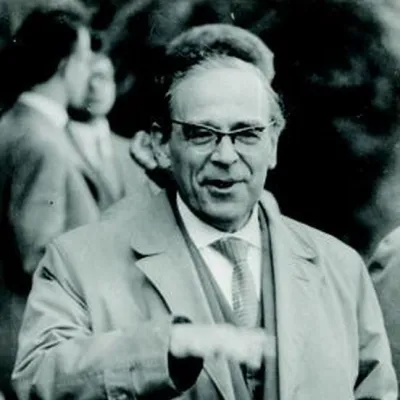
Willi Rinow
Human Design Chart
Biography
Rinow was the son of a schoolteacher. In 1926, he attended the Humboldt University of Berlin, studying mathematics and physics under professors such as Max Planck, Ludwig Bieberbach, and Heinz Hopf. There, he received his doctorate in 1931. In 1933, he worked at the Jahrbuch über die Fortschritte der Mathematik in Berlin. In 1937, he joined the Nazi Party. During 1937—1940, he was an editor of the journal Deutsche Mathematik. In 1937, he became a professor in Berlin and lectured there until 1950. His lecturing was interrupted because of his work as a mathematician at the Oberspreewerk in Berlin (a producer of radio and telecommunications technology) from 1946 to 1949.
In 1950, he became a professor at the University of Greifswald. In 1959, he became the director of the Institute for Pure Mathematics at the German Academy of Sciences at Berlin and president of the German Mathematical Society.
Willi Rinow retired in 1972. He died on 29 March 1979 at age 72 in Greifswald.
The Human Design of Willi Rinow: Generator 3/5
Generator 3/5 — Design at a Glance
Willi Rinow revealed himself as someone with remarkable endurance and a great capacity for continuous work. His design as a Generator endowed him with a powerful sacral energy source that made him appear like a strong working horse – ready to cover long distances, so long as he felt inner consent. This energy was not freely available for any initiative; it primarily unleashed itself through reactions to external impulses. The strategy of his design involved waiting first and then responding from the gut when life sent a clear signal.
Rinow's path was marked by the necessity of recognizing and following this inner resonance. When he responded to stimuli that his sacral center answered with an internal 'yes', he could push his projects forward with great efficiency and found deep satisfaction in doing so. Conversely, frustration or feelings of exhaustion threatened when he acted against this inner compass – whether through constant initiative-taking without inner confirmation or by neglecting activities he was passionate about pursuing. His strength lay not in mere willpower but in the ability to deploy his immense energy precisely where it was released through authentic reactions. This protected him from squandering his resources on tasks that did not intrinsically bring him joy.
Emotional Authority
Willi Rinow exhibited an inner authority rooted in his defined Emotional Center. In Human Design mechanics, this center always carries decision-making authority once it is defined – regardless of all other definitions in the chart. This priority shaped how he judged and chose.
His emotional landscape followed a natural wave pattern of highs and lows. The world appeared to him colored by his current mood; what was exciting one moment could be perceived negatively the next. His immediate feeling was merely a snapshot, not a final judgment. Quick, spontaneous decisions based directly on this first emotional reaction often proved problematic due to incomplete information.
The mechanics of his authority required patience and time. To reach true clarity, Willi Rinow had to let decisions mature ideally over several days. Only when the initial intense feelings subsided and emotional distance was gained did calmness set in. This process of 'sleeping on important questions' was no obstacle for him but rather the decisive mechanism to gain deeper insights and secure long-term life decisions.
The 3/5 Profile — Martyr / Heretic
Willi Rinow's design inclined him towards experimental action based on practical experience. As a person with Profile 3/5 – Explorer and Hero – he lived out of necessity to try things himself before trusting them. This line of the adventurer drove him to gather knowledge through trial and error, which he later offered as solutions for others' problems. His attractiveness stemmed from presenting this treasure trove of life experience.
This approach was shaped by specific energetic configurations. Gate 37 emphasized adaptability and sensitive binding management within community or family structures. Here it was about securing resources by focusing on the essentials, with rules serving as a framework to ensure stability. Simultaneously, Gate 9 with its Line 5 promoted intense focus on details and almost dogmatic loyalty towards established patterns or laws. The belief that certain processes would repeat stood in tension with the mutational power of Earth, which could raise doubts about the durability of this understanding. When earlier patterns lost their validity, Willi Rinow had to recalibrate his strategies. His life was thus a constant process of learning from failures and passing on tested wisdom, where failure before others' eyes could be painful but necessary for developing his practical authority.
Split Definition — Defined & Open Centers
Willi Rinow's Human Design profile indicates a tendency towards a stable, self-determined presence paired with the ability to influence through inner clarity and persistent energy. His defined G Center provides him with a reliable sense of self-identity and direction; he can love and lead others without becoming dependent by helping them understand their own evolutionary nature. This magnetic presence is further strengthened by his defined Heart Center, which gives him willpower and the desire to determine his life and resources for himself. He seeks recognition for his contributions and works best as his own boss, where it is essential to keep promises to strengthen his self-esteem.
As a Generator with a defined Sacral Center, Willi Rinow possesses an enormous source of vital energy. His strategy involves not initiating but responding to questions or invitations to correctly use his sacral power and avoid frustration. Simultaneously, his defined Solar Plexus serves as inner authority: he must wait for the emotional wave to clear before making important decisions. His defined Root Center provides the necessary pressure to move forward in the world and master existential challenges.
In contrast, his open Head Center shows a vulnerability to mental stress and confusion; he tends to engage with others' questions or seek inspiration rather than trusting his inner authority. His open Ajna Center means conceptual thinking is not constant – he can adopt other people's opinions but should not identify them as his own truth. The open Throat Center leads him to feel the pressure of seeking attention or speaking, even though invitations for expression must come naturally. Finally, his undefined Spleen Center reveals a deep survival fear; he tends to cling to things that are not good for him just to simulate a sense of security and well-being rather than following spontaneous decisions.
Channels for rhythm, focus and community.
Willi Rinow's Human Design profile indicates a tendency towards firm rhythm and precise concentration. The Rhythm Channel 5-15 connects his Sacral Center with the G Center, giving him an inner pulse through fixed habits (Gate 5) and love for human diversity (Gate 15). This impersonal magnetism draws others into his energy flow and sets the course for groups by directing them towards a secure future. Parallel to this, the Concentration Channel 9-52 between Root and Sacral Centers operates. Through the Gate of Focusing (9) and the Gate of Non-action (52), he exerts a calm pressure to remain still and evaluate details precisely. This formative energy enables him to immerse himself intensely in one thing, perfecting patterns as long as his sacral reactions confirm this.
Additionally, further Gates shape his essence: Gate 34 in his design provides great power and energy for the common good, while Gate 58 in his Root Center promotes experiments towards refining life processes. On a personal level, Gates 16 (Collective Experimentation), 36 (Crisis Management), and 38 (Setting Boundaries to Preserve Integrity) stand out. The juxtaposed Community Channel 37-40 shows tension between the need for recognition in groups (Gate 37) and the urge for solitude as well as caring for loved ones (Gate 40), leading him to carefully weigh where he finds his place.
Collective Circuitry — Circuit Signature
Willi Rinow's Human Design profile indicates a tendency towards structured, emotionless rationality driven by the desire to guide society toward a better future. This attitude results from the Understanding Circuit connecting his Identity, Sacral, and Root Centers. Here, the Rhythm Channel (Gates 15/5) for temporal structure and the Concentration Channel (Gates 9/52) for focused logic work together, enabling him to share rational insights free of conditioning and plan strategically.
Parallel to this, a separate but equally powerful force exists in his Ego Circuit. This connects Willi Rinow's Heart and Solar Plexus Centers via the Community Channel (Gates 40/37). Since this circuit does not connect to the Sacral Center, its operation requires necessary pauses for resource regeneration. The focus lies on cooperation, mutual support, and fair exchange of giving and taking within a group.
As a person with split definition, Willi Rinow consists of two clearly separate energetic systems. One system (Identity-Sacral-Root) provides inner stability, rhythm, and strategic clarity. The other system (Heart-Solar Plexus) regulates emotional waves and social bonds in the context of clan and community work. These two areas do not flow into each other; they exist as parallel, independent forces in his life. One side plans the future with cool reason, while the other nurtures traditional values and interpersonal balance through emotional resonance. Both aspects shape his actions without directly mixing or forming a single continuous stream.
Right Angle Cross of Planning 1
Willi Rinow's design indicated a tendency towards strategic and long-term thinking. He was someone who steered actions not impulsively but through careful consideration beforehand. This attitude resulted from the configuration 'The right cross of planning 1'. In Human Design, this structure describes the ability to recognize complex connections and derive concrete, actionable plans from them. It wasn't mere daydreaming or abstract theory, but a pragmatic process: first understanding the big picture, then building the path there step by step.
For Willi Rinow, this meant that he used his energy most effectively when he took time before acting. His inner self demanded clarity and structure. Without this preparatory phase, his actions would often be fragmented or inefficient. The mechanics of this cross emphasized the importance of patience and discipline in implementing goals. It was about transforming chaos into order by focusing on what's essential and filtering out distractions.
Willi Rinow lived this strategy through a calm, deliberate approach. He did not immediately react to external stimuli but let information digest before making decisions. This process of inner maturation was crucial for him to achieve sustainable results. His design thus promoted a lifestyle based on preparation and planning rather than spontaneous impulses or external pressure.
Saturn Return · Uranus Opposition · Chiron Return · 2nd Saturn Return — Life Cycles
Willi Rinow's design revealed a structure that tended towards defined positioning under pressure. This became evident in 1937 with his first Saturn return: at the age of 30, he joined the NSDAP and became a lecturer for mathematics at the University of Berlin. This cycle often marked the moment when inner tensions sought external validation; here, life circumstances condensed into a clear, though politically charged role.
Later, the energy of his Uranus return acted as a catalyst for structural change. In 1950, at age 43, he became a professor at the University of Greifswald. This opposition aspect promoted breaking with old patterns in favor of new authority; his career rose through this realignment to an academic level that combined independence and expertise.
The peak of his development occurred during his Chiron return. In 1959, at age 52, he became director of the Institute for Pure Mathematics and president of the German Mathematical Society. This fulfillment cycle allowed his incarnation cross to bloom: meaning and purpose were experienced through the highest institutional responsibility. His design enabled him to unite mathematical precision with leadership; previous phases of adaptation and ascent culminated in recognized leadership and professional maturity.
Generator · Emotional Authority — Synthesis
Willi Rinow was a Generator whose life was marked by deep sacral energy (Generator type). This power unfolded particularly in the Rhythm Channel (Gate 5/15), which gave him natural access to universal life streams and enabled him to gain knowledge from practical experience. His profile as an experimenter/hero (3/5) indicates that he learned through personal experimentation and then provided this knowledge to others – a pattern evident in the documented events of his academic career (professor, director). The defined identity (G Center) strengthened his inner compass and ability to lead while maintaining a sense for natural order.
A central paradox lay in the combination of emotional authority and the need for sacral flow. Rinow needed time for feelings to mature (emotional wave), yet his energy was strongest when working on something that truly excited him (sacral center). Cycle analysis shows that crises (Saturn return) often coincided with significant career turning points, suggesting he had to continually reorient and adjust direction to stay in harmony with his inner rhythm.
3 Defined Channels
Incarnation Cross - Right Angle Cross of Planning 1
Solar Return
The Solar Return shows the moment when the sun returns to its exact birth position - your personal solar year.
Life Cycles
Discover the life cycles with a detailed triple view (birth chart, cycle chart, composite).
Human Design Profile
- Type
- Generator
- Strategy
- To respond - wait for something to respond to
- Authority
- Emotional Authority
- Profile
- 3/5 - Martyr / Heretic
- Definition
- Split Definition
- Incarnation Cross
- Right Angle Cross of Planning 1
- Date of Birth
- 28.02.1907 02:30
- Place of Birth
- Berlin, GER
Frequently Asked Questions
What was Willi Rinow's Human Design type?
What profile did Willi Rinow have in Human Design?
Which authority guided Willi Rinow's decisions?
Which incarnation cross characterized Willi Rinow?
When was Willi Rinow born?
Discover your own Human Design
Are you also a Generator? Find out in a personal reading how to use your sacral energy correctly and discover deep satisfaction.
More Personalities
Back to overviewAaliyah

Alexia

Angèle

Anne-Marie

Arcángel

Arno
