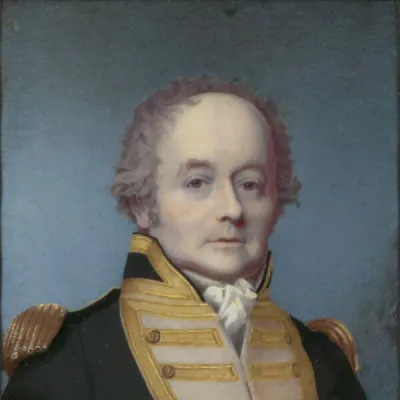
William Bligh
Human Design Chart
Biography
Bligh died in London on 7 December 1817.
William Bligh — Manifesting Generator with Profile 6/2
Manifesting Generator 6/2 — Design at a Glance
William Bligh's design features a hybrid nature: the constant energy of a Generator paired with the ability to skip steps. He was someone who could act swiftly by reacting to impulses and bypassing traditional sequences. This configuration combined the necessity of responding to life with an unparalleled speed in action.
As a Manifestor Generator, he had a steady sacral energy source that allowed him to dive deeply into his work. At the same time, he possessed the capacity to quickly draw things into his life without any intermediate steps. However, this carried risks: His speed led him to skip important phases, which later required catching up and caused frustration – an expression of his Non-Self theme. Additionally, he tended to pursue multiple projects simultaneously, driven by various impulses.
When his inner authority agreed, William Bligh found deep satisfaction in this 'play mode'. Working on different tasks at once was not a distraction for him but rather a source of creative power. The advice to focus solely on one thing did not suit his nature. Instead, he flourished when seeking variety and channeling his energy through parallel actions. His effectiveness depended on whether he responded to life and ensured that his sacral center supported every endeavor. Thus, potential frustration from hasty action transformed into satisfying creation as long as he acted in harmony with his inner approval.
Sacral Authority
William Bligh's decision-making did not occur through intellectual deliberation in the head but rather as an immediate physical reaction to external stimuli. As a Generator, his strategy of 'waiting for the trigger' was identical to his sacral authority mechanism. This mechanics simplified his process: He acted only when an inner resonance occurred.
This resonance manifested as gut feeling or surge – often audible through grunts, hums, or affirming 'Mhm'. When this reaction happened, William Bligh had inexhaustible energy and tackled tasks with great enthusiasm. He proceeded without rigid purposefulness but was guided by the joy of the activity itself. Absent resonance led to no action initiation; the energy remained preserved for appropriate stimuli.
Central here was his open Emotional Center. It prevented impulsive actions and demanded emotional clarity. William Bligh could not immediately react to every stimulus but had to wait until the emotional wave subsided or clarified before he could reliably use the sacral response. This combination of physical intuition and emotional detachment shaped his path: He only reacted when both body and feeling system were in harmony. Thus, he lived his nature by waiting for the right impulse rather than acting prematurely or being driven by passing moods.
The 6/2 Profile — Role Model / Hermit
William Bligh's design set a clear two-phase life dynamic: In his youth, an impulsive, experimental approach dominated. As a role model and natural talent (Profile 6/2), the energy of Line 3 was dominant before the age of thirty. This phase showed as one of trial and error, where retreats after mistakes were necessary to learn from personal experiences. William Bligh went through this period of intense life experience, marked by the need to find orientation through his own actions.
After turning thirty, his fundamental attitude changed radically. The activation of Line 6 led him to withdraw to view earlier experiments with great distance. This phase was characterized by deep reflection and healing. William Bligh used this time for intensive self-knowledge, analyzed his past, and sought mental security to overcome confusion. He developed methods for inventorying his own paths.
Only after completing this inner process did he re-emerge into the public eye. Then, William Bligh appeared as a wise person emerging from his metaphorical cave. Others recognized his mature insight and sought his advice to learn from his deep introspection ability. His influence no longer came through youthful restlessness but rather through the calm authority of a tribal leader who verified agreements and passed on tested wisdom. This transformation from an experimenting youth to a reflective mentor profoundly shaped his later work.
Single Definition — Defined & Open Centers
William Bligh's design indicated a tendency towards constant, reactive energy and a firm inner direction. His defined Sacral Center provided vital force that he utilized by waiting for stimuli and then responding; he had consistent endurance for tasks to which he correctly reacted. The defined G Center gave him a reliable sense of self-identity and purpose without his being able to control the path. His defined Throat allowed him to consistently implement this identity and energy in communication and action, while the defined Root Center provided the necessary existential pressure to move forward.
At the same time, William Bligh was exposed to situational influences through open centers. His open Head and Ajna Centers made him susceptible to mental confusion or adopting foreign concepts that he could not identify as his own truth. The open Heart Center tended to feel the pressure to make promises or prove value, despite lacking consistent willpower. His open Solar Plexus absorbed emotional moods from the environment, leading to a risk of over-identification emotionally, and the open Spleen Center made him sensitive to fears about health and well-being that were externally conditioned. These open areas served as mirrors for environmental information rather than stable personal authority; William Bligh thus showed himself as someone who had to use his defined energy base to filter these external influences instead of personalizing or impulsively reacting to them.
Channels for discovery, logical leadership and focused endurance.
William Bligh's design was characterized by leadership that did not rely on whim but on logical reasoning and recognition from the collective. His authority established itself through the ability to recognize tested patterns and communicate them clearly, which only became truly effective when he was invited by his environment to lead.
This dynamic originated in the Alpha Animal Channel 7-31. This channel connected the G Center with the Throat Center, creating a logical, collective leadership personality. Gate 7 provided the role of rational guidance – often described as 'the power behind the throne' – while Gate 31 represented the voice of the leader whose influence depended on the majority following him. Bligh could show the way but only within an existing social framework that recognized his competence; thus, his leadership depended on being perceived as someone who understood current trends and needs.
This attitude was supported by the Channel of Concentration 52-9. This connection between Root and Sacral Centers generated intense pressure for detailed scrutiny and perfectionism. Gate 9 focused on facts and details, while Gate 52 offered silent resistance to distractions. This forced Bligh into a calm endurance: he had to gather his energy and focus entirely on a pattern before acting to correct or confirm it. It was an organizing energy that built logic step-by-step and based every action on precise analysis.
His mental self-understanding was also strongly influenced by Gate 64. As a dominant element in his personality, Bligh sought clarity through interpreting past experiences. This abstract mind linked old events to new concepts, underpinning his decisions with deep, often unconscious logical reasoning. The tension between the need for external validation (Channel 7-31) and the inner drive for perfect pattern recognition (Channel 52-9) defined his specific leadership style: rigorous in analysis but dependent on collective approval.
Collective Circuitry — Circuit Signature
William Bligh's design presented two complementary, separate energetic strands. The Understanding Circuit connected the Throat with the Identity Center as well as the Sacral with the Root Center. This created a capacity for strategic, emotionless ratio aimed at improving the future through focus and structure. Parallel to this, the Meaning Circuit worked, connecting his Identity with the Sacral Center. Here, wave-like processing of past experiences and emotions dominated. Both systems led to the need to share insights with the collective – once strategically-rational towards shaping the future, once reflective for learning from the past. This configuration generated a tension between cool logic and cyclical emotionality. William Bligh showed himself as someone who used these dual approaches: on one hand to build logical structures, on the other to grasp the meaning behind past events and pass on these lessons. The connection of Identity and Throat allowed him to clearly articulate his strategic visions, while the connection of Identity and Sacral Center transformed his emotional cycles into action-oriented reflection. Thus, his design united the drive for future-oriented improvement with deep processing of historical experiences, always in service of communal learning.
Left Angle Cross of Dominion 2
William Bligh's design indicated a tendency towards strategic alignment in the realm of authority. His focus was on defining and delineating his own authority and influence zones. This internal logic determined how power and responsibility were perceived, creating a stable foundation for leadership.
This stance originated from the left cross of the domain 2 in his configuration. This aspect anchored the ability to draw clear boundaries and build structures that enable control over one's area. It was not about arbitrary dominance but rather about creating an orderly space where authority could be effective. William Bligh thus demonstrated himself as someone who strengthened his position through precise delineation. The energy of this cross promoted a deep understanding that true leadership rests on clearly defined responsibilities. Without this structural clarity, the exercise of responsibility would have been chaotic and ineffective. His design therefore shaped an approach seeking stability through order. The emphasis was on laying a foundation resilient against external influences. Through this consistent demarcation, he created the conditions for his instructions to be heard and respected. It was a strategy of inner fortification before acting outwardly. William Bligh lived these principles by always maintaining oversight over his territory and ensuring that every role within his hierarchy was clearly defined. This ensured efficiency and minimized misunderstandings in critical situations.
Saturn Return · Uranus Opposition · Chiron Return · 2nd Saturn Return — Life Cycles
William Bligh's life was marked by three significant turning points corresponding to specific planetary cycles. In 1791, at the age of 37, he began his second voyage to the South Seas with HMS Providence. This fell on the Uranus opposition, a cycle that often forces unexpected breaks or new directions and dissolves old structures to make way for necessary changes.
Another key experience occurred in 1805 when Bligh was appointed Governor of New South Wales at the age of 51. This marked his Chiron return. In Human Design mechanics, this is not a healing process in a psychological sense but rather an achievement cycle: one's incarnation cross unfolds increasingly, and meaning and purpose become experiential if the person has followed their strategy. It is a phase of bloom and fulfillment of life’s purpose.
The third point occurred in 1811 when Bligh was promoted to Rear Admiral at age 57. This happened during his second Saturn return. This cycle condenses years of groundwork into a solid result and strengthens the achieved position through structure and responsibility. These three events illustrate how planetary cycles shape concrete career stages: Uranus as an initiator for new paths, Chiron as confirmation of purpose, and Saturn as anchoring of achievements.
Manifesting Generator · Sacral Authority — Synthesis
William Bligh's life was characterized by a deep internal tension between the urge for quick reaction and the necessity to rely on his own inner authority. As a Manifesting Generator, he possessed the ability to rapidly initiate things (Gate 31), driven by a constant flow of sacral energy (Sacral Center). Yet this speed required simultaneous focus and concentration (Channel 52-9) to avoid sinking into aimless activities. The connection to the G-Center indicates a strong inner compass that gave him clear direction but also brought with it an expectation to communicate and guide others in that direction (Channel 7-31).
A central paradox in Bligh's design lies in the combination of his ability for quick initiation and the need for sacral confirmation. While he could potentially act swiftly, his Sacral Center required a reaction to external stimuli to achieve truly satisfying results. This discrepancy likely led to an internal conflict between the desire for control and the necessity to trust the flow of life – a tension field amplified by the connection of Gate 46 (Determination) and Gate 29 (Saying Yes).
3 Defined Channels
Incarnation Cross - Left Angle Cross of Dominion 2
Solar Return
The Solar Return shows the moment when the sun returns to its exact birth position - your personal solar year.
Life Cycles
Discover the life cycles with a detailed triple view (birth chart, cycle chart, composite).
Human Design Profile
- Strategy
- To respond - wait for something to respond to
- Authority
- Sacral Authority
- Profile
- 6/2 - Role Model / Hermit
- Definition
- Single Definition
- Incarnation Cross
- Left Angle Cross of Dominion 2
- Date of Birth
- 09.09.1754 01:00
- Place of Birth
- Plymouth, United Kingdom
Frequently Asked Questions
What was William Bligh's Human Design type?
What profile did William Bligh have in Human Design?
Which authority guided William Bligh?
What incarnation cross did William Bligh have?
When was William Bligh born?
Discover your own Human Design
Are you also a Manifesting Generator? Find out in a personal reading how to unfold your multi-talents and direct your energy wisely.
More Personalities
Back to overviewAldair

Alizée

Angeli
Arletty
Artus

Balthus