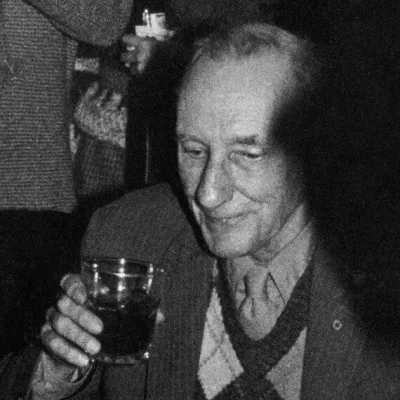
William S. Burroughs
Human Design Chart
Biography
Born into a wealthy family in St. Louis, Missouri, Burroughs attended Harvard University, where he studied English, then anthropology as a postgraduate, and went on to medical school in Vienna. In 1942, he enlisted in the U.S. Army to serve during World War II. After being turned down by both the Office of Strategic Services and the Navy, he veered into substance abuse, beginning with morphine and developing a heroin addiction that would affect him for the rest of his life. In 1943, he befriended Allen Ginsberg and Jack Kerouac while living in New York City. This liaison would become the foundation of the Beat Generation, later a defining influence on the 1960s counterculture.
What does Manifesting Generator 3/5 mean for William S. Burroughs?
Manifesting Generator 3/5 — Design at a Glance
William S. Burroughs was someone who could quickly bring things into his life by skipping steps. This behavior resulted from his configuration as a Manifesting Generator, a hybrid type that combines the constant sacral energy of a Generator with the Manifestor traits of an active connection from Motor to Throat Center. Although he had this continuous energy source and should have reacted to impulses, he tended to work on several projects simultaneously. This speed often led to important steps being skipped, which inevitably required him to backtrack and make up for the missing steps. Such setbacks quickly led to frustration, which was linked to his Non-Self theme. To draw deep satisfaction from his work, it was crucial for him to react to life and only act when his sacral center agreed. With the correct application of this strategy, he gained his creative power through variety and a playful mode. Then it was no problem for him to work on different tasks simultaneously; on the contrary, the compulsion to finish one thing before starting the next would have hindered rather than promoted his energy. His life task was to use this inner authority to shape his quick implementation power in a productive and satisfying way.
Emotional Authority
William S. Burroughs never made decisions immediately but subjected them to a necessary maturation period. His inner authority was Emotional Authority, carried by the defined Emotional Center. In Human Design mechanics, once the Emotional Center is defined, it takes on the role of inner authority, independent of other defined centers in the chart. This meant for William S. Burroughs that he was subject to a constant emotional wave that colored his perception of the world through the current mood. What appeared inspiring in one moment could seem negative in the next. These fluctuating feelings were, however, only snapshots, not an ultimate truth. Quick, spontaneous decisions from such an emotional state would have had negative consequences. The strategy was to take time. William S. Burroughs had to exercise patience and sleep on decisions multiple times to let the intense feelings subside. Only when emotional distance was gained, clarity and calmness set in. This process was essential for long-term life decisions. By hesitating and asking himself multiple times, he could ensure that his choice was not based on a temporary feeling but on a deeper, more comprehensive understanding that only became visible after the initial emotional wave had subsided.
The 3/5 Profile — Martyr / Heretic
William S. Burroughs was someone who learned through personal experimentation and later offered these experiences to others. His Profile 3/5, that of the experimenter and hero, set this tendency. Line 3 of the Adventurer meant that he initially had few preconceived beliefs and had to test everything himself. He learned from his experiments and also from the failures associated with them. This self-acquired, practical knowledge later served him to solve other people's problems, which corresponded to Line 5, the Hero Line.
His way of learning was characterized by listening and seeking evidence, as described by Gate 13 in Line 3. Abstract trust in the best was foreign to him; instead, he asked for concrete evidence, often marked by a certain skepticism. As a reaction to pessimism, satire could be humorous and inspiring. However, Line 5 also brought a large field of expectations and projections from society. William S. Burroughs was attractive to others through his experiential knowledge, those who wanted to learn from his stories. This heroic role flattered him, but it was painful when he failed in front of others. Eccentric behavior could slow down the creative process, but the steadfastness of his ego helped him to handle interference and maintain his creativity, especially in crisis times, where practical solutions were needed.
Single Definition — Defined & Open Centers
William S. Burroughs revealed himself as someone whose life energy and expression were marked by a deep connection between vitality, communication, and emotional flow. His defined Sacral Center endowed him with a constant, motoric force that manifested as an insatiable need for action and verbal release. This energy flowed directly into his defined Throat Center, making his voice not just a tool of communication but an immediate transformer of inner pressure into outer reality. He spoke and acted from this sacral source, giving him a persistent, though often intense, form of self-expression.
Parallel to this, his defined Solar Plexus Center acted as an inner authority. His decisions followed the rhythm of the emotional wave; clarity did not arise from immediate impulse but only after he had navigated the wave motion of his feelings. This created a tension between the immediate expression of the throat and the necessary patience of the solar plexus. His defined Root Center provided a constant, adrenalized background pressure that propelled him forward and infused existential intensity into his interactions.
In contrast, his undefined centers revealed areas of receptivity and conditioning. His open Head and Ajna Centers meant he did not possess a fixed mental structure but rather absorbed thoughts and concepts from the environment. He tended to identify with foreign questions or intellectual streams rather than understanding them as his own truth. His open G Center led to his identity and direction being strongly influenced by the people and places around him. He often sought security through adaptation, lacking a fixed inner core of identity. His open Heart Center made him vulnerable to the pressure of proving his worth through promises or performance, leading to frustration when these external expectations could not be met. Finally, his open Spleen Center was sensitive to health and survival fears, causing him to make spontaneous decisions to enforce a sense of security rather than trusting his inner authority.
Channels for mystical synthesis, focus and emotional change.
William S. Burroughs revealed himself as someone who worked through an unrelenting inner stillness and precise focus. The Channel of Concentration 52-9 connected his Root Center with his Sacral Center and generated a calm pressure to hold still, directing energy towards details. This format energy drove him to logically analyze, correct, and perfect patterns once he committed to a task.
At the same time, the Channel of Synthesis 19-49 shaped his interpersonal dynamics. As a Personality Channel, it connected Root Center with Solar Plexus Center and created an emotional frequency of belonging and rejection. Burroughs sought what held the "tribe" together and rejected everything that did not align with his principles. This emotional wave determined who deserved support and who did not.
In his design, the Channel of Transience 36-35, connecting Solar Plexus Center with Throat Center, was active. This emotional Manifestation Channel urged him to learn through experience and enforce change, often by provoking crises to force new perspectives. His wisdom emerged from this restless search for the new and the acceptance of transience.
Additionally, Gates like 13 (collective memory), 7 (hierarchical leadership), and 1 (creative mutation) contributed to his unique perspective, while Gates like 16 (experimentation) and 6 (friction) propelled the process of further development. Gate 38 set boundaries to preserve integrity, and Gate 56 enabled the figurative narration of mental processes. Gate 41 focused on evolutionary changes through specific experiences, while Gate 62 supported the logical structuring of facts and patterns.
Collective Circuitry — Circuit Signature
William S. Burroughs revealed himself through a unified energetic structure, as he was simply defined. His defined centers – Sacral, Root, Solar Plexus, and Throat – formed a continuous flow that did not have any internal energetic gaps. This shaped his experiential world as an integrated whole, in which impulses could directly translate into action or expression without being interrupted by undefined areas.
Within this flow, three specific circuits were at work. The Understanding Circuit connected his Sacral and Root Centers through the Channel of Concentration. This promoted a focused, rational approach aimed at structure and logical improvement, free from emotional influence. Parallel to this, the Meaning Circuit linked his Throat Center with the Solar Plexus. Here, it was about processing past experiences and emotions, which emerged in waves and were shared to learn from history. The Ego Circuit also connected Solar Plexus and Root Center, this time through the Channel of Synthesis. This involved cooperation and the exchange of resources within a group, where the absence of a direct connection to the Sacral Center in this specific circuit required periods of rest for regeneration. Together, these circuits formed a complex but coherent pattern of rational focus, emotional reflection, and cooperative resource utilization, always carried by the underlying, undivided energy flow of his simple definition.
Right Angle Cross of the Sphinx 1
William S. Burroughs revealed himself through a deeply rooted, almost instinctive ability to penetrate the hidden mechanisms and power structures of his environment. His design indicated a tendency not only to see the obvious but to recognize the invisible threads that control human behavior and systems. This ability stemmed from the configuration of the right cross of the Sphinx 1. In Human Design mechanics, this cross symbolizes the connection between the emotional center and the solar plexus, translated into the language of intuition and deep perception. It grants the individual the ability to sense the underlying emotions and motives that often remain hidden. William S. Burroughs used this gift to analyze the absurdities and control mechanisms of society. He was able to recognize the emotional truth behind the facades and let these insights flow into his work. This was not a conscious intellectual process but a direct, intuitive perception that allowed him to observe human nature in its raw and often painful reality. His perspective was shaped by this profound, almost painful clarity, which enabled him to penetrate the illusions of the surface and reveal the underlying truths.
Saturn Return · Uranus Opposition · Chiron Return · 2nd Saturn Return — Life Cycles
William S. Burroughs showed himself as someone whose life phases were marked by clear structural turning points where inner maturation translated into outer action. His design indicated a tendency to reorient himself at certain age stages, with Saturn returns as moments of condensation and consolidation. In 1942, at the age of 28, he volunteered for service in the U.S. Army during World War II. This marked the first Saturn return, a phase in which years of groundwork often condense into a solid, binding step. Later, in 1953, when the Uranus opposition was active, he published “Junkie.” This configuration represents a break with the old and the beginning of a new, often provocative form of expression that breaks the established framework. The second Saturn return occurred in 1971 when he published “Electronic Revolution.” Here, the typical mechanics of this phase were evident: after years of development and change, a new, stable creative period crystallized, building on the previously established foundation. Burroughs’ journey illustrates how these astrological cycles in Human Design serve as a framework for concrete life decisions and creative milestones, without being deterministic, but rather as temporal windows for structural changes.
Manifesting Generator · Emotional Authority — Synthesis
He was a Generator who, through the connection to the Throat Center, possessed a fast, almost manifesting energy (Design). However, this ability to quickly initiate things was tempered by the emotional authority (Authority) that required thorough maturation of decisions. Thus, he moved in a field of tension between the impulse to act immediately and the necessity to take time for emotional clarity. The profile as an experimenter and hero (Profile Role) reinforced this trait, as he had to collect experiences himself and then pass them on – a process that included both quick action and reflection. The defined communication and manifestation channel (Channels/Gates) pointed to a strong voice, which, however, had to be channeled through the need to focus on the Sacral and the Root (Circuit).
Life showed a recurring dynamic: he initiated things (Sacral Energy, Manifestor Aspect), but he had to go back and refine them (Design) to handle the consequences. Notable events, such as entering military service (Saturn Return 1) and the publication of works (Uranus Opposition, Saturn Return 2), followed this pattern. He was a Generator who, through the structure of the Mind Circuit (Understanding Circuit) and concentration (Channel 52/9), tried to create order and meaning while being shaped by the unpredictable currents of emotions.
3 Defined Channels
Incarnation Cross - Right Angle Cross of the Sphinx 1
Solar Return
The Solar Return shows the moment when the sun returns to its exact birth position - your personal solar year.
Life Cycles
Discover the life cycles with a detailed triple view (birth chart, cycle chart, composite).
Human Design Profile
- Strategy
- To respond - wait for something to respond to
- Authority
- Emotional Authority
- Profile
- 3/5 - Martyr / Heretic
- Definition
- Single Definition
- Incarnation Cross
- Right Angle Cross of the Sphinx 1
- Date of Birth
- 05.02.1914 07:40
- Place of Birth
- St. Louis, Missouri, United States
Frequently Asked Questions
What was William S. Burroughs' Human Design type?
What profile did William S. Burroughs have?
Which authority guided William S. Burroughs?
What incarnation cross did William S. Burroughs have?
When was William S. Burroughs born?
Discover your own Human Design
Are you also a Manifesting Generator? Find out in a personal reading how to unfold your multi-talents and direct your energy wisely.
More Personalities
Back to overviewAlain-Fournier

Aldair

Alizée

Angeli

Arletty

Artus