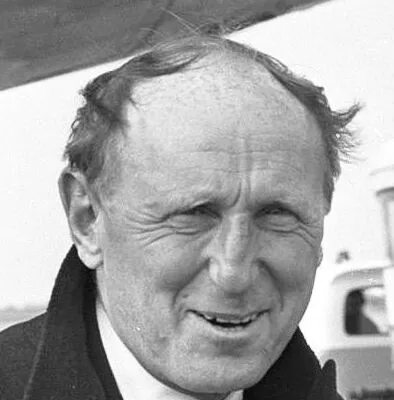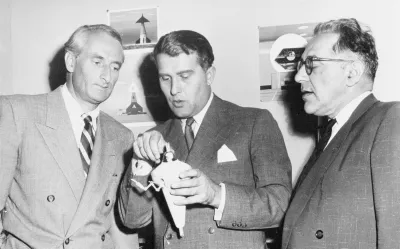
Willy Ley
Human Design Chart
Biography
After publishing Die Fahrt ins Weltall ("Travel in Outer Space") in 1926, Ley became one of the first members of Germany's amateur rocket group, the Verein für Raumschiffahrt (VfR – "Spaceflight Society") in 1927 and wrote extensively for its journal, Die Rakete ("The Rocket"). In 1935, carrying only his favourite books, a few changes of clothing and travel documentation, Ley fled from Nazi prosecution in Germany for Great Britain and ultimately the United States.
In 1936, he supervised operations of two rocket planes carrying mail at Greenwood Lake, New York. Ley was an avid reader of science fiction, and began publishing scientific articles in American science fiction magazines.
His works from the 1950s and '60s are regarded as classics of popular science and include The Conquest of Space 1949 (with Chesley Bonestell), The Conquest of the Moon (with Wernher von Braun and Fred Whipple, 1953), and Beyond the Solar System (1964).
Ley died at the age of 62 on 24 June 1969 in his home in Jackson Heights, Queens. Less than a month later men first landed on the Moon. The crater Ley on the far side of the Moon is named in his honour.
What does Projector 5/1 mean for Willy Ley?
Projector 5/1 — Design at a Glance
Willy Ley revealed himself as someone who could immediately identify weaknesses in other systems. As a Projector, he had a dense, focused aura that acted like a bright flashlight: it illuminated exactly those areas in others that were still dark or not functioning properly. However, this ability to pinpoint errors instantly could be counterproductive when he addressed these flaws directly. Such direct comments were often perceived as unpleasant – comparable to a light beam shining directly into someone's face, which tends to repel rather than help.
The most effective way for him to express his nature was by being a harmonious example himself. By embodying this quality, he became attractive; people came to him of their own accord and sought his advice. His strategy therefore lay in waiting for an honest, appreciative invitation from his environment instead of taking the initiative himself. Additionally, due to his undefined sacral center, he lacked a constant internal energy source. Instead, he experienced phases of high productivity and speed followed by necessary rest periods for recovery. This cyclical distribution of energy contrasted with the demands of traditional school systems or standardized work models that did not allow for pauses. Living according to this principle rewarded him with success; ignoring his need for restraint and waiting for an invitation led sooner or later to a feeling of bitterness as an expression of his non-self.
Splenic Authority
Willy Ley's Human Design profile indicated a tendency towards immediate, instinctive orientation. His inner authority was located in the Spleen Center, the center of survival intelligence and health. This was possible because both his Emotional Center and Sacral Center were open—a configuration unique to Projectors or Manifestors.
This structure meant that Willy Ley could not make long-term strategic plans from a distance. Instead, he had a fine, spontaneous inner sense of whether a situation, environment, or society served him or harmed him. The first impulse was always the correct indicator for his physical well-being and safety. However, this Spleen voice only appeared in the present moment; it was a fleeting, subtle signal that could easily be drowned out or ignored by external influences.
Therefore, his decision-making required high vigilance and often a brief withdrawal to perceive this delicate impulse. Since his knowledge of what was "right" only became apparent at the moment of occurrence, long-term constraints or rigid plans were counterproductive for him. His design called for maximum flexibility and freedom to react spontaneously to each situation without pre-committing himself. Thus, he rigorously protected himself through intuitive boundary-setting against harmful influences of all kinds.
The 5/1 Profile — Heretic / Investigator
Willy Ley's design inclined him to accumulate deep knowledge to offer solutions to others' problems. As a 5/1 (Hero/Researcher), he combined Line 1, which requires security through intensive study and analysis, with Line 5, which magnetically radiates this knowledge outward. Others often sought his advice, but without clear boundaries, this could lead to exhaustion—similar to an expert drained after long consultations. His Profile demanded a balance: time for personal research (Line 1) to overcome obstacles through mental clarity and selection, combined with exchange in relationships (Therapy Line). This collective correction was crucial; isolation would have fostered psychological instability. Thus, Willy Ley demonstrated someone who acted by uncovering hidden connections and sharing these insights. The challenge lay in saying "no" to preserve energy for his own knowledge base while optimally utilizing his gifts. His design described a process of freeing himself from obstacles through provocation of the mind and careful selection of environment to sort out negative influences.
Split Definition — Defined & Open Centers
Willy Ley revealed himself as someone with a set inner direction and clear self-image. His defined G Center gave him a reliable identity and the sense of his own life mission, without being dependent on others. This internal security allowed him to support others on their path rather than having to direct them.
His way of expressing himself and impacting the world was shaped by the defined Throat Center. This center served as a pivot point for messages from the entire design. Ley had a consistent yet limited form of communication that enabled him to articulate his truth with clarity and honesty, provided he trusted his inner authority.
Additionally, Ley possessed a defined Spleen Center responsible for intuition, health, and well-being. This center operated in the here and now and delivered spontaneous intuitive warnings or confirmations. Through this existential awareness, he could make trustworthy judgments and strengthen his immune system by following the momentary instinct rather than rationalizing. The also defined Root Center provided the necessary pressure to maintain the life impulse and helped him cope with stress, especially concerning material well-being and correcting dysfunctions.
In contrast, Head, Ajna, and Heart Centers were open. The open Head Center made him vulnerable to mental confusion and the pressure to find answers to questions that weren't his own. He tended to get lost in intellectual pursuits or overwhelmed by doubts when he didn't listen to his inner authority. The open Ajna Center allowed for a flexible mind and the absorption of many ideas but also led to the risk of holding others' concepts as his own truth or feeling uncertain.
The open Heart Center lacked consistent willpower. Ley was not designed to make promises or prove his worth through performance. Instead, he tended to get caught in cycles of self-doubt and trying to meet other people's expectations, which often led to failure. The wisdom of this open center lay in not having to prove his value and avoiding making promises.
The Sacral and Solar Plexus Centers were also open. The open Sacral Center had no consistent energy flow. Ley was prone to absorbing others' energy and amplifying it, leading to exhaustion if he didn't pause. He needed to learn setting boundaries and resting before fatigue set in. The open Solar Plexus Center absorbed the emotions of the environment. Ley was sensitive to emotional climates and tended to interpret other people's feelings as his own or avoid confrontation to prevent negative reactions. The challenge lay in not personalizing these emotions and regularly retreating alone to regain clarity.
Channels for logical leadership and discerning judgment.
Willy Ley showed a design that combined logical analysis with clear, collective projection. His inner drive was an unrelenting urge to test and improve patterns. Channel 58-18 ensured this: It connected the vital energy of life continuity (Gate 58) with the critical correction instinct (Gate 18). This created internal vigilance that constantly evaluated what worked and what didn't. Ley sought perfection in structures but relied on others inviting his corrections to save energy.
This analytical sharpness resulted in a leadership ability based on trust. Channel Alpha Animal 7-31 linked the G Center with the Throat Center. Gate Role of Self (Gate 7) provided the logical foundation for authority – often as 'power behind the throne' – while Gate Leadership (Gate 31) translated this logic into a voice that addressed others. Ley did not act through mere commands but by presenting verified patterns that one could safely follow. His leadership role was collective: He gained influence only when his environment recognized and invited him as a competent leader.
Supporting this structure were Channels of Succession and Logical Teaching (Gates 17), which focused on organizing for the future and integrated doubt as a necessary part of the learning process. Simultaneously, Gate 38 brought defensive integrity that set boundaries when identity was threatened. In the background, Gates of Reflection (Gate 33) and Mystical Innocence (Gate 25) allowed him to withdraw to process experiences and maintain spiritual depth without projecting this directly into his external leadership stance. Thus, a profile emerged that combined rational clarity with a sensitive, often reserved inner world.
Collective Circuitry — Circuit Signature
Willy Ley's design tended towards clear, structured analysis driven by the desire to make complex connections understandable. As someone with Split Definition, his internal system consisted of two independent, non-directly connected power fields. This did not create a unified energy flow but rather parallel impulses that he used situationally.
Central was the Understanding Circuit, whose task is to share logical insights free from emotional conditioning and thus contribute to societal advancement. In Willy Ley's case, this circuit consisted of two separate parts. The first connected the Throat Center with the Identity Center through the Alpha Animal Channel (Gates 31 and 7). This shaped a capability to directly express inner convictions and strategic concepts – identity spoke itself.
The second part linked the Spleen with the Root Center via the Judgment Channel (Gates 18 and 58). Here, an intuitive safety energy worked that responded to survival necessities and mobilized instinctive knowledge. Since these two groups were not connected, intuitive judgment remained energetically separate from verbal expression ability. Willy Ley had to consciously coordinate these areas; they did not flow into each other automatically. His design thus showed someone who possessed strategic clarity and instinctive safety as separate resources that he could activate contextually to create and convey rational structures.
Left Angle Cross of Upheaval 2
Willy Ley's design carried the signature of the left cross of revolution, hinting at a specific life direction: initiating change by revealing new paths. This configuration is not just a property but an archetypal impulse aimed at actively transforming existing structures rather than merely criticizing them. The focus was on the 'revolution' – breaking through old patterns and creating space for something new. In Human Design, this cross marks an energy that deals less with preserving the status quo and more with the necessity of instigating change when it is required for the overall structure. It was not about destructive destruction but constructive renewal through targeted interventions. Willy Ley thus played a role in bridging the old and the new by showing how transitions could succeed. This energy often acts as a catalyst for societal or individual turning points, where rigid stances must be dissolved to enable progress. The task was to make this change visible and understandable without slipping into pure theory. Instead, practical implementation of changes was prioritized, supported by a clear vision of what is possible after the revolution. Thus, his design shaped an attitude of active co-creation in the process of transformation.
Saturn Return · Uranus Opposition · Chiron Return · 2nd Saturn Return — Life Cycles
Willy Ley's design indicated a tendency towards structural anchoring and later public unfolding. His first Saturn return around 1935 marked the beginning of a consolidation phase; that year he emigrated to the USA, a step that redefined his life base. The Uranus opposition around 1944 brought necessary adaptation to new societal realities: He became an American citizen, cementing his professional integration and identity.
The Chiron return starting in 1955 served as a fulfillment cycle where his incarnation purpose increasingly unfolded and found meaning in life. This was concretely shown through the successful TV show 'Man in Space' by Walt Disney, a milestone that confirmed his role as an intermediary of complex connections. Finally, years of groundwork culminated in a solid result during his second Saturn return around 1964: The publication of 'Beyond the Solar System' stood for a mature synthesis of his knowledge and communicative power, now firmly anchored in public consciousness.
Projector · Splenic Authority — Synthesis
Willy Ley was a Projector who naturally exercised authority through his ability to recognize patterns (Gate 7 & 31) and develop logical structures (Mind Circuit). This inclination towards uncovering system errors was reinforced by the defined Throat Center, enabling him to filter information and communicate precisely. His profile as Hero/Researcher (5/1) indicates that he deeply researched knowledge and made it available to others – a process that magnetically attracted others but also required clear boundaries. The connection between G-Center and Throat Center underscored his ability to exercise collective leadership and develop future perspectives, evident in events like publications and media successes.
A central paradox lay in the tension between his Projector strategy – waiting for an invitation to contribute knowledge – and the drive of his profile to offer solutions (Line 5). This likely led to an internal dynamic where he instinctively recognized errors (Spleen authority) but was also mindful of conveying insights without being perceived as intrusive. Cyclical events in life pointed to a recurring need to realign and bring expertise into new contexts.
2 Defined Channels
Incarnation Cross - Left Angle Cross of Upheaval 2
Solar Return
The Solar Return shows the moment when the sun returns to its exact birth position - your personal solar year.
Life Cycles
Discover the life cycles with a detailed triple view (birth chart, cycle chart, composite).
Human Design Profile
- Type
- Projector
- Strategy
- Wait for the respectful invitation
- Authority
- Splenic Authority
- Profile
- 5/1 - Heretic / Investigator
- Definition
- Split Definition
- Incarnation Cross
- Left Angle Cross of Upheaval 2
- Date of Birth
- 02.10.1906 05:00
- Place of Birth
- Berlin, Germany
Frequently Asked Questions
What is Willy Ley's Human Design type?
Which Profile did Willy Ley have in Human Design?
What Authority guided Willey Ley?
What incarnation cross did Willy Ley have?
When was Willy Ley born?
Discover your own Human Design
Are you also a Projector? Find out in a personal reading how to unfold your leadership qualities and recognize the right invitations.
More Personalities
Back to overviewSissy Spacek

Alain-Fournier

Anémone

Angeli

Ann-Margret

Bourvil