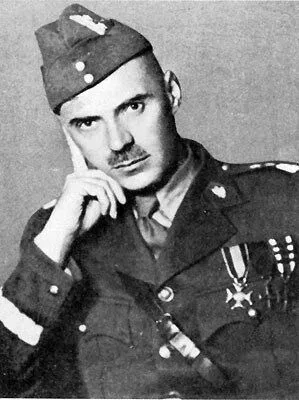
Wladyslaw Anders
Human Design Chart
Biography
Anders was born to his Baltic-German father Albert Anders and his mother Elizabeth, born Tauchert. He was baptized as a member of the Protestant Evangelical-Augsburg Church in Poland; but while being kept in Soviet prisons he made a promise that if he survived and regained strength in his legs (he was seriously injured) he would convert to Roman Catholicism. He did survive, and did indeed convert.
Anders was in command of a cavalry brigade at the time of the outbreak of World War II. The Polish forces were no match for the larger and better equipped German Wehrmacht with their massive Blitzkrieg tactics and were forced to retreat to the east. During the fighting and retreat Anders was wounded a number of times. He was later taken prisoner by Soviet forces and was jailed, initially in Lviv (then Lwów) and later in Lubyanka prison in Moscow. During his imprisonment Anders was tortured.
General Anders
Shortly after the attack on the Soviet Union by Germany on 22 June 1941, Anders was released by the Soviets with the aim of forming a Polish Army to fight alongside the Red Army. Continued friction with the Soviets over political issues as well as shortages of weapons, food and clothing, led to the eventual exodus of Anders' men – known as the Anders Army – together with a sizeable contingent of Polish civilians via the Persian Corridor into Iran, Iraq and Palestine. Here, Anders formed and led the 2nd Polish Corps, fighting alongside the Western Allies, while agitating for the release of Polish nationals still in the Soviet Union.
Anders was the commander of the 2nd Polish Corps in Italy 1943–1946, capturing Monte Cassino in the Battle of Monte Cassino.
After the war the Soviet-installed communist government in Poland in 1946 deprived him of Polish citizenship and of his military rank.
The Human Design of Wladyslaw Anders: Projector 1/3
Projector 1/3 — Design at a Glance
Wladyslaw Anders had a dense, focusing aura that enabled him to immediately recognize system errors in his environment. As a projector, his energy acted like a bright flashlight beam directed straight towards weaknesses or 'dark' areas in others. However, this ability to identify flaws instantly could be counterproductive if he addressed these shortcomings actively and directly. Such interventions often felt like blinding light to the other person, provoking resistance or anger rather than fostering clarity.
His more effective expression of nature was simply shining pleasantly – for example, by exemplifying a harmonious relationship or functioning system. This passive glow was highly attractive; people came to him naturally seeking advice instead of feeling pressured. His strategy thus lay in waiting for an honest, appreciative invitation from others rather than direct confrontation. Since his sacral center was undefined, he did not have constant life energy but experienced phases of high activity followed by necessary rest periods to avoid exhaustion. When Wladyslaw Anders lived according to this design and waited for the invitation, he was rewarded with success. Acting out of non-self and pushing his insights onto others led sooner or later to bitterness as his characteristic non-self theme.
Emotional Authority
Wladyslaw Anders showed a decision-making strategy that strictly required patience. His design dictated that he did not give in to immediate impulses but consciously let decisions rest until emotional clarity emerged. This stance resulted from his emotional authority, carried by the defined solar plexus center. In Human Design mechanics, this means: As long as this center is active, it functions as an internal compass needle – independent of other defined centers in the chart.
Anders was subject to a natural wave dynamics of his feelings. His perception of the world fluctuated with this inner tide; what appeared highly positive at one moment could turn negative in the next. His immediate feeling was always just a snapshot, a first impression that did not yet represent deeper truth. Quick, spontaneous judgments from this emotional heat would have easily led him astray.
Therefore, his system required time and distance. By letting decisions 'rest overnight multiple times', he gained distance from intense initial reactions. Over time, the waves smoothed out, initial excitement subsided, and a deep calmness along with clear insight set in. This process of waiting was no obstacle for him but the essential mechanism to safely make long-term life decisions without being swayed by passing moods.
The 1/3 Profile — Investigator / Martyr
Wladyslaw Anders lived as a researcher and experimenter whose design drove him not only to study knowledge theoretically but also to test it through active experimentation. His Profile 1/3 created tension between the first line's need for perfect timing and complete preparation, and the third line's requirement for bold action and learning from mistakes. Often he initially hesitated because he felt he did not know enough yet; however, his authenticity emerged only through integrating both poles: intellectual foundation met practical experience.
This cyclical process shaped his judgments. When Wladyslaw Anders made a decision or rendered an opinion, it was the result of double testing – both in study and real application. The first line sought the right moment and answers at the right time, while the third line gained individual insights through trial and error. This combination gave his conclusions high credibility since they were neither purely speculative nor blindly improvised but based on self-examined, tested facts. He showed himself to be someone who courageously expressed his personality, was willing to make mistakes and learn from them, thereby making his judgment absolutely trustworthy.
Split Definition — Defined & Open Centers
Wladyslaw Anders was characterized by a persistent mental structure and emotional depth. His defined Ajna Center ensured continuous conceptual processing, while the also defined Throat Center translated these thoughts into clear communication. This connection allowed him to express what he thought. His inner authority lay in the emotional Solar Plexus Center; decisions required patience to wait out the emotional wave and gain clarity rather than reacting impulsively to highs or lows. The defined Root Center provided a constant pressure to cope with stress and maintain life force.
In contrast, Head, G, Heart, Sacral, and Spleen Centers were open. This openness made him receptive to external influences but required boundary setting. The open Head Center tended to engage with foreign questions or doubts, which could lead to mental confusion if he did not trust his inner authority. Without a fixed identity in the G Center, he sought orientation through the right place and fitting relationships; wrong environments directly affected his well-being. The open Heart Center lacked consistent willpower, making him vulnerable to needing to prove his worth through promises or competition – a trap of conditioning.
The open Sacral Center meant no constant energy flow; he could easily be infected by others' life force, leading to overexertion if boundaries were not respected. Finally, the open Spleen Center reflected fears and health conditions of the environment. Spontaneous decisions here were risky as they often relied on absorbed impulses. Anders' design challenged him to use the stability of his defined centers as anchors to consciously navigate fluctuations in his open areas and free himself from conditioning patterns.
Channels for mystical pressure, spontaneous insight and assimilation.
Wladyslaw Anders was characterized by a fundamental tension between the tribal need for belonging and the isolating insight of individual intellect. His personality pushed towards synthesis, tradition, and the „We“, while his design generated unique, often misunderstood perspectives that were only accepted at the right time.
This dynamic was shaped by the Channel of Synthesis 19-49 in his personality. This channel connected Root with Solar Plexus Center and created an emotional frequency of acceptance or rejection that acted as social glue. It determined who belonged to the community based on loyalty and protection of shared resources. Anders was thus deeply rooted in the dynamics of family and tribe, where emotional waves regulated interpersonal bonds.
Simultaneously, the Channel of Structuring 23-43 in his design formed an individual, mutative intelligence. Through the connection between Ajna and Throat Center, he received spontaneous insights (Gate 43) and processed these into innovative expressions (Gate 23). This perspective was often light years ahead and changed how people saw things. The challenge lay in not prematurely expressing this unique knowledge; without strategic alignment and proper timing, he risked rejection by the tribal mechanism of his personality. His design required patience until the community was ready to accept his visions rather than dismissing them as foreign.
Additionally, Gates like 4 (Formulation for future security) and 24 (mental mutation in pulse) enhanced his ability to recognize complex patterns and renew knowledge rhythmically. Gates like 52 (concentration through pause) and 41 (evolutionary feeling) supported him in maintaining inner silence and using emotional crises as opportunities for development. This constellation required a delicate balance: aligning the tribal emotional connection with individual intellectual independence without one overshadowing or blocking the other.
Tribal Circuitry — Circuit Signature
Wladyslaw Anders' design tended towards two parallel, separate energy fields. On one hand, there was an individual drive to structure new knowledge; on the other, a conservative focus on tribal resources and cooperation existed. These two forces were not energetically directly connected but coexisted as separate systems.
The Knowledge Circuit in him linked Ajna Center with Throat Center via the Channel of Structuring (Gates 43-23). This enabled translating inner concepts and ideas into clear, understandable language. It was about expressing one's identity through articulating thoughts. The energy was pulsing and aimed at momentary clarity of expression, thus transforming new knowledge and carrying it outward.
Simultaneously, the Ego Circuit connected Solar Plexus Center with Root Center (Channel 49-19, Synthesis). Here, emotional evaluation of resources took precedence. With no direct connection to Sacral Center, there was no constant life force; instead, rhythm was crucial. Wladyslaw Anders needed pauses to gather energy and build material security for the tribe. This area promoted cooperation and mutual support within a group based on emotional trust and the ability to synthesize information.
The tension lay between the creative, individual expression in knowledge and the collective, resource-oriented need for pauses and tradition in the ego domain. Both fields shaped his actions as independent, non-fusing units.
Right Angle Cross of Explanation 3
Wladyslaw Anders' design carried the structure of the right cross of statement 3. This configuration established a specific inner dynamics aimed at clarity and uncovering connections. In Human Design, this cross describes an energy focused on deciphering complex issues and articulating these insights in a way that is understandable to others. It's not just about conveying information but about communicating understanding through precise formulation.
Wladyslaw Anders was someone whose nature it was to bring order to confusion and make hidden patterns visible. The mechanics of this cross support an attitude seeking the true meaning behind things and then clearly communicating them. This shaped his way of interacting with his environment: by providing insights that helped others sharpen their own perspective. It was a process of unraveling, where Wladyslaw Anders served as a channel for clarity. His energy worked most strongly in reducing uncertainty through explanation, thereby creating space for better understanding. This trait formed a central part of his design and significantly determined how he made truths accessible.
Saturn Return · Uranus Opposition · Chiron Return · 2nd Saturn Return — Life Cycles
Wladyslaw Anders' life was marked by two decisive turning points that signified profound reorientations. The Chiron Return, a cycle of fulfillment and blooming purpose, occurred in 1941 at the age of 49. During this phase, he was released from the Soviets and tasked with forming a Polish army alongside the Red Army. This aligned with the characteristic pattern of this transit: his inner alignment found expression in concrete external action, making his life's purpose tangible.
Later came the second Saturn Return in 1948 when he was 56 years old. This cycle represents structure and commitment. Anders married actress Iryna Jarosiewicz for a second time; two years later their daughter Anna Maria was born. This development underscored the saturnine theme of anchoring: after the turbulent war years, he created a new stable foundation for life. Both events illustrate how planetary transits not only reflect inner processes but also justify concrete biographical decisions and structures.
Projector · Emotional Authority — Synthesis
Wladyslaw Anders' life was characterized by a deep urge to research, fueled by the combination of a defined mental center (Ajna) with the energy of experimentation (Profile 1/3). This constellation led to an ongoing search for understanding and readiness to explore new paths – a process refined further through emotional authority. He needed time to absorb and digest information before expressing it, which helped him make well-founded judgments and communicate his insights clearly. The connection between Root and Solar Plexus centers also points to a deep sensitivity towards the needs of others and an ability to find stability in crisis situations – an inner compass guiding him through difficult times.
A central paradox in Wladyslaw Anders' design lies in the tension between his mental sharpness and open Heart Center. While he possessed a pronounced ability for logical thinking and analysis (Channel 23-43), he lacked at the same time the constant internal strength to pursue his own goals without reservation. This likely led him to seek external validation and define himself through relationships while simultaneously striving to express and share his unique perspective.
2 Defined Channels
Incarnation Cross - Right Angle Cross of Explanation 3
Solar Return
The Solar Return shows the moment when the sun returns to its exact birth position - your personal solar year.
Life Cycles
Discover the life cycles with a detailed triple view (birth chart, cycle chart, composite).
Human Design Profile
- Type
- Projector
- Strategy
- Wait for the respectful invitation
- Authority
- Emotional Authority
- Profile
- 1/3 - Investigator / Martyr
- Definition
- Split Definition
- Incarnation Cross
- Right Angle Cross of Explanation 3
- Date of Birth
- 11.08.1892 11:00
- Place of Birth
- Krosniewice, Poland
Frequently Asked Questions
What was Wladyslaw Anders' Human Design type?
Which Profile did Wladyslaw Anders have?
What Authority did Wladyslaw Anders have?
What incarnation cross was assigned to Wladyslaw Anders?
When was Wladyslaw Anders born?
Discover your own Human Design
Are you also a Projector? Find out in a personal reading how to unfold your leadership qualities and recognize the right invitations.
More Personalities
Back to overviewSissy Spacek

Alain-Fournier

Anémone

Ann-Margret

Bourvil
Hergé