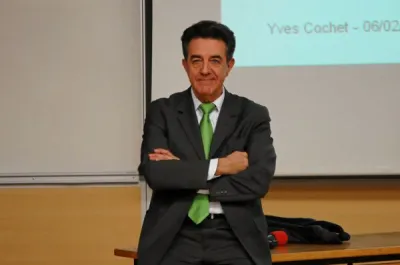
Yves Cochet
Human Design Chart
Biography
He wrote "Apocalypse pétrole" which was published in 2005.
The Human Design of Yves Cochet: Projector 2/4
Projector 2/4 — Design at a Glance
Yves Cochet was someone who immediately recognized weaknesses in systems and relationships. His aura seemed like a focused flashlight, directly pointing to problems in the darkness of his surroundings. This ability to identify errors in a system is typical for Projectors, who are there to bring 'light into the darkness' for others.
However, this direct confrontation with flaws in others could quickly be perceived as unpleasant or even insulting, similar to a bright light beam in someone's face. The more effective way to express this design is to serve as an example oneself – for instance, through harmonious relationships – which leads others to come to him and seek advice. Yves Cochet's strategy was therefore to wait for a respectful and honest invitation rather than acting independently.
As a Projector, he did not have a defined Sacral Center, meaning he did not have a constant, intrinsic life force. Instead, he experienced phases of high productivity, followed by necessary rest periods to prevent burnout. Traditional work life often ignores this need for rhythm. If Yves Cochet lived according to his design, he was rewarded with success. If he did not follow his strategy, the non-self theme of bitterness would manifest.
Splenic Authority
Yves Cochet showed a basic attitude based on immediate, intuitive perception. His design suggested that he did not make decisions through prolonged thinking but through a spontaneous inner impulse that signaled what was right for his well-being and health in the moment. This ability came from his Authority in the Spleen, a center that functions as our health and alarm system. For this Spleen Authority to be effective, the Emotional and Sacral Centers must be open, a configuration only Projectors or Manifestors can have.
This system grants a pronounced survival intelligence. Yves Cochet had a reliable inner knowledge that served as an indicator whether he was in a suitable environment or society. The first, spontaneous impulse was the decisive factor; it served to protect him from harmful influences and allowed for rigorous demarcation. However, this impulse was very subtle and only occurred once in the moment. It could easily be drowned out by external influences, requiring high vigilance. A short retreat often helped to hear this subtle voice clearly.
Since Yves Cochet only knew what was right in the moment, his plans often changed short-term. Long-term commitments were difficult for his design, as they restricted the necessary flexibility. He needed a lot of space to react spontaneously to his inner guidance rather than being pressed into rigid structures that contradicted his natural rhythm.
The 2/4 Profile — Hermit / Opportunist
Yves Cochet was someone who oscillated between the deep need for withdrawal and the desire to connect with a close community. His design created a tension resulting from Profile 2/4: the conflict between the Hermit (Line 2) and the Community Orientation (Line 4). This created an internal dynamic where clear communication about availability was crucial – the signal 'I need space now' as well as 'I want company now'.
During his alone time, Yves Cochet immersed himself in internal processes to gain clarity. This phase of isolation was not a flight but necessary to collect energy. Gate 30 in the Sun position promoted objectivity and pragmatism. It was about selectively withdrawing to unfold one's flame and use energy without waste. Only when this need for balance was fulfilled could he be productive.
Once inner peace was established, the other need emerged: the connection to familiar people. Here, Gate 14 in the Moon position came into play, seeking security through a solid foundation and practical intelligence. Line 4 required opportunism in a positive sense – waiting for the right moment to use power and resources in the community. Without this prepared base, security remained illusory.
Yves Cochet's path involved reflecting and evaluating the knowledge of his network in solitude. Only then did brilliant ideas emerge. The challenge was to make this rhythm transparent externally to avoid misunderstandings. His design demanded a safe, loving environment where he could clearly distinguish between 'me-time' and social interaction. Thus, he transformed the tension between isolation and community into a source of creative power and pragmatic wisdom.
Single Definition — Defined & Open Centers
Yves Cochet demonstrated a reliable inner direction and a clear self-identity, paired with the ability to control his own resources and willpower. His defined G Center gave him a sense of his life mission and the security of being loved without being dependent on others. The defined Heart Center allowed him to keep promises and recognize his own worth, preferring to follow his own mechanisms. Additionally, his defined Spleen Center provided a strong instinct for health and well-being, enabling him to make intuitive decisions in the present moment and strengthen his immune system.
At the same time, Yves Cochet was vulnerable to external influences through several open centers. His open Head Center made him receptive to mental inspiration but also to confusion and the pressure to find answers to questions that were not his. The open Ajna Center allowed him to take in flexible concepts but tended to interpret other people's ideas as his own truth or to feign uncertainty. His open Throat Center attracted attention when he waited, but could lead him to speak to be noticed rather than waiting for the right invitation.
The open Sacral Center meant that Yves Cochet did not have constant generative energy but amplified the energy of others, which could lead to exhaustion if he did not pay attention to his limits. His open Solar Plexus absorbed emotions from the environment, making him vulnerable to emotional waves that were not his and leading him to avoid confrontation. Finally, his open Root Center took on stress from the environment, which could drive him into a cycle of adrenalized pressure and attempts to escape it rather than trusting his inner authority.
Channels for intuitive elegance and instinctive devotion.
Yves Cochet showed an intuitive, self-referential life artistry that combined his own well-being with adaptation to the environment. This attitude came from the Channel of Perfect Form 57-10, linking the Spleen and G Centers. Through Gate 57, intuitive insight, and Gate 10, self behavior, a spontaneous ability to act in the moment and love oneself without being driven by future fears emerged. This created a unique aura that invited others to live authentically.
Parallel to this, an entrepreneurial, instinctive vigilance was at work. The Channel of Devotion 44-26 linked the Spleen and Heart Centers. Here, Gate 44, vigilance, combined with Gate 26, the egoist. This configuration allowed instinctively recognizing what the tribe or market needed and selling it with willpower. It was the ability to present products or ideologies persuasively before others consciously recognized the need, always in exchange for fair compensation.
Additionally, specific Gates shaped his inner self: Gate 30 controlled the recognition of feelings and the acceptance of fate, while Gate 29 promoted persistence and the right “yes-saying.” Gate 14 ensured skillful power handling and direction, Gate 8 for individual contribution and identity. On the personality side, Gate 7 projected leadership and hierarchy, while Gate 50 preserved traditional values and protective reflexes. Gate 15 established logical social rhythms, and Gate 18 worked on correcting collective processes, always without taking it personally.
Individual Circuitry — Circuit Signature
Yves Cochet's design tended towards strategic resource utilization and intuitive adaptation. As someone with a simple definition, he showed himself as a person whose energy flows are coherent and direct, without the fragmentation of shared definitions.
The Ego Circuit connected Yves Cochet's Heart with his Spleen Center. This occurred through the Channel of Devotion (26-44), which bundles the gift of mediation and communication. This flow promoted cooperation and the joint creation of resources within the tribe group. Since there was no connection to the Sacral Center, rest pauses were necessary to regenerate energy for these supportive processes.
Parallel to this, the Integration Circuit worked, linking the Identity with the Spleen Center. The Channel of Perfect Form (10-57) channeled power from the reaction to life through proper behavior and intuitive knowledge to realize it in the present moment. This ensured individual survival through highest individuality and acoustic perception.
Both circuits shared the Spleen Center as an interface. However, the Heart Center (from the Heart-Spleen group) and the Identity Center (from the Identity-Spleen group) were not directly connected to each other but formed two separate, parallel existing energetic subparts. Energy therefore did not flow as a single stream from identity through the heart but as two distinct mechanisms: on the one hand, communicative resource generation, on the other hand, intuitive self-reinforcement. This structure shaped Yves Cochet's approach by creating clear, focused action fields that each targeted specific life areas without mixing.
Right Angle Cross of Contagion 1
Yves Cochet exhibited a fundamental disposition marked by a deep, often unconscious entanglement in collective patterns. His design bore the signature of the right infection cross, indicating that he did not primarily act through isolated personal decisions but was strongly influenced by the energies and beliefs of his environment. This configuration describes a life task where the individual serves as a mirror or catalyst for societal currents rather than consciously positioning against them.
For Yves Cochet, this was not a choice but a mechanical given: He absorbed the "infection" of his time – whether in the form of political ideologies, ecological crises, or social tensions – and processed this internally. This led to his actions and reactions often appearing as responses to external pressure waves, not as initiated impulses. The challenge lay in understanding and integrating this inherited energy without dissolving his own identity in it. His path did not lie in isolating himself from these influences but in accepting them as part of a larger, often painful learning process. Through this entanglement, however, he could also gain deep insights into the nature of collective dynamics, as he was their direct expression.
Saturn Return · Uranus Opposition · Chiron Return · 2nd Saturn Return — Life Cycles
Yves Cochets design shows a clear structure where inner maturity and outer responsibility condense into specific life phases. In 1971, at the age of 25, he defended his doctoral thesis in mathematics. This marked the first Saturn return, a cycle often serving to transform years of groundwork into a solid foundation. The structure here demands consolidation before new directions are set.
Later, in 1989 at the age of 43, he was elected to the city council of Rennes. This falls into the phase of the Uranus opposition, a configuration often associated with a need for change and breaking out of old structures. It is a moment when inner dynamics seek external recognition and new roles, often through a sudden shift or new responsibility.
The Chiron return around 1997, when he became a member of the French National Assembly at the age of 51, marks a fulfillment cycle. In this phase, the individual's incarnation cross unfolds increasingly; meaning and purpose become experiential, provided the strategy and authority were previously heeded. It is not a healing of wounds but a blooming of the life task.
In 2002, at the age of 56, he was re-elected to the French National Assembly. This corresponds to the second Saturn return, often bringing confirmation and deepening of the previously found position. The mechanics here show how inner structures become visible through external milestones: from academic foundation through political change to full unfolding of the purpose.
Projector · Splenic Authority — Synthesis
A central red thread in this design is the ability to recognize patterns and shed light into the dark – both in oneself and in others. This draws from the projector definition, the focus on uncovering flaws in the system (Channel 57-10) and the inner authority of the Spleen center, which spontaneously recognizes what is beneficial. The profile as a natural talent and networker reinforces this tendency, as Line 4 emphasizes the need for connection and exchange with others, while Line 2 underscores the necessity of withdrawal and inner clarification. The repeated professional successes (doctoral thesis, city council, member of parliament) indicate that this ability to recognize and direct is effective in the world.
The central paradox lies in the tension between the need for recognition and the way this recognition is received. As a projector, he intuitively projects what does not work for others, yet the G Center signals a deep need for love and affirmation. This combination can lead to a situation where direct addressing of problems (projector mechanics) undermines the desired outcome (connection, love), as the impulse from the Spleen center signals immediate action, while Profile 2/4 requires both social interaction and withdrawal.
2 Defined Channels
Incarnation Cross - Right Angle Cross of Contagion 1
Solar Return
The Solar Return shows the moment when the sun returns to its exact birth position - your personal solar year.
Life Cycles
Discover the life cycles with a detailed triple view (birth chart, cycle chart, composite).
Human Design Profile
- Type
- Projector
- Strategy
- Wait for the respectful invitation
- Authority
- Splenic Authority
- Profile
- 2/4 - Hermit / Opportunist
- Definition
- Single Definition
- Incarnation Cross
- Right Angle Cross of Contagion 1
- Date of Birth
- 15.02.1946 09:40
- Place of Birth
- Rennes, France
Frequently Asked Questions
What is Yves Cochet's Human Design type?
What profile does Yves Cochet have?
What authority does Yves Cochet have?
What incarnation cross does Yves Cochet have?
When was Yves Cochet born?
Discover your own Human Design
Are you also a Projector? Find out in a personal reading how to unfold your leadership qualities and recognize the right invitations.
More Personalities
Back to overviewSissy Spacek

Alain-Fournier

Anémone

Ann-Margret

Bourvil
Hergé