
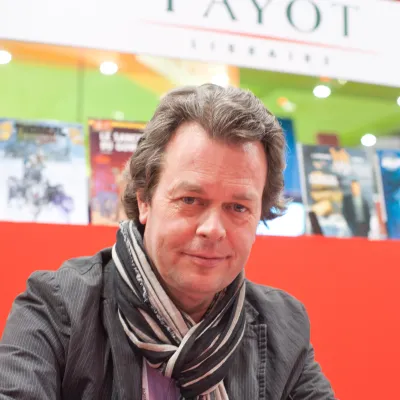
Yves Sente
Human Design Chart
Biography
Yves Sente — Generator with Profile 1/3
Generator 1/3 — Design at a Glance
Yves Sente exhibited a fundamental stance based on endurance and inner confirmation. His design as a Generator indicated that he possessed considerable sacral energy, making him resilient like a strong workhorse—provided he found tasks that truly engaged him. This energy, however, was not released through spontaneous initiative but rather through reacting to external impulses. The strategy involved waiting for signals from life and then acting only when his inner center gave a clear "yes."
If Yves Sente lived in harmony with this mechanism by reacting rather than initiating, it led to a deep sense of fulfillment. Conversely, two specific risks loomed: either he would expend his energy on things that did not bring him joy, leading to exhaustion, or he would be held back from his heart project despite still having high inner motivation. Both scenarios resulted in frustration and energy loss. His path to satisfaction, therefore, did not lie in constant pushing forward but in the ability to intuitively respond from the gut to what came his way. Only through this reactive approach could he fully unleash his potential without holding himself back or running into resistance stemming from a wrong approach.
Emotional Authority
Yves Sente exhibited a decision dynamics characterized by emotional waves. His inner authority resides in the defined Solar Plexus Center. In Human Design mechanics, this center always carries the authority, independent of other defined areas in the chart. This means that Yves Sente was constantly subject to fluctuations in feelings. The world appeared to him colored by the current mood: one moment full of enthusiasm, the next deeply negative.
A crucial mechanism here is that the immediate feeling is only a snapshot, not the deeper truth. Spontaneous decisions made directly from this emotional heat carried the risk of having negative consequences. Yves Sente's strategy was to allow time. By letting decisions sleep and taking multiple opportunities to reflect, the intense feelings subsided. Only with this emotional distance did true clarity and calmness set in. This process of maturation was essential, especially for long-term life decisions that would shape his path sustainably. Patience and allowing delays were thus not a weakness, but the necessary path to grounded insight.
The 1/3 Profile — Investigator / Martyr
Yves Sente has shown himself to be someone who does not just collect knowledge theoretically but tests it through direct, often flawed actions. His design as a 1/3 Profile "Researcher / Experimenter" defines this duality: The first line drives the insatiable thirst for foundational knowledge, while the third line demands practical experimentation and learning from experience. For Yves Sente, life is an ongoing process of trial and error. If he holds back because he feels he does not know enough, he blocks the necessary energy of the third line, which only matures through action and failure.
His judgments are particularly trustworthy because they have stood the test of both the theoretical depth of Line 1 and the practical scrutiny of Line 3. Gate 60 in the first line anchors him in the acceptance of limitations and the preservation of inner harmony despite external pressure factors. At the same time, Gate 50 in the third line calls for adaptability and support from others to maintain his own values. Yves Sente must learn that theoretical planning alone is not enough; only through practical experimentation, even with mistakes, do his insights coalesce into a reliable truth. His path is that of an adventurer who validates through personal experience what truly works.
Split Definition — Defined & Open Centers
Yves Sente revealed himself through a persistent, active mental field and a reliable expression capability. His defined Ajna Center ensured a continuous conception and theory formation, which he could directly translate into the world through his defined Throat Center. This connection allowed him to articulate his thoughts clearly and without filters, thereby shaping the mental environment around him.
The driving force of his design was his defined Sacral Center, which provided him with immense vital energy. This energy was only available when he reacted correctly to external impulses. Initiated actions without prior questioning led to frustration and exhaustion, while reactive actions generated deep satisfaction and endurance. His defined Solar Plexus Center functioned as an inner authority; decisions therefore required patience to wait out the emotional wave and gain clarity, rather than acting impulsively. Additionally, his defined Root Center propelled him forward through a constant, adrenaline-fueled pressure that anchored him in the material world.
At the same time, Yves Sente was vulnerable to specific conditioning through his open centers. His open Head Center tended to identify with foreign questions and doubts, leading to mental pressure and confusion if he did not trust his inner authority. His open G Center meant that he did not have a fixed, stable identity but oriented himself through the reflection of his environment and initiation by others. The search for his own direction was often a trap; the truth revealed itself to him only at the right place.
His open Heart Center made him vulnerable to the urge to prove his worth through promises and competition, which led to a cycle of self-doubt as he lacked the consistent energy for such competitions. Finally, his open Spleen Center was sensitive to health and well-being; spontaneous decisions were risky as they were often driven by conditioned fears or the wrong environment rather than intuitive wisdom. Yves Sente had to learn to use these open spaces as mirrors rather than getting caught in their traps.
Channels for transformation, curious exploration and emotional release.
Yves Sente showed a fundamental attitude driven by a deep, often unpredictable transformation, coupled with the need to translate complex connections into tangible stories. His design tended towards evolutionary leaps that did not come through logical planning but through an inner, pulsating energy.
This dynamic was particularly shaped by the Mutation Channel 60-3, connecting the Root Center with the Sacral Center and generating a powerful on/off energy. Yves Sente had to learn to accept the limitation that this transformation was not arbitrarily controllable but came in waves. During the pauses between impulses, melancholy could arise as the energy worked underground before manifesting as a new innovation. This channel conditioned his environment and demanded patience until the next mutation was ripe.
Parallel to this, the Channel of Curiosity 11-56, connecting the Ajna Center with the Throat Center, was at play. Here lay the ability to tell ideas not as dry facts but as living stories. Yves Sente constantly sought inspiration to discover new perspectives and then convey them in a way that sparked the imagination of others. His creativity showed in weaving parables from individual impressions that were either instructive or entertaining.
Emotionally, the Channel of Emotion Release 39-55, connecting the Root and Solar Plexus Centers, marked him. This channel caused a mood swing between joy and sadness. Yves Sente learned not to rationalize these moods but to live authentically to find the right resonance with others. His provocation served to awaken the minds of others and establish fitting connections.
Additionally, Gates like 50 (Protection Reflex, Traditions) and 58 (Pressure, Perfection) contributed to his inner structure, while 41 (Evolution, Feeling) and 49 (Principles, Sacrifice) supported emotional depth and the drive for development. Gate 14 facilitated skillful power accumulation, Gate 38 for the protection of individual integrity through resistance.
Individual Circuitry — Circuit Signature
Yves Sente was marked by two clearly separated, coexisting energy blocks that did not communicate directly with each other. On one side, a pulsating, vital force from the realm of existence and emotion was at work. Here, the Knowledge Circuit connected the Sacral, Root, and Solar Plexus Centers. This connection generated a rhythmic, acoustic energy based on the expression of one's unique identity. Through the Mutation Channel (3-60), this often led to a deviation from the known, an innovative impulse. Simultaneously, the Channel 'Emotions Free' (55-39) allowed these inner wave movements from the Solar Plexus Center to be carried outward. It was about creating new knowledge and its transformative effect.
Parallel to this, but energetically isolated, existed a second block: the Meaning Circuit. It exclusively connected the Ajna and Throat Centers. Here, it was not about vital future power but reflecting the past. The Channel of Curiosity (11-56) drove a cyclical, visual confrontation with past experiences. The emotional insights gained should be shared with the collective to learn together. As Yves Sente has a Shared Definition, these two systems – the mutating, vital identity and the reflective, meaning-making communication – remained separate. They worked as two parallel, independent forces that did not flow together but existed as distinct fields of experience side by side.
Right Angle Cross of Laws 4
Yves Sente was marked by the right cross of Law 4, a configuration that describes a profound confrontation with the rules of one's own life and society. This design points to an inner dynamic aimed at recognizing hidden orders and translating them into concrete, tangible structures. It is not about arbitrary rebellion, but about precisely understanding what is allowed and what is not, from which to derive a stable basis for one's own actions.
The mechanics of this cross work with the tension between the desire for freedom and the necessity of boundaries. Yves Sente tended to understand these boundaries not as limitations, but as necessary frameworks within which true autonomy becomes possible. It is a process of learning through experience, where each law that is broken or confirmed serves to define one's position in the world more clearly.
This orientation promotes a stance of clear delineation. Yves Sente sought the truth behind the facades by analyzing the underlying laws that govern human and systemic behavior. Through the conscious negotiation of these rules, he developed an inner integrity that was independent of external expectations. The design suggests that strength does not lie in ignoring rules, but in the conscious decision to accept certain laws for oneself and leave others behind, thus leading an authentic existence.
Saturn Return · Uranus Opposition · Chiron Return · 2nd Saturn Return — Life Cycles
Yves Sente's design shows a clear tendency towards structural anchoring and the building of responsibility, which was reflected in his career steps. In 1991, at the age of 27, the first Saturn Return occurred. This cycle often marks the transition from an experimental phase to long-term commitment. Sente used this time to move to the publishing house Le Lombard and take on leadership positions – a step that confirmed the chart's inherent ability to organize and carry burdens.
In 2004, at the age of 40, the Uranus Opposition was felt. This planet stands for sudden changes and the liberation from old structures. For Sente, this was evident in the appearance of the comic album 'Skarbek'. The work represented a creative breakthrough that embarked on new paths and broke established patterns, which is typical of the energy-rich, transformative effect of this astrological constellation.
The Chiron Return around 2011, at the age of 47, ushered in a phase of fulfillment. Here, the deeper meaning of one's own design unfolds if one has followed their own strategy. Sente began work on the new cycle of the series XIII with Youri Jigounov. This was not a mere new beginning, but a deepening and continuation of a lifelong task. The cycle confirmed that his work went beyond mere entertainment and possessed a sustainable, meaning-generating dimension that was now fully realized in life.
Generator · Emotional Authority — Synthesis
Yves Sente's design is characterized by a deep, pulsating energy drawn from the defined Sacral Center (Generator Type) and the Channel of Mutation (3-60). This combination generates a natural talent for creative processes, driven by constant experimentation (Profile 1/3) and the ability to develop concepts (defined Ajna Center). Emotional authority underscores the need to let decisions mature to grasp the true quality of the energetic response to external stimuli. This inner dynamic manifests in recurring phases of intense creative power, accentuated by melancholy and the urge for the new (Knowledge Circuit) – a continuous cycle of renewal and expression of one's individuality.
Central to Yves Sente's design is the tension field between the need for deep emotional clarity and the impulsive, experimental spirit of the researcher. The emotional wave demands time and reflection, while the Line 3 of the profile urges to try and learn through experience. This dynamic leads to an inner tension, as the Ajna Center creates concepts, but these must be filtered and validated by emotional authority before they can be carried into the world. The documented events show how this shift between inner maturation and creative implementation manifests in career turns and new projects.
3 Defined Channels
Incarnation Cross - Right Angle Cross of Laws 4
Solar Return
The Solar Return shows the moment when the sun returns to its exact birth position - your personal solar year.
Life Cycles
Discover the life cycles with a detailed triple view (birth chart, cycle chart, composite).
Human Design Profile
- Type
- Generator
- Strategy
- To respond - wait for something to respond to
- Authority
- Emotional Authority
- Profile
- 1/3 - Investigator / Martyr
- Definition
- Split Definition
- Incarnation Cross
- Right Angle Cross of Laws 4
- Date of Birth
- 17.01.1964 20:45
- Place of Birth
- Uccle, BEL
Frequently Asked Questions
What is Yves Sente's Human Design type?
What Profile does Yves Sente have in Human Design?
What authority governs Yves Sente's decisions?
What incarnation cross is Yves Sente associated with?
When was Yves Sente born?
Discover your own Human Design
Are you also a Generator? Find out in a personal reading how to use your sacral energy correctly and discover deep satisfaction.
More Personalities
Back to overviewAaliyah

Alain-Fournier

Alexia

Angèle

Angeli

Anne-Marie
