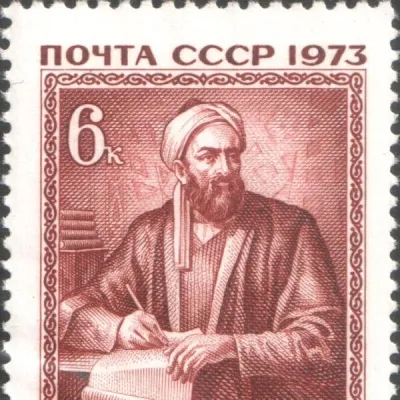
Abdul Al-Biruni
Human Design Chart
Biography
He was, for his time, an admirably impartial writer on the customs and creeds of various nations, his scholarly objectivity earning him the title al-Ustadh ("The Master") in recognition of his remarkable description of early 11th-century India.
He died on 13 December 1048 (Jul.Cal.) in Ghazni (now Afghanistan).
The lunar crater Al-Biruni and the asteroid 9936 Al-Biruni were named in his honour.
Abdul Al-Biruni as a Manifesting Generator 6/3 in Human Design
Manifesting Generator 6/3 — Design at a Glance
Abdul Al-Biruni showed a fundamental stance that combined quickness with a deep, constant energy source. His design as a Manifesting Generator worked like a hybrid: He had the endurance and powerful potential of a generator through his defined Sacral Center, but also possessed the ability to skip steps and proceed in parallel when acting. This configuration allowed him to quickly draw things into his life, yet it carried specific risks.
The key mechanics for Abdul Al-Biruni lay in the strategy of responding. Instead of starting with self-initiative, it was essential to wait for external impulses and then act only when the Sacral Center gave a clear "yes." If he acted too quickly or ignored this inner approval, he tended to miss important steps or get lost in too many projects at once. This often led to the need to backtrack and fill gaps – a source of frustration that touched on his Non-Self theme.
When this strategy was correctly applied, however, his nature transformed. The parallel handling of various tasks did not become an obstacle but rather a strength. Abdul Al-Biruni could then enter into a productive "play mode" that brought him deep satisfaction and fulfillment from his work. His quickness served him only when variety and inner resonance were in the foreground, instead of rigid linear planning.
Emotional Authority
Abdul Al-Biruni's design inclines towards emotional distance in decision-making; spontaneous judgments are misleading for him. His inner authority is the emotional one, carried by the defined Solar Plexus Center. This configuration subjects a person to constant waves of emotional ups and downs. The world appears colored by the current mood: A moment of enthusiasm can turn into negative evaluation in the next instant, without the matter itself changing.
This first impression is not an ultimate truth but merely a snapshot. Quick decisions made purely out of emotion often have negative consequences. The mechanics here require patience and consciously "sleeping on" choices. Only through gaining time do intense feelings subside and emotional distance arise. Then clarity and calmness set in, which are necessary for well-founded judgments. This filtering process between the current mood wave and deeper insight significantly shapes Abdul Al-Biruni's decision-making, especially in long-term steps with significant influence on life's course.
The 6/3 Profile — Role Model / Martyr
Abdul Al-Birunis design inclines towards intense self-experiments driven by the Explorer's Line 3. In the first three decades of his life, he lived this phase as a pure experimenter, marked by trial and error, and fierce chaos leading him into extreme situations. This inner restlessness of older souls did not seek ordinary perfection but an extraordinary life far from standards.
The mechanics of Profile 6/3 describe this developmental line: While Line 3 remains permanently present and experimentation never fully ends, the focus transforms after the age of thirty. The accumulated experiences from crises now serve to take responsibility and develop wisdom. Abdul Al-Biruni used his unusual experiences to become a visionary and humorous role model.
Especially influential was the Sun in Fall (Gate 40), symbolizing authority and magnanimity. This power only became fully effective after a phase of "dethronement," during which inferior forces and unjust claims to power within the community were identified and rejected. Through this clear demarcation against unfair demands, his willpower was established, allowing him later to take on an authoritative role based on genuine experience rather than mere presumption.
Single Definition — Defined & Open Centers
Abdul Al-Biruni's design inclined towards a constant and reliable presence: clear voice and manifestation, firm identity and direction, independent willpower as well as vital reactive energy. These defined centers – Throat, G Center, Heart, Sacral and Solar Plexus – formed the stable foundation of his personality. The Throat transmuted information from the body into communication and action; the G Center endowed him with a strong sense of self-love and life direction; the Heart Center provided access to willpower and ego strength; the Sacral Center generated constant vital energy that responded to questions; the Solar Plexus served as an emotional authority, whose truth only revealed itself after waiting out the emotional wave.
At the same time, Head-, Ajna-, Spleen- and Root Centers were open. These centers reflected their environment situationally rather than exercising inner control. The open Head Center tended to absorb mental pressure or inspiration from the surroundings, leading to doubts if not trusting one's inner authority. The open Ajna Center allowed a flexible mind that mirrored concepts and ideas of others without holding them as personal truth. The open Spleen was vulnerable to survival fears or absorbing well-being from the environment; spontaneous decisions here were risky due to an inconsistent intuition. The open Root Center absorbed external stress and adrenaline, which could lead to hyperactivity if not recognized as foreign.
The mechanical dynamics consisted of connecting the constant power of defined centers – especially the emotional depth of Solar Plexus and the vital response of Sacral – with the receptivity of open centers. Abdul Al-Biruni showed himself through this configuration as someone who clearly possessed his own direction and energy, but had to consciously remain aware which thoughts, fears or stress signals originated from outside. His strength lay in trusting his emotional clarity and sacral response while learning not to take on mental confusion or external pressure as personal problems.
Channel 40-37: Community — Channels & Gates
Abdul Al-Biruni's design inclined towards a natural carrier of life flow and timing. He moved within fixed habits that he connected with universal love for humanity; his energy magnetically drew others in and synchronized group rhythms. This basic attitude resulted from the rhythm channel 5-15 in his design. This channel connects the Sacral Center through Gate 5 (fixed rhythms) to the G Center via Gate 15 (Extremes). Gate 5 holds fast to rituals, while Gate 15 integrates the diversity of society into life flow. The channel acts as a pillar for biological processes, unaffected by mind or emotional waves. His magnetism in the G Center projected an impersonal love towards humanity and drew everyone into this rhythm. When Abdul Al-Biruni followed this inner pulse, everything worked effortlessly; deviations led to chaos.
In interpersonal relationships, he functioned as a bridge-builder, shaped by the community channel 37-40 in his personality. This channel connects the Solar Plexus Center (Gate 37: Friendship) with the Heart Center (Gate 40: Solitude). He sought his place within the whole and needed clear agreements for cooperation, worked hard to provide for his loved ones but also required breaks. The connection was guaranteed by willpower yet demanded careful consideration over time to conclude fair contracts without exercising hierarchical dominance.
Additionally, personality gates 31 (Leadership/Transmission) and 33 (Reflection/Retreat) were active. Gate 31 transmitted power to others while Gate 33 gained clarity through retreat. This configuration supported his role as a mediator who passed on energy and collected strength for the next cycle through reflection.
Collective Circuitry — Circuit Signature
Abdul Al-Biruni appeared as someone rooted in cooperative structures and the principle of 'give and take'. His design inclined towards tradition-oriented community building where material and immaterial resources were created through mutual support. This dynamic stemmed from his ego circuit, which connected the Heart and Solar Plexus Centers. Since this circuit did not have a direct connection to the Sacral Center, its effectiveness was not constant but wave-like; he needed mandatory rest periods for regeneration to sustainably support others. Overload here quickly led to the collapse of support capacity.
Alongside this tribal dynamic, further separate energetic strands were active. The Understanding Circuit connected his Identity and Sacral Centers via the Rhythm channel, enabling focused future-oriented logic without emotional influence. Parallel to this existed the Sense Finding Circuit, which linked Throat, Solar Plexus, Identity, and Sacral Centers. This was about sharing emotional insights from the past and finding meaning in past events. Furthermore, the Protector Circuit was active, linking the Sacral and Solar Plexus Centers to connect instinctive survival energies with life force. Although all these centers were defined, they did not form a cohesive unit due to simple definition but existed as parallel adjacent forces: once cooperative resource care, once rational future planning, once emotional past reflection, and once instinctive protection.
Left Angle Cross of Migration 2
Abdul Al-Biruni's design sets a tendency towards continuous movement and the pattern of the Pull. This configuration, the left cross of the Pull 2, describes not a static position but a dynamic process. It is about the necessity to move forward continuously, not out of fear of stagnation, but because the energy of this design finds its clarity in motion itself.
The mechanics of this cross show that insight and identity often arise through movement or change. Abdul Al-Biruni was shaped by this structure to experience situations not as fixed states, but as transitional places. The 'Pull' here is not a flight, but a strategic adaptation to one's own nature: By moving, he created space for new perspectives. Stagnation would often lead to inner unrest in this design because the underlying energy is oriented towards change and progress.
This pattern does not mean that every decision was impulsive, but that the path itself was part of the answer. The presence of this cross indicates that Abdul Al-Biruni did not find his truth at a fixed point, but through continuous adaptation to new circumstances. It is a design that prioritizes learning through experience and movement, where each step is understood as an integral part of the overall process.
Saturn Return · Uranus Opposition · Chiron Return · 2nd Saturn Return — Life Cycles
A characterization of Abdul Al-Biruni within the context of Human Design based on the available information is not possible. The raw content lists exclusively astrological planetary cycles: the first and second Saturn return, the Uranus opposition, and the Chiron return. These data points describe transpersonal time windows or general life phases as considered in classical astrology. They contain no specific Human-Design mechanics. There are no details about defined centers, active channels, gates, energy type, strategy, and authority of Abdul Al-Biruni. Without these individual chart components, it is impossible to derive a person-specific dynamics. The mentioned cycles do not provide insight into how Abdul Al-Biruni made decisions, managed his energy, or interacted with his environment. An interpretation would require making assumptions about his design, which violates the rule of using only provided facts. Therefore, a mechanical classification of his essence and behavior in terms of Human Design is excluded here. The focus lies solely on temporal markers without reference to Abdul Al-Biruni's individual energy map.
Manifesting Generator · Emotional Authority — Synthesis
The central red thread in this design is the dynamic balance between the urge for quick reaction and the need to develop deep emotional clarity. Sacral energy, paired with the manifesting aspects of the design, generates a natural tendency towards action and experimentation (Line 3), while simultaneously the emotional authority demands waiting and maturing decisions. This combination leads to a lifestyle that is shaped by both impulsive energy and careful reflection – an ongoing navigation between the flow of the moment and the wisdom of time. The Channel of Rhythm (5/15) intensifies this dynamic, establishing a deep connection to the natural life flow, which is modulated through the need for emotional clarity.
5 Defined Channels
Incarnation Cross - Left Angle Cross of Migration 2
Solar Return
The Solar Return shows the moment when the sun returns to its exact birth position - your personal solar year.
Life Cycles
Discover the life cycles with a detailed triple view (birth chart, cycle chart, composite).
Human Design Profile
- Strategy
- To respond - wait for something to respond to
- Authority
- Emotional Authority
- Profile
- 6/3 - Role Model / Martyr
- Definition
- Single Definition
- Incarnation Cross
- Left Angle Cross of Migration 2
- Date of Birth
- 04.09.0973 05:05
- Place of Birth
- Kath, Uzbekistan
Frequently Asked Questions
What is Abdul Al-Biruni's Human Design type?
What Profile does Abdul Al-Biruni have in Human Design?
What Authority does Abdul Al-Biruni have?
What incarnation cross is defined for Abdul Al-Biruni?
When was Abdul Al-Biruni born?
Discover your own Human Design
Are you also a Manifesting Generator? Find out in a personal reading how to unfold your multi-talents and direct your energy wisely.
More Personalities
Back to overviewAldair

Alizée

Angeli

Arletty

Artus

Balthus