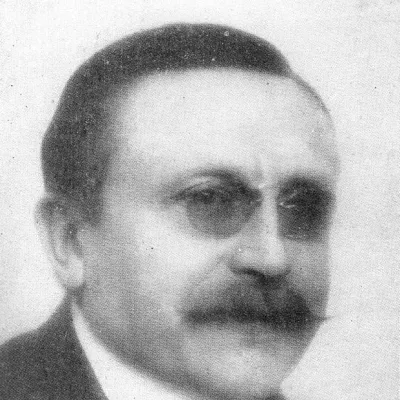
Photo: Wikimedia Commons
Albert Mathiez
Human Design Chart
Biography
Mathiez held the highly prestigious Sorbonne chair in French Revolutionary Studies and was the founder of the Societe des Etudes Robespierristes which led to the creation in 1908 of the highly regarded journal Annales révolutionnaries that became Annales historiques de la Révolution française in 1924.
Albert Mathiez died in Paris on 25 February 1932 at age 58.
What does Generator 6/2 mean for Albert Mathiez?
Generator 6/2 — Design at a Glance
Albert Mathiez was someone who possessed immense, enduring strength, comparable to a workhorse that only effectively uses its energy when it feels inner approval for its task. As a Generator, he had a lot of sacral energy, but it was released not through self-initiative, but by reacting to impulses from the environment. His strategy was to wait for signals and only act when his inner self gave a clear 'yes'.
This design profoundly shaped his life: when he responded to this inner resonance, he experienced deep satisfaction and unparalleled endurance. Conversely, ignoring these signals or forcing himself led to persistent frustration and a noticeable energy deficit. Two major pitfalls lay on his path. On one hand, he tended to waste energy on things that didn't bring him inner fulfillment, making him vulnerable to exhaustion. On the other hand, he suffered from the feeling of being held back from his heart project, even though he was still full of power and wanted to continue working. His success thus did not depend on who he was, but on whether he learned not to initiate, but to patiently react and respond from the gut. Only in this harmony could he unleash his full potential without falling into the trap of frustration.
Sacral Authority
Albert Mathiez was a Generator whose decision-making was shaped by sacral authority. As the only type, he could unite his strategy with his inner authority, simplifying the process of choice. This mechanism worked through a physical reaction to external stimuli: a gut feeling or a surge of energy. His inner signals appeared as grunts, hums, or simple sounds like 'Mhm'. When his sacral motor kicked in, he felt vital and alive. He had inexhaustible energy and tackled his work with great enthusiasm. His design helped him move through life with joy and satisfaction, fully immersed in his tasks without needing a sense of purpose.
A prerequisite for this clear guidance was an open emotional center. This meant he didn't have to wait for emotional clarity, which often fluctuates, but could directly listen to the immediate physical response. Additionally, his activated spleen center acted as a supporting authority. This gave him the ability to react particularly quickly and spontaneously. He had direct access to his physical well-being and instinctive perception. This combination allowed him to make decisions that he could reliably follow, directing his life energy where his body gave a positive signal, thus efficiently using his natural power.
The 6/2 Profile — Role Model / Hermit
Albert Mathiez showed himself to be someone who only gathered his life experience through long-term experiments before becoming an authoritative figure. In his younger years, before the age of 30, his design followed the pattern of Line 3: Trial and error characterized this phase. He learned through his own failures and retreats, gathered information, and tested various paths to ensure he made the right decisions. This period was marked by a certain waste of energy, as he still lacked the necessary distance.
After the age of 30, with the activation of Line 6, his approach fundamentally changed. He metaphorically retreated into a 'cave' to look back at his earlier experiments with distance. This phase of intense reflection served for healing and deep self-awareness. The 54,6 Line of Selectivity challenged him to make wise decisions and limit relationships that stood in the way of his ambition. At the same time, he had to learn to see through the projected expectations of others, as the second line of Gate 32 often led to control and projection. Only after this inner work did he emerge as a wise person. Others sought him out to learn from his life wisdom and introspective ability. His design described a path from uncertain search to secure authority through conscious selectivity and reflection.
Split Definition — Defined & Open Centers
Albert Mathiez was characterized by a persistent mental intensity paired with a deep, intuitive grounding. His design was marked by defined Head and Ajna Centers, creating a constant inner pressure to question and form concepts. However, this mental process was not coupled with direct action; it served to inspire or pressure others, but he himself lacked the energy to implement it. At the same time, he had a defined G Center, which gave him a stable identity and a clear sense of direction, as well as a defined Sacral Center, providing him with vital energy for personal expression – provided he responded to life rather than initiating it. His defined Spleen Center also fostered spontaneous, intuitive judgments in the here and now, while his defined Root Center provided a constant pressure for forward movement.
In contrast, his Throat, Heart, and Solar Plexus Centers were open. The open Throat Center meant that he did not need to speak constantly to gain attention; he tended to wonder if he was heard when he was not actively communicating. The open Heart Center lacked consistent willpower; he avoided making promises he could not keep on his own and tended to want to prove his worth through performance. The open Solar Plexus Center allowed him to absorb and amplify emotions from his environment without identifying them as his own. He was prone to feeling emotionally unstable when he personalized the feelings of others rather than observing them as external weather. This openness required patience and trust in his inner authority, rather than being guided by conditioned fear of rejection or the desire for control.
Channels for intuitive struggle, transformation and maturation.
Albert Mathiez was someone who intuitively acted to secure his own survival and uniqueness, driven by a deep inner pressure to find meaning in life's struggles. His design inclined him to spontaneous, appropriate reactions that did not stem from logical planning but from an acute sensitivity to his immediate surroundings.
This attitude was shaped by the Channel of Perfect Form 7-10. This channel connected the Spleen Center with the G Center and allowed Albert Mathiez to guide his behavior moment by moment from deep intuitive impulses. He paid less attention to words and more to the tone and quality of the sounds around him, giving him a rare clarity to act spontaneously when something in his environment was amiss. This was not a self-reflective process of the mind but an innate wisdom that allowed him to existentially and unburdenedly walk through the world by loving himself enough to remain true.
Parallel to this, the Channel of Awareness 61-24 was at work. It connected the Head Center with the Ajna Center and created the individual thinker in Albert Mathiez. His mind was geared to transform inspiration from Gate 61 – the “white noise” of unknown secrets – into a rational response through the rationalization of Gate 24. He did not seek discoveries in the traditional sense but waited for the moment of mutation, the Satori, when knowledge simply happened. He could not control his thinking to achieve goals but had to surrender to the happy coincidence of inner truth that revealed itself in its own time.
Another defining aspect was the Channel of Life Struggle 38-28, which connected the Root Center with the Spleen. It endowed Albert Mathiez with the stubborn determination to follow his own path and fight external forces that might distract him from his true individuality. Gate 28 helped him recognize which struggles were appropriate and what value they held, while Gate 38 exerted the pressure to maintain individual integrity. This channel drove him to find meaning and purpose precisely in the difficulties and resistances he encountered on his unique path.
Additionally, the Channel of Transformation 54-32 promoted ambition through constant effort. Driven by the fear of failure or loss of position in the tribe, Albert Mathiez sought ways to rise through talent and competence. He wanted to be seen and recognized, not out of vanity, but to secure the continuity and survival of his social environment. His ambition was closely tied to the awareness of the Spleen, which instinctively showed him when support was available to increase his well-being and success.
The Channel of Maturation 42-53 connected the Root Center with the Sacral Center and emphasized the necessity of fully experiencing cycles. For Albert Mathiez, it was important to enter new cycles, complete them, and then reflect to gain the wisdom contained within. Each experience had to be brought to a satisfying conclusion before he could move on to the next, as only then could the lessons be useful for the higher good of humanity.
Individual Gates complemented this picture: Gate 44 brought awareness and the ability to transform through proper interaction. Gate 58 in the Root Center promoted experiments and the perfection of the life process through pattern recognition. Gate 46 emphasized dedication to the process and love for the body as a temple. Gate 41 drove evolutionary development through specific experiences and crises. Gate 2 allowed external changes to be reshaped into new directions, while Gate 1 emphasized uniqueness and creative mutation in the here and now. Gate 7 projected patterns for the future and the need to lead, and Gate 47 helped to create clarity and meaning from past experiences. Finally, Gate 3 promoted mutations and the creation of new orders out of confusion, necessary for survival struggles and adaptation to global changes.
Individual Circuitry — Circuit Signature
Albert Mathiez was marked by his design through two separate, parallel functioning energetic systems. On one side, the Knowledge Circuit connected his Head with the Ajna Center and his Spleen with the Root Center. This created a tendency towards innovative, creative flashes of insight and conscious perception, but it did not directly connect with his emotional or identity-forming power. Parallel to this, the Meaning Circuit connected his Sacral with the Root Center. This was about reflecting on the past and sharing emotional experiences from the collective, driven by a cyclical process of maturation. Another independent element was the Ego Circuit, which also connected his Spleen with the Root Center. This promoted a transformative power in the realm of intuition and survival instinct, without a direct connection to the life energy of the Sacral. Finally, the Integration Circuit connected his Identity with the Spleen Center, supporting high individuality and the ability to perfectly form reactions in the now. As Albert Mathiez had a split definition, these forces existed as separate parts: Intellectual inspiration (Head-Ajna) did not flow directly in an energetic stream to emotional meaning (Sacral-Root) or identity-forming intuition (Identity-Spleen). Instead, these areas acted as independent, coexisting potentials, each with its own dynamics and expression, without merging into a single, continuous flow.
Left Angle Cross of Cycles 2
Albert Mathiez was marked by the left cross of cycles 2, a configuration that described a deep connection to the earth and physical life. His design inclined him to focus on the material and sensual, experiencing the beauty and richness of the natural world as central life forces. This mechanism fostered an attitude of gratitude and enjoyment towards what life offered in the here and now.
In Human Design, this cross represents the ability to recognize and appreciate the gifts of the earth. It was not a spiritual withdrawal from the world, but rather an intense anchoring in it. Albert Mathiez was someone who understood physical existence as a gift and was mindful of maintaining this connection. The energy of this cross worked stabilizing and grounding, encouraging him to see the material aspects of his existence not as a burden, but as a source of nourishment and inspiration.
This orientation meant that his focus was on what was tangible and experiential. He lived with the belief that true happiness is found in the appreciation of simple, natural things. His Human Design chart revealed a life task that involved strengthening the connection between human and nature, celebrating the richness of physical existence without slipping into excessive materialism, but rather remaining in a conscious, grateful attitude.
Saturn Return · Uranus Opposition · Chiron Return · 2nd Saturn Return — Life Cycles
Albert Mathiez's design was characterized by a clear orientation towards structural affirmation and the establishment of authority in his field of expertise. His life path followed a pattern where external recognition and institutional anchoring played central roles. This was concretely evident in 1911, at the age of 37, when the Uranus opposition became active. This cycle often marked a turning point leading to sudden changes or new responsibilities. Mathiez was then appointed to a professorship in Besançon, officially confirming his professional competence and providing him with a firm platform.
Later, in 1926, the Chiron return occurred. At the age of 52, this completed a phase of his incarnation task. It was not a healing, but the bloom of his life purposes. The call to the Sorbonne underscored the peak of his career and the full unfolding of his intellectual authority. His design promoted the ability to structure knowledge and anchor it in recognized institutions.
The second Saturn return, which occurred in 1932 at the age of 58, concluded this life cycle. Saturn represents boundaries, structure, and also the end of cycles. Mathiez's death in Paris that year marked the end of a life phase strongly marked by the search for and achievement of academic legitimacy. His path demonstrated how his inner design reacted to external structures and was concretized through professional stations.
Generator · Sacral Authority — Synthesis
Albert Mathiez primarily lived through his sacral energy (Generator type) and the associated ability to find joy and satisfaction in work as long as it aligned with his inner response. The defined connection between Spleen Center and G Center (Channel 57-10) pointed to a deep intuitive understanding of his own well-being and the ability to secure this through self-determined action. This integration of intuition and behavior shaped his path to acquire and transform new knowledge – a process amplified by the Knowledge Circuit. The role as a role model (6/2 Profile) suggests that he developed wisdom in his later years that attracted and influenced others.
A central paradox in his design lay in the combination of the pulsating, creative expression of the Knowledge Circuit and the need to withdraw after intense experience and reflect (6/2 Profile). While he showed new paths through inspiration and emotional depth, he also sought phases of distance to process his own insights. The documented events – professional successes followed by death – reflect this rhythm: phases of active engagement culminating in a concluding phase of contemplation and farewell.
5 Defined Channels
Incarnation Cross - Left Angle Cross of Cycles 2
Solar Return
The Solar Return shows the moment when the sun returns to its exact birth position - your personal solar year.
Life Cycles
Discover the life cycles with a detailed triple view (birth chart, cycle chart, composite).
Human Design Profile
- Type
- Generator
- Strategy
- To respond - wait for something to respond to
- Authority
- Sacral Authority
- Profile
- 6/2 - Role Model / Hermit
- Definition
- Split Definition
- Incarnation Cross
- Left Angle Cross of Cycles 2
- Date of Birth
- 10.01.1874 17:00
- Place of Birth
- Bruyères, France
Frequently Asked Questions
What was Albert Mathiez's Human Design type?
What profile did Albert Mathiez have in Human Design?
What authority guided Albert Mathiez?
What incarnation cross did Albert Mathiez have?
When was Albert Mathiez born?
Discover your own Human Design
Are you also a Generator? Find out in a personal reading how to use your sacral energy correctly and discover deep satisfaction.
More Personalities
Back to overviewAaliyah

Alexia

Angèle

Anne-Marie

Arcángel

Arno